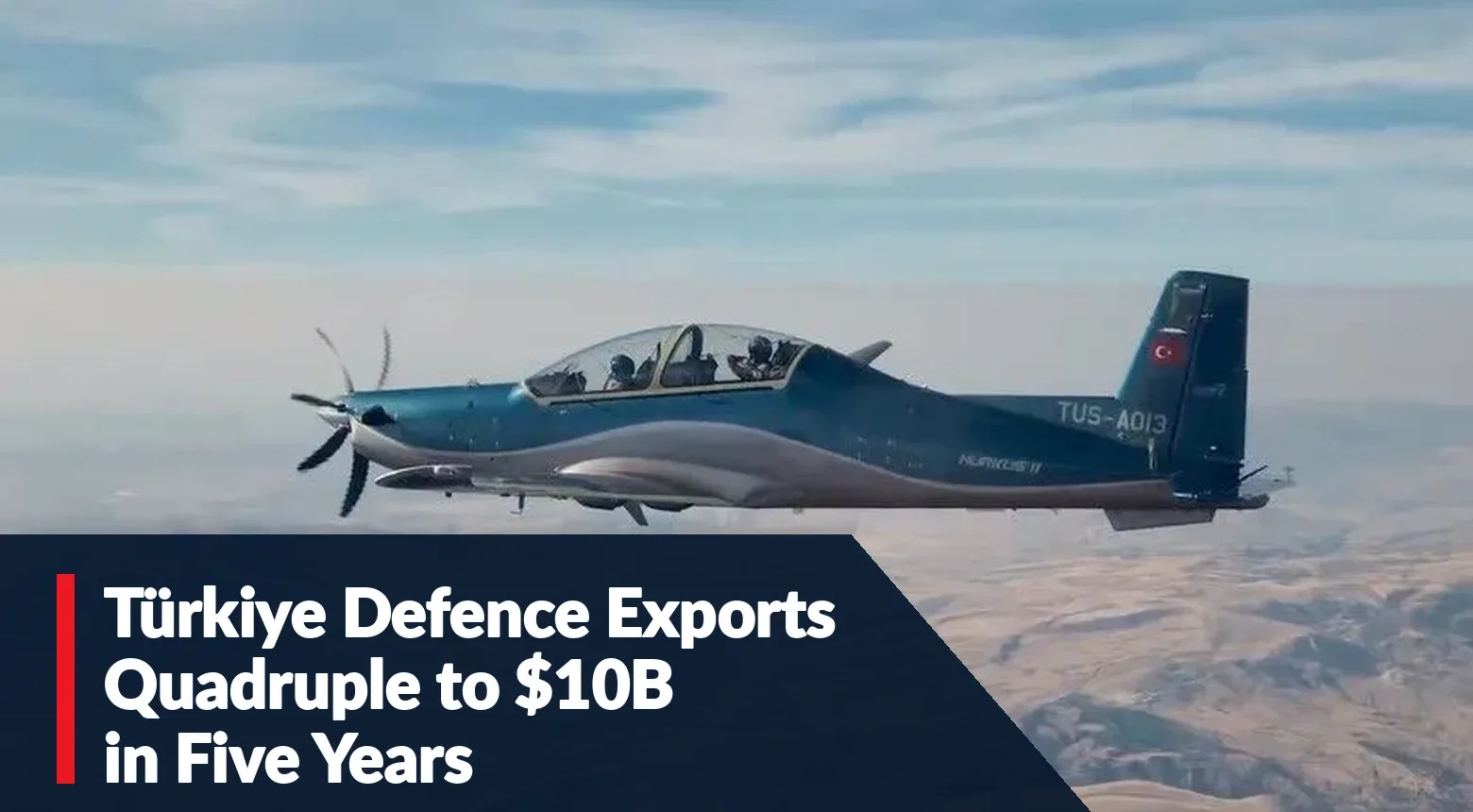
Türkiye defence exports rose from US$2.279 billion in 2020 to US$10.016 billion in 2025, according to a consistent annual series compiled by Anadolu Agency from Türkiye Exporters Assembly (TİM) data. The 4.4-fold increase marks a shift in the scale of Türkiye’s defence and aerospace sales abroad. An Anadolu Agency report published on 6 November 2026 also recorded US$8.05 billion in exports during January–October 2026, up 20.2% year on year. For procurement offices and manufacturers, the key question is how sustained contract demand is being converted into deliveries and support capacity—not simply whether the headline exceeds US$10 billion.
Five-Year Defence Export Trajectory: 2020–2025
The TİM-based series reported by Anadolu Agency records uninterrupted annual expansion between 2020 and 2025. It includes a pandemic-era starting point and therefore should not be treated as a constant annual growth rate. The values below are annual export totals, not new contracts, factory revenue or cumulative commitments.
| Calendar year | Defence and aerospace exports (US$bn) | Change from previous year |
|---|---|---|
| 2020 | 2.279 | — |
| 2021 | 3.225 | +41.5% |
| 2022 | 4.396 | +36.3% |
| 2023 | 5.546 | +26.2% |
| 2024 | 6.735 | +21.4% |
| 2025 | 10.016 | +48.7% |
On that like-for-like series, 2025 exports were approximately 4.39 times the 2020 value, equivalent to a cumulative rise of about 339.5%. The faster 2025 growth followed several years of expansion; it should not be interpreted as evidence that yearly growth will continue near 49%.
The sector’s reported share of Türkiye’s total exports rose from 1.5% in 2020 to 4.2% in 2025 in the same AA/TİM presentation. That change points to a larger contribution to the national export mix, but it does not identify the exact split between major platforms, components, ammunition, electronics and services.
Why the 2025 Total Passed US$10 Billion
December was decisive. Anadolu Agency cites US$2.571 billion in December 2025 exports, representing approximately 25.7% of the US$10.016 billion annual total. This unusually concentrated month matters for interpreting the trend: defence sales may be recognised in large increments around delivery, clearance or other programme milestones rather than in even monthly instalments.
High-value aircraft, naval platforms, unmanned systems and complex subsystems typically entail extensive acceptance work, export authorisations, supply-chain coordination and follow-on services. A large final-quarter value may reflect those programme schedules. However, the 6 November report does not allocate December’s total to named platforms, buyers or firms. Assigning it to an individual aircraft or warship programme would therefore be unsupported.
The five-year rise is significant without relying on an assumption that each December will repeat. The more useful commercial question is whether OEMs, lower-tier suppliers, test organisations and logistics providers can deliver across a wider range of customers while protecting quality and schedule performance.
TİM and SSB Export Figures Must Remain Separate
A reporting distinction is essential. US$10.016 billion is the 2025 annual figure in the TİM series quoted by Anadolu Agency on 6 November. The Presidency of the Republic of Türkiye Secretariat of Defence Industries (SSB) separately publicised US$10.054 billion for 2025, while its president discussed goods exports of approximately US$9.87 billion and services of US$184 million in a January 2026 statement.
The difference between the two headline totals is approximately US$38 million. The available public summaries do not establish a complete reconciliation of classification, coverage and later revisions, so it would be premature to attribute the difference to one specific accounting mechanism. Other official comments have also used different rounded sector totals. For consistent multi-year growth calculations, this article uses the single AA/TİM annual series throughout; SSB figures are presented as a separate reporting basis.
The same rule applies to 2024: the AA/TİM table records US$6.735 billion, while earlier SSB communications described a higher sector total. Mixing the smaller 2024 denominator with an SSB 2025 numerator would produce a misleading annual growth percentage.
This is not a merely technical point. Programme managers, analysts and export-finance teams may use the data to assess addressable markets and industrial throughput. An apparent trend created by changing definitions is not equivalent to real growth in a matched series.
January–October 2026: Growth Continues, But It Is Not a Full Year
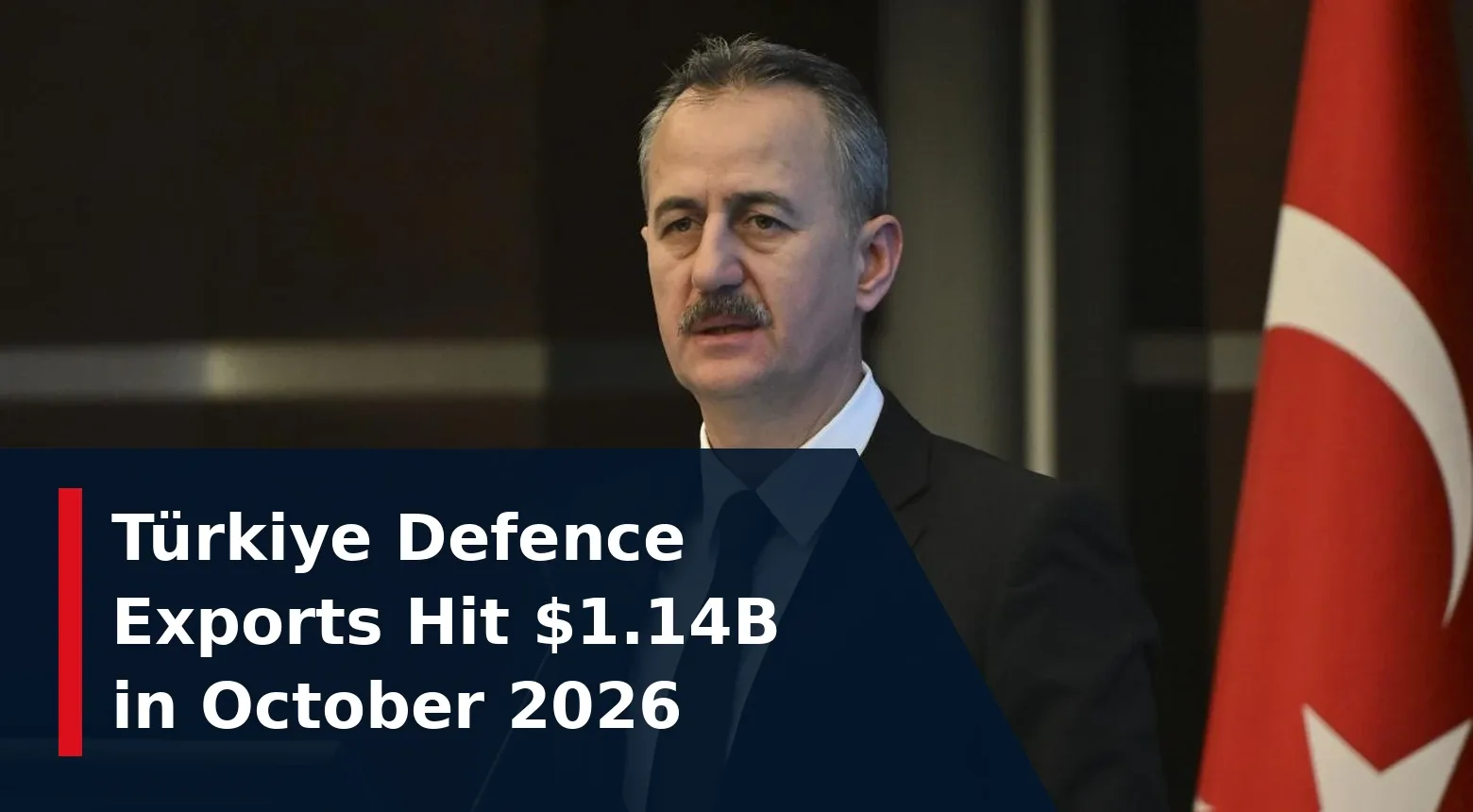
The 6 November AA report puts January–October 2026 exports at US$8.05 billion, an increase of 20.2% compared with the same ten months of 2025. The TİM October release separately reported a 61.1% year-on-year rise for the defence and aerospace sector in October. Defence Agenda has already analysed the monthly result in Türkiye Defence Exports Hit $1.14B in October.
These statistics describe different measurement windows. The ten-month total cannot be presented as the 2026 calendar-year result, while a strong October percentage does not prove that full-year growth will match it. The latest public monthly series requires the November and December data to complete the year.
Likewise, a trailing-12-month total is not a January–December total. In July 2026, the sector crossed US$11 billion on a rolling 12-month basis; that milestone included months from two calendar years. Any subsequent rolling figure should be labelled with its exact start and end dates rather than silently substituted for the year-to-date result.
Defence Platforms, Suppliers and International Market Access
The export profile extends beyond a single product category. Türkiye’s manufacturing and engineering base covers unmanned aerial systems, manned aircraft, land platforms, naval vessels, missiles, ammunition, radars and communications equipment. Across these categories, export competitiveness depends on more than a product demonstration: buyers also assess qualification, spares availability, training, upgrade pathways, cybersecurity, interoperability and lifecycle costs.
For large original equipment manufacturers, a rising aggregate export value can support further investment in production lines and global service networks. For small and medium-sized suppliers, the opportunity can be more conditional. A larger platform backlog does not automatically translate into purchase orders for every domestic subcontractor; access depends on approved-vendor status, certification, export controls and the OEM’s sourcing strategy.
Defence Agenda’s five-year industry transformation analysis examines these structural changes, while its 2026 Defense News Top 100 review shows the growing scale of several Turkish manufacturers. The latter records company defence revenues rather than national exports. The two measures should not be added together or interpreted as interchangeable.
European and NATO customers may offer industrial opportunities, but successful entry still requires customer-specific acceptance, local support and, in some programmes, industrial participation. Export statistics alone do not establish how much supply-chain value remains in Türkiye or which overseas customers generated the latest growth.
Export Contracts Are Not the Same as Recorded Exports
The SSB also reported approximately US$17.8 billion in new export contracts signed during 2025 in January 2026 reporting. Such contracts can create a pipeline of future work, but their signature does not mean that the full amount was shipped, accepted or paid in 2025.
This distinction matters especially for aviation and naval procurement, where deliveries can span several years and support packages may extend further. Contract value may include equipment, integration, training, spares, maintenance or other services that are recorded at different points. Announced agreements may also be subject to options, conditions and implementation schedules.
Defence Agenda previously documented the 2025 export milestone. The separate five-year view here is intended to explain the trend behind that record, not to recast the same contracts as additional export sales.
What the Headline Does Not Prove
The annual export series provides clear evidence of growth in reported export value, but it does not by itself prove a proportional increase in physical production volume, profit margins, domestic value added or delivery punctuality. Changes in product mix can move the value series sharply even when the number of units delivered changes little. Foreign-exchange movements, imported content and reporting coverage also matter when assessing industrial impact.
The 2020 starting point was affected by the COVID-19 shock to global trade. Using that year as a baseline is valid for the published five-year comparison, but it is not sufficient to assess the entire industry’s structural growth independently of pandemic effects. A fuller assessment would consider pre-2020 years, comparable currency and price treatment, destination markets and export value by product category.
There is also a concentration question. With more than one-quarter of the TİM-based 2025 total recorded in December, a single monthly record is not a reliable proxy for recurring production throughput. Financial and operational resilience depend on programme diversity and continued conversion of orders into verified deliveries, not simply record announcements.
Implications / Next: The Tests for 2026 and Beyond
The next milestones are publication of the November and December 2026 sector export releases, a reconciled full-year comparison against a clearly identified 2025 statistical series, and more granular disclosure on destinations and product categories. Company accounts and official programme delivery records can then help explain which segments support the aggregate.
For international buyers, the practical indicators will be production readiness, qualification, documentation, sustainment support and predictable delivery schedules. For Turkish suppliers, the decisive issue is whether export-led growth creates sustained, diversified and commercially viable workload beyond individual platform awards.
The evidence available on 6 November 2026 supports a precise conclusion: Türkiye’s TİM-based defence and aerospace exports grew from US$2.279 billion in 2020 to US$10.016 billion in 2025, while exports for January–October 2026 reached US$8.05 billion. These are strong indicators of sector expansion, provided that the reporting periods and source definitions remain distinct.
Further Reading
- Anadolu Agency — Five-year defence and aerospace export series, 6 November 2026
- SSB — Official 2025 export performance announcement
- TİM — October 2026 export briefing
- Anadolu Agency — SSB export statements, 5 January 2026
- Defence Agenda — Türkiye Defence Exports Hit $10B Record in 2025
- Defence Agenda — Türkiye Defence Exports Hit $1.14B in October
- Defence Agenda — Five-Year Industry Transformation
- Defence Agenda — Five Turkish Firms in the 2026 Defense News Top 100