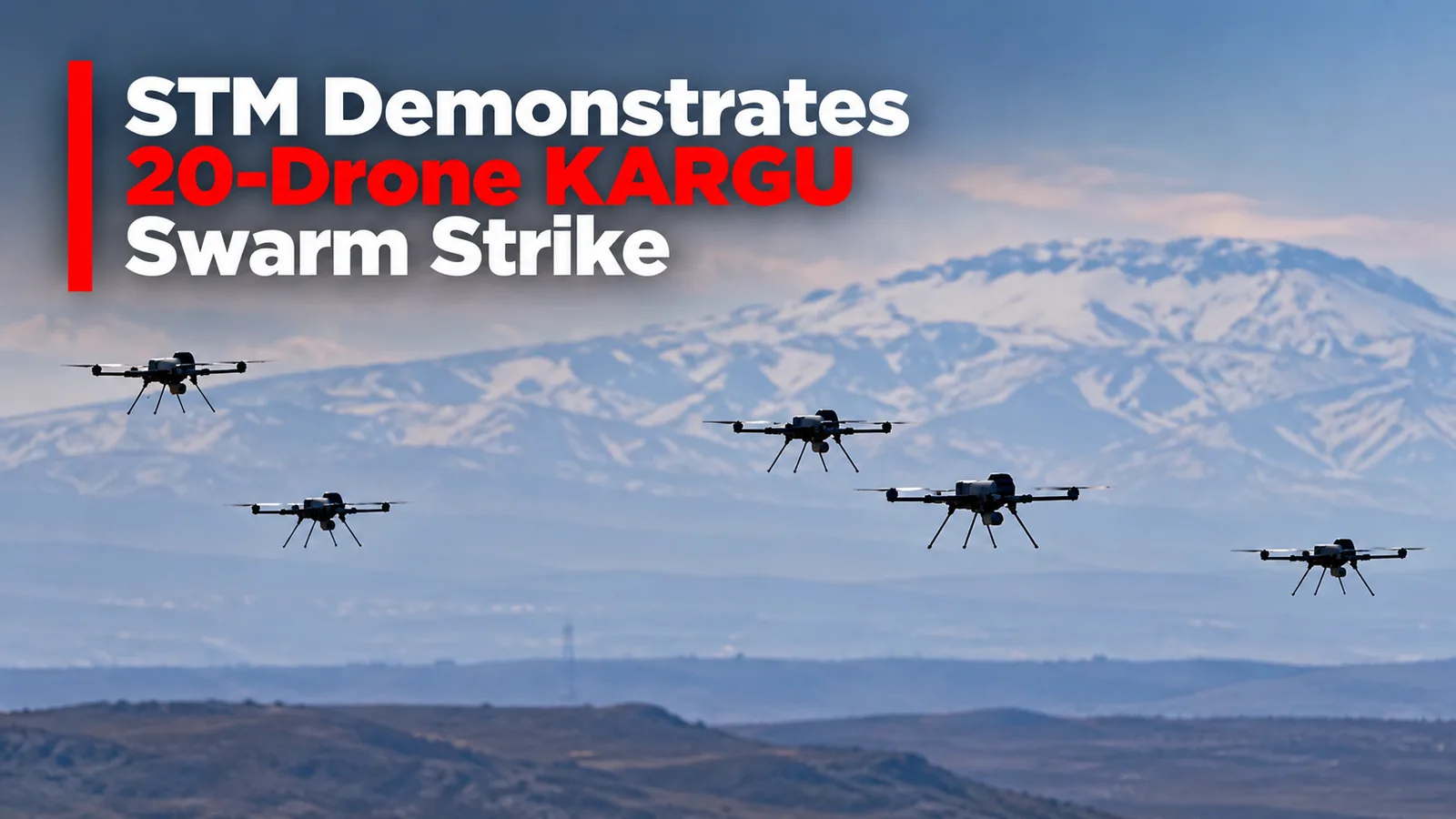
STM demonstrated a coordinated live-fire attack by 20 KARGU loitering munitions at Türkiye's Ateş Serbest 2026 exercise, according to an account published by Anadolu Agency on 14 October. The aircraft operated under one operator's supervision and divided into two groups before striking separate targets, showing a distributed swarm architecture in an exercise scenario rather than announcing a newly procured 20-aircraft operational unit.
The Exercise Combined One Operator with Twenty Effectors
STM's account describes 20 KARGU aircraft taking off autonomously and travelling together to a target area after simulated hostile personnel were detected. The swarm used inter-aircraft communications for target detection, classification and sharing, then separated into two groups of ten for coordinated attacks with anti-personnel warheads. The numbers in this account describe the exercise formation and engagement sequence; they are not procurement quantities or a statement of a force-wide standard unit structure.
The event also involved BOYGA, which released an 81 mm munition against a designated target, and KarguFPV aircraft. These are different systems with different control and weapons concepts. BOYGA's inclusion should not be confused with evidence that its aircraft were part of the same twenty-unit KARGU swarm, nor should a successful range strike be assumed to represent performance against live, manoeuvring opponents.
Distributed Control Is the Main Technical Claim
STM describes its swarm software as using distributed decision-making rather than relying on continuous individual piloting. Aircraft exchange information about targets and mission state and can be divided into subgroups with revised assignments. This approach is intended to improve mission continuity if a member is lost or communications are disrupted, although the October announcement does not quantify the system's resilience under active electronic attack.
The useful distinction is between autonomy in navigation and coordination, and the authority to select or engage real-world targets. The exercise report states that the formation acted under the control of a single operator, but it does not set out a complete human-authorisation model or legal review for different missions. Defence Agenda therefore treats the result as a supervised live-fire demonstration of distributed coordination, not proof of unrestricted independent weapons release.
Continuity from Earlier STM Live-Fire Work
This is not STM's first claimed twenty-aircraft KARGU live-fire event. The company reported a twenty-unit swarm demonstration at EFES 2026 in May, building on an earlier Turkish live-ammunition test in January 2026. Ateş Serbest adds a different training setting and the reported two-group engagement structure, but the new event should not be described as the worldwide debut of twenty-unit KARGU swarming.
STM's own earlier material establishes that KARGU has long been a fielded loitering-munition platform. The maturity of the individual air vehicle is not the same as the maturity of every swarm software configuration or tactic. Repeat exercises are valuable because they can test procedures, operator workload and integration with the wider target-acquisition chain without implying that a new production contract has been signed.
Operational Questions Beyond an Exercise Success
The battlefield utility of a coordinated swarm depends on launch logistics, endurance, target discrimination, communications security and resistance to jamming or spoofing. A formation of twenty expendable aircraft also creates an inventory and sustainment requirement: batteries, motors, warheads, software updates, training and replenishment all have to scale together. The public account does not specify costs, launch-to-impact time, communication bandwidth, autonomous retasking success rates or the number of repeatable exercise runs.
A second issue is command integration. Detecting an object and deciding that it can lawfully be attacked are different functions, particularly in cluttered terrain. No independent instrumented evaluation accompanied the public demonstration, so reported precise hits should remain attributed to the company and official exercise account rather than treated as comprehensive proof of combat effectiveness.
Implications / Next
Next indicators include further exercises with mixed target types, published results under contested communications, larger formations, unit-level procedures and any contract connecting swarm software to a formal fielding plan. STM's repeated KARGU demonstrations show sustained engineering effort and a practical path for tactical mass, but procurement, battlefield adoption and validated resistance to countermeasures each require separate evidence.