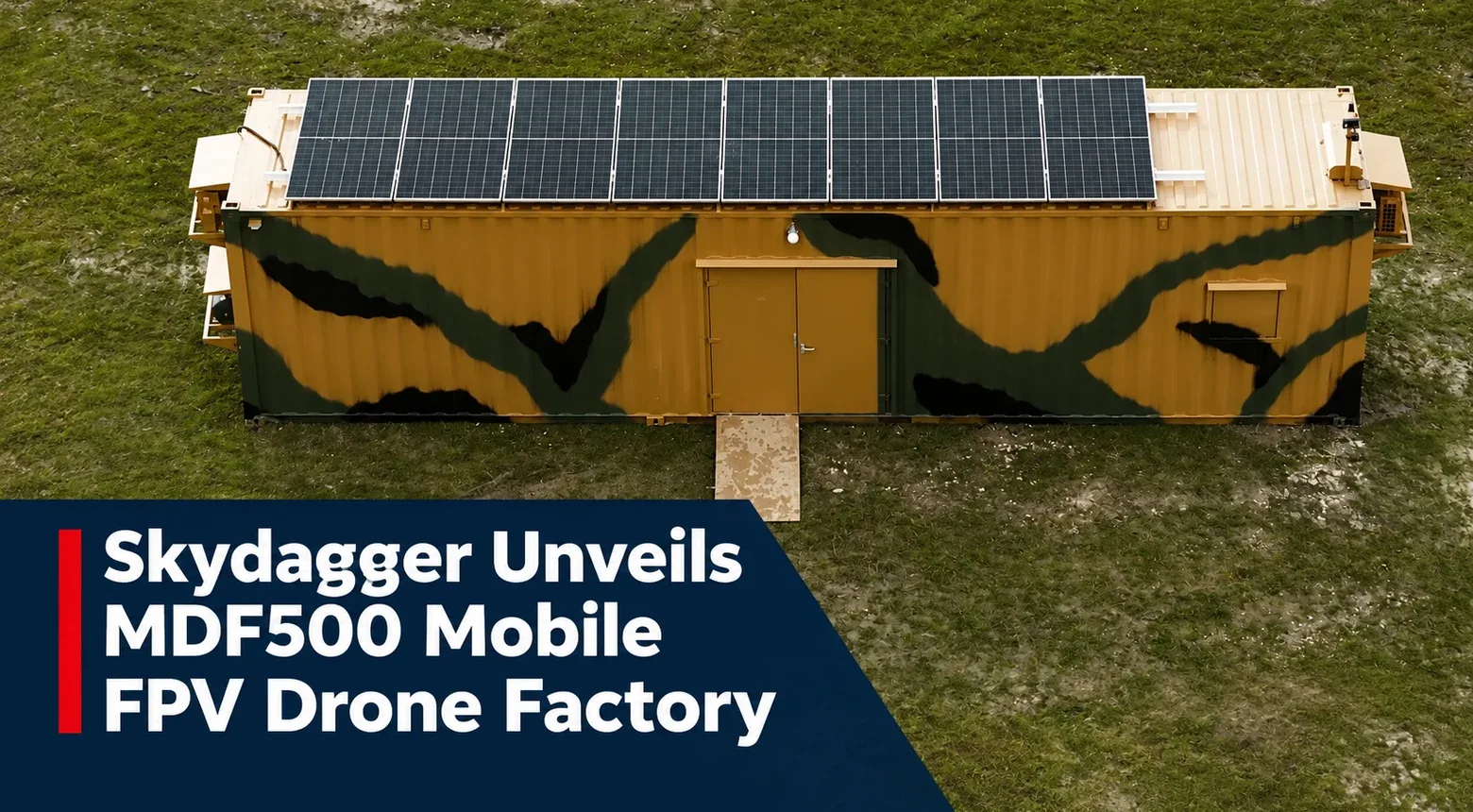
Skydagger has introduced the MDF500 mobile drone factory, a containerised facility that the Turkish manufacturer says can produce more than 500 first-person-view (FPV) drones per month. Reported on 8 November 2026 by Tabya Dijital, the concept combines semi-automated assembly, storage, power support and control functions in a transportable installation. For defence procurement and industrial planners, the key development is an attempt to make distributed drone production a deployable capability rather than a fixed-factory output alone. The published throughput is a reported capacity, not a demonstrated record of independently verified monthly deliveries.
What the MDF500 Announcement Establishes
The 8 November report describes a mobile installation equipped for FPV drone assembly using a semi-automated workflow. The unit incorporates a climate-controlled working environment, solar-assisted electrical infrastructure, an integrated security system and a fire-resistant area intended for battery storage. Images accompanying the announcement show a workspace that appears capable of accommodating at least four personnel undertaking assembly tasks at the same time.
The report also describes facilities for storing, launching and controlling drones from the mobile unit. These functions make MDF500 broader in concept than a conventional shipping container fitted with workbenches. However, the public material does not establish that all of those functions have completed an independent customer qualification process, nor does it identify a named military operator that has accepted the factory for field service.
No contract price, unit count for factory deliveries, production start date, customer list or formal military acceptance certificate was disclosed in the reporting reviewed for this article. The announcement therefore supports the description newly presented mobile manufacturing solution, not proof of a completed procurement programme.
What 'More Than 500 Drones Per Month' Actually Means
The defining numerical claim is an MDF500 capacity exceeding 500 FPV drones a month. A rate stated in this way can describe the intended throughput of the installation under specified staffing, parts availability and operating conditions. It is not automatically a record of finished, tested and accepted drones delivered over a previous 30-day period.
The published material does not specify the operating-day assumptions behind the figure, production yield, quality-control rejection rate, production mix or whether the count includes final acceptance tests. Nor does it distinguish between different airframe variants and the degree of assembly completed before components arrive at the mobile facility. Those omissions limit how directly the claimed figure can be compared with a conventional factory's published monthly output.
This distinction is particularly important because Skydagger already operates a much larger fixed manufacturing business. Anadolu Agency reported on 11 January 2026 that Skydagger's established production line had reached 120,000 FPV drones of annual capacity, citing Baykar management. That is a separate industrial figure, equivalent to the capacity of a central production operation, and should not be presented as the output of one MDF500 unit. A mobile line's commercial case may instead rest on flexibility, proximity to a customer and continuity of supply.
Containerised Production, Energy and Safety
Bringing production activities into a mobile environment changes the support requirements. Working conditions, electricity, environmental controls, component security, storage and personnel safety all become part of the system delivered to the customer. MDF500's reported climate control and battery storage features address visible categories of that challenge, while its solar-assisted infrastructure offers a potential supplementary source of power.
The phrase solar-assisted should not be confused with proof of full energy autonomy. No independently verified power budget, daily solar generation, battery reserve, backup generation specification or uninterrupted operating duration has been disclosed. Similarly, the description of fire-resistant battery storage does not establish compliance with a named safety or transport certification. Such matters would require documented assessment before a buyer could treat the installation as a fully qualified field production facility.
Images suggesting at least four simultaneous assembly positions should also not be translated into a guaranteed four-person staffing requirement. Production management, inspection, logistics, maintenance and safety activities may require additional staffing; the published announcement does not provide a complete personnel model.
Distributed Manufacturing and the Defence Supply Chain
A mobile FPV drone production unit could allow customers to examine more distributed approaches to manufacturing and sustainment. Instead of viewing replenishment exclusively through deliveries from a fixed industrial hub, procurement authorities could assess whether selected final-assembly and support functions should be located nearer a training establishment, maintenance hub or authorised customer facility.
This is a question of industrial design, not a demonstrated reduction in logistics costs. A transportable factory still depends on a reliable supply of motors, electronics, airframes, communications components, batteries and inspection equipment. Moving the final stage of assembly does not by itself eliminate external suppliers or export-control obligations. The result may be a redistribution of dependencies rather than their removal.
For OEMs and subcontractors, traceability and configuration control would be particularly important. A decentralised line must preserve consistent product specifications and reliable records across different locations. From a purchaser's standpoint, the relevant measures are accepted units, conformity, support burden, maintenance requirements and repeatable output under a defined contract—not simply the appearance of a working mobile workshop.
The distinction between industrial capability and operational availability is also central. An announced factory capacity says nothing definitive about how many drones a customer could deploy at any given moment, or how many have passed acceptance and operator training.
Skydagger's Broader FPV Programme and TB2 Integration
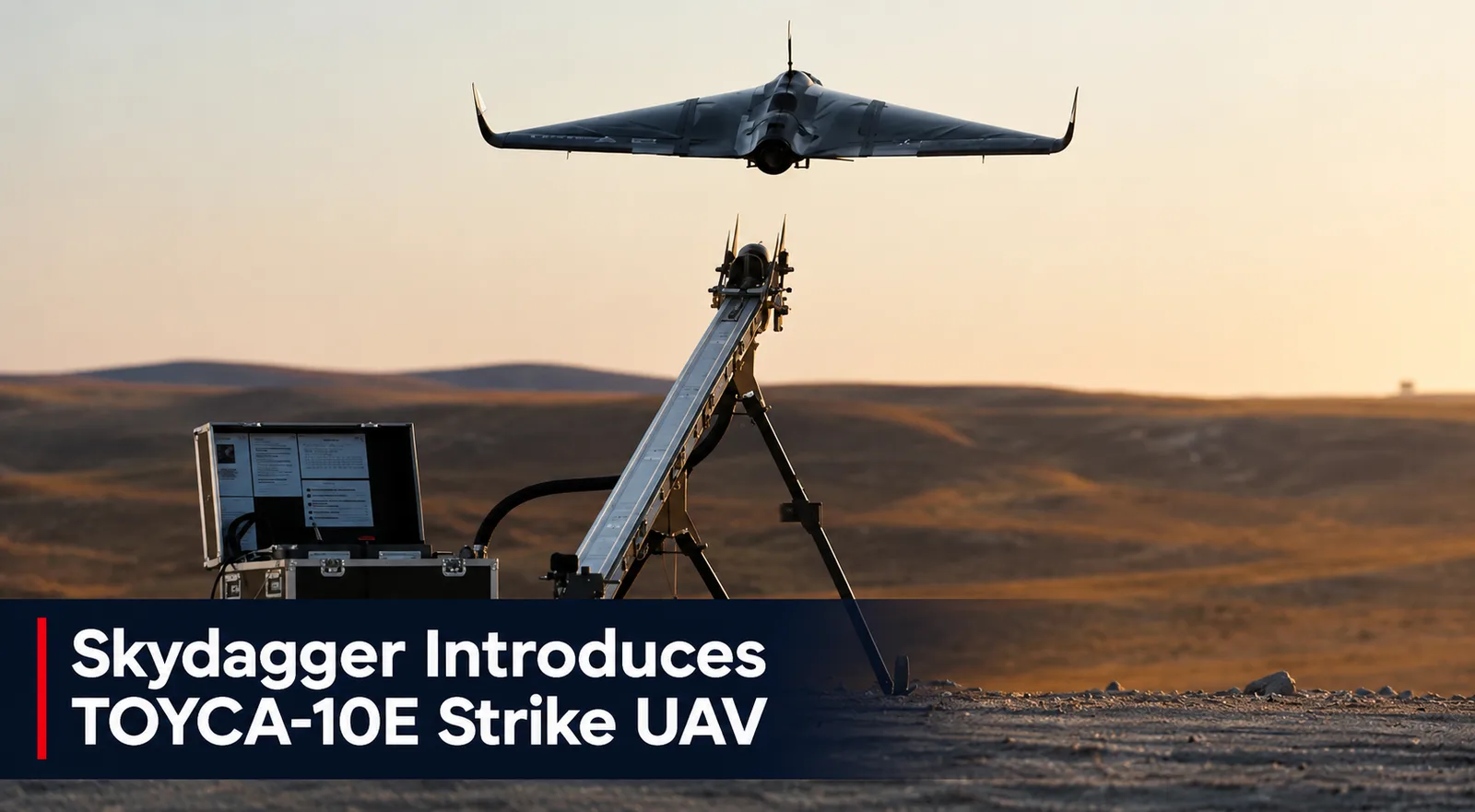
The MDF500 announcement follows another Skydagger-related development announced only days earlier. On 4 November 2026, Baykar said that a Bayraktar TB2 flew carrying 16 Skydagger FPV drones during a trial from its Keşan test centre. The company reported releasing two of those drones and said both struck designated targets under operator control through a communications connection supported by the TB2.
Defence Agenda's report on the TB2's 16-drone carriage demonstration explains why the distinction between carriage and release matters. The 4 November event was an aircraft integration and engagement trial, whereas MDF500 concerns the manufacturing and support infrastructure for FPV drones. They belong to the same broader industrial ecosystem, but one announcement does not independently validate the technical performance or commercial readiness of the other.
There is a wider supply-and-defence relationship, too. Defence Agenda has covered STM's TUNGA-X counter-drone system and ASELSAN's layered counter-UAS developments. Their relevance is economic and industrial: as smaller unmanned systems proliferate, armed forces are examining both the ability to maintain inventories of inexpensive drones and the cost of defending against them. The announcements address different parts of that problem and should not be treated as components of a single verified programme.
Procurement Case: Benefits, Costs and Missing Evidence
For potential customers, MDF500 offers a proposition that combines a transportable production footprint with on-site support functions. The appeal is conceptually clear, but procurement value cannot yet be assessed from the published monthly capacity alone. No acquisition price, installation footprint, transport mass, operating cost, service package, parts-consumption schedule or warranty arrangement has been publicly specified.
Any comparison with a central factory would need a like-for-like definition of accepted output and total cost of ownership. Fixed production can offer economies of scale, centralised quality assurance and established supplier interfaces. Mobile production could offer greater geographic flexibility while adding requirements for local staffing, secure storage, calibration, maintenance and movement of equipment. Neither model is intrinsically superior in every deployment or procurement setting.
There is also a difference between marketing a production capability and proving it under contracted conditions. Public evidence of sustained throughput, manufacturing yields, repeatable inspection results and customer acceptance would make MDF500 materially easier to evaluate. Without those records, more than 500 units per month remains a reported claim, not a procurement-grade measure of delivered capability.
Implications / Next: What to Watch
The next meaningful milestones would be disclosure of the first named customer or signed supply agreement, published delivery and acceptance data, defined personnel and energy requirements, and independently checkable evidence of sustained production. Clarification of which activities are performed within MDF500 and which components arrive pre-assembled would also support better comparisons with other mobile manufacturing concepts.
For Türkiye's defence and aerospace sector, the development points towards an industry exploring production mobility as a product in its own right. It also raises questions about export support, localisation, quality assurance and long-term sustainment that matter to international buyers. The central news as of 8 November 2026 remains specific: Skydagger has presented a mobile, semi-automated FPV drone factory and a monthly capacity claim above 500; public evidence of completed deliveries, independently audited throughput or a military acceptance decision has not accompanied the announcement.