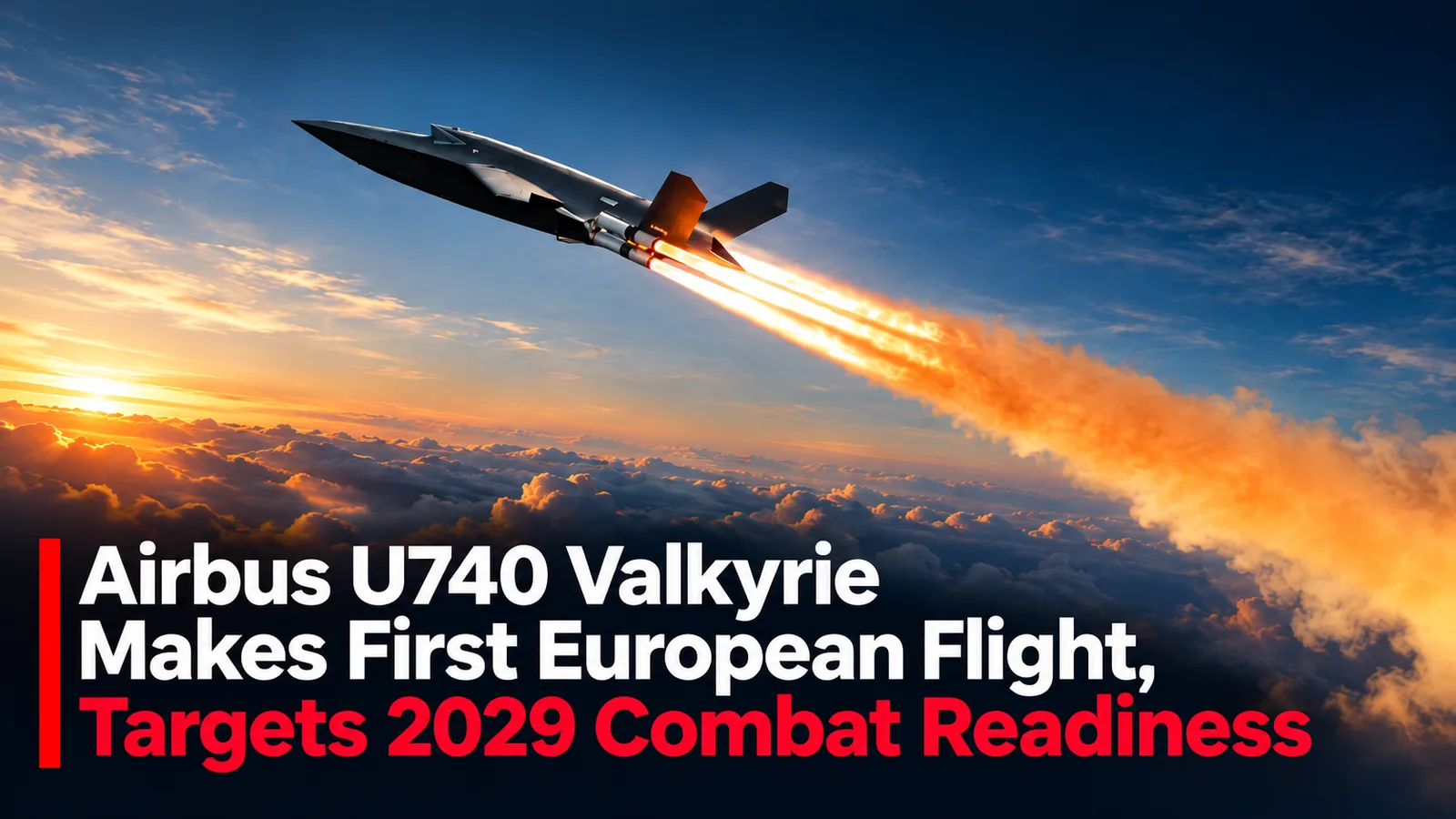
Airbus and Kratos Defense & Security Solutions have completed the first European flight of the U740 Valkyrie collaborative combat aircraft. The test used a runway-independent rocket-assisted launch, covered multiple altitudes and speeds up to Mach 0.8, and included in-flight mission adjustments.
The companies say the milestone keeps the programme on track to deliver a combat-ready uncrewed Collaborative Combat Aircraft, or CCA, by 2029 for Germany and other European armed forces. The aircraft itself is based on Kratos’ Valkyrie family, while Airbus is adding a sovereign European mission-system layer around it.
The First European Flight Focused on the Air Vehicle
The flight took place at an undisclosed test facility in Northern Europe. Airbus and Kratos said all planned objectives were completed, including rocket-assisted launch, flight at different altitudes and speeds, manoeuvring up to Mach 0.8 and mission changes while airborne.
The key limitation is equally important: Airbus’ MARS mission system was not yet part of this first European flight. The sortie therefore demonstrated the air vehicle and European operating framework, but not the full autonomous combat architecture Airbus intends to field.
MARS Is the Core European Technology Layer
Airbus describes MARS — Multi-platform Autonomous Reconfigurable and Secure — as the aircraft’s “European brain.” The system is intended to give Germany and other European operators sovereign control over mission software, applications, data and system hardware rather than depending entirely on a U.S.-controlled mission stack.
MARS uses AI-enhanced software to execute missions autonomously and coordinate mission groups. Airbus says a strict command hierarchy keeps a human on the loop for critical decisions, with engagement decisions remaining subject to rules of engagement and legal and ethical constraints.
The Next Flight Phase Will Add MARS
Airbus says subsequent flights will become progressively more complex as MARS is integrated. Reuters reported that the next flight with the mission system is planned for early 2027, followed later that year by a test in which the Valkyrie will coordinate with Eurofighter aircraft.
That sequence is strategically more important than the first flight itself. A collaborative combat aircraft only becomes operationally relevant when autonomy, sensors, communications and mission-control software can function together with crewed fighters under realistic mission conditions.
The U740 Combines a U.S. Airframe With a European Mission System
The U740 approach deliberately avoids starting from a clean-sheet European airframe. Kratos provides a mature Valkyrie air vehicle, while Airbus contributes mission systems, integration, software, European certification experience and crewed-uncrewed teaming expertise.
This hybrid model is designed to compress schedule. Rather than waiting for a new European combat drone to move through years of aerodynamic development, Airbus can focus on the mission layer that determines how the aircraft works inside a European combat-air force.
Runway Independence Is a Major Part of the Operational Concept
The first European sortie used a rocket-assisted rail launch, allowing the aircraft to operate without a conventional runway. Airbus argues that this can increase resilience by allowing dispersed deployment from locations that are harder to target than a small number of fixed air bases.
The aircraft can also perform conventional runway take-off and landing. That dual approach gives operators a choice between normal peacetime air-base operations and more dispersed wartime deployment concepts.
Published Performance Places U740 in the Jet-Powered CCA Class
Airbus lists the U740 at 9.1 metres in length with an 8.2-metre wingspan and a maximum take-off weight of approximately three tonnes. The aircraft has a published range of more than 5,000 kilometres and a service ceiling of 45,000 feet.
The design includes an internal weapons bay and external payload stations under the wings. Those features allow the aircraft to carry mission systems or weapons while preserving flexibility between lower-signature internal carriage and higher-payload external configurations.
Eurofighter Teaming Is Central to the European Use Case
Airbus explicitly positions the Valkyrie as an uncrewed partner for crewed fighters such as Eurofighter. The company says the aircraft can extend the range, firepower and survivability of crewed formations by accepting higher-risk tasks or operating forward of piloted aircraft.
In practical terms, mission sets could include sensing, electronic warfare, weapons carriage, decoy activity or strike. The precise operational configuration for Germany has not yet been publicly fixed, so those roles should be treated as capability categories rather than a confirmed first fielded loadout.
The 2029 Target Creates an Aggressive Test Schedule
Airbus and Kratos are aiming for a combat-ready CCA by the end of the decade. That leaves roughly three years to complete MARS integration, crewed-uncrewed teaming trials, weapons and sensor integration, certification, operational testing and any customer-specific configuration work.
The tight schedule helps explain the decision to use an existing Kratos airframe. The programme is attempting to reduce airframe-development risk so more of the remaining effort can be concentrated on autonomy, mission systems and operational integration.
Germany Is Driving a Wider European CCA Competition
The U740 is being positioned directly against Germany’s accelerated requirement for an uncrewed combat aircraft by 2029. The requirement has attracted other industry teams, including Rheinmetall and Boeing Australia with the MQ-28 Ghost Bat.
Europe’s wider combat-air market is also filling with competing concepts from Airbus, Boeing, Lockheed Martin, Shield AI, General Atomics and others. The emerging competition is therefore not only about aerodynamic performance but also software sovereignty, mission-system openness, industrial localisation and how quickly a system can enter service.
The Programme Still Has to Prove the Full Mission System
The first European flight validates an important integration and regulatory milestone, but it does not yet demonstrate the complete operational concept. MARS, Eurofighter teaming, weapons employment, contested communications and autonomous mission execution still need to be proven in flight.
No production contract, aircraft quantity or operational unit assignment was announced with the first-flight release. The next meaningful evidence will therefore come from MARS-enabled flights in 2027 and any German or other European procurement decision that follows.