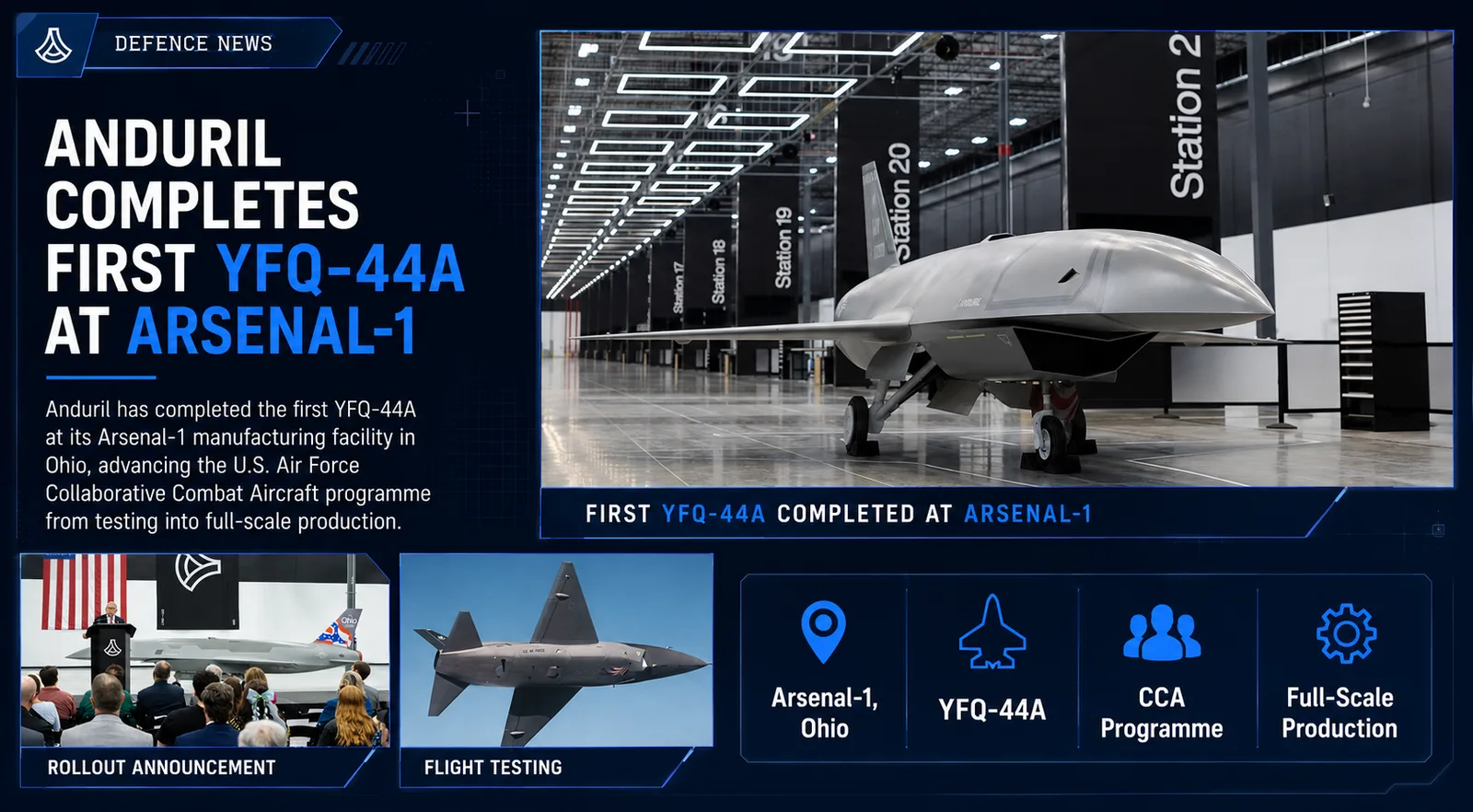
Anduril YFQ-44A production has begun in Ohio, marking the transition of the US Air Force’s Collaborative Combat Aircraft programme from prototype testing toward full-scale manufacturing.
The first Ohio-built YFQ-44A rolled off Anduril Industries’ Arsenal-1 production line on 27 July 2026. According to Defense News’s report on the production milestone, the aircraft was completed approximately four months after manufacturing activity began at the new Pickaway County facility.
The milestone followed the US Air Force’s June 2026 production-contract announcement, which selected Anduril’s FQ-44 and General Atomics’ FQ-42 for Collaborative Combat Aircraft Increment 1.
It also came less than two weeks after the Air Force conducted a YFQ-44A live-fire test involving an AIM-120 air-to-air missile and a digital target over the Mojave Desert.
Defense News continues to identify the Ohio-built aircraft as YFQ-44A, while the Air Force’s production-contract announcement uses FQ-44 for the production system. Under the service’s designation structure, the “Y” prefix denotes prototype status and is removed as an aircraft enters production.
Key Facts
- Aircraft: Anduril YFQ-44A, with the production system officially identified as FQ-44.
- Commercial name: Fury.
- Programme: US Air Force Collaborative Combat Aircraft Increment 1.
- Production milestone: First Ohio-built aircraft completed on 27 July 2026.
- Manufacturing site: Arsenal-1 in Pickaway County, Ohio.
- Facility location: Near Rickenbacker International Airport.
- Planned facility area: Approximately 5 million square feet.
- Reported investment: Approximately $1 billion.
- Employment target: Approximately 4,000 jobs.
- Production capacity: Up to 150 aircraft per year, according to Defense News.
- Production partner: Anduril Industries.
- Other Increment 1 aircraft: General Atomics FQ-42.
- Air Force near-term goal: More than 150 combat-capable CCA by the end of the decade.
- Long-term objective: Approximately 1,000 Collaborative Combat Aircraft.
- Live-fire milestone: YFQ-44A released an AIM-120 against a digital target in July 2026.
- Human control: Weapon-release authority remains exclusively with a human operator.
What Has Anduril Produced at Arsenal-1?
Anduril has completed the first YFQ-44A manufactured at its new Arsenal-1 facility in central Ohio.
The aircraft is a missionised version of Anduril’s Fury uncrewed combat-aircraft design and is being developed for the US Air Force’s Collaborative Combat Aircraft programme.
The production-line milestone does not necessarily mean that the aircraft has been formally delivered to an operational unit. Newly manufactured aircraft normally pass through inspection, acceptance, ground testing, software installation and customer-verification activities before operational assignment.
Neither Anduril nor the Air Force has publicly identified the serial number, intended unit, delivery date or final mission-software configuration of the first Ohio-built aircraft.
Why Is the First Ohio-Built YFQ-44A Important?
The aircraft demonstrates that the programme is moving beyond individually manufactured developmental vehicles and toward repeatable industrial production.
Producing Collaborative Combat Aircraft at scale is central to the Air Force’s concept of affordable combat mass. The service intends to field enough uncrewed aircraft to extend the sensors, weapons, range and survivability of crewed fighters in contested environments.
The speed of the transition is also significant. The Air Force awarded the FQ-44 and FQ-42 production contracts four months earlier than originally scheduled, while Anduril completed the first Ohio aircraft shortly after the facility began manufacturing activity.
The milestone will now shift attention from construction speed to quality, production consistency, software integration, acceptance testing and the ability to sustain a higher annual manufacturing rate.
What Is the Difference Between YFQ-44A and FQ-44?
The designation difference reflects programme status rather than a completely separate aircraft family.
The US Air Force originally designated Anduril’s prototype as YFQ-44A:
- Y: Prototype or developmental status
- F: Fighter mission
- Q: Unmanned aircraft
- 44: Design number
- A: First series
When the Air Force awarded the production contract in June 2026, its official announcement referred to the production system as FQ-44. Removing the “Y” prefix indicates the move from prototype status into engineering, manufacturing development and production.
Defense News nevertheless described the first Arsenal-1 aircraft as YFQ-44A. Until the Air Force provides aircraft-specific acceptance or delivery information, both terms may continue to appear in reporting about the transition period.
Prototype and Production Transition Comparison
| Capability Area | YFQ-44A Development Phase | FQ-44 Production Phase | Programme Significance |
|---|---|---|---|
| Designation | YFQ-44A prototype designation | FQ-44 in the official production-contract announcement | Signals transition from developmental aircraft toward a fielded system |
| Manufacturing approach | Developmental and production-representative test vehicles | Repeatable full-scale manufacturing at Arsenal-1 | Moves the programme from test-article construction toward fleet quantities |
| Primary activity | Flight testing, weapons integration and operational experimentation | Production, acceptance, delivery and fleet expansion | Introduces schedule, cost and production-quality requirements |
| Weapons testing | Captive carriage, data-link validation and AIM-120 live-fire testing | Operational configuration subject to qualification and acceptance | Demonstrates progression from safe carriage to controlled weapon employment |
| Mission autonomy | Multiple vendors integrating software through A-GRA | Competitive production software expected to remain separately upgradeable | Reduces dependence on one hardware and software combination |
| Operator involvement | Human-commanded tests with autonomous execution inside defined limits | Human oversight remains a programme requirement | Maintains human authority over weapon release |
| Industrial scale | Small number of test aircraft | Arsenal-1 capacity reported at up to 150 aircraft annually | Supports the Air Force objective of generating affordable combat mass |
| Programme objective | Validate aircraft, software, weapons and operating concepts | Field more than 150 combat-capable CCA by the end of the decade | Begins transition into an operational force structure |
What Is Arsenal-1?
Arsenal-1 is Anduril’s large-scale advanced manufacturing campus in Pickaway County, Ohio, near Rickenbacker International Airport.
Plans announced for the site describe a facility covering approximately 5 million square feet on a roughly 500-acre property.
The programme represents an investment of approximately $1 billion and is expected to create around 4,000 jobs when fully developed.
Anduril presents the facility as a hyperscale manufacturing site intended to combine software-defined production, automation, common tooling and high-rate assembly across multiple autonomous defence products.
The YFQ-44A is the first product publicly associated with the start of manufacturing at the Ohio site.
How Many FQ-44 Aircraft Can Arsenal-1 Produce?
Defense News reports that the production line has capacity for as many as 150 aircraft per year.
Capacity does not equal confirmed annual output. Actual production will depend on Air Force orders, congressional funding, supplier readiness, workforce growth and customer acceptance schedules.
Anduril had not disclosed the number of YFQ-44A or FQ-44 aircraft that Arsenal-1 would initially produce when the first Ohio-built aircraft was announced.
The Air Force has also not published the division of Increment 1 orders between Anduril’s FQ-44 and General Atomics’ FQ-42.
How Many Collaborative Combat Aircraft Does the Air Force Want?
The Air Force’s June 2026 announcement states that the production contracts support confidence in procuring more than 150 combat-capable CCA by the end of the decade.
Defense News has separately reported that Increment 1 has generally been associated with approximately 100–150 aircraft.
The longer-term Air Force objective is approximately 1,000 Collaborative Combat Aircraft across multiple increments.
That figure should not be interpreted as a confirmed order for 1,000 FQ-44s. Future increments may include different manufacturers, aircraft designs, mission roles and autonomy-software suppliers.
What Is a Collaborative Combat Aircraft?
A Collaborative Combat Aircraft is a jet-powered, uncrewed and semi-autonomous platform designed to operate with crewed combat aircraft.
CCA are intended to extend the reach, sensor coverage, weapons capacity and survivability of crewed fighters while accepting missions that would expose pilots to greater risk.
Potential roles include:
- Air-to-air combat support
- Forward sensing
- Weapons carriage
- Electronic warfare
- Communications relay
- Intelligence, surveillance and reconnaissance
- Decoy and deception operations
- Strike support
- Protection of crewed aircraft
The precise Increment 1 mission configuration has not been fully disclosed. The early programme emphasis is on air superiority, weapons integration and crewed-uncrewed teaming.
What Did the YFQ-44A Live-Fire Test Demonstrate?
In July 2026, the Air Force conducted a live-fire test in which a YFQ-44A released an AIM-120 weapon against a digital target over the Mojave Desert.
The event followed a phased weapons-integration campaign that included inert captive-carriage flights and data-link evaluations.
The test was intended to validate the complete weapon-employment sequence, including aircraft integration, command transmission and weapon release.
The Air Force stated that the aircraft could execute the employment sequence autonomously inside pilot-defined parameters. It also stressed that the decision to release the weapon remained exclusively with a human operator.
The test did not establish that the aircraft independently selected a target or made an autonomous decision to fire.
Does the FQ-44 Autonomously Fire Weapons?
The Air Force says Collaborative Combat Aircraft will not autonomously employ weapons without human authorisation.
Onboard autonomy can support navigation, manoeuvring, task execution and completion of a weapon-employment sequence within defined parameters.
However, a human operator maintains command and control and retains exclusive authority over the release decision.
This model is better described as supervised or human-commanded autonomy than unrestricted autonomous weapon employment.
How Was the YFQ-44A Tested at Creech Air Force Base?
The Air Force’s Collaborative Combat Aircraft Experimental Operations Unit conducted a multi-day Agile Combat Employment exercise at Creech Air Force Base in July 2026.
The event placed CCA into a more operationally representative environment rather than limiting activity to a conventional developmental test range.
During the exercise, participating aircraft generated multiple sorties, operated in local airspace with crewed platforms and completed simulated mission scenarios.
Personnel also tested servicing, refuelling, inert weapon loading, relaunch procedures and the logistical footprint needed to operate the aircraft from distributed locations.
The resulting data will contribute to tactics, techniques, procedures and future fielding decisions.
What Is A-GRA and Why Does It Matter?
The Autonomy Government Reference Architecture, or A-GRA, is the government-owned open architecture supporting the CCA programme.
Its purpose is to separate mission-autonomy software from the aircraft hardware so that software supplied by different companies can be integrated across compatible platforms.
This approach is intended to prevent vendor lock, increase competition and allow autonomy algorithms to be replaced or upgraded without developing an entirely new aircraft.
The Air Force has reported integration work involving Shield AI software with the YFQ-44 platform and RTX Collins Aerospace software with the YFQ-42 platform.
Continuous A-GRA compliance is required for companies participating in the mission-autonomy programme.
Who Is Competing to Supply CCA Autonomy Software?
The Air Force selected six companies for the CCA mission-autonomy contract pool:
- Anduril
- General Atomics
- Lockheed Martin
- Northrop Grumman
- RTX Collins Aerospace
- Shield AI
Anduril, RTX Collins Aerospace and Shield AI received the initial production options for the first six-month competitive phase.
The Air Force plans a second competitive phase before selecting a primary Increment 1 mission-autonomy provider, with the decision planned for summer 2027.
The service may still award software licences to other companies in the six-vendor pool during the contract period.
How Much Funding Is Planned for CCA Production?
The Air Force’s fiscal 2027 budget request includes $996.5 million in procurement funding to begin Increment 1 CCA production and $150 million in advance procurement for fiscal 2028, according to Defense News’s review of budget documents.
Combined with continued research-and-development funding, the programme’s fiscal 2027 request was reported at approximately $2.37 billion.
The budget documents reviewed by Defense News did not provide a definitive number of aircraft in the first procurement lot.
The value of the separate Anduril and General Atomics production contracts and the allocation of aircraft between the two manufacturers have not been publicly disclosed.
How Will FQ-44 Operate With Crewed Fighters?
The Air Force intends CCA to operate alongside crewed platforms such as the F-35 and the future F-47.
A crewed aircraft or another authorised command element would provide mission objectives, engagement constraints and tactical priorities.
The uncrewed aircraft could then use onboard autonomy to maintain formation, navigate, reposition, manage sensors or execute assigned mission tasks.
The final number of CCA that one pilot or mission commander will supervise has not been fixed publicly and will depend on software maturity, workload, mission complexity and communications conditions.
What Does Production Mean for Affordable Combat Mass?
Affordable combat mass is the ability to deploy enough capable aircraft to create operational scale without relying exclusively on a small number of highly expensive crewed fighters.
CCA are intended to be less expensive than advanced crewed aircraft while retaining enough sensors, weapons and autonomy to make a meaningful contribution.
The concept does not mean that the aircraft are considered disposable in every mission. Rather, the Air Force may accept greater operational risk for an uncrewed system than for an aircraft carrying a pilot.
Arsenal-1’s reported annual capacity would support this strategy only if production costs, quality, software readiness and support infrastructure remain aligned with the Air Force’s requirements.
What Technical Specifications Have Been Disclosed?
Detailed operational specifications for the YFQ-44A and FQ-44 have not been publicly released.
Available official information confirms that the platform is jet-powered, uncrewed, semi-autonomous and designed for combat-aircraft teaming.
Public imagery and test reporting confirm external AIM-120 carriage and weapon-release testing.
Official sources have not published a complete data sheet covering maximum speed, combat radius, endurance, payload, radar, internal fuel, electronic-warfare systems or radar cross-section.
Unverified numerical specifications should therefore not be presented as confirmed production performance.
What Are the Main Production and Fielding Risks?
Completing the first Ohio-built aircraft is a major industrial milestone, but scaling the programme introduces additional risks.
- Maintaining quality as annual production increases
- Expanding and training the Arsenal-1 workforce
- Securing engines, electronics and specialised materials
- Completing mission-autonomy software competition
- Maintaining compatibility with A-GRA
- Qualifying weapons and sensors
- Demonstrating reliable crewed-uncrewed teaming
- Reducing the logistical footprint for dispersed operations
- Protecting command-and-control links against jamming and cyberattack
- Establishing basing, training and maintenance organisations
- Obtaining sustained congressional procurement funding
- Balancing Increment 1 production with future Increment 2 development
The Air Force has not yet published a complete operational fielding plan identifying all bases, units, maintenance structures or deployment locations.
What Happens After the First Aircraft Leaves the Line?
The first Ohio-built aircraft is expected to proceed through inspection, verification and customer-acceptance activity before formal delivery.
Further production will test Arsenal-1’s ability to repeat the manufacturing process while maintaining configuration control and quality.
The Air Force will continue operational experimentation, weapons testing and mission-autonomy evaluation in parallel with aircraft production.
Important future indicators include:
- Formal delivery of the first Arsenal-1 aircraft
- Disclosure of the initial production quantity
- Annual production-rate growth
- Selection of the primary mission-autonomy provider
- Integration with additional crewed aircraft
- Creation of operational CCA units
- Deployment to distributed or overseas locations
- Approval of follow-on procurement lots
Conclusion
The first Ohio-built YFQ-44A represents the clearest industrial sign that the US Air Force Collaborative Combat Aircraft programme is progressing from development into production.
Anduril completed the aircraft at Arsenal-1 shortly after receiving an Increment 1 production contract for the FQ-44.
The facility’s reported capacity of up to 150 aircraft annually could support the Air Force’s objective of fielding more than 150 combat-capable CCA before the end of the decade.
The programme has also advanced through AIM-120 weapon-release testing, operational exercises at Creech Air Force Base and implementation of a government-owned open architecture for mission autonomy.
However, the initial order quantity, production division between FQ-44 and FQ-42, final autonomy-software provider and detailed aircraft performance remain undisclosed.
The next decisive test will be whether Anduril and the Air Force can convert the speed demonstrated by the first aircraft into sustained, affordable and operationally reliable fleet production.
For related coverage, visit Defence Agenda’s aerospace, unmanned systems and air warfare sections. Related reports include Airbus MARS networked autonomy, ANKA III’s updated production configuration and the Pentagon’s drone-launching robot-boat programme.
Further Reading
- Defense News: First Anduril YFQ-44A rolls off Ohio production line
- US Air Force: FQ-42 and FQ-44 production contracts
- US Air Force: YFQ-44A AIM-120 live-fire test
- US Air Force: Collaborative Combat Aircraft exercise at Creech
- US Air Force: Autonomy Government Reference Architecture
- US Air Force: YFQ-42A and YFQ-44A designations
- Anduril: Arsenal-1 manufacturing facility
- Anduril: Arsenal-1 development update