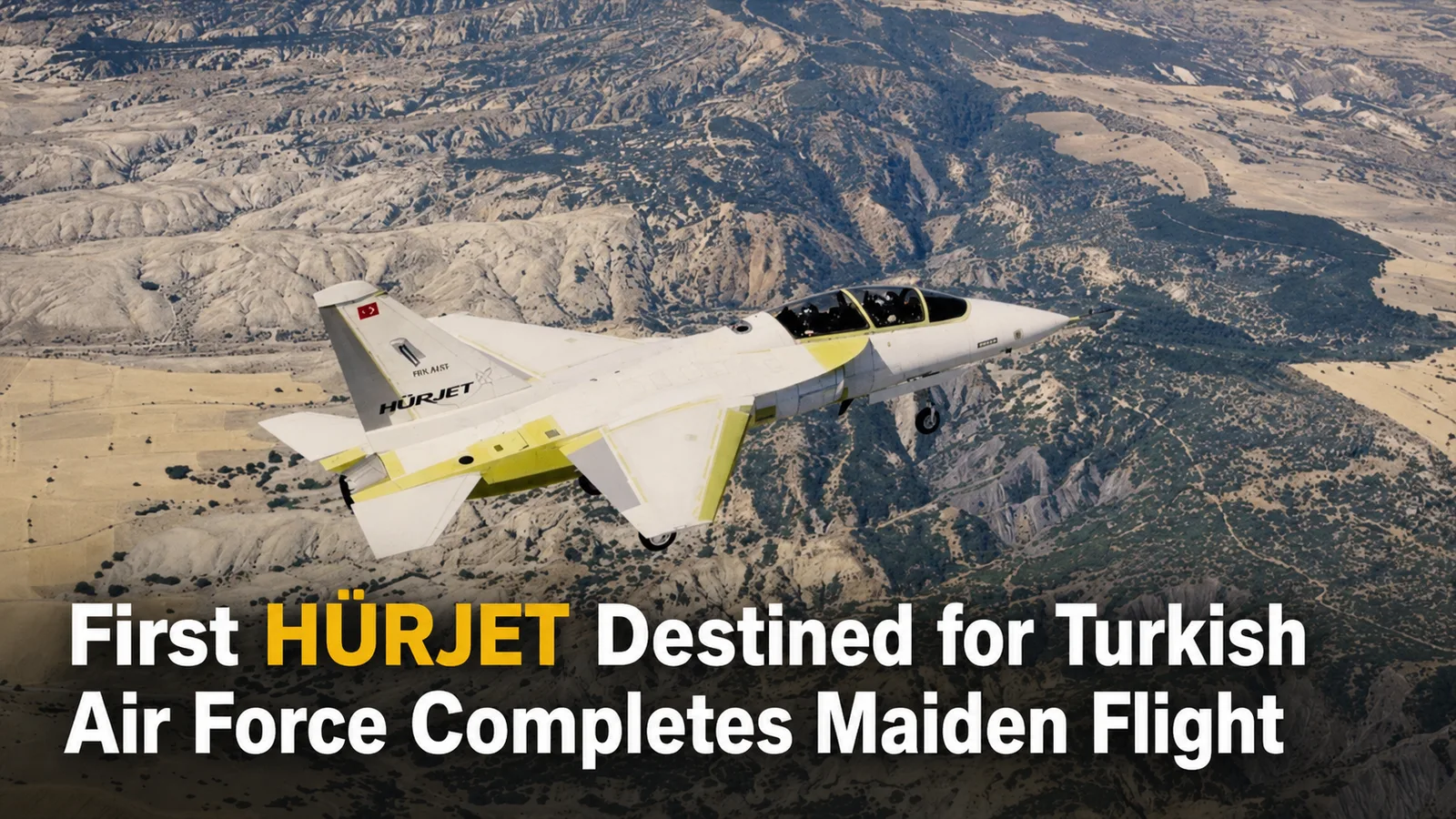
The first HÜRJET jet trainer built for delivery to the Turkish Air Force completed its maiden flight on 30 August 2026, marking the programme’s transition from prototype development toward aircraft intended for operational service.
The aircraft flew for 18 minutes after completing ground and taxi tests, accompanied by HÜRJET’s first development prototype. The milestone comes as Turkish Aerospace continues serial-production preparation, expands the flight-test fleet and targets the start of Turkish Air Force deliveries in 2027.
Key Facts
- Aircraft: HÜRJET Advanced Jet Trainer
- Developer: Turkish Aerospace
- Customer: Turkish Air Force Command
- Milestone: Maiden flight of the first aircraft intended for operational delivery
- Date: 30 August 2026
- Flight duration: 18 minutes
- Programme first flight: 25 April 2023
- Current programme phase: Flight testing and serial production
- Latest publicly stated Turkish delivery target: End of 2027
- Spain delivery target: From 2028
The Programme Has Moved Beyond Prototype-Only Testing
The significance of the 30 August flight is not that HÜRJET flew for the first time. The programme’s original prototype completed its maiden flight on 25 April 2023 and a second prototype followed in November 2024.
The new aircraft is different because Turkish authorities describe it as the first HÜRJET that will be delivered to the Turkish Air Force.
That moves the programme into a more mature stage in which flight testing begins to involve aircraft built in the delivery configuration rather than only development prototypes.
Anadolu Agency reported that final assembly had been completed before the aircraft underwent ground and taxi testing. After those checks were completed, the aircraft was cleared to fly and remained airborne for 18 minutes with the first HÜRJET prototype accompanying the sortie.
The 18-Minute Sortie Was a Configuration Milestone, Not a Performance Demonstration
No detailed performance figures were released for the maiden flight beyond the 18-minute duration.
The public statement does not disclose maximum altitude, speed, angle of attack, G-loading or test points achieved during the sortie.
Those values should not be inferred from earlier HÜRJET prototype tests.
The purpose of a first flight for a newly completed production or delivery-configured aircraft is normally to confirm basic airworthiness, flight-control behaviour and system function before progressively expanding the envelope.
Turkish authorities have not published the exact certification or acceptance-test sequence that the aircraft must complete before handover to the Air Force.
HÜRJET Has Already Proven Supersonic Flight
The broader HÜRJET development fleet has already passed several major aerodynamic milestones.
The first prototype exceeded Mach 1 in October 2024 and has flown above 45,000 ft. Turkish Aerospace currently lists a maximum speed of Mach 1.4 and a service ceiling of 45,000 ft for the aircraft.
The company also publishes a 1,060-nautical-mile range, a maximum payload capacity of 7,500 lb and G limits of +8/-3.
HÜRJET uses the GE Aerospace F404-GE-104 engine, with Turkish Aerospace listing 17,700 lb of thrust.
These are manufacturer-level aircraft specifications and should not be treated as the achieved performance of the new 30 August delivery aircraft on its maiden sortie.
The Flight-Test Fleet Is Expanding Rapidly
Turkish Aerospace Chief Executive Mehmet Demiroğlu said in August 2026 that HÜRJET’s first two prototypes had accumulated approximately 550 hours of flight testing.
He also said four additional aircraft were being built to increase test tempo, with the first pair expected to begin flying within weeks and the remaining pair to follow.
The 30 August maiden flight appears to be part of that acceleration, although public programme statements use different labels for prototypes, production aircraft and delivery-configured aircraft.
The important operational point is that Turkish Aerospace is moving from a two-aircraft test fleet toward several simultaneously flying HÜRJETs.
That allows structural, avionics, handling, mission-system, certification and customer-acceptance work to proceed in parallel rather than sequentially on only one or two airframes.
Delivery Timing Has Shifted During the Programme
HÜRJET’s public delivery schedule has changed as the programme matured.
Turkish Aerospace’s current product page still states that delivery to the Air Force Command is planned for 2026.
However, more recent statements from company management provide a later schedule. In August 2026, Demiroğlu said Turkish Aerospace was committed to beginning deliveries to the Turkish Air Force by the end of 2027.
Earlier 2026 reporting similarly placed HÜRJET’s entry into Turkish service in 2027.
Defence Agenda therefore treats 2027 as the latest publicly stated delivery target rather than presenting the older 2026 website schedule as definitive.
The Turkish Air Force Order Has Been Described in Different Ways
Public reporting on the initial Turkish quantity has also evolved.
In May 2025, Demiroğlu said Turkish Aerospace had received an order for 16 HÜRJET aircraft from the Turkish Air Force.
By January 2026, he described four HÜRJET prototypes and 12 aircraft for the Turkish Air Force as being in production.
Earlier programme planning separated four Block 0 aircraft and 12 Block 1 aircraft.
Because these descriptions may reflect different programme accounting, prototype status or contract phases, the 30 August aircraft should not be assigned to a specific Block 0 or Block 1 quantity unless SSB or Turkish Aerospace identifies it publicly.
The reliable new fact is narrower: it is the first HÜRJET explicitly identified by Turkish authorities as intended for delivery to the Air Force.
HÜRJET Is Intended to Replace the T-38 Training Layer
The core operational requirement is advanced jet training.
HÜRJET was launched to replace ageing training aircraft and give Turkish pilots a modern transition platform before they move to frontline fighters.
The aircraft uses a tandem-seat cockpit, modern avionics and high-performance flight characteristics intended to prepare pilots for increasingly complex combat aircraft.
Turkish Aerospace also markets the platform for Introduction to Fighter Fundamentals, aggressor or “Red Air” missions and aerobatic-team applications.
For the Turkish Air Force, the aircraft is particularly relevant as the service transitions toward a fleet that will include upgraded F-16s and eventually KAAN.
Training for Fifth-Generation Operations Is the Larger Requirement
Modern pilot training increasingly needs to reproduce the information environment of frontline combat aircraft rather than only teach basic jet handling.
Advanced trainers therefore require mission computers, digital cockpits, tactical displays, datalinks and simulation functions capable of exposing pilots to sensor-rich missions before they enter expensive combat-aircraft conversion units.
HÜRJET is intended to fill that gap in Türkiye’s training pipeline.
This also reduces the need to use frontline fighters for some advanced training sorties, potentially preserving combat-aircraft flying hours and reducing training cost.
Actual lifecycle savings will depend on fleet utilisation, support contracts, fuel consumption and simulator integration and have not been publicly quantified.
HAVELSAN Is Building the Training-System Layer Around HÜRJET
The aircraft is only one component of the wider training system.
HAVELSAN has developed a full mission and flight-training simulator for HÜRJET and is preparing the system for Turkish Air Force service.
The simulator architecture is also included in the Spanish HÜRJET programme.
This is important because modern advanced-jet training increasingly combines live flying with high-fidelity simulation, computer-based training and mission rehearsal.
A mature synthetic environment allows pilots to practise complex tactical scenarios that may be expensive, difficult or unsafe to reproduce entirely in the air.
Spain Has Turned HÜRJET Into an Export Programme
HÜRJET’s industrial significance increased substantially after Spain selected the aircraft for its future fighter-pilot training system.
Turkish and Spanish industry are working through a programme involving Turkish Aerospace and Airbus Defence and Space, with Spanish deliveries scheduled to begin in 2028.
Airbus officials said in April 2026 that Spain plans to receive 30 aircraft during the 2030–2035 period after initial deliveries begin in 2028.
The Spanish programme is not simply an off-the-shelf aircraft purchase. Spanish industry is expected to participate in adaptation, systems integration, support and the wider Integrated Training System.
For Turkish Aerospace, that gives HÜRJET an operational path into a second NATO air force before the Turkish production programme has fully matured.
The Spanish Order Increases Pressure on Production Ramp-Up
Domestic and export schedules now overlap.
Turkish Aerospace needs to complete Turkish Air Force deliveries while preparing aircraft for Spain from 2028.
Demiroğlu said earlier in 2026 that the company wanted to increase HÜRJET production first to two and then to three aircraft per month.
That is a significant industrial target for a new supersonic aircraft programme because higher-rate production requires stable suppliers, repeatable assembly, quality control and predictable engine and subsystem delivery.
The first Turkish delivery aircraft entering flight test is therefore also an industrial milestone: serial production has to generate aircraft that can move through final assembly, ground tests, flight tests and customer acceptance at a recurring cadence.
Türkiye Is Expanding the HÜRJET Industrial Base
HÜRJET production is not confined to Turkish Aerospace’s Ankara facilities.
TOMTAŞ has been integrated into the programme for component-level assembly work and is developing production infrastructure in Kayseri.
The company has previously been contracted for assembly activity associated with 12 HÜRJET Block 1 aircraft and multiple structural components.
Turkish Aerospace is also expanding overall aviation manufacturing capacity as HÜRJET, KAAN, GÖKBEY, ANKA-3 and other programmes move toward larger production runs.
The ability to distribute work across qualified suppliers will be important if HÜRJET is to serve domestic, Spanish and potential additional export customers simultaneously.
A Naval HÜRJET Could Create a Second Turkish Customer
Turkish Aerospace is separately developing concepts for a carrier-capable HÜRJET variant.
The Turkish Naval Forces are the principal prospective customer for that configuration as Türkiye develops the 60,000-tonne MUGEM aircraft carrier.
The naval programme remains earlier in maturity than the standard trainer.
Carrier operation would require structural strengthening, arrested-recovery equipment, landing-gear changes, corrosion protection and shipboard operating procedures.
No Turkish Navy serial-production contract or completed carrier qualification has been publicly announced.
The standard Air Force aircraft entering flight test should therefore not be described as a naval HÜRJET, but the growing production base gives Turkish Aerospace a platform from which to develop the derivative.
The GE F404 Remains a Critical Imported Subsystem
HÜRJET’s airframe, avionics integration and systems architecture are led by Turkish industry, but the aircraft currently depends on the U.S.-origin GE F404 engine.
Turkish Aerospace lists the F404-GE-104 as the production powerplant.
Engine availability therefore remains an important supply-chain factor for production scale and exports.
Türkiye is pursuing wider propulsion localisation across its aviation programmes, but no indigenous HÜRJET engine has been publicly identified as ready to replace the F404 in the near-term production configuration.
The programme’s localisation level should consequently not be described as complete.
First Delivery Aircraft Reduces a Key Schedule Risk
For any new aircraft programme, one of the major schedule risks is the transition between prototypes and repeatable production.
A prototype can be heavily instrumented, manually reworked and supported by engineering teams in ways that are not sustainable for a fleet.
A delivery-configured aircraft needs to emerge from the production system with consistent build quality and then complete customer-oriented testing.
The 30 August flight shows that HÜRJET has crossed that transition point at least for the first aircraft intended for the Turkish Air Force.
The next challenge is repetition: subsequent aircraft must follow at increasing speed without creating unacceptable rework or certification bottlenecks.
Limitations and Counterpoint
The first flight does not mean the aircraft has been delivered or entered operational inventory.
Ground and flight testing, customer acceptance and any remaining certification work still need to be completed.
The exact delivery date for this individual airframe has not been publicly announced.
Public programme sources also contain schedule differences. Turkish Aerospace’s product page still references 2026 delivery, while more recent management statements point to 2027.
Likewise, public descriptions of the Turkish order vary between 16 aircraft, four prototypes plus 12 production aircraft and earlier Block 0/Block 1 planning.
The article therefore avoids assigning the new aircraft to a specific block or claiming a fixed fleet quantity beyond what each source explicitly states.
Implications / Next
The first near-term milestone is expansion of the new aircraft’s flight envelope and completion of Air Force acceptance testing.
The second is the arrival of additional delivery-configured aircraft in the flight-test fleet. A recurring flow of aircraft would demonstrate that serial production is moving beyond one-off completion.
The third is the formal first handover to the Turkish Air Force. That will establish the actual start of operational conversion and instructor training.
The fourth is production rate. Turkish Aerospace’s ability to increase monthly output will determine whether Turkish and Spanish schedules can be supported in parallel.
The fifth is Spain. The transition from Turkish production to Spanish integration and training-system delivery will be HÜRJET’s first large international industrial test.
Conclusion
The 30 August 2026 maiden flight marks one of HÜRJET’s most important programme transitions since the first prototype flew in 2023.
For the first time, an aircraft explicitly identified for Turkish Air Force delivery has moved from final assembly and ground testing into flight.
The milestone does not yet equal operational service, and the latest public schedule points to deliveries beginning in 2027.
But it demonstrates that HÜRJET is moving from a development programme built around two prototypes toward a serial-production aircraft supporting both Türkiye’s future training fleet and a growing export pipeline led by Spain.