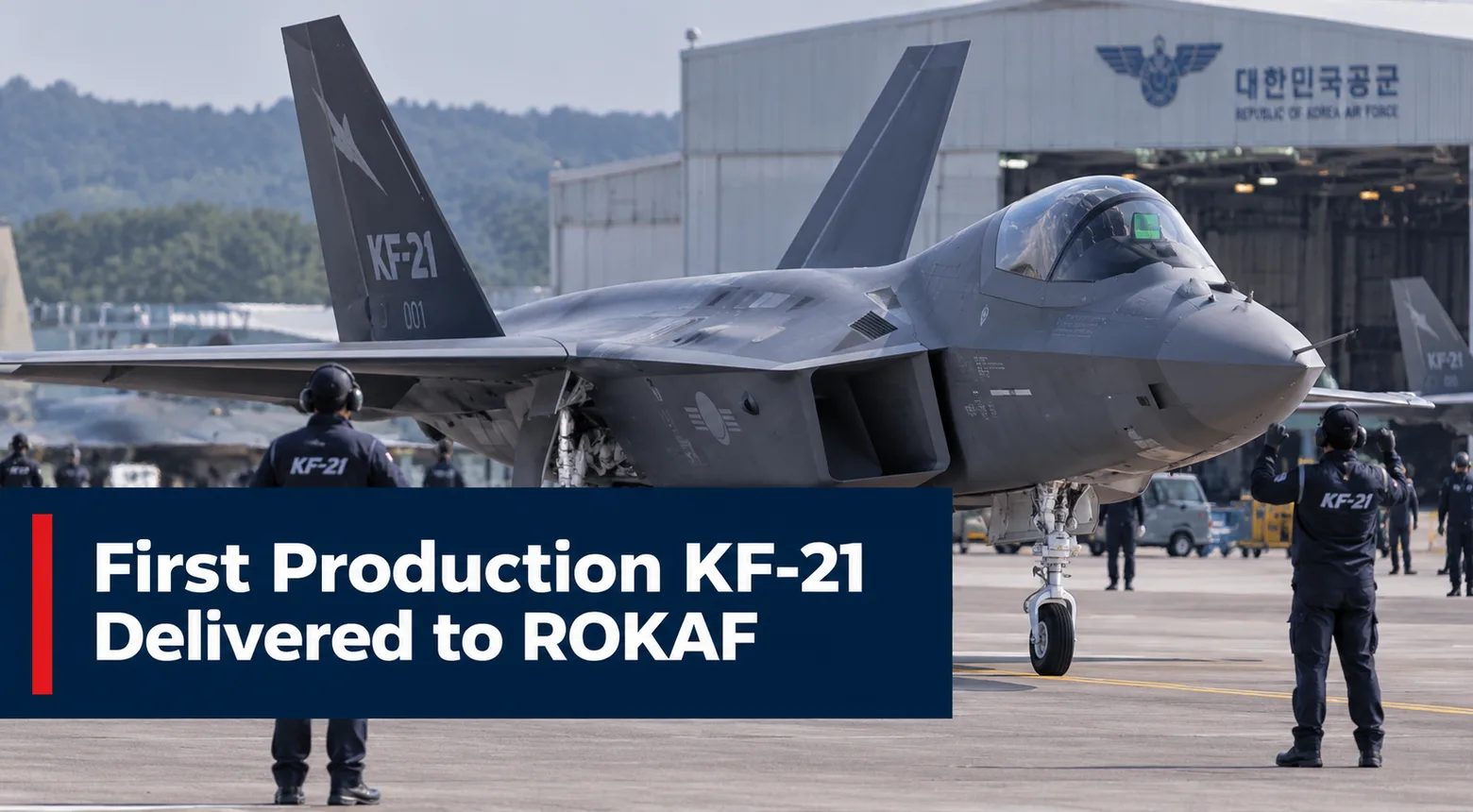
The Republic of Korea Air Force received the first serial-production KF-21 Boramae on 22 September 2026, moving the indigenous fighter programme from development and prototype testing into service introduction. The delivery is a production milestone; it should not be treated as full operational capability for the fleet.
The programme has crossed from prototype work into fleet introduction
South Korea has delivered the first serial-production KF-21 Boramae to the Republic of Korea Air Force, marking the clearest transition yet from development aircraft to an operational customer fleet. South Korea’s Defence Acquisition Program Administration and Air Force said production aircraft 001 was formally accepted on 22 September 2026 at Korea Aerospace Industries’ Sacheon facility before flying to Yecheon Air Base.
The aircraft’s arrival does not mean the KF-21 programme is complete. The first production handover begins a new phase centred on conversion training, maintenance, spares, software baselines, weapons integration and squadron-level operating procedures. Those activities determine whether a new fighter can generate reliable combat sorties, and they normally continue well beyond the first aircraft ceremony.
Serial production changes the programme’s risk profile
Prototype campaigns are primarily designed to validate aerodynamics, systems and performance. Production aircraft add a different set of risks: manufacturing repeatability, supply-chain stability, configuration control and the ability to sustain multiple jets simultaneously. The first delivery therefore gives the programme office a real fleet article on which to measure maintenance hours, parts consumption and turnaround time in routine Air Force use.
The Aviationist reported that aircraft 001 had previously rolled out in March 2026 and completed acceptance activity before handover. The same reporting places the initial aircraft with the 156th Fighter Squadron under the 16th Fighter Wing. That assignment provides a defined organisational base for the conversion of pilots and maintainers as additional aircraft arrive.
Block I is the start of an incremental capability path
The KF-21 was deliberately structured around phased capability growth rather than a single final configuration. Initial Block I aircraft are focused on establishing the air-to-air combat baseline, while later Block II development is expected to expand air-to-ground capability. That incremental path allows South Korea to begin fielding the aircraft while weapons and mission-system work continues in parallel.
Open reporting describes a plan for 40 Block I aircraft followed by a larger Block II fleet. Those quantities are programme objectives rather than evidence that every aircraft is already under the same production status today. The meaningful near-term measure is whether KAI can sustain the planned delivery tempo while the Air Force builds trained personnel and support infrastructure.
The delivery strengthens KAI’s export reference but does not guarantee sales
A domestic Air Force delivery is important for export credibility because potential customers can examine an aircraft that is moving through an actual military introduction process. It provides evidence on maintenance, sortie generation and software growth that cannot be demonstrated by prototypes alone. KAI can also point to an established national production line and a committed home customer when discussing future opportunities.
However, first delivery should not be conflated with international adoption. Export campaigns remain separate procurement decisions shaped by price, weapons access, industrial participation, financing and political approvals. The KF-21 will have to build a service record before those questions can be answered with operational data rather than programme projections.
Programme maturity and verification
For acquisition and programme-management teams, the milestone is most useful when separated from the claims that usually surround it. The confirmed event establishes technical or contractual progress, while production scale, operational availability, unit adoption and future performance still require their own evidence. That distinction keeps the programme baseline stable as new announcements arrive.
Implications / Next
The next milestones are the pace of follow-on deliveries, squadron conversion, weapons and mission-system qualification, and any formal declaration of operational capability by ROKAF. Those events will show how quickly the first production aircraft becomes a repeatable combat-air capability.