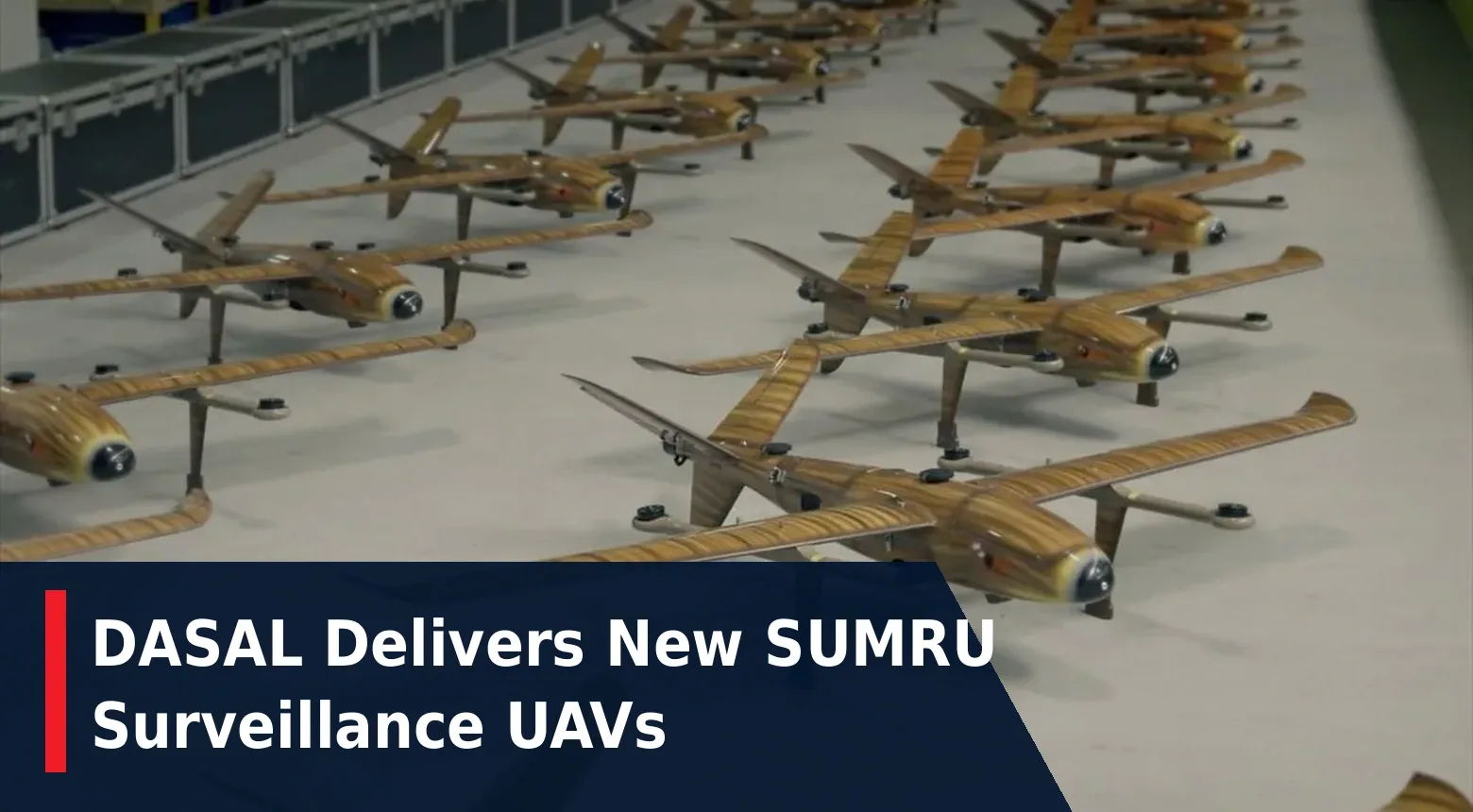
DASAL has completed another delivery of its SUMRU surveillance UAV, a compact Turkish fixed-wing aircraft combining vertical take-off and landing (VTOL) with day-and-night intelligence, surveillance and reconnaissance (ISR) sensors. The latest handover was reported by Anadolu Agency on 19 November 2026 and indicates the programme is moving equipment into further mission areas. Its operational significance is the ability to launch tactical aerial surveillance without an airstrip, while retaining more sustained flight than many small multirotor aircraft. Neither the customer nor the number of aircraft, contract value or precise deployment location was disclosed, so the announcement should not be treated as a quantified fleet expansion or a new export contract.
SUMRU VTOL Surveillance UAV: Delivery and Technical Profile
SUMRU was developed by DASAL Aerospace Technologies, part of Türkiye’s Altınay Defence Group. Anadolu Agency reported that deliveries were proceeding as planned and that the latest systems had been sent to a new mission area. DASAL General Manager Kutay Çağıl Büyüköztürk welcomed the delivery and described feedback from operational users as supporting the company’s confidence in the platform. The report did not name those users, provide a delivery certificate, identify a military unit or specify the latest batch size. The most defensible programme status is therefore a manufacturer-reported follow-on delivery, rather than a documented procurement award with a disclosed quantity.
DASAL’s current SUMRU technical page lists a 15 kg maximum take-off weight and up to 2.5 hours of flight endurance. The stated maximum operational altitude is 3,000 metres above mean sea level (MSL), with a separate 1,000-metre above-ground-level (AGL) specification. These are different altitude references and should not be used interchangeably. The product sheet also lists a maximum ground speed of 25 metres per second, although that headline performance figure does not by itself specify a recommended surveillance cruise speed or an operational sortie profile.
The platform uses fixed wings for forward flight while its vertical-lift rotors enable launch and recovery from limited areas. This offers a practical alternative where a runway, catapult or recovery net would be difficult to position. It does not remove the need for a safe launch area, weather assessment, maintenance and local airspace coordination. In tactical use, the benefit can be reduced basing infrastructure for a reconnaissance team, particularly when the sensor needs to remain above an area of interest for longer than the endurance typical of small hovering platforms.
The principal payload is a stabilised electro-optical/infrared (EO/IR) imaging system. Both Anadolu Agency and DASAL’s current specifications describe a 1920 × 1080 electro-optical camera with 40× optical zoom and an infrared sensor with 640 × 512 resolution. DASAL also advertises automatic tracking of stationary or moving targets, real-time imagery transfer, onboard object detection and classification, autonomous patrol functions and return to the launch point if the datalink is lost. These are stated product capabilities; the 19 November delivery report does not provide independent acceptance-test results for each feature.
Communications require particular care in interpreting the numbers. The standard radio-frequency (RF) configuration is listed with a 10 km mission radius, while the optional LTE/4G link can extend the advertised radius to 50 km, provided suitable mobile-network infrastructure is available. The 50 km figure is not a guarantee of coverage in communications-denied terrain or without supporting networks. Nor is either radius equivalent to the aircraft’s total flight distance. The operational outcome will depend on terrain, network quality, electromagnetic conditions, mission payload and the need to preserve a safe return margin.
DASAL lists approximately seven minutes to readiness and specifies autonomous and semi-autonomous flight modes, real-time video recording, a plug-and-play sensor mount and night-time surveillance. The reported rapid set-up can reduce preparation time, but independently measured deployment timelines, launch-to-recovery turnaround, mission availability and maintenance burden have not been released for the delivered systems. Those metrics would help procurement and unit commanders evaluate how the aircraft performs over repeated sorties rather than a single nominal mission.
Operational Value, Procurement Transparency and Next Steps
The handover expands the publicly reported delivery record for a runway-independent ISR aircraft. SUMRU sits between short-endurance multirotor observation drones and larger tactical fixed-wing aircraft that may require more elaborate support equipment. This classification does not imply a direct performance equivalence to other Turkish platforms. For context, Defence Agenda covered Bayraktar KALKAN DİHA entering Türkiye’s inventory, a separate fixed-wing VTOL surveillance programme with its own procurement and test record. The two programmes illustrate market demand for runway-independent reconnaissance, but available public information does not support a head-to-head operational ranking.
Mission usefulness is ultimately determined by the whole ISR chain: image quality under real lighting and weather conditions, operator workload, data-link stability, identification reliability and the speed with which imagery reaches a command post. A nominal 2.5-hour flight capability will not necessarily produce 2.5 hours of continuous on-station surveillance once outbound transit, reserve energy and return requirements are included. The same qualification applies to optical zoom, sensor detection and tracked-object claims: the actual ability to recognise objects depends on range, weather, line of sight, stabilisation and the analyst’s needs.
The broader Turkish ecosystem is also experimenting with different approaches to persistent surveillance. Defence Agenda’s reporting on STM’s TOGAN-NEST field tests examines automated recovery and remote observation, while its analysis of KALKAN DİHA trials from Turkish Navy ships explores launch-location flexibility in a maritime environment. These are distinct platforms and demonstrations. They provide industry context, not evidence that SUMRU has received identical integrations, naval acceptance or certification.
A notable transparency limit remains the delivery itself. The Anadolu Agency announcement does not state whether the newly delivered equipment was supplied under an existing framework order, a separate contract or another acquisition arrangement. It does not identify the latest operator, platform quantity, total fleet size, contract value, export destination or delivery acceptance conditions. Consequently, it is inappropriate to calculate programme revenue, a serial-production rate or an export backlog from this news item alone.
Differences between past catalogues and the current manufacturer webpage also deserve attention. DASAL’s historical general catalogue has presented a broader range of SUMRU-related configurations, while its current dedicated product page gives the 15 kg, 2.5-hour and 10–50 km mission-radius specification set used here. This article follows the current named product page for technical baseline figures rather than merging maximum values drawn from different brochure variants into a hypothetical aircraft. Buyers should request the exact delivered configuration and applicable acceptance standard before comparing systems.
Implications / Next: The next meaningful disclosures would be the receiving organisation, number of airframes and ground-control elements, contract or procurement basis, user acceptance and verified fleet availability. Further operational evidence could document endurance with mission payloads, actual RF and LTE performance, sensor identification at representative distances, resilience in degraded navigation conditions and repeated sortie turnaround. As of 20 November 2026, the confirmed development is a reported new SUMRU delivery with disclosed manufacturer specifications, not an audited statement of fleet strength or mission effectiveness.
Further Reading
- Anadolu Agency — New Delivery of SUMRU Surveillance UAV, 19 November 2026
- DASAL — Official SUMRU VTOL Fixed-Wing Surveillance UAV Specifications
- DASAL — Turkish-Language SUMRU Product Specification Page
- DASAL — UAV Systems Demonstrated at Ateş Serbest 2026
- Defence Agenda — Bayraktar KALKAN DİHA Enters Türkiye’s Inventory
- Defence Agenda — STM TUNGA-X and TOGAN-NEST in Field Tests
- Defence Agenda — KALKAN DİHA Trials on Turkish Navy Vessels