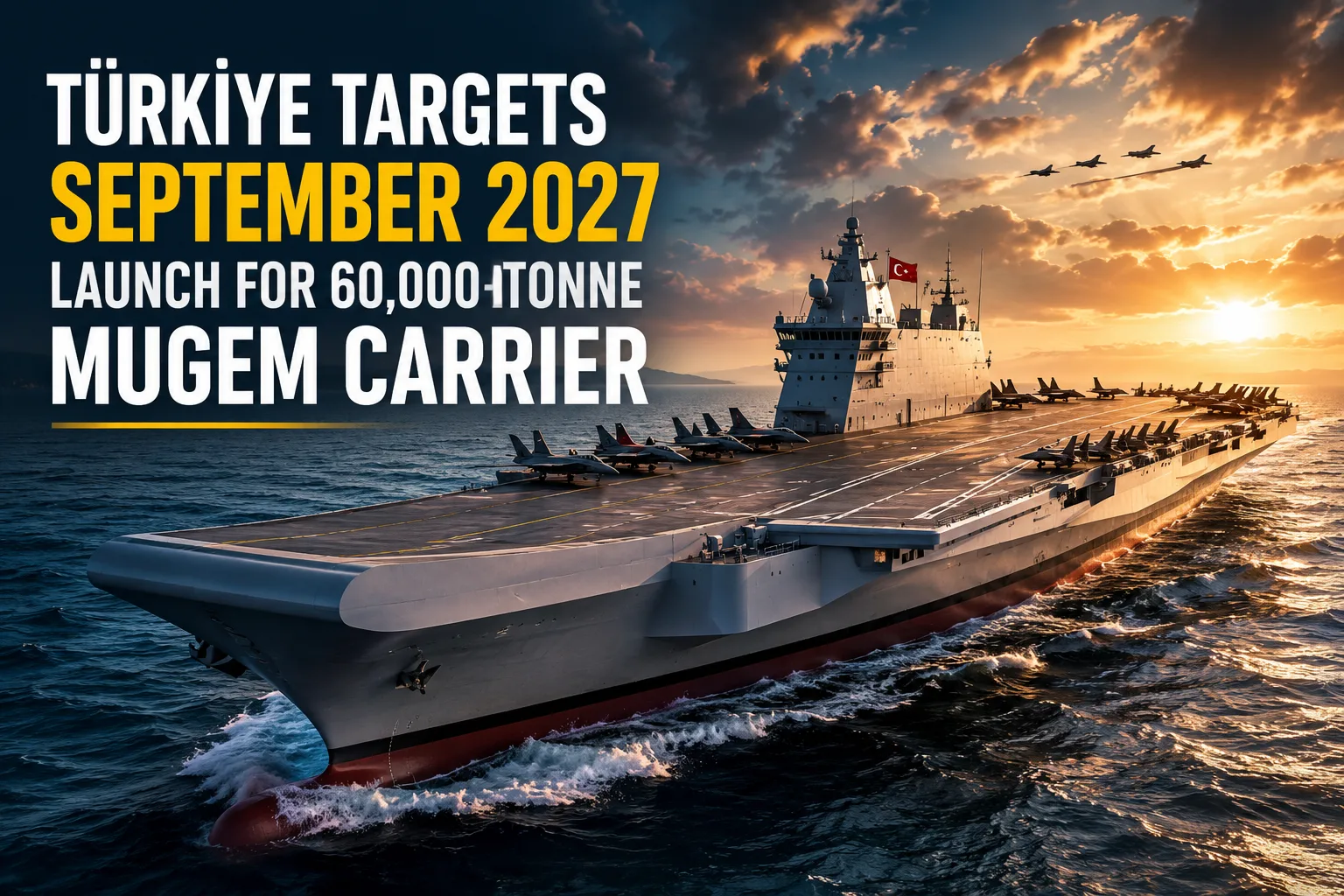
Türkiye plans to launch its first indigenous aircraft carrier, MUGEM, on 27 September 2027, accelerating a programme intended to deliver a 60,000-tonne multi-domain flagship to the Turkish Naval Forces in 2032.
The new launch date, announced by Turkish Naval Forces Commander Admiral Ercüment Tatlıoğlu during TEKNOFEST Mavi Vatan and subsequently highlighted by Italian publication Formiche, sharpens the timeline for a project already under construction at Istanbul Naval Shipyard. The carrier is being designed around a 52-aircraft mixed air wing, a 12-degree ski-jump and STOBAR operations while also incorporating facilities for unmanned surface and underwater vehicles. The 2027 launch should not be confused with operational entry into service: outfitting, system integration, harbour trials, sea trials and verification are planned to continue toward a 2032 delivery target.
Key Facts
- Programme: MUGEM / Milli Uçak Gemisi
- Operator: Turkish Naval Forces
- Construction site: Istanbul Naval Shipyard
- Planned launch: 27 September 2027
- Planned delivery: 2032
- Length: 285 metres
- Maximum beam: 72 metres
- Draught: 10.1 metres
- Displacement: Approximately 60,000 tonnes
- Maximum speed: 26+ knots
- Range: Approximately 10,000 nautical miles at 14 knots
- Accommodation: Up to 2,500 personnel
- Air wing capacity: 52 aircraft in the current public design
- Launch/recovery concept: STOBAR with 12-degree ski-jump
The New Milestone Is a Fixed Launch Date
MUGEM’s construction has been public since January 2025, and Turkish officials had previously discussed a 2027–2028 launch window. The August 2026 statement is more specific: Admiral Tatlıoğlu identified 27 September 2027 as the planned date for the first carrier to enter the water.
That date is important because it turns a broad construction schedule into a defined industrial milestone. It also provides a measurable benchmark for Istanbul Naval Shipyard, which is simultaneously supporting several major naval programmes.
The carrier’s planned 2032 delivery date remains separate. Naval News reported in June 2026 that Rear Admiral Hakan Uçar, Commander of the Naval Technical Command, presented a programme timeline at Combined Naval Event 2026 showing delivery after construction, outfitting, testing and verification.
The distinction is critical. Launching a carrier means the hull can transition from major structural assembly toward afloat outfitting and later trials. It does not mean the carrier air wing, combat system, propulsion plant and mission systems are operational in 2027.
Official Programme Data Point to Istanbul, Not Gölcük
The Italian Formiche analysis described the carrier as being built at Gölcük, while A Haber’s Turkish version referred to Istanbul Naval Shipyard.
The stronger programme evidence supports Istanbul Naval Shipyard as the construction site. Turkish programme reporting, Naval News coverage of the Navy’s CNE 2026 presentation and subsequent technical reporting all identify Istanbul Naval Shipyard as the yard responsible for MUGEM construction.
Gölcük remains central to Turkish naval activity and hosted TEKNOFEST Mavi Vatan in August 2026, which likely contributed to confusion between the event location and the construction yard.
The Defence Agenda package therefore identifies Istanbul Naval Shipyard as the construction site and treats the Gölcük reference as a secondary-source discrepancy.
MUGEM Is a Purpose-Designed Carrier, Not an Enlarged TCG Anadolu
MUGEM represents a different category from TCG Anadolu.
TCG Anadolu is a multi-purpose amphibious assault ship adapted to operate helicopters and short-deck unmanned aircraft such as Bayraktar TB3. MUGEM is being designed from the outset around sustained fixed-wing carrier aviation and arrested recovery.
The current design calls for a 285-metre hull, 72-metre maximum beam and approximately 60,000 tonnes displacement. That makes it substantially larger than TCG Anadolu and places it in the medium-to-large conventionally powered carrier category.
Türkiye’s Presidency of Defence Industries Chairman Haluk Görgün said earlier in 2026 that production activities had begun and described the programme as one of the country’s highest-priority naval platforms.
The Current Configuration Uses STOBAR
The 2026 design presented by the Turkish Navy uses Short Take-Off But Arrested Recovery, or STOBAR.
The flight deck incorporates a 12-degree ski-jump ramp for take-off and arresting equipment for fixed-wing recovery. The latest public layout shows three take-off lanes and one arrested landing area.
STOBAR avoids the technical complexity and electrical requirements of steam or electromagnetic catapults, but aircraft must provide their own take-off thrust and may face payload or fuel constraints compared with catapult-assisted launch.
The design therefore places significant importance on the characteristics of the aircraft intended for the carrier, particularly the naval HÜRJET and jet-powered unmanned aircraft.
Public Turkish presentations have discussed future technologies beyond the initial STOBAR configuration, but the currently disclosed baseline remains a ski-jump and arrested-recovery architecture.
The Carrier Is Designed Around 52 Aircraft
The CNE 2026 presentation increased the publicly stated air-wing capacity from an earlier figure of 50 aircraft to 52.
The current planned aircraft family includes a naval version of HÜRJET, Bayraktar KIZILELMA, TUSAŞ ANKA-3 and Bayraktar TB3.
The Presidency of the Republic of Türkiye Directorate of Communications also reported in June that Rear Admiral Uçar’s presentation specified a 52-aircraft air wing.
Admiral Tatlıoğlu was subsequently reported as saying the ship could carry as many as 52 KIZILELMA aircraft in a single-type configuration. This should be interpreted as a maximum loading concept rather than the normal operational air-wing composition.
A practical carrier air wing would normally balance different aircraft roles, maintenance requirements, deck cycles and mission needs rather than embark the maximum number of one type in all conditions.
KIZILELMA Is Central to the Uncrewed Air-Wing Concept
Bayraktar KIZILELMA is one of the most strategically important aircraft associated with MUGEM.
The jet-powered uncrewed combat aircraft is progressing through weapons, mission-system and collaborative-combat-air testing. Its potential carrier role offers Türkiye a route toward naval tactical aviation without depending entirely on a conventional heavy carrier fighter fleet.
However, MUGEM integration will require more than general aircraft flight testing. Carrier suitability requires deck handling, ski-jump launch profiles, arrested recovery or another recovery architecture, corrosion resistance, maritime maintenance procedures and integration with the ship’s command-and-control environment.
No public source reviewed for this package confirms that KIZILELMA has yet completed arrested landings on a carrier.
Naval HÜRJET Could Provide the Crewed Layer
TUSAŞ is also examining a navalised HÜRJET configuration for MUGEM.
A crewed aircraft would give the carrier air wing functions that may remain useful even as autonomous systems mature, including pilot training, command roles, selected combat missions and manned-unmanned teaming.
The naval version remains developmental. Carrier operation would require structural strengthening, landing-gear changes, arresting-hook integration, corrosion protection and other modifications compared with the land-based trainer/light-combat aircraft.
The final division of missions between HÜRJET and uncrewed systems has not been publicly fixed.
TB3 Provides Türkiye With a Practical Starting Point
Bayraktar TB3 offers the clearest existing bridge between TCG Anadolu and MUGEM.
TB3 has already demonstrated autonomous short-deck take-off and landing from TCG Anadolu and participated in NATO Steadfast Dart 2026 operations from the ship.
These activities give the Turkish Navy practical experience in deck handling, UAV mission planning, ship-aircraft data exchange and sustained uncrewed flight operations at sea.
MUGEM will require a far more complex aviation system, particularly because it adds high-speed jet aircraft and arrested recovery, but the TB3 experience reduces the number of carrier-aviation processes Türkiye must develop from zero.
ANKA-3 Adds a Flying-Wing Combat-Air Option
TUSAŞ ANKA-3 is also included in the publicly presented MUGEM air-wing concept.
Its tailless flying-wing architecture offers a different balance of payload, signature management and mission profile from KIZILELMA and TB3.
As with the other aircraft, inclusion in programme slides should not be confused with completed naval qualification. ANKA-3 would require ship-specific launch, recovery and sustainment work before it could become an operational carrier aircraft.
The value of including several national aircraft families at the design stage is that the ship’s deck, hangar, elevators, aviation fuel, maintenance spaces and command architecture can be planned around multiple vehicle classes rather than retrofitted later.
MUGEM Is Being Designed as a Multi-Domain Carrier
One of the most unusual elements of the programme is the planned integration of unmanned surface and underwater vehicles.
The Turkish Navy’s 2026 presentation described MUGEM as a multi-domain carrier capable of supporting vehicles in the air, on the surface and below the sea.
The Directorate of Communications reported that the design includes capability to launch and recover USVs and UUVs. Formiche highlighted the same feature as a distinctive part of Türkiye’s carrier concept.
This goes beyond the traditional carrier model, in which the ship is primarily an aviation platform protected by an escort group.
If realised as planned, MUGEM could act as a host and command node for distributed unmanned systems conducting surveillance, electronic warfare, mine countermeasures, strike or anti-submarine support.
The exact USV/UUV types, quantities, launch mechanisms and operational concepts have not been publicly finalised.
Carrier Aviation Will Depend on Network Integration
The carrier’s value will depend heavily on how its sensors and aircraft are linked.
Türkiye has already demonstrated bidirectional data exchange between Bayraktar TB3 and the ADVENT Combat Management System aboard TCG Anadolu.
That architecture provides a relevant precursor for MUGEM because aircraft-derived imagery and mission information can be fused with shipboard sensors and distributed to other naval units.
A larger carrier managing KIZILELMA, HÜRJET, ANKA-3, TB3, helicopters, USVs and UUVs will create a substantially more demanding command-and-control problem.
Mission planning, deconfliction, targeting, datalink management and air-traffic control will consequently be as important as the physical flight deck.
Self-Defence Is Planned Around Indigenous Systems
The current public MUGEM configuration includes indigenous sensors, combat-management systems and defensive weapons.
Open technical presentations have shown two 16-cell MİDLAS vertical-launch modules for a total of 32 cells, point-defence missile systems, close-in weapon systems and remote-controlled guns.
Those systems would provide organic self-defence, but a carrier of this size is not intended to operate alone.
High-value carrier operations require escorts for area air defence, anti-submarine warfare and surface protection. Türkiye’s TF-2000 air-defence destroyer is therefore strategically connected to MUGEM even though the two are separate programmes.
The first TF-2000 hull is already under construction, supporting the longer-term formation of a carrier task group built largely around indigenous platforms and combat systems.
TF-2000 Will Be a Critical Escort
MUGEM’s value changes significantly depending on the quality of its escorts.
A 60,000-tonne carrier concentrates aircraft, command systems and personnel into one high-value platform. It therefore requires layered air and missile defence well beyond its own point-defence systems.
The TF-2000 programme is intended to provide the Turkish Navy with a purpose-built area-air-defence destroyer using national radar, vertical-launch and missile technology.
Defence Agenda has previously examined the relationship between MUGEM and TF-2000 as complementary elements of Türkiye’s future high-end naval force.
Frigates, submarines, replenishment ships and unmanned systems would also be required to create a sustainable deployable carrier group.
Türkiye’s Naval Construction Base Is Scaling Simultaneously
MUGEM is being built during an unusually intense period for Turkish naval construction.
Admiral Tatlıoğlu said in August 2026 that 61 warships were under construction across Türkiye for domestic and export customers.
The workload includes İstif-class frigates, TF-2000, MİLDEN, fast attack craft, patrol ships, amphibious platforms and multiple export programmes.
President Recep Tayyip Erdoğan also said in June that more than 50 warships were being produced simultaneously, with over 15 intended for friendly and allied countries.
This wider shipbuilding load is relevant to MUGEM because carrier construction draws on the same national ecosystem for steel, propulsion, electronics, weapons, design talent and skilled labour.
Erdemir Is Supplying Strategic Ship Steel
The MUGEM programme is also reaching deeper into Türkiye’s materials industry.
Erdemir is producing high-performance ship steel for the carrier’s hull and deck, using its domestic plate-rolling capability.
Anadolu Agency reported in August that the company’s work for MUGEM forms part of a broader effort to supply strategic naval steel for Türkiye’s next generation of warships and submarines.
Domestic steel supply does not by itself make an aircraft carrier fully indigenous, but it reduces dependence in a high-volume structural input and expands sovereign control over production scheduling.
The larger localisation challenge includes propulsion, bearings, aviation equipment, arresting gear, radar, weapons, software and other specialised subsystems.
The 2027 Launch Will Begin a Long Outfitting Phase
The planned September 2027 launch is an important industrial milestone, but the following years will be decisive.
Large combatants require extensive installation and integration after the hull reaches the water. Electrical cabling, propulsion completion, radar installation, weapons, communications, aviation systems, accommodation and command spaces all must be finished and tested.
Harbour acceptance trials then verify systems before sea trials progressively evaluate propulsion, manoeuvring, sensors, weapons and aviation.
The 2032 target therefore leaves several years for outfitting and trials after launch.
That chronology is consistent with the Navy’s CNE 2026 presentation and should replace any implication that the carrier becomes operational in September 2027.
Italian Coverage Frames MUGEM as a Mediterranean Power Shift
Formiche’s analysis focused heavily on the strategic effect of MUGEM in the Mediterranean.
The Italian publication argued that a Turkish carrier would introduce another significant naval-aviation actor into a region where France and Italy currently operate the most prominent carrier-capable forces.
That is an analytical interpretation rather than an official NATO or Italian government assessment.
The Mediterranean already contains several forms of aviation-capable ships, including Spain’s Juan Carlos I, so describing France and Italy as the only Mediterranean states with any carrier aviation capability would be too broad.
The more precise point is that a 60,000-tonne Turkish STOBAR carrier with a 52-aircraft mixed air wing would represent a major increase in Türkiye’s sustained naval-air capacity and would be larger than most European aviation ships currently operating in the Mediterranean.
Competition and NATO Reinforcement Are Not Mutually Exclusive
Formiche also noted the dual strategic effect of the programme.
Türkiye’s ability to deploy a larger carrier force could increase competition and operational autonomy in the Mediterranean, particularly where national interests diverge.
At the same time, Türkiye remains a NATO member. A stronger Turkish fleet can contribute additional aviation, surveillance, escort and strike capacity to the Alliance’s southern flank.
The two effects are not mutually exclusive. NATO members regularly develop national capabilities that strengthen the Alliance while also increasing their independent regional influence.
MUGEM Is a Power-Projection Programme, Not Only a Shipbuilding Project
The carrier’s strategic significance ultimately depends on what Türkiye can deploy around it.
A large hull without suitable aircraft, escorts, logistics, trained flight-deck crews and command systems would provide limited power projection.
MUGEM is therefore better understood as an ecosystem programme linking shipbuilding, carrier aviation, autonomous systems, missiles, electronic warfare, logistics and command-and-control.
The Navy’s simultaneous work on KIZILELMA, naval HÜRJET, TB3, ANKA-3, TF-2000, MİLDEN and uncrewed maritime vehicles demonstrates that the carrier is being developed as the centre of a broader force architecture rather than as an isolated prestige platform.
Limitations and Counterpoint
The 27 September 2027 date is a planned launch target. Large naval programmes remain exposed to schedule risk, design change, supplier delays and test findings.
The 52-aircraft figure is a current design parameter, not a guaranteed deployed air-wing composition.
Similarly, the statement that the ship could carry 52 KIZILELMA aircraft represents a maximum single-type concept and should not be presented as the expected routine air wing.
Several associated aircraft remain under development for maritime use, including naval HÜRJET, ANKA-3 and KIZILELMA carrier integration.
The final propulsion configuration, aviation-support details and some weapons and sensor arrangements may continue to evolve during detailed design.
Finally, Formiche’s claim about changing the Mediterranean balance is strategic analysis, not a measurable programme requirement or official assessment.
Implications / Next
The first milestone is whether Istanbul Naval Shipyard meets the 27 September 2027 launch target.
The second is carrier-aircraft qualification. KIZILELMA, naval HÜRJET, ANKA-3 and TB3 will need progressively more demanding maritime testing before the 2032 delivery date.
The third is escort development. TF-2000 construction and the expansion of Türkiye’s frigate and submarine fleet will determine whether MUGEM can deploy as part of a credible high-end task group.
The fourth is the unmanned maritime layer. Public demonstration of USV or UUV launch, recovery and command from a large naval platform would validate one of the most distinctive elements of the multi-domain carrier concept.
The fifth is propulsion and flight-deck integration. Arresting gear, aviation safety and sustained sortie-generation testing will determine whether the carrier can convert nominal aircraft capacity into practical combat output.
Conclusion
Türkiye’s decision to target 27 September 2027 for MUGEM’s launch moves the national aircraft-carrier programme from a broad development schedule toward a defined shipbuilding deadline.
The carrier’s current design combines a 60,000-tonne hull, 52-aircraft capacity, STOBAR flight operations and support for unmanned systems across the air, surface and subsurface domains.
The date should not be mistaken for operational entry into service. Delivery remains targeted for 2032, leaving several years for outfitting, integration and trials.
If Türkiye meets that schedule while maturing KIZILELMA, naval HÜRJET, ANKA-3, TB3, TF-2000 and the associated unmanned maritime systems, MUGEM will represent more than a new flagship. It will mark the transition of the Turkish Navy toward an indigenous carrier-centred, multi-domain power-projection architecture.