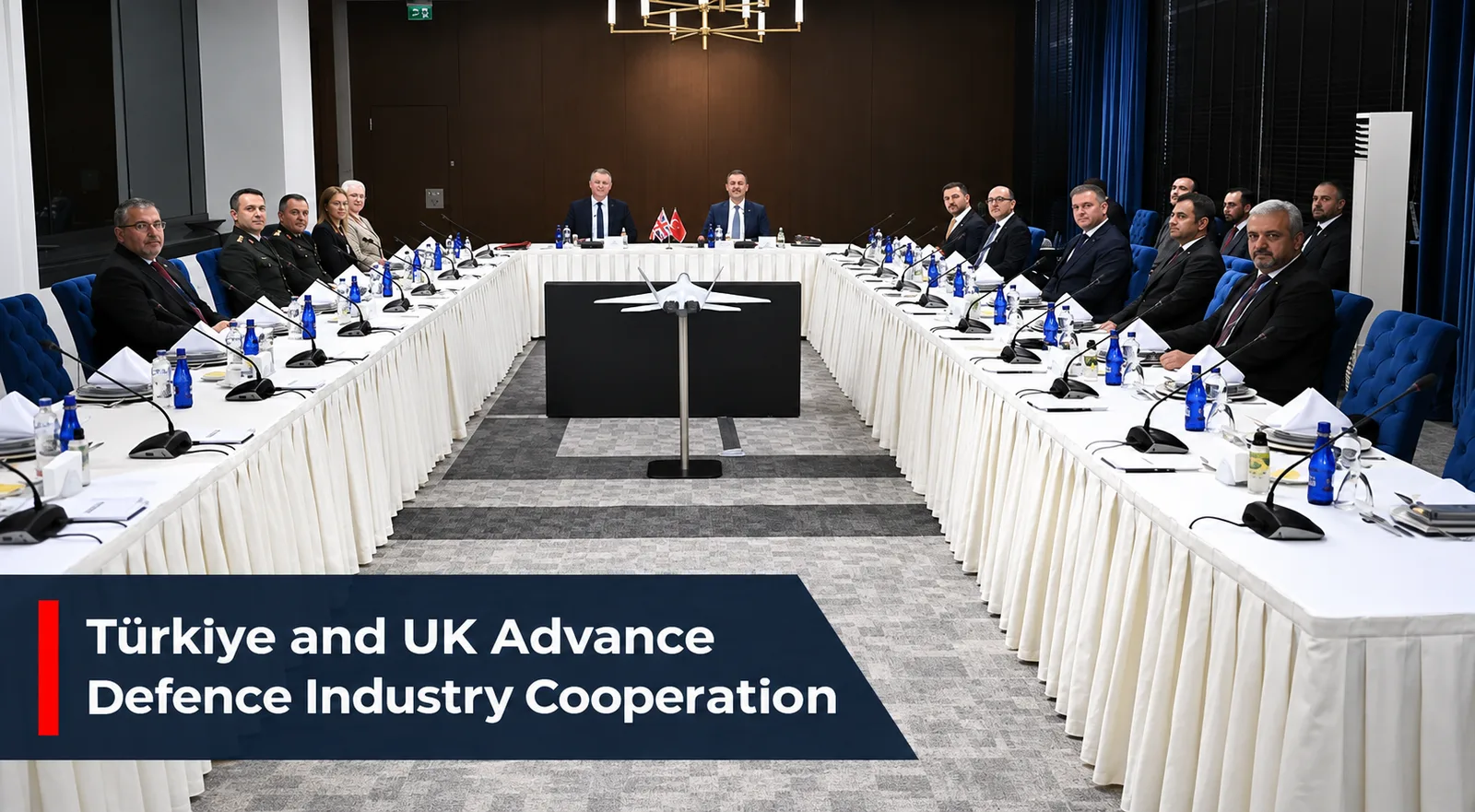
Türkiye and the United Kingdom convened the second Türkiye–UK Defence Industry Council (TUDIC) in Ankara on 19 November 2026, focusing on joint programme development, technology sharing, industrial cooperation and potential joint production. Hosted by the Presidency of Defence Industries (SSB), the meeting brought together SSB President Haluk Görgün, Türkiye’s Deputy Minister of National Defence Musa Heybet and UK Minister for Defence Readiness and Industry Luke Pollard, together with official delegations. Government-to-government and business-to-business discussions were held, followed by a visit to Turkish Aerospace (TUSAŞ). The meeting reinforces a structured bilateral industrial dialogue, but no new contract value, order quantity or signed joint-production agreement was disclosed in the official account carried by Anadolu Agency.
TUDIC Moves from Diplomatic Framework to Industrial Dialogue
The latest meeting builds on a formal bilateral mechanism established at the first TUDIC meeting in London in April 2025. That gathering brought representatives of Türkiye’s Ministry of National Defence and SSB together with the UK Ministry of Defence, establishing a council charter to provide an institutional setting for defence-industrial engagement. The SSB’s 2025 bulletin records the earlier London meeting. The November 2026 session was therefore a second-stage consultation rather than the announcement of a newly created institution.
According to the 19 November 2026 Anadolu Agency report, the Ankara agenda examined progress since the inaugural meeting and considered additional areas for collaboration. Subjects included joint project development, technology sharing, production cooperation and industrial partnerships. Officials also held government-to-government (G2G) consultations while Turkish and British defence companies met through business-to-business (B2B) discussions. The public statement did not identify participating companies by a complete verified list or publish a count of completed B2B meetings.
Görgün presented the council as a way to translate previously stated cooperation intentions into practical opportunities between two NATO Allies. His remarks identify the intended direction of policy but do not themselves create contracts. The distinction is particularly relevant to programme offices: a bilateral council can help discuss requirements, export permissions, industrial capacity and potential workshare before the partners agree a technical baseline and commercial terms. That process may be valuable even when an individual meeting has no immediate signing ceremony.
Following the council, Pollard and the British delegation visited Turkish Aerospace (TUSAŞ). Görgün said the visitors were able to observe capabilities extending from aircraft design to manufacturing. The visit illustrates the prominence of aerospace in bilateral discussions, but the available reporting does not name a new TUSAŞ–UK contract or define the scope of any specific aircraft project arising from the visit. A facility tour is evidence of industrial engagement, not proof of a procurement decision.
The institutional background expanded further on 8 July 2026, when the United Kingdom and Türkiye announced a broader Security and Defence Partnership at the NATO Summit in Ankara. The joint statement describes consultations on defence industry and technology, deterrence, cyber security, hybrid threats, space, resilience and military cooperation. That agreement is a separate political framework, rather than a purchase order or an outcome newly concluded at the November TUDIC meeting. Its relevance is that the council has a wider policy basis in which industrial opportunities can be assessed.
For suppliers, possible areas of collaboration include systems engineering, software and electronic subsystems, manufacturing, integration, testing, maintenance and lifecycle support. These are analytical opportunity categories, not a list of contracts announced by the council. Any eventual programme would require defined end-user requirements, export-control approvals, integration and intellectual-property arrangements, security assurances and demonstrable delivery capability. Smaller firms may gain access through prime-contractor supply chains, although the meeting disclosure provides no evidence that particular companies secured business.
Eurofighter Context, Industrial Risks and Next Steps
One existing anchor in UK–Türkiye defence relations is the Eurofighter Typhoon programme. The UK Ministry of Defence announced a multi-billion-pound training and support agreement on 25 March 2026, following the fighter export deal agreed in October 2025. The support package covers the training of Turkish pilots and ground technicians and long-term maintenance assistance. It also involves UK defence manufacturers and the provision of components, spares and specialist support equipment. This is a previously announced contract, not a newly awarded TUDIC agreement.
The UK statement named BAE Systems, Leonardo UK, MBDA, Rolls-Royce and Martin-Baker among the industries supporting the Typhoon package. The agreement provides concrete evidence of operational support and industrial supply-chain engagement between the two countries. However, it should not be used to infer that those firms signed additional agreements in Ankara on 19 November or that other companies automatically obtained programme workshare. Defence Agenda has separately followed Türkiye’s Typhoon sustainment preparations at RAF Coningsby, which concern the implementation of existing arrangements.
There are also independent examples of collaboration in more specialised technologies. Defence Agenda has reported BAE Systems and TUALCOM cooperation in autonomous technologies and Altınay Defence’s establishment of a UK subsidiary. These illustrate industry links in different segments, not transactions attributed to the latest council meeting. Their combined significance is the existence of several potential channels for engagement: prime contractors, specialist subsystem suppliers, cross-border corporate presence and bilateral government frameworks.
For programme managers, the next challenge is to move from broad cooperation areas to fundable, certifiable and supportable projects. Joint production may promise local economic benefits, supplier diversification and increased capacity, but it can be complicated by export restrictions, technology-transfer permissions, intellectual-property rights, programme security and differing qualification regimes. A supply chain that looks complementary in meetings may still require lengthy engineering and commercial negotiations before a production line or subsystem can be qualified for a military user.
A related risk is mistaking diplomatic momentum for measurable industrial output. The second council meeting identified future opportunities, but its published record contained no new named customer contract, contract value, delivery milestone or jointly financed programme. This is not a negative assessment of bilateral relations; it is a distinction between confirmed activity and future intentions. The most useful indicators will be official programme announcements, funded contracts, workshare allocations, demonstration schedules and evidence of progress on export permissions or testing.
The broader NATO context can support cooperation, particularly where the two countries have overlapping interoperability needs and seek resilient supply chains. Yet a bilateral technology programme must still meet national acquisition rules and relevant Allied standards. The earlier Eurofighter relationship shows how ministerial agreements, industrial production, training and sustainment can develop through distinct phases. The same phased approach should guide scrutiny of new proposals discussed under TUDIC.
Implications / Next: The immediate result of the 19 November 2026 meeting is continued institutional and commercial engagement, including G2G and B2B contacts and the subsequent TUSAŞ visit. The next verifiable milestones would be named industrial partnerships, formally announced project scopes, procurement decisions, export authorisations, manufacturing workshare or test programmes. Until such evidence is released, the Ankara gathering is best described as an effort to deepen UK–Türkiye defence-industry cooperation, not as a new signed arms contract.
Further Reading
- Anadolu Agency — TUDIC second meeting held in Ankara
- Presidency of Defence Industries — 2025 weekly defence-industry bulletin
- UK Government — Security and Defence Partnership statement
- UK Ministry of Defence — Typhoon support agreement
- Defence Turkey — TUDIC second meeting in Ankara
- Türkiye Maps Typhoon Sustainment at RAF Coningsby
- BAE Systems and TUALCOM Partner on Autonomous Technologies
- Altınay Defence Establishes UK Subsidiary
- Türkiye and UK Defence Industry Collaboration: Typhoon Export