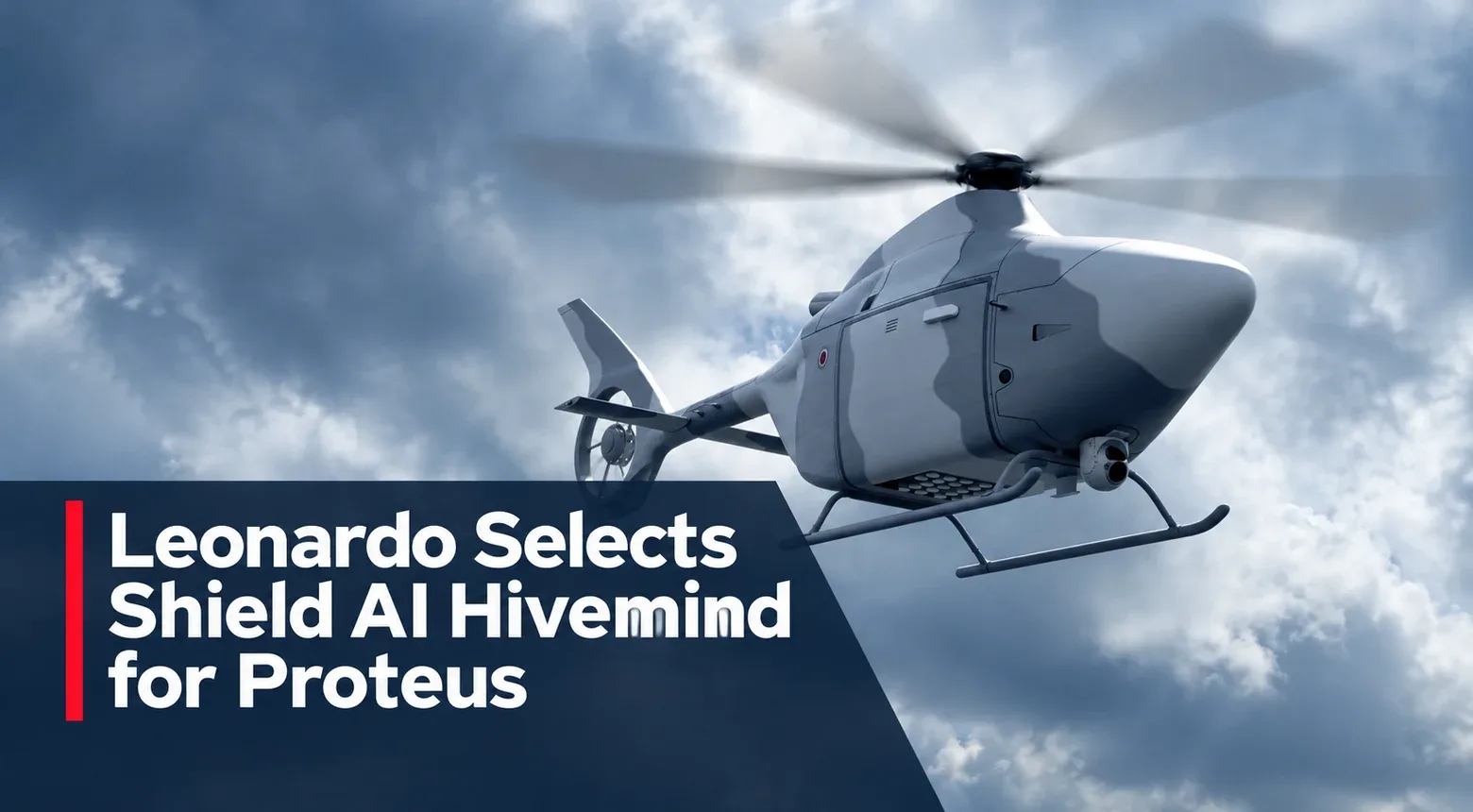
Leonardo has selected Shield AI's Hivemind autonomy software to develop additional mission capabilities for Proteus, its large uncrewed helicopter demonstrator being developed with the Royal Navy. Announced in a Shield AI statement dated 29 October 2026, the agreement gives Leonardo engineers access to the Hivemind Software Development Kit (SDK) to build and adapt mission software for anti-submarine warfare, intelligence, surveillance and reconnaissance (ISR), and logistics operations in contested environments. The agreement matters because it connects an already flying British rotary-wing demonstrator with a US autonomy software ecosystem while retaining in-house development of mission-specific functions.
Why the Leonardo–Shield AI Agreement Matters
The immediate development is about software engineering capability rather than the delivery of a new helicopter fleet. According to Shield AI's announcement, Leonardo will use the Hivemind SDK to create, integrate, test and refine autonomous functions for Proteus. The two companies will work on adapting the software to rotary-wing operations and to changing sensors, mission requirements and environments.
The distinction between providing a software development environment and supplying a completed operational autonomous pilot is important for procurement assessment. Shield AI says partners can retain ownership of the mission autonomy they build, supporting subsequent maintenance and adaptation. That statement does not establish a transfer of ownership of Shield AI's proprietary Hivemind core technology or disclose the commercial licensing terms.
Leonardo also sees potential for applications beyond Proteus in its wider helicopter portfolio, but the companies have not announced the conversion of a specific crewed helicopter model or an approved acquisition programme. The published agreement does not identify a contract price, delivery quantity, integration deadline or operational acceptance schedule.
Proteus Flew Before Hivemind Was Selected
Proteus already reached an important flight milestone on 16 January 2026, when it completed its maiden flight from Predannack airfield in Cornwall. In its official flight announcement, the Royal Navy said the aircraft operated its own flying controls during a short routine under the supervision of test pilots on the ground. Its autonomy for that flight was developed by Leonardo.
Therefore, Shield AI's October agreement must not be described as the enabling technology for Proteus's first flight. The new software is intended to support the next stage of development. Whether Hivemind-enabled functions have completed flight testing remains a separate question requiring evidence beyond the announcement.
Proteus is being developed through the Rotary Wing Uncrewed Air System (RWUAS) technology-demonstrator programme involving Leonardo, the Royal Navy and UK Defence Innovation. The Navy previously described the project as a £60 million development programme, not as the value of the new Shield AI arrangement. Its broader objective is to investigate how large autonomous aircraft can work alongside crewed helicopters in future maritime aviation formations.
Hivemind SDK and the Mission-Autonomy Architecture
The Hivemind SDK offers Leonardo engineers a toolset for developing and updating platform-specific mission autonomy. This approach differs from buying a fixed feature that cannot readily be modified by the aircraft integrator. It potentially permits engineering teams to update task logic, integrate additional sensing inputs and refine behaviours as operational needs change.
Potential benefits are operational and industrial. For maritime users, autonomy could help extend persistence over large patrol areas while preserving crewed helicopter capacity for missions requiring personnel aboard. For the manufacturer, internally developed mission code may support faster iteration, more predictable sustainment and a reusable integration approach. However, those advantages are prospective: the announcement contains no comparative cost data, certified reliability metrics or evidence of operational deployment.
The proposed missions have different assurance requirements. Intelligence and surveillance tasks depend on sensor integration, data handling and dependable reporting. Anti-submarine warfare introduces demanding mission coordination involving acoustic search, maritime situational awareness and interaction with other naval platforms. Contested logistics requires robust navigation, contingency handling and operational supervision where communications may be interrupted. The agreement outlines development ambitions; it does not prove that Proteus has demonstrated all three mission sets.
Royal Navy's Hybrid Air Wing and Atlantic Bastion
The agreement aligns with the Royal Navy's Maritime Aviation Transformation (MATx) strategy, which addresses maritime aviation capability towards 2040. The Navy has presented Proteus as an element of its proposed hybrid air wing, in which uncrewed systems operate alongside aircraft flown by naval aircrew.
Proteus features a modular payload bay designed for a payload of approximately one tonne or two standard NATO 463L pallets, according to Shield AI. Payload capacity is a design characteristic rather than proof that every proposed equipment configuration has been tested or cleared. The modular architecture could support different mission-specific payloads for surveillance, anti-submarine warfare, airborne early warning and intra-theatre transport.
The Royal Navy's January account also linked the demonstrator to the UK's Atlantic Bastion approach to protecting the North Atlantic. A future uncrewed aircraft able to carry sensors and work with ships, helicopters and submarines could expand search coverage. Yet the public record does not establish that Proteus is currently conducting operational submarine-hunting sorties. Its status remains that of a technology demonstrator.
Industrial Strategy and the Sovereignty Question
A prominent feature of the agreement is the intended role of Leonardo's own engineering teams. Shield AI is providing a development environment rather than announcing a wholly outsourced mission-software product. This has implications for technical sovereignty, because the ability to update and support application-level autonomy in-house can reduce dependence on an external integration contractor for every change.
However, genuine sovereignty depends on contract rights, availability of software tools, access to interfaces, export-control conditions, cybersecurity, independent verification and the ability to maintain critical functions over decades. The parties have not published the relevant software licence or intellectual-property allocation. A development kit should therefore not be equated with unrestricted access to underlying source code.
This is consistent with a broader shift towards adaptable autonomy architectures. Defence Agenda has separately covered Shield AI's Hivemind integration work with UAV Navigation–Grupo Oesía, which focuses on software integration with existing unmanned-aircraft control systems. Its coverage of the Shield AI X-BAT industrial framework in Poland also illustrates how autonomy, industrial cooperation and sustainment can be addressed under different commercial arrangements. Neither initiative should be interpreted as a contract for the Proteus programme.
Operational Challenges and Programme Risks
Autonomous rotary-wing systems intended for maritime use face difficult combinations of weather, sensor reliability, aircraft health monitoring, communications availability and mission assurance. A remotely supervised test flight in controlled conditions does not establish safe, persistent operations at sea or performance against sophisticated threats.
The Hivemind integration will need to be assessed against Proteus's existing flight-control architecture, safety case, sensor interfaces and user requirements. Software configuration management and independent verification will be particularly important if the aircraft is later tasked with military missions that demand clear command accountability. The Navy has previously stated that autonomous systems operate within operator-defined limits and rules of engagement; the October announcement does not change those controls.
An additional issue is industrial scalability. A successful technology demonstrator does not automatically become a funded aircraft programme. Procurement authorities would still need to establish costs, supportability, training, interoperability, certification and the comparative value of autonomous aircraft against other ways of delivering maritime surveillance or logistics capacity.
Implications / Next
The next milestones are a defined integration baseline for Hivemind on Proteus, evidence of software-in-the-loop and hardware-in-the-loop qualification, subsequent flight trials of the integrated functions, and any Royal Navy decision about mission-specific requirements or follow-on procurement. None of those events has been assigned a confirmed completion date in the announcement.
The strategic significance is the proposed combination of a British-built, large-payload autonomous helicopter with software that the platform integrator can use to develop its own mission functions. The commercial and operational consequences will depend on what Leonardo demonstrates, what rights it receives and whether the Royal Navy elects to move beyond experimentation.
Further Reading
- Shield AI: Leonardo selects Shield to develop rotary-wing autonomy — primary announcement, 29 October 2026 dateline.
- Royal Navy: Proteus completes its first autonomous flight — official statement, 16 January 2026.
- Royal Navy: Proteus completes ground-running trials — official programme context, 2 December 2025.
- UK Defence Journal: Proteus demonstrator to get US autonomy software — independent defence coverage, 29 October 2026.
- Defence Agenda: Shield AI and UAV Navigation expand Hivemind autonomy.
- Defence Agenda: Shield AI X-BAT industrial partnership in Poland.
- Defence Agenda: US Navy backs Shield AI X-BAT.