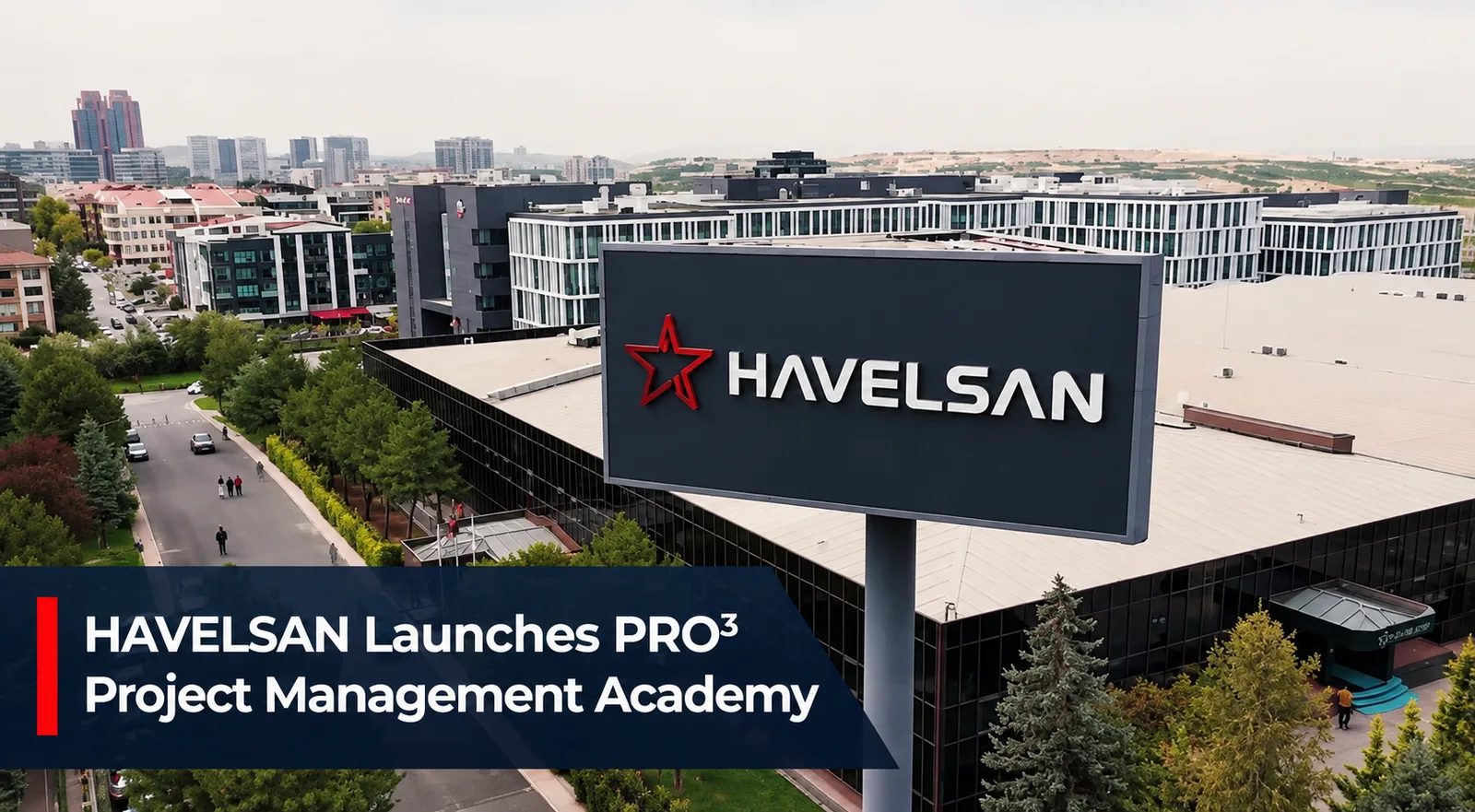
HAVELSAN has announced the PRO³ Project Management Academy, a new internal training initiative designed to improve employees’ project-management capabilities and reinforce a shared approach to programme delivery. The Turkish defence software and systems company outlined the initiative on 19 November 2026, describing it as part of its effort to develop staff competencies and support effective project management. The announcement matters because software-intensive defence programmes depend on coordination across engineering, procurement, integration, testing and customer acceptance. HAVELSAN has not disclosed a course syllabus, participant count, certification scheme or measurable performance targets, so the academy’s outcomes remain to be demonstrated.
What HAVELSAN Says PRO³ Will Deliver
HAVELSAN described PRO³ as an internal education programme intended to strengthen the company’s common project-management approach. Its official announcement emphasised two linked objectives: improving individual professional capabilities and supporting effective coordination across the organisation. The message establishes the intended purpose of the academy, rather than a claim that new standards or performance improvements have already been delivered.
The initial Defense Here report also characterised PRO³ as a company-wide effort to strengthen a common approach. That distinction is important: PRO³ is not presented as a public university programme, a commercial training product or a newly accredited international certification. Other media coverage of the announcement repeats the internal-training emphasis but does not identify an external examination body or independently verified training results.
For large defence-systems businesses, a consistent project-management language can help departments distinguish programme milestones, engineering deliverables, changes in scope and the evidence required for acceptance. However, these are potential management benefits, not a detailed list of modules that HAVELSAN has confirmed for PRO³. The company has not published a training curriculum, contact hours, instructor roster, eligibility rules, programme budget or the number of staff expected to attend.
That disclosure boundary also applies to the launch date. HAVELSAN’s public message said the academy was beginning, but it did not specify a dated classroom timetable or separate completion schedule. An announcement of a programme launch therefore should not be rewritten as proof that a first cohort has graduated or that a particular certification has been issued. Any later claim of programme scale should be supported by a new company statement or an independently verifiable record.
Why Project Management Skills Matter for Defence Programmes
HAVELSAN works across software-led command-and-control, naval systems, simulation and uncrewed technologies. Its programmes illustrate the management challenges created when multiple technical disciplines and delivery partners must reach the same operational acceptance milestone. Defence Agenda has documented FLEETSTAR systems for MİLGEM vessels 10 and 11, where software integration and testing are integral to a naval platform’s digital architecture. The new academy has not been announced as part of that specific contract, but such work helps explain why cross-functional project discipline has strategic value.
The same applies to HAVELSAN’s investment in ETE Teknoloji and AVISTA underwater research platform. These are distinct industrial and technology activities, not confirmed PRO³ pilot projects. They illustrate the breadth of engineering, research, integration and stakeholder-management work in which common reporting conventions and consistent programme controls could prove useful.
An external benchmark comes from the Project Management Institute’s Pulse of the Profession 2026. PMI reported that 97% of surveyed project professionals had managed at least one complex project during the previous year and identified organisational, environmental and human factors as sources of complexity. The research found substantially better outcomes among teams that managed complexity effectively. These findings are cross-industry research, not measured results from HAVELSAN’s academy, and they cannot be used to forecast a specific improvement in its schedules or costs.
The analytical case for an internal academy is that training may make project controls more repeatable, particularly where teams handle changing requirements, contractors, technical dependencies and security constraints. Nevertheless, training alone cannot solve programme challenges created by supplier delays, unstable specifications, resource constraints or shifting customer requirements. Governance, decision rights, engineering authority and the quality of baseline data will remain decisive. A curriculum without opportunities for supervised application may also create inconsistent uptake across departments.
Implications / Next: The next meaningful milestones would be a published PRO³ curriculum, the number of employees trained, an account of how skills are assessed and indicators showing whether the training changes programme delivery. Potential measures include milestone reliability, the timely resolution of scope changes, risk closure rates and acceptance-document quality. These are suggested assessment criteria, not targets set by HAVELSAN. As of 20 November 2026, the confirmed development is the announcement of an internal project-management academy; claims of programme-wide results or accredited certification would be premature.
Further Reading
- HAVELSAN — Official announcement of PRO³ Project Management Academy
- Defense Here — HAVELSAN launches PRO³ Project Management Academy
- SSBülten — HAVELSAN launches PRO3 Project Management Academy
- Project Management Institute — Pulse of the Profession 2026
- HAVELSAN Delivers FLEETSTAR for MİLGEM 10 and 11
- HAVELSAN Takes Stake in ETE Teknoloji
- HAVELSAN Unveils AVISTA Underwater R&D Platform