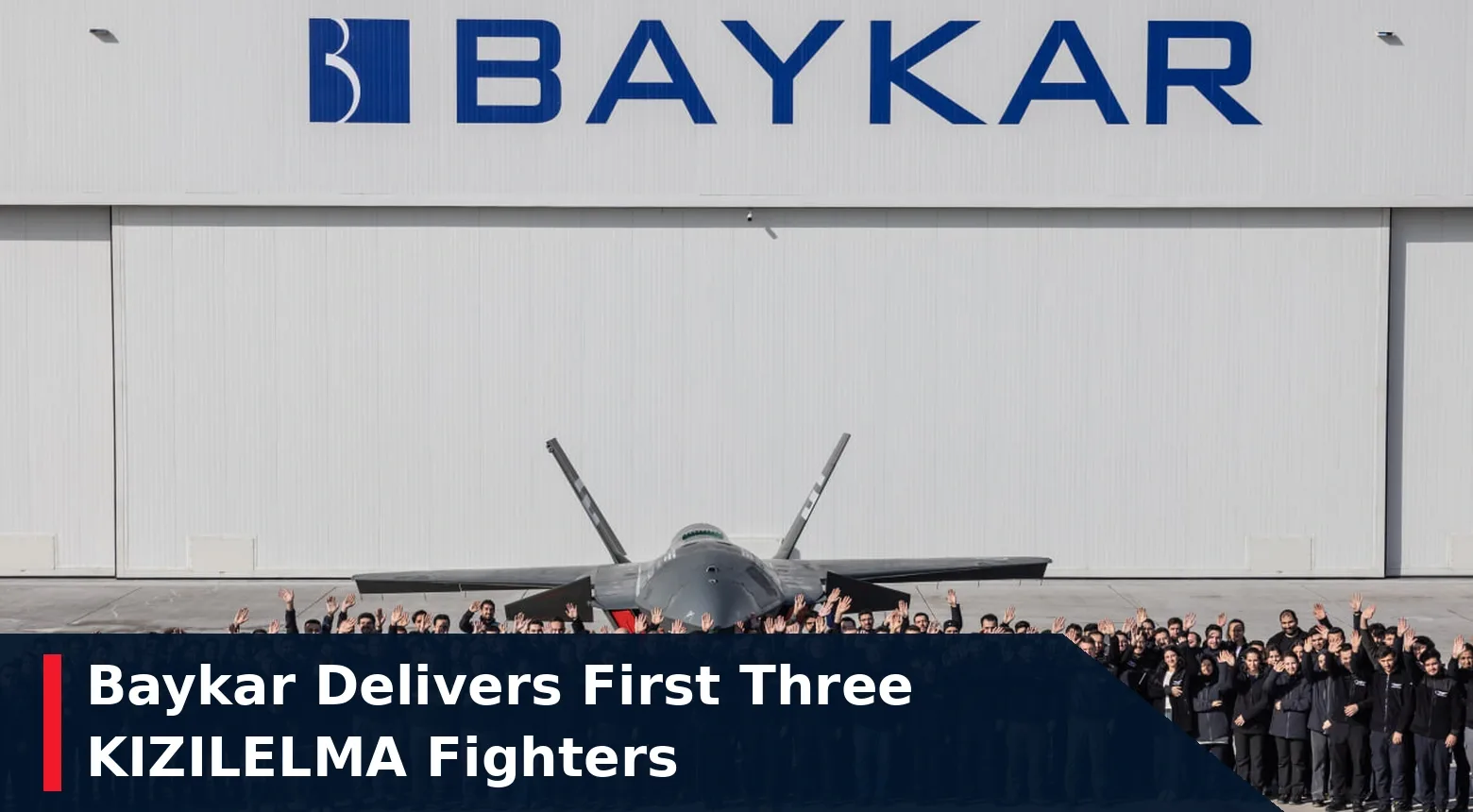
Baykar delivered the first three Bayraktar KIZILELMA uncrewed fighter aircraft to Türkiye’s security forces on 19 November 2026, following completion of acceptance testing, the manufacturer announced. Baykar said its fighter-class UAV programme had accumulated 600 flight sorties during testing and training, and described the delivery as the first operational inventory entry of an uncrewed fighter aircraft worldwide. President Recep Tayyip Erdoğan separately confirmed that KIZILELMA had entered the Turkish Armed Forces inventory. The milestone moves Türkiye’s jet-powered uncrewed combat-aircraft effort from development and weapons trials into its initial delivery phase, although the recipient unit, contractual value and operational deployment schedule were not disclosed.
KIZILELMA Delivery Follows Acceptance and Weapons Trials
The 19 November 2026 announcement by Baykar states that three aircraft passed acceptance activities and were transferred to security forces. The company located the announcement in the Çorlu/Tekirdağ programme context and said total testing and training activity had reached 600 sorties. The reported sortie count applies to the programme as a whole; it should not be read as 600 missions flown by each newly delivered aircraft. Anadolu Agency's English-language report independently confirmed the announcement while attributing the global-first characterisation to Baykar.
The distinction between acceptance, inventory entry and fully mature operational capability is significant. A successful acceptance process provides evidence that a defined initial equipment standard has met its contractual or user-agreed checks. It does not, by itself, establish squadron readiness, a completed weapons qualification programme for every store, a sustained mission-generation rate or fleet availability over extended deployments. President Erdoğan confirmed the Turkish Armed Forces inventory entry, but no receiving service unit or base was named in the public statements reviewed as of 20 November 2026.
KIZILELMA is designed as a jet-powered uncrewed combat aircraft rather than a conventional medium-altitude, long-endurance reconnaissance drone. Baykar's current specification page lists 8.5 tonnes maximum take-off weight, 1.5 tonnes payload capacity, 14.5 metres length, 10 metres wingspan, a 0.6 Mach cruise speed and more than three hours of endurance. These are manufacturer-published platform or design figures; the release does not verify that each performance point was remeasured on all three accepted aircraft, nor does it identify the configuration and engine of each delivered airframe.
The delivery also follows a sequence of publicly reported weapons and mission-system tests. According to Baykar, KIZILELMA conducted early TOLUN and TEBER-82 weapons testing on 8 October 2025, followed by a TOYGUN electro-optical targeting-system integration milestone on 17 November 2025. The company says that on 29 November 2025 a KIZILELMA used an ASELSAN MURAD active electronically scanned array radar and the TÜBİTAK SAGE GÖKDOĞAN beyond-visual-range air-to-air missile to engage a jet-powered target near Sinop. These are specific manufacturer-reported test events, not public proof that every possible operational engagement mode has been certified.
Further milestones followed in 2026. On 20 May 2026, the aircraft performed autonomous formation work with Leonardo M-346 aircraft, as described in subsequent reporting on the crewed-uncrewed trials. Baykar also reported a JET-230 air-to-surface missile firing on 13 July 2026, and internal-bay TEBER-82 and TOLUN munition launches later that month. Anadolu Agency reported the internal-bay demonstrations. These tests establish visible progress across air-to-air, air-to-surface and low-observable carriage arrangements, but operational configurations and permissions may remain narrower than the complete published design portfolio.
Combat-Air Integration and Industrial Implications
For planners, the first delivery matters because fighter-class UAVs pose more demanding operational and sustainment requirements than the addition of an isolated reconnaissance platform. They need defined relationships with air-defence identification systems, secure communications, mission planning, airworthiness oversight, training, weapon release authorisation and maintenance organisations. Depending on the operating concept, KIZILELMA could support strike missions, sensor distribution and crewed-uncrewed teaming. The exact initial mission allocation of the accepted three aircraft, however, was not made public.
Türkiye's indigenous ecosystem is central to the programme. The reported test campaigns involve Baykar as the aircraft prime, ASELSAN in radar and electro-optical mission systems, and TÜBİTAK SAGE in air-to-air missile technology, alongside other industrial suppliers. This does not mean every domestic subsystem is already installed in all delivered aircraft or that every integration has reached the same qualification standard. For an early fleet, the most relevant measures will be configuration control, spare-parts availability, software baselines, operator training and the repeatability of acceptance testing as subsequent aircraft are delivered.
Baykar calls KIZILELMA the world's first uncrewed fighter aircraft to enter operational inventory. That is the manufacturer's historical claim, also reported by Anadolu Agency, and it depends on the definition of an 'uncrewed fighter' compared with other armed drones, experimental combat aircraft and fielded UAVs. Defence Agenda therefore distinguishes the confirmed three-aircraft delivery and Turkish inventory confirmation from the broader international first-of-its-kind comparison, which has not been assessed here through a comprehensive cross-country acquisition database.
The aircraft's intended air-combat role also needs a careful operational interpretation. Defence Agenda's GÖKDOĞAN integration coverage documents the development path toward a networked uncrewed fighter, while its MURAD radar milestone report explains the earlier sensor-integration work. The KIZILELMA programme hub tracks weapons, autonomy and industrial developments. Those articles describe prior stages; the 19 November 2026 acceptance announcement is the new inventory milestone and should supersede older 'delivery planned' language in current programme summaries.
The same distinction applies to naval aviation ambitions. Baykar describes the aircraft as being developed for operations from ships with short flight decks, but the initial land-based aircraft acceptance release does not confirm deployment aboard a Turkish Navy vessel. Operational sea-based qualification would require separate evidence of launch and recovery, deck handling, maintenance procedures and integration into naval command systems. It should not be inferred simply from the aircraft's published short-runway design goals.
The industrial question now changes from whether Baykar can demonstrate advanced missions to whether it can maintain configuration stability and expand deliveries with dependable support. Defence Agenda's earlier production assessment concerned the manufacturing ramp-up; the new announcement is a delivery and acceptance event rather than just an output forecast. It does not disclose a price per aircraft or a total order value, and neither a future production rate nor export deliveries can be extrapolated from the first three airframes alone.
Implications / Next: The next verifiable indicators will be additional accepted deliveries, named operational receiving units, fleet training and sustainment arrangements, qualification of specific weapons and sensors on production-standard aircraft, and evidence of regular operations under military command. Any future export execution or shipboard qualification should be reported separately when a customer or authority issues a dated statement. As of 20 November 2026, three KIZILELMA aircraft had been reported delivered and accepted, but publicly available sources do not establish full fleet operational readiness or a disclosed follow-on delivery schedule.
Further Reading
- Baykar — KIZILELMA enters inventory, 19 November 2026
- Anadolu Agency — Baykar delivers first three KIZILELMA jets
- Anadolu Agency — President confirms military inventory entry
- Baykar — KIZILELMA official technical specifications
- Defence Agenda — Bayraktar KIZILELMA programme hub
- Defence Agenda — GÖKDOĞAN missile integration
- Defence Agenda — MURAD 100-A radar first flight
- Defence Agenda — KIZILELMA production milestone