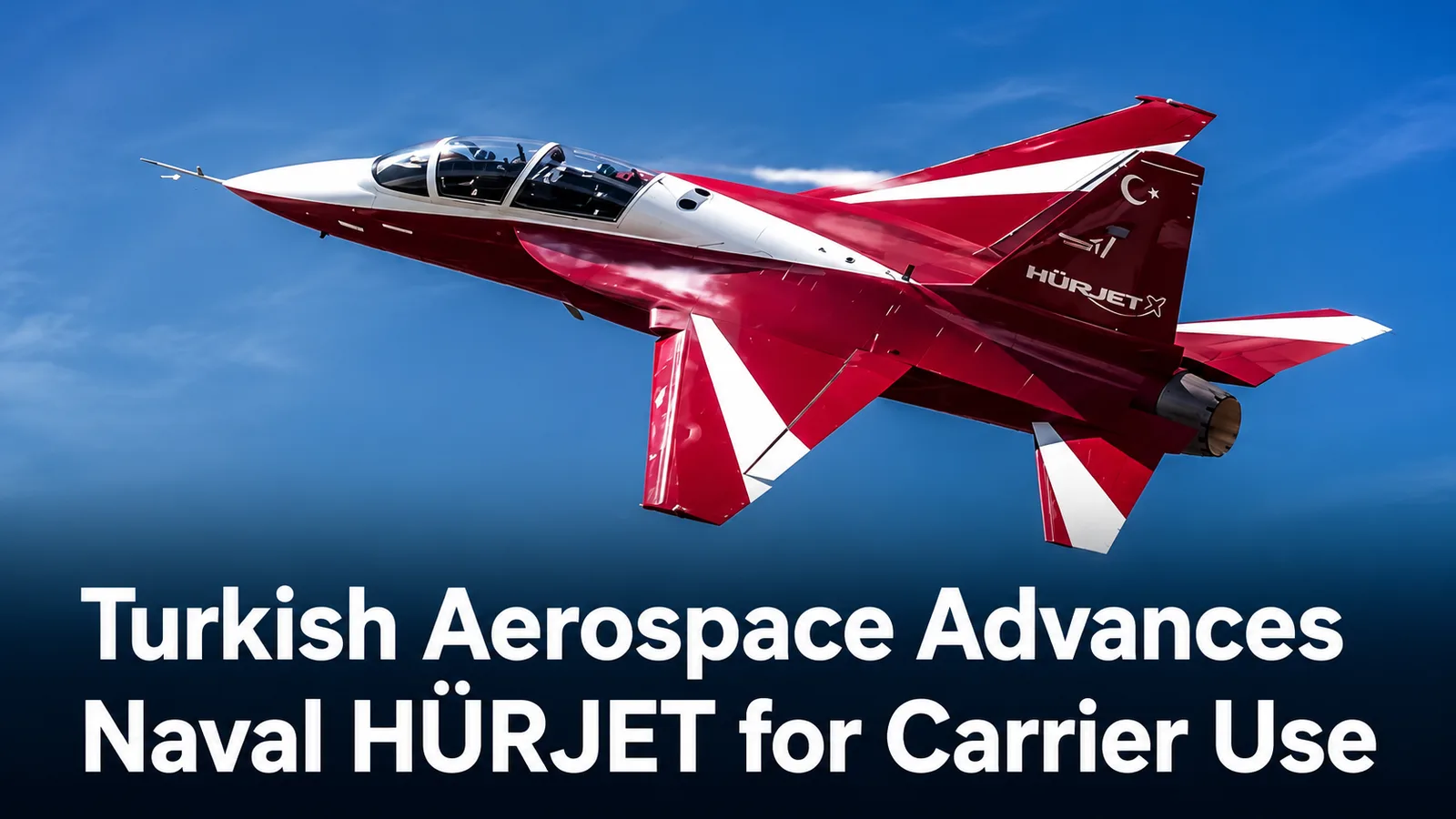
Naval HÜRJET development is emerging as the next major expansion of Turkish Aerospace’s supersonic trainer programme, with the company continuing design work on a carrier-capable configuration while seeking to build on the aircraft’s breakthrough export to NATO member Spain.
Turkish Aerospace President and CEO Mehmet Demiroğlu has confirmed that the company is working on a naval configuration of HÜRJET, identifying the Turkish Naval Forces as the principal prospective customer while also signalling that international opportunities could be considered where the aircraft matches operational requirements.
The development gives HÜRJET a dual strategic trajectory. The land-based aircraft is moving into serial production and export, while the naval derivative could become a crewed component of Türkiye’s future carrier air wing alongside increasingly capable uncrewed aircraft. If both tracks mature, HÜRJET would evolve from a national jet-trainer programme into a broader NATO-compatible combat-aircraft family.
Key Facts
- Naval development: Turkish Aerospace is continuing conceptual and design work on a carrier-capable HÜRJET.
- Primary prospective customer: Turkish Naval Forces.
- Expected naval changes: Reinforced landing gear and airframe structure, arresting hook integration and protection against salt, humidity and corrosion.
- Current propulsion: GE Aerospace F404; Turkish Aerospace has said different future configurations could justify evaluation of other engines in the same broader family.
- Spanish programme: Spain is acquiring 30 HÜRJET aircraft through an Airbus-led integrated training system.
- Spain deliveries: Planned to begin in 2028.
- Programme status: The naval HÜRJET remains under development; no publicly announced carrier qualification or Turkish Navy serial-production contract has yet been disclosed.
Turkish Aerospace Moves Naval HÜRJET Beyond Concept
The idea of adapting HÜRJET for naval aviation has circulated for several years, but activity accelerated during 2026.
Breaking Defense reported in August 2026 that Turkish Aerospace is planning a naval version of the aircraft while pursuing additional NATO export opportunities.
The announcement is consistent with information disclosed earlier in the year.
Naval News reported on 16 May 2026 that work had begun on the shipborne configuration, including structural and environmental modifications required for carrier operations.
During the Farnborough International Airshow in July, Demiroğlu subsequently confirmed that Turkish Aerospace was continuing conceptual and design work on the naval aircraft.
This progression suggests the project is moving beyond marketing imagery, although it remains substantially earlier in maturity than the standard HÜRJET.
Carrier Operations Require a Different HÜRJET
Adapting a runway-based jet for an aircraft carrier is not a simple matter of installing an arresting hook.
Carrier aircraft experience substantially higher structural loads during recovery. Landing gear, attachment points and parts of the airframe therefore need to withstand harder and more frequent impact cycles than those associated with conventional land-based operations.
Publicly reported work on naval HÜRJET includes strengthening the landing gear and parts of the aircraft structure, adding an arresting hook and introducing protection against the corrosive maritime environment.
Salt and humidity can accelerate deterioration of structural materials, electrical connections, avionics and mechanical systems, making marinisation a lifecycle and availability issue rather than merely a surface-treatment requirement.
Further changes could emerge during detailed design and carrier qualification, but Turkish Aerospace has not released a complete final naval configuration.
The Future MUGEM Carrier Is the Primary Driver
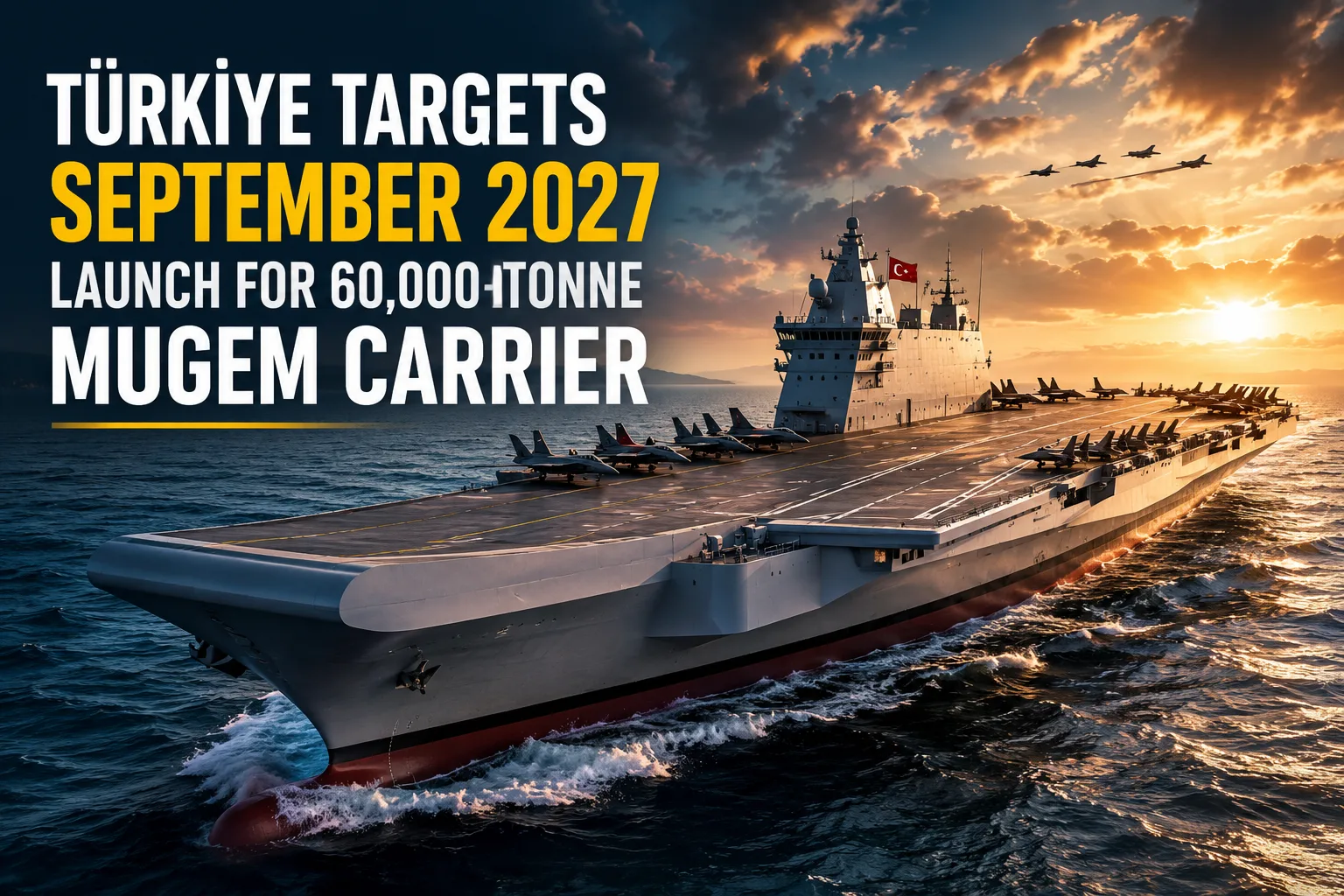
The naval aircraft project is closely linked to Türkiye’s future indigenous aircraft carrier programme, commonly referred to as MUGEM.
The carrier is intended to give the Turkish Navy a substantially larger aviation platform than TCG Anadolu and support a mixed air wing containing both crewed and uncrewed aircraft.
Current public concepts have repeatedly associated HÜRJET with MUGEM alongside Bayraktar TB3, KIZILELMA and other indigenous unmanned platforms.
Defence Agenda previously examined this force structure in Türkiye’s MUGEM Aircraft Carrier and TF-2000 Programmes, where HÜRJET was identified as one of the aircraft expected to form part of the future carrier aviation ecosystem.
The concept is notable because Türkiye is not designing its future carrier exclusively around conventional crewed tactical aviation.
Instead, MUGEM is emerging around a hybrid air-wing model in which relatively small numbers of crewed aircraft could work alongside a larger number of autonomous or remotely operated systems.
Naval HÜRJET Could Become the Crewed Command Layer
HÜRJET’s potential role therefore extends beyond pilot training at sea.
A naval trainer could prepare pilots for carrier qualification while also conducting selected light-combat, maritime-support or command functions when a higher-end combat aircraft is unnecessary.
The platform could become particularly relevant to manned-unmanned teaming.
Türkiye is developing KIZILELMA and ANKA III as jet-powered uncrewed combat aircraft while Bayraktar TB3 has already demonstrated operations from TCG Anadolu.
A two-seat naval HÜRJET could eventually provide a crewed tactical node within such an architecture, although detailed operational concepts and final integration requirements have not been publicly confirmed.
The strategic attraction is clear: a carrier air wing would not need every aircraft to provide the same range, payload or survivability if different platforms are networked and assigned complementary roles.
HÜRJET Remains a Single-Engine Design
Turkish Aerospace currently envisages the naval HÜRJET as a single-engine aircraft.
This preserves a major element of the existing aircraft architecture and potentially limits the redesign burden compared with developing an entirely new twin-engine naval platform.
Single-engine carrier aircraft are technically feasible, but naval operations place particular emphasis on engine reliability because the aircraft has fewer propulsion redundancies during launch and recovery.
As a result, propulsion reliability, deck procedures and safe recovery performance will become important parts of naval qualification.
GE F404 Remains the Baseline HÜRJET Engine
The current HÜRJET is powered by the GE Aerospace F404.
GE Aerospace and Turkish Aerospace announced a new F404 agreement on 5 May 2026 covering the HÜRJET programme and continued technical and operational support as the aircraft expands internationally and develops future variants.
GE describes the F404 as the current powerplant for HÜRJET and notes that aircraft using the engine are operated or ordered by 16 countries.
The existing propulsion relationship is significant because an expanding HÜRJET production run will require a stable engine supply alongside growth in aircraft manufacturing.
A Higher-Thrust Engine Remains an Option, Not a Decision
Turkish Aerospace is also keeping future propulsion options open.
At Farnborough 2026, Demiroğlu referred to the F404 and F414 as examples of engines within the same wider family offering different thrust levels.
He indicated that HÜRJET could be redesigned around another engine if a future configuration required additional thrust and customer demand justified the development effort.
This should not be interpreted as confirmation that the naval HÜRJET has already selected the F414.
The publicly confirmed baseline remains F404-powered, while an alternative engine is a future engineering option rather than an announced production decision.
Carrier Qualification Will Be the Critical Technical Milestone
The most important difference between a naval concept and an operational carrier aircraft is qualification.
A carrier variant must prove its performance through extensive ground and flight testing before it can routinely operate from a ship.
Development typically includes structural testing, arrested-landing trials, approach-control evaluation, low-speed handling, deck compatibility and repeated environmental testing.
The aircraft must also be integrated with the carrier’s arresting equipment, deck procedures and aviation-support infrastructure.
No public evidence reviewed for this article indicates that naval HÜRJET has yet completed those stages.
The programme should therefore be described as a naval variant under development rather than an operational carrier-capable aircraft.
Spain Has Changed HÜRJET’s Export Position
The naval project is developing while the standard HÜRJET achieves a different strategic milestone in Europe.
Spain selected HÜRJET as the aircraft element of its new Integrated Training System – Combat programme.
Airbus Defence and Space is leading the Spanish programme as national coordinator, with Turkish Aerospace supplying the aircraft.
The programme covers 30 HÜRJET aircraft, conversion to a Spanish configuration, creation of an Aircraft Conversion Centre in Spain, modernisation of the training centre at Talavera la Real Air Base and long-term operation and maintenance services.
Aircraft deliveries are scheduled to begin in 2028.
Defence Agenda previously detailed the structure in TAI and Airbus Formalize Spanish HÜRJET Program Cooperation.
Spain Is More Important Than a 30-Aircraft Sale
The Spanish programme gives Turkish Aerospace something strategically more valuable than one export customer.
It creates a NATO and European reference operator.
Advanced jet-trainer procurements are closely linked to national combat-aircraft fleets, pilot syllabi, simulators, maintenance ecosystems and certification standards.
Successfully delivering HÜRJET into the Spanish Air and Space Force therefore gives other European customers the opportunity to evaluate an aircraft already integrated into another NATO nation’s training architecture.
That can reduce perceived programme risk for subsequent buyers.
NATO Markets Are Becoming Central to Türkiye’s Export Strategy
HÜRJET also reflects a wider change in the geography of Türkiye’s defence exports.
For much of the industry’s early expansion, major Turkish export successes were concentrated in Asia, the Middle East and Africa.
European and NATO markets are now becoming substantially more important.
Official Turkish data for 2025 showed approximately $5.6 billion — roughly 56% of annual defence and aerospace exports — going to EU countries, NATO members and the United States.
Türkiye’s total defence and aerospace exports passed $10 billion in 2025 and continued to grow through 2026.
Defence Agenda analysed the structural change in Türkiye Defence Industry Transformation: 40x Export Growth and the latest export momentum in Türkiye Defence Exports Reach $1.12B in July.
HÜRJET Gives Türkiye a Different Entry Point Into NATO Air Forces
The advanced trainer market is commercially attractive because many NATO air forces need to prepare pilots for increasingly sophisticated combat aircraft without consuming expensive fighter flight hours.
F-35, Eurofighter, Rafale and future sixth-generation aircraft place increasing demands on pilot preparation, tactical simulation and networked training.
An advanced trainer can therefore be marketed as part of an integrated training ecosystem rather than merely as a lower-cost jet.
Spain demonstrates this model directly. Its procurement includes simulators, support infrastructure, aircraft modification and long-term services alongside the airframes.
That approach increases programme value and creates a longer industrial relationship than a conventional aircraft-only sale.
The UK Is an Opportunity, Not a Confirmed HÜRJET Programme
Turkish Aerospace has also indicated that it will monitor international requirements where HÜRJET could provide a suitable solution, including opportunities in the United Kingdom.
This should be interpreted cautiously.
Demiroğlu’s comments indicate commercial interest in relevant future competitions rather than confirmation of a British procurement decision or formal HÜRJET selection.
The company’s broader objective is to position HÜRJET as a flexible platform capable of being adapted to national requirements rather than build a single export configuration for every customer.
Spanish Customisation Could Strengthen Third-Country Exports
The cooperation with Airbus also creates a potential European industrial route for future HÜRJET variants.
Türkiye’s Secretariat of Defence Industries has said that the Spanish programme includes opportunities for technological collaboration, integration of different subsystems and potential joint exports to third countries.
A Spanish-adapted HÜRJET could therefore become more than a nationally modified version.
If the Airbus–Turkish Aerospace structure performs successfully, it could provide an industrial and certification model for additional European customers.
Naval HÜRJET Could Add Another Export Niche
A carrier-capable derivative would create a much smaller but more specialised market.
Very few countries operate aircraft carriers capable of conventional arrested recovery, and fewer still require a dedicated supersonic naval trainer.
This limits the potential customer pool compared with the land-based trainer.
However, the scarcity of available modern carrier-capable trainers can also reduce competition if HÜRJET reaches full naval qualification.
The more realistic early business case remains the Turkish Navy requirement and the ability to share development cost with the already expanding land-based HÜRJET production ecosystem.
Navalisation Will Increase Cost and Weight
The naval version will inevitably involve engineering trade-offs.
Structural reinforcement, arresting equipment and corrosion protection add weight.
Additional mass can affect payload, fuel fraction, acceleration and take-off performance — all particularly important when runway length is replaced by a carrier deck.
The aircraft designer therefore has to balance structural durability against the performance required for safe carrier launch and recovery.
This is another reason the final naval HÜRJET specification should not simply be assumed to match that of the land-based aircraft.
The Carrier Itself Remains a Parallel Development Risk
The naval aircraft cannot be evaluated independently of MUGEM.
Aircraft and carrier development must converge around deck dimensions, launch philosophy, arresting equipment, approach characteristics, aircraft elevators, hangar arrangements and support facilities.
Changes to the carrier design can therefore create corresponding aircraft requirements.
This creates a programme-integration risk absent from the standard HÜRJET, which operates from conventional land bases.
Close coordination between Turkish Aerospace and the naval carrier-design team will be essential if flight qualification is to proceed without major late-stage redesign.
HÜRJET Production Scale Will Matter
The naval project arrives while Turkish Aerospace is already increasing HÜRJET test and production activity.
By July 2026, Demiroğlu said two flying prototypes had accumulated almost 500 flight hours, while four additional prototypes were being prepared to fly before the end of the year.
The enlarged test fleet is intended to support qualification and configuration-development work.
At the same time, serial production for the Turkish Air Force and preparations for Spain will place increasing demands on suppliers, engine deliveries, test infrastructure and final assembly.
Adding light-attack and naval derivatives will broaden the programme but also increase configuration-management complexity.
The Main Opportunity Is a HÜRJET Aircraft Family
The commercial logic behind the current roadmap is increasingly clear.
Rather than develop HÜRJET as a single-purpose trainer, Turkish Aerospace is attempting to spread the aircraft’s development base across several mission configurations.
The standard trainer provides the largest addressable market. A light-attack version can serve customers seeking a lower-cost tactical aircraft. The naval derivative creates a specialist carrier role.
A common underlying architecture can potentially reduce development and support costs compared with creating independent aircraft for each mission.
The model is commercially strongest if avionics, propulsion, training systems and maintenance infrastructure remain highly common across variants.
Implications / Next
The first milestone to watch is a clearly defined naval HÜRJET configuration. Turkish Aerospace has confirmed design work, but final structural, propulsion and carrier-interface requirements remain incomplete in the public domain.
The second is prototype development. A dedicated naval test aircraft would mark a significant transition from design activity toward physical carrier qualification.
The third is a formal Turkish Naval Forces procurement decision. The service is identified as the principal prospective customer, but a publicly disclosed serial-production order would provide the strongest confirmation of programme commitment.
The fourth is MUGEM. Carrier design maturity, launch and recovery architecture and construction milestones will determine when a naval HÜRJET can realistically begin ship integration.
The fifth is Spain. Successful delivery from 2028 will be critical to Turkish Aerospace’s effort to use HÜRJET as a reference platform for additional NATO and European competitions.
Finally, propulsion should be watched carefully. The F404 remains the confirmed baseline, while any shift toward a higher-thrust alternative would represent a substantial engineering and commercial decision rather than a routine engine substitution.
Conclusion
HÜRJET is beginning to evolve from a Turkish advanced trainer into a broader aircraft family.
The land-based programme has already crossed a major international threshold through Spain’s 30-aircraft acquisition, giving Turkish Aerospace its first major HÜRJET customer inside both NATO and the European Union.
The naval derivative represents a different challenge.
Strengthening the structure, adding arresting capability and protecting the aircraft against maritime conditions are only the opening steps toward full carrier qualification.
If Turkish Aerospace completes that process alongside MUGEM development, Türkiye could field a crewed supersonic aircraft within a carrier air wing otherwise built heavily around uncrewed systems such as KIZILELMA and TB3.
The strategic opportunity is therefore broader than naval training. HÜRJET could become the crewed component of a new Turkish hybrid carrier-air doctrine while the Spanish programme provides the industrial scale and NATO reference customer needed to support wider exports.
The decisive indicators will now be a naval prototype, a formal Navy procurement commitment and successful carrier qualification. Until those milestones occur, naval HÜRJET should be treated as an increasingly concrete development programme — but not yet as an operational carrier aircraft.
Further Reading
- Breaking Defense: Turkish Aerospace Plans Naval HÜRJET as It Eyes Expanded NATO Exports
- Naval News: Türkiye Starts Work on HÜRJET Naval Variant
- GE Aerospace: F404 Agreement for HÜRJET Programme
- Secretariat of Defence Industries: HÜRJET Advanced Jet Trainer Project
- Defence Agenda: TAI and Airbus Formalize Spanish HÜRJET Program Cooperation
- Defence Agenda: Türkiye’s MUGEM Aircraft Carrier and TF-2000 Programmes
- Defence Agenda: Türkiye Defence Industry Transformation — 40x Export Growth
- Defence Agenda: Türkiye Defence Exports Reach $1.12B in July