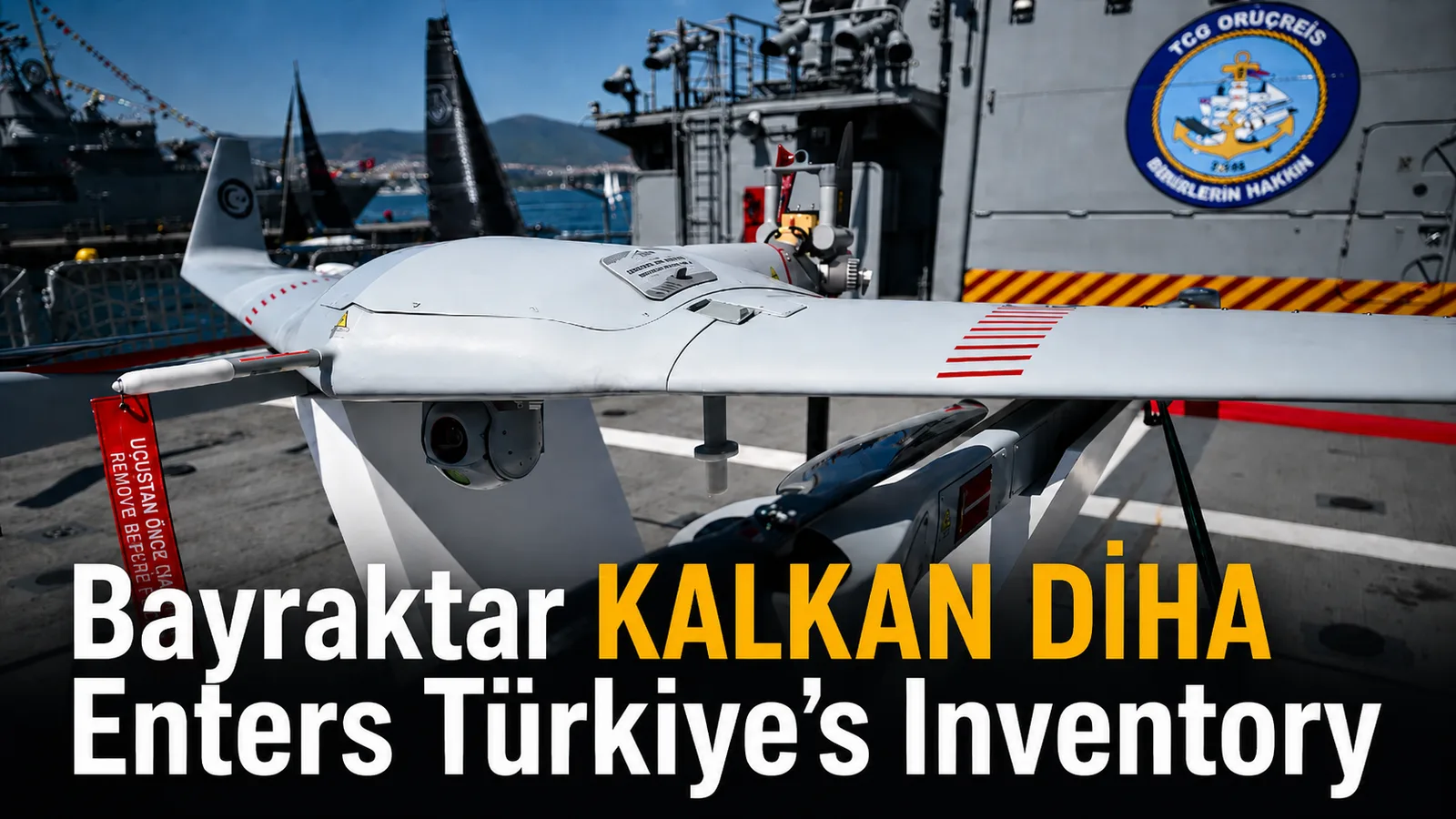
Bayraktar KALKAN DİHA has entered Türkiye’s inventory following a formal acceptance ceremony held aboard the frigate TCG Oruçreis during TEKNOFEST Mavi Vatan 2026 on 20 August 2026.
Developed by Baykar, the runway-independent vertical take-off and landing unmanned aerial vehicle is designed primarily for intelligence, surveillance and reconnaissance missions. Its hybrid propulsion architecture combines four electric motors for vertical flight with an internal-combustion engine for forward cruise.
The milestone expands Türkiye’s inventory of indigenous unmanned aircraft into a lighter VTOL category positioned between small tactical drones and larger runway- or ship-operated systems. The ceremony’s location aboard a Turkish Navy frigate also highlights the platform’s potential maritime relevance, although no public source reviewed by Defence Agenda confirms that KALKAN has yet completed shipboard operational qualification.
Key Facts
- Milestone: Inventory acceptance ceremony on 20 August 2026.
- Location: TCG Oruçreis during TEKNOFEST Mavi Vatan at Gölcük Naval Shipyard Command.
- Developer: Baykar.
- Primary role: Intelligence, reconnaissance and surveillance.
- Maximum take-off weight: 78 kg according to Baykar.
- Payload capacity: 3 kg.
- Current manufacturer-stated endurance: 6 hours.
- Current manufacturer-stated communications range: More than 80 km.
Bayraktar KALKAN DİHA Formally Enters Inventory
SavunmaSanayiST reported on 20 August 2026 that the inventory ceremony was conducted aboard TCG Oruçreis following the opening programme of TEKNOFEST Mavi Vatan.
The ceremony was attended by Minister of National Defence Yaşar Güler, Presidency of Defence Industries Chairman Haluk Görgün, force commanders, Baykar Chairman Selçuk Bayraktar and defence-industry representatives.
Anadolu Agency also reported the inventory ceremony on the same date, providing independent confirmation that the programme had reached the formal acceptance milestone.
Publicly available reports reviewed for this article do not specify which individual Turkish Armed Forces service has taken operational ownership of the system or disclose the number of aircraft accepted.
The milestone should therefore be described as KALKAN entering Türkiye’s inventory rather than assigning it to a specific service branch without further official disclosure.
KALKAN Adds a Runway-Independent ISR Layer
KALKAN is designed around a significantly different operational model from Baykar’s larger Bayraktar TB2, TB3 and AKINCI families.
Baykar describes the aircraft as a vertical take-off and landing UAV designed specifically for intelligence, reconnaissance and surveillance missions.
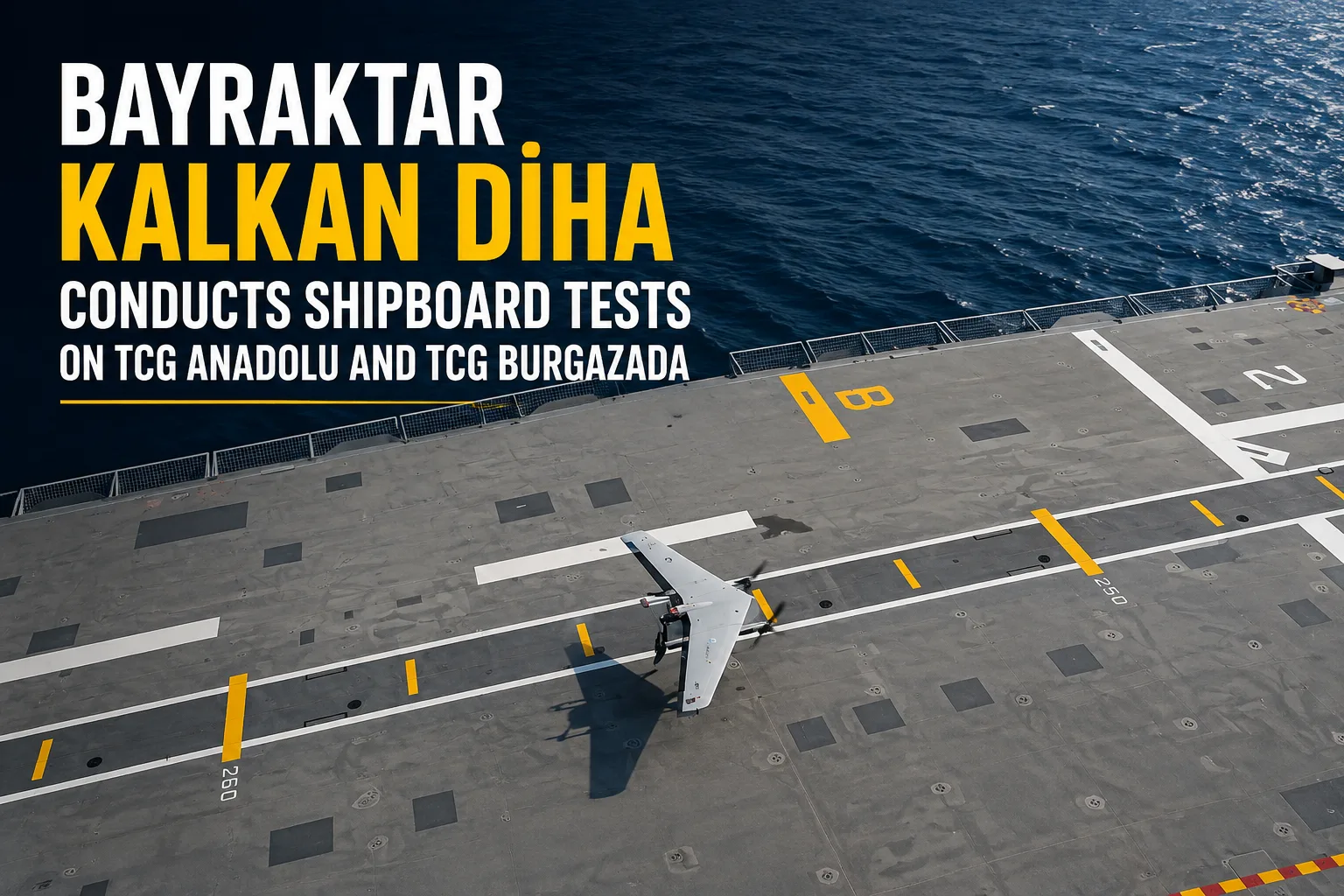
The aircraft does not need a conventional runway for take-off or landing. Four electrically powered lift motors are used during vertical flight, while an internal-combustion engine powers the aircraft during cruise.
This hybrid arrangement allows KALKAN to combine the site flexibility of a multicopter with the aerodynamic efficiency of a fixed-wing aircraft during the majority of its mission.
Operationally, that creates possibilities for deployment from small forward operating sites, dispersed bases and other locations where runway infrastructure is unavailable or vulnerable.
Current Baykar Specifications for KALKAN DİHA
Baykar’s current product page lists the following baseline performance characteristics:
- Maximum take-off weight: 78 kg.
- Payload: 3 kg.
- Wingspan: 5 metres.
- Length: 1.9 metres.
- Height: 0.7 metres.
- Endurance: 6 hours.
- Communications range: More than 80 km.
- Operational altitude: 6,000 feet.
- Service ceiling: 10,000 feet.
- Cruise speed: 48 KIAS.
- Maximum speed: 55 KIAS.
Those figures are the most appropriate baseline for describing the current production configuration because they are published directly by Baykar.
Published Performance Figures Require Source Separation
Reports surrounding the 20 August inventory ceremony provide several different figures.
SavunmaSanayiST reported an operational range of 500 km, communications range above 70 km, endurance exceeding seven hours and altitude capability above 14,500 feet.
These figures do not completely match Baykar’s current official product page, which lists more than 80 km communications range, six-hour endurance and a 10,000-foot service ceiling.
The 14,500-foot figure can be traced directly to an earlier test milestone rather than the current published service ceiling.
Baykar announced on 7 April 2024 that KALKAN had climbed to 14,500 feet during its 30th flight test and had accumulated 70 hours of flight time across the test campaign.
Defence Agenda therefore treats 14,500 feet as a demonstrated test altitude rather than the aircraft’s currently published operational ceiling.
Similarly, the 500 km operational-range figure is reported in coverage of the inventory ceremony but is not listed on Baykar’s current KALKAN specification page. Until Baykar publishes the same figure in its formal technical material, it should remain attributed to the ceremony reporting rather than presented as an independently confirmed manufacturer specification.
BG-160 Gives KALKAN an Indigenous ISR Payload
KALKAN can carry Baykar’s indigenous BG-160 multi-sensor electro-optical payload.
Baykar lists electro-optical and infrared imaging, laser rangefinding and multi-target identification and tracking among the aircraft’s available payload functions.
The company demonstrated the BG-160 during the April 2024 flight campaign, including thermal imaging in night conditions.
This is significant from an industrial perspective because the mission sensor is one of the highest-value elements of a tactical ISR aircraft.
Combining the air vehicle, flight-control architecture, data link and electro-optical payload within the same domestic industrial ecosystem reduces dependence on imported mission-critical subsystems and gives Baykar more control over integration and future software development.
Autonomy Reduces the Infrastructure Requirement
KALKAN supports fully autonomous take-off, cruise and landing as well as semi-autonomous flight modes.
Baykar lists automatic route following, object tracking, loitering and return-home functions alongside sensor-fusion-assisted flight control and a fault-tolerant system architecture.
For a tactical ISR platform, these functions can reduce operator workload and make distributed deployment easier because the aircraft does not require a traditional runway or conventional launch-and-recovery equipment.
That characteristic is becoming increasingly important as armed forces adapt to environments in which large fixed air bases can be located and targeted by long-range precision weapons.
Why the Ceremony Aboard TCG Oruçreis Matters
The decision to hold the acceptance ceremony aboard the Turkish Navy frigate TCG Oruçreis gives the milestone a clear maritime context.
A VTOL UAV has obvious utility at sea because it does not require the arresting systems, ski-jump or long flight deck associated with larger fixed-wing naval aircraft.
In principle, a compact aircraft such as KALKAN could extend visual and electro-optical surveillance beyond a ship’s horizon, inspect maritime contacts, support coastal surveillance and provide local reconnaissance without requiring a conventional aviation facility.
However, the location of the ceremony should not be interpreted as evidence that KALKAN has already completed shipborne flight qualification from TCG Oruçreis.
No source reviewed for this article confirms an operational take-off or landing from the frigate, permanent shipboard integration or assignment of KALKAN to a specific naval unit.
KALKAN Occupies a Different Naval-UAV Tier From TB3
If KALKAN develops into a shipborne capability, its role would differ substantially from that of the much larger Bayraktar TB3.
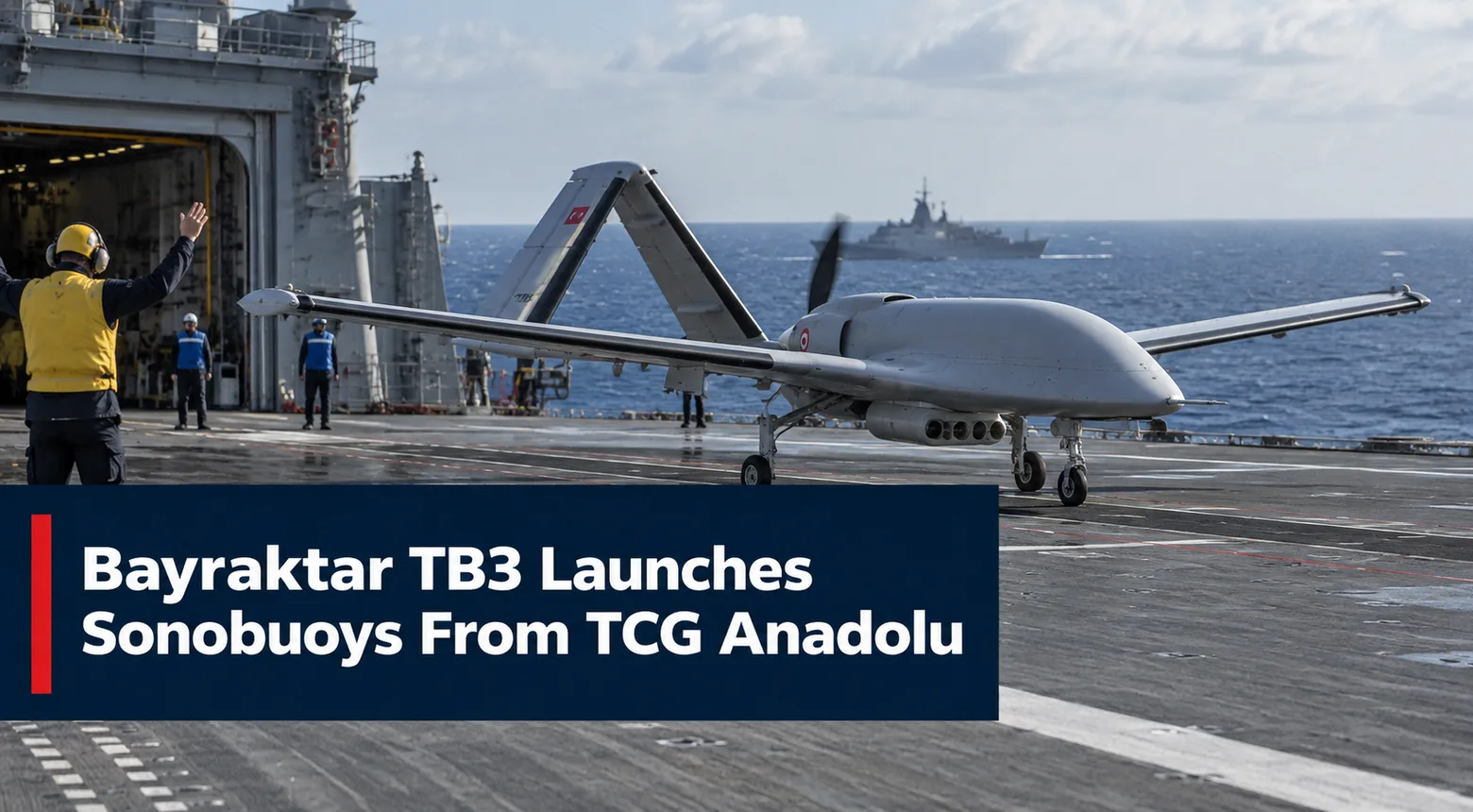
TB3 is designed for longer-duration missions, substantially greater payload and short-runway flight operations from vessels such as TCG Anadolu.
Defence Agenda previously examined that concept in Bayraktar TB3 Reaches New Threshold on TCG Anadolu, where TB3 operations during NATO Steadfast Dart 2026 demonstrated the growing maturity of Türkiye’s shipborne unmanned aviation model.
KALKAN would instead occupy a lighter tactical tier: easier to deploy, smaller in footprint and potentially applicable to ships without the aviation facilities required by TB3.
The platforms are therefore potentially complementary rather than direct alternatives.
A Distributed UAV Fleet Could Extend Maritime Sensors
The wider operational value lies in distributed sensing.
A warship’s radar and electro-optical sensors are constrained by line of sight and the curvature of the Earth, particularly against small surface contacts and low-altitude targets.
Launching an unmanned aircraft allows the sensor to move away from the ship and observe from a different altitude and geometry.
If KALKAN can eventually exchange tracks, imagery and targeting information through Türkiye’s naval command-and-control architecture, a relatively small UAV could become an extension of the ship’s sensor network rather than merely an independent camera platform.
The precedent already exists at a larger scale. Defence Agenda reported that HAVELSAN’s ADVENT Combat Management System integration aboard TCG Anadolu enables bidirectional data exchange with Bayraktar TB3.
Whether similar network integration is planned for KALKAN has not yet been publicly disclosed.
Inventory Entry Is More Important Than Another Flight Test
The 20 August milestone is significant because KALKAN has been publicly visible in development for several years.
Baykar’s April 2024 announcement documented the 30th flight test, system-identification work, 14,500-foot test altitude and more than 70 accumulated flight hours.
The transition from repeated development flights to an inventory acceptance ceremony changes the programme’s status.
It indicates that at least an initial configuration has matured sufficiently to pass the customer’s acceptance process, even though details concerning fleet quantity, service branch and operational unit remain undisclosed.
The Missing Number Is Fleet Quantity
The most important procurement detail not disclosed is quantity.
Neither the original SavunmaSanayiST report nor Baykar’s current public material reviewed by Defence Agenda provides a confirmed number of KALKAN aircraft accepted into inventory.
Without that information, it is not yet possible to determine whether the 20 August event represents a limited initial operating batch, a larger production delivery or the beginning of a multi-year procurement programme.
Quantity will strongly affect operational significance. A handful of platforms could primarily support evaluation and selected tactical units, while a larger procurement could allow distributed deployment across multiple land and maritime formations.
KALKAN Fits Türkiye’s Broader Uncrewed-Aircraft Architecture
The inventory milestone also illustrates the continued segmentation of Türkiye’s UAV portfolio.
Baykar now operates across multiple weight and mission categories, ranging from smaller tactical UAVs through TB2 and TB3 to AKINCI and the KIZILELMA uncrewed combat aircraft.
KALKAN fills a niche where runway independence is more important than heavy payload.
This reflects a wider transition analysed by Defence Agenda in Türkiye Defence Industry Transformation: 40x Export Growth: the domestic UAV ecosystem is expanding from individual reconnaissance and strike aircraft into increasingly specialised, networked and autonomous systems.
Maritime Potential Should Not Be Overstated Yet
There is a strong operational argument for deploying VTOL ISR drones from ships, but naval aviation introduces requirements that are not replicated by operations from land.
Shipboard systems must contend with deck motion, saltwater corrosion, wind turbulence around superstructures, electromagnetic compatibility and secure storage and maintenance in confined spaces.
Landing an autonomous aircraft on a moving vessel also requires significantly different guidance and control from landing at a fixed land site.
Until Baykar or the Ministry of National Defence announces dedicated shipboard qualification, KALKAN’s naval potential should therefore be treated as an operational opportunity rather than a confirmed deployed capability.
Implications / Next
The first issue to watch is operator disclosure. Confirmation of whether KALKAN has entered Army, Navy, Gendarmerie or another inventory would clarify its initial operational role.
The second is procurement quantity. The number of accepted aircraft and follow-on production orders will determine whether KALKAN becomes a specialised capability or a widely distributed tactical ISR system.
The third is shipboard testing. A successful autonomous take-off and landing campaign aboard a moving naval platform would substantially strengthen the maritime case suggested by the TCG Oruçreis ceremony.
The fourth is network integration. Connecting BG-160 imagery and KALKAN-derived tracks directly into tactical command systems would increase the platform’s value beyond standalone surveillance.
The fifth is specification consolidation. Current ceremony reporting and Baykar’s official product page contain different range, endurance and altitude figures. Future manufacturer documentation should clarify whether these differences reflect a newer production configuration, test achievements or different definitions of mission performance.
Conclusion
Bayraktar KALKAN DİHA’s inventory acceptance marks the transition of another Baykar platform from sustained flight testing toward operational use.
Its principal advantage is not heavy payload or extreme endurance. It is the combination of runway-independent operation, multi-sensor ISR capability, hybrid propulsion and a comparatively compact 78 kg maximum take-off weight.
That combination could make KALKAN useful for dispersed land forces and, following dedicated qualification, potentially for maritime platforms that cannot operate larger fixed-wing UAVs.
The ceremony aboard TCG Oruçreis provides a strong signal of that maritime relevance, but it does not yet constitute evidence of shipboard operational certification.
The next decisive disclosures will therefore be the system’s service operator, fleet quantity, production configuration and whether Türkiye proceeds with operational KALKAN deployments from naval vessels.
Further Reading
- SavunmaSanayiST: Bayraktar KALKAN DİHA Enters Inventory
- Baykar: Bayraktar KALKAN DİHA Official Product Data
- Baykar: KALKAN DİHA Completes 30th Flight Test
- Anadolu Agency: TEKNOFEST Mavi Vatan Coverage
- Defence Agenda: Bayraktar TB3 Reaches New Threshold on TCG Anadolu
- Defence Agenda: ADVENT CMS Integration on TCG Anadolu
- Defence Agenda: LBA Systems Joint Venture Reaches Operational Readiness
- Defence Agenda: Türkiye Defence Industry Transformation