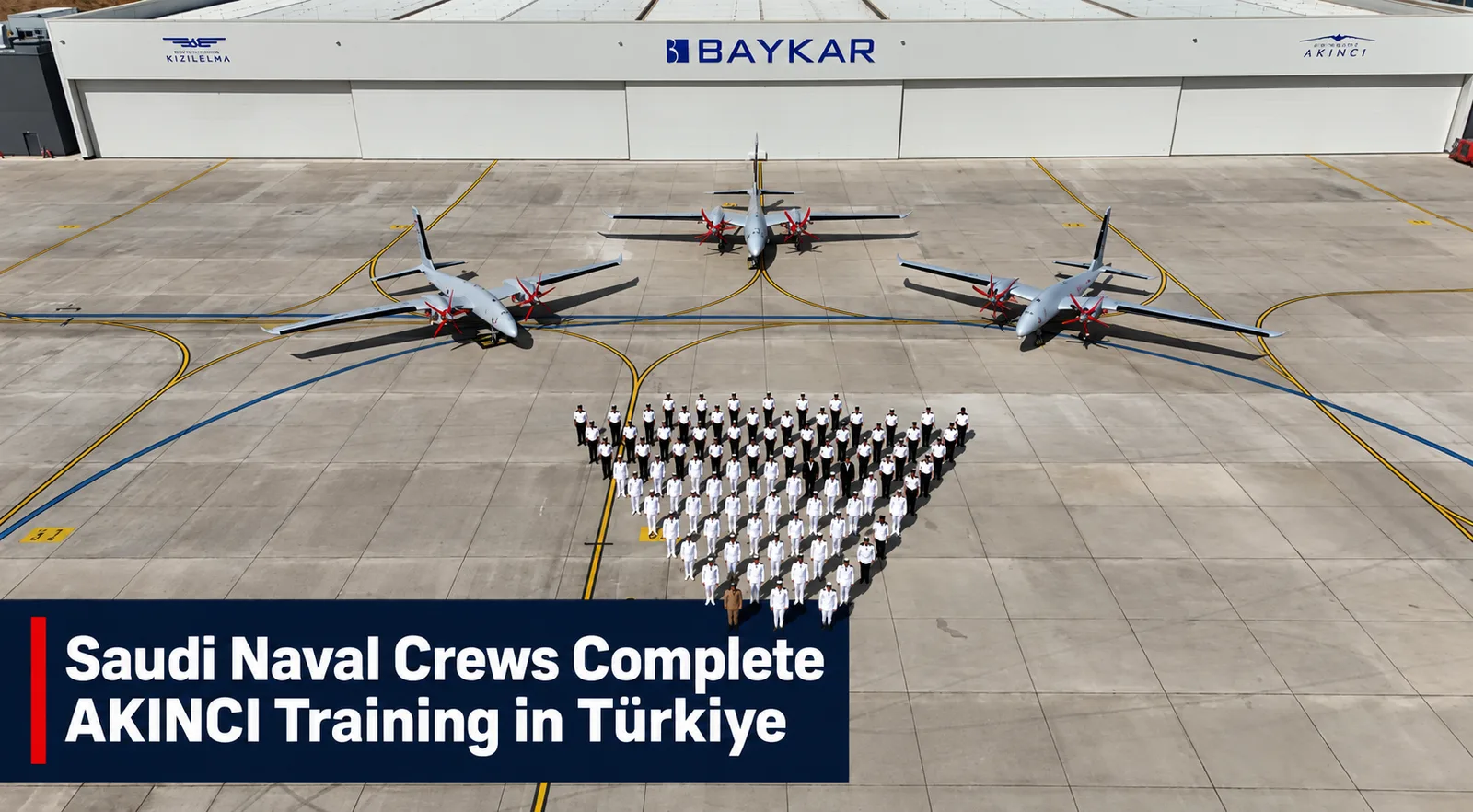
Royal Saudi Naval Forces personnel have completed Bayraktar AKINCI operator training in Türkiye, advancing the Saudi naval UCAV programme from acquisition toward operational preparation. The graduation is a training milestone, not proof that the aircraft have entered routine Saudi Navy operations.
Training completion moves the export programme toward operational preparation
Royal Saudi Naval Forces personnel have completed Bayraktar AKINCI training in Türkiye, marking a personnel-readiness milestone in Saudi Arabia’s acquisition of the Turkish high-altitude long-endurance unmanned combat aircraft. Anadolu Agency reported the graduation at Baykar, while Naval News framed the event as preparation for the Saudi Navy’s future use of AKINCI in maritime surveillance and stand-off strike missions.
The distinction between training and operational deployment is important. A graduation confirms that a cadre of Saudi personnel has completed the relevant course; it does not by itself confirm that a specific number of aircraft has been accepted, that a squadron has reached initial operational capability or that routine missions have begun. No such claim should be inferred unless Saudi or Baykar authorities disclose it separately.
A naval AKINCI user changes the mission context
AKINCI was developed as a strategic-class unmanned aircraft with a large payload allowance, beyond-line-of-sight control and a broad sensor and weapon integration roadmap. For a naval operator, those characteristics can support persistent maritime surveillance, over-water intelligence collection and stand-off engagement when paired with suitable sensors, communications and weapons. The platform’s value is therefore not just endurance; it is the ability to carry a mission system tailored to maritime tasks.
Naval employment also creates integration requirements that differ from land-centric UCAV operations. Operators need maritime target classification, deconfliction with surface and airborne assets, communications resilient over long over-water distances, and command arrangements that fit naval rules of engagement. Training graduates are one part of that system. Mission planning, maintenance, weapons qualification and data-link integration are equally important before a fleet can be described as operational.
Saudi Arabia is becoming a major localisation and training market for Turkish systems
The AKINCI programme is part of a wider defence-industrial relationship between Türkiye and Saudi Arabia. Export programmes increasingly combine platform supply with training, maintenance, local industrial participation and technology-transfer discussions. For suppliers, that model can create a more durable customer relationship than a stand-alone aircraft sale. For the customer, it offers a pathway to sovereign support capacity and a larger domestic role over the programme lifecycle.
The graduation therefore matters even though it is not a delivery announcement. It shows that the programme is investing in the human and organisational layer required to absorb the aircraft. In complex unmanned systems, operator and maintainer qualification often becomes a schedule driver just as important as airframe production.
Implications / Next
The next verifiable milestones should be Saudi confirmation of aircraft acceptance, unit activation, operational basing, weapons qualification or the start of routine maritime missions. Any disclosure of local maintenance or industrial workshare would also be significant because it would show how the export programme is being sustained beyond initial training.
Until those milestones are announced, the appropriate description is that Saudi naval personnel have completed AKINCI training in Türkiye and the customer is preparing for future operational use. The graduation advances the programme, but it is not the same as operational fielding. Defence Agenda will continue to separate public demonstration evidence from procurement and fielding claims. Future reporting should be updated only when the responsible authority, end user or manufacturer discloses a concrete milestone with a date, quantity or contractual status that can be independently checked. This avoids turning marketing language or programme intent into an unsupported statement about operational capability.
The training milestone also highlights a recurring feature of high-end unmanned-aircraft exports: the aircraft is only one component of the delivered capability. Ground control stations, communications infrastructure, mission-planning software, maintenance tooling, training syllabi and weapons integration can all determine when a customer is able to generate reliable sorties. For a naval user, coordination with maritime headquarters and surface units adds another layer. These supporting elements are rarely visible in headline export announcements, but they are central to readiness. Future Saudi disclosures on basing, maintenance, mission-system configuration and weapon qualification will therefore be more informative than simply counting graduation ceremonies. Until then, the course completion should be treated as evidence of programme absorption rather than proof of operational deployment.