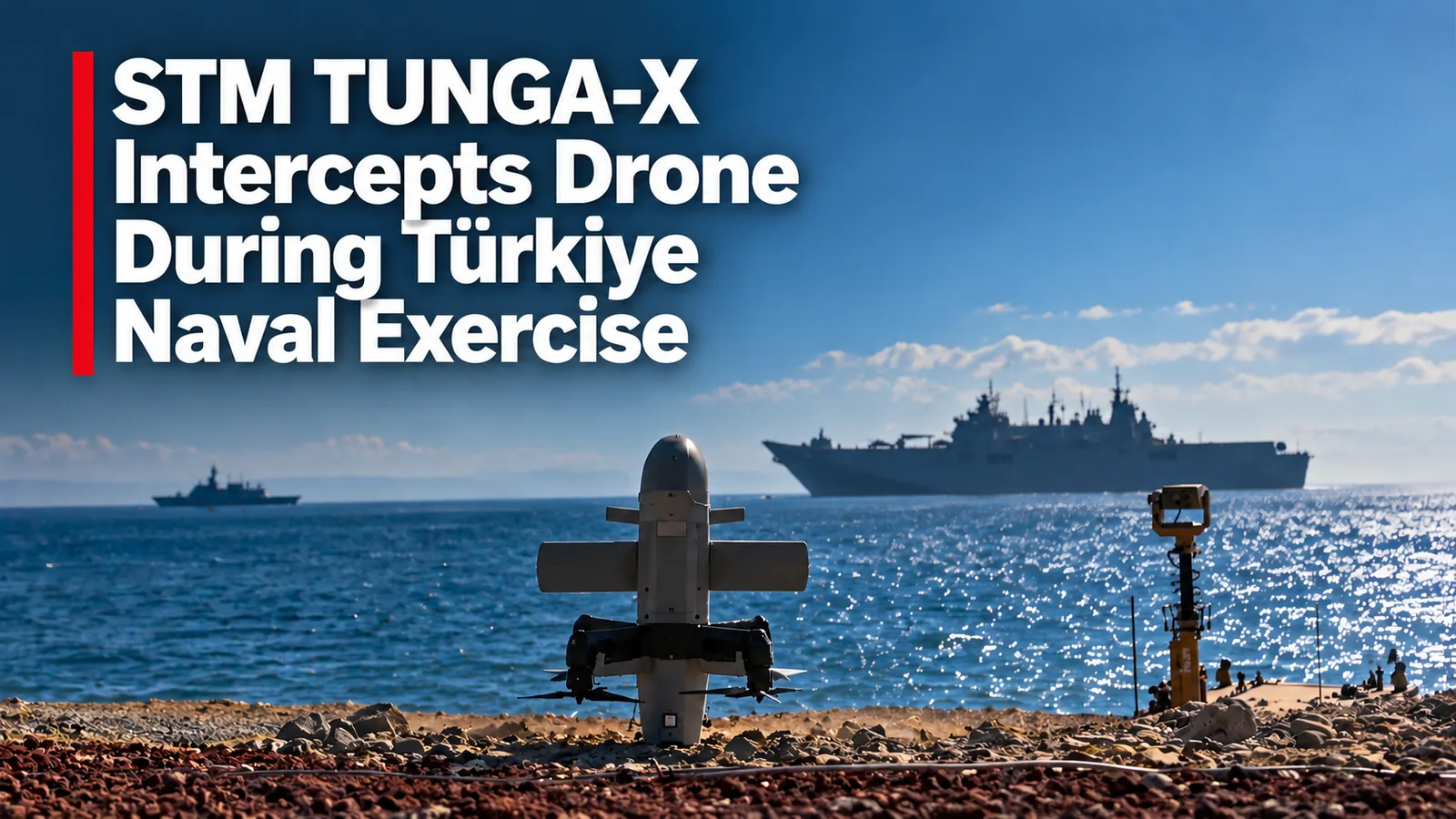
Türkiye’s STM says its STM TUNGA-X interceptor drone destroyed a representative hostile uncrewed aerial vehicle (UAV) during the Turkish Naval Forces’ TURNAs-2026 unmanned maritime systems exercise. In an announcement dated 25 October 2026 , STM said radar cueing and image-based guidance supported the airborne interception. The demonstration is relevant to naval counter-UAS protection, but the public record does not establish fleet acceptance, sustained operational performance or an equipment procurement award.
Key Facts
- Exercise: TURNAs-2026 Unmanned Maritime Systems Exercise, conducted by the Turkish Naval Forces in the Gulf of Antalya and eastern Mediterranean.
- Announcement date: 25 October 2026; the exact engagement time was not established in the cited statement.
- Reported outcome: STM says TUNGA-X tracked and destroyed a representative hostile UAV in flight using radar and image-guidance integration.
- Manufacturer specifications: 300 km/h maximum speed; 15 minutes' endurance; up to 25 km range at 150 km/h and 1,500 m above ground level (AGL).
- Configuration: Multirotor, launcher-free vertical take-off; electro-optical/infrared sensing and image-processing-based target tracking.
- Verification limits: Target model, engagement distance, number of attempts and independent acceptance metrics have not been disclosed.
- Procurement status: No new contract, serial-production quantity or operational service-entry milestone was announced alongside the exercise result.
Context: The Maritime Counter-UAS Challenge
Small UAVs and one-way attack drones have complicated defensive planning for ships, ports and deployed formations. A naval force may require overlapping layers of surveillance, electronic protection, gun-based weapons and airborne interceptors rather than relying on any single effector. The relative cost of the target and its interceptor is also a procurement consideration, although STM has not published a verified TUNGA-X unit price or cost-per-engagement figure.
Interception near ships introduces additional operational requirements. Radar contacts must be correlated with other information, the operator or autonomous system must discriminate between threats and friendly traffic, and the engagement must respect the safety envelope around nearby aircraft and vessels. A single successful exercise strike demonstrates part of a kill chain, not its effectiveness across contested or saturated conditions.
The system is not new to the public domain. STM unveiled TUNGA-X at SAHA 2026, as covered in Defence Agenda's platform introduction . That earlier account established the intended counter-drone role and manufacturer specifications. The October event adds a maritime exercise scenario rather than a first-ever unveiling.
What Happened During TURNAs-2026
According to STM's 25 October announcement , TUNGA-X took part in an exercise conducted by the Turkish Naval Forces in the Gulf of Antalya and eastern Mediterranean. The company reports that the interceptor received radar-supported targeting information, pursued a representative hostile drone through image-guidance integration and destroyed it in the air.
Anadolu Agency's 25 October report carried the account and attributed the key claims to STM. This is useful corroboration of the public announcement, but it is not an independently instrumented performance assessment. Neither the company's statement nor the reporting provides a measured interception distance, closing velocity, target characteristics or documented trial success rate.
The exercise also involved other unmanned capabilities. A separate STM statement on NETA 300 describes underwater mine-detection activity and participation by TOGAN, BOYGA and KARGU systems. That broader context matters because TUNGA-X was demonstrated within a naval unmanned-systems exercise, rather than as evidence of a fully fielded shipboard counter-UAS architecture.
TUNGA-X Technical Characteristics and Engagement Concept
STM defines TUNGA-X as a high-speed multirotor interceptor intended to defeat small hostile UAVs. On the manufacturer's specification page , the maximum speed is 300 km/h , flight endurance is 15 minutes , and the quoted 25 km range applies at a cruise speed of 150 km/h and altitude of 1,500 m AGL. The listed maximum altitude is 5,000 m AGL. These are published product parameters, not demonstrated measurements from TURNAs-2026.
The manufacturer describes launcher-free vertical take-off, electro-optical/infrared imaging, autonomous image-based target tracking and radar or lidar proximity sensing. The published description includes expendable attack profiles as well as mission-abort and return options. Those features indicate design intent; the October statement does not establish that every operating mode was tested during the naval engagement.
A radar-cued interceptor may provide an additional response option between electronic countermeasures, guns and larger missiles. Yet the specific sensor-to-shooter interface, target identification rules, communications resilience and integration with a naval combat-management system were not detailed. No quantified performance against swarms, electronic attack or high-speed manoeuvring targets was released.
Programme and Procurement Implications
The event builds upon STM's previous autonomous-system field demonstrations. Defence Agenda reported radar-assisted TUNGA-X and TOGAN-NEST field tests in September 2026 . The latest announcement therefore extends the reported test environment into a maritime exercise and provides a further manufacturer-claimed interception result.
For prospective operators, procurement decisions would require evidence beyond an exercise video or statement: repeatable target-engagement results, integration and safety qualification, supportability, maintainability, operator workload and lifecycle cost. Different shipboard counter-UAS layers can also have distinct operational roles. For context, Defence Agenda's coverage of MKE TOLGA integration aboard TCG Beykoz describes a gun-based maritime defensive approach rather than an airborne interceptor.
No TUNGA-X contract value, order quantity, named buyer acceptance or serial-delivery schedule accompanies the 25 October announcement. Calling this a new procurement award or an operationally deployed fleet capability would overstate the evidence.
Implications and Next Steps
The next useful indicators are repeatable independently documented interceptions, tests against more demanding target profiles and multi-target scenarios, and evidence of performance under communications or electronic-warfare disruption. Future announcements may also clarify integration with naval sensors and command systems, and whether a user organisation has formally accepted the capability.
TURNAs-2026 is best characterised as a manufacturer-reported maritime exercise interception involving radar and image-guidance integration. It advances the publicly visible test record for STM's counter-UAS interceptor but does not, by itself, confirm operational readiness, cost-effectiveness or procurement at scale.
Further Reading
- Defence Agenda — STM TUNGA-X Drone Debuts at SAHA 2026
- Defence Agenda — STM Validates TUNGA-X and TOGAN-NEST in Field Tests
- Defence Agenda — MKE TOLGA Naval C-UAS Integrated on TCG Beykoz
- STM — TUNGA-X Interception at TURNAs-2026, 25 October 2026
- STM — Official TUNGA-X Product Specifications
- Anadolu Agency — TUNGA-X Exercise Engagement, 25 October 2026
- Defence Drones — Independent Editorial Assessment, 26 October 2026