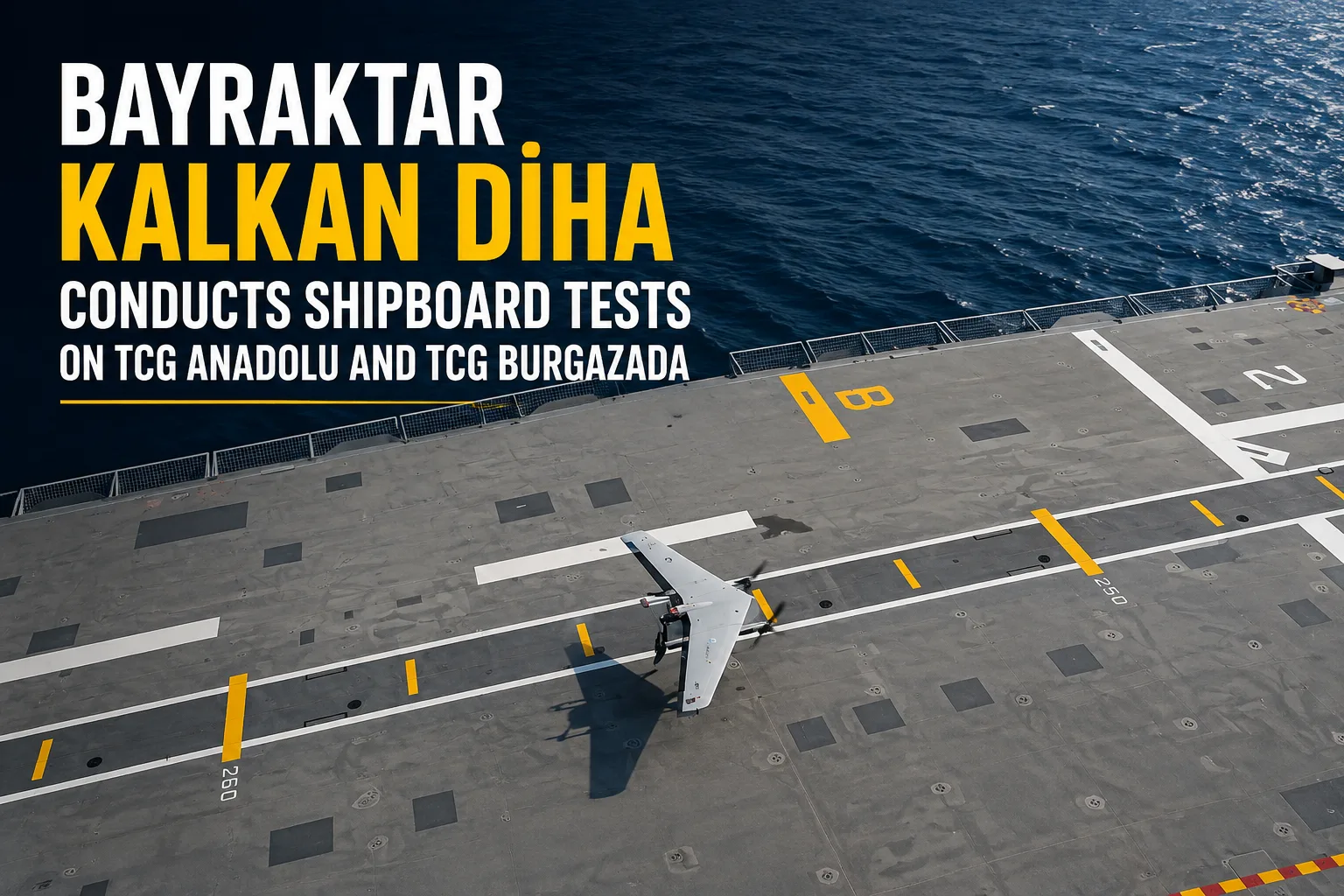
Bayraktar KALKAN DİHA has completed shipboard flight tests on the Turkish Navy’s TCG Anadolu amphibious assault ship and TCG Burgazada Ada-class corvette, expanding the newly accepted vertical take-off and landing UAV into a maritime operating environment.
The Turkish Ministry of National Defence said the tests were conducted as part of efforts to use KALKAN from naval platforms and to assess its intelligence, surveillance and reconnaissance performance under maritime conditions. The tests came less than a week after the system’s formal inventory acceptance during TEKNOFEST Mavi Vatan, marking a rapid transition from acceptance to shipboard evaluation.
Key Facts
- System: Bayraktar KALKAN DİHA
- Developer: Baykar
- Test date announced: 26 August 2026
- Ships: TCG Anadolu and TCG Burgazada
- Test purpose: Evaluate use from naval platforms for ISR missions under maritime conditions
- Aircraft type: Hybrid-propulsion VTOL UAV
- Maximum take-off weight: 78 kg
- Payload: 3 kg
- Endurance: 6 hours
- Current manufacturer-stated communications range: 70+ km
- Operational qualification status: Shipboard testing confirmed; fleet-wide operational qualification not publicly confirmed
The Latest Milestone Is Shipboard Testing
The Ministry of National Defence said Baykar’s KALKAN DİHA successfully conducted test flights aboard TCG Anadolu and TCG Burgazada as part of activities aimed at using the system from naval platforms.
The ministry later clarified that the tests were intended to evaluate KALKAN’s ability to perform reconnaissance, surveillance and intelligence missions under maritime conditions.
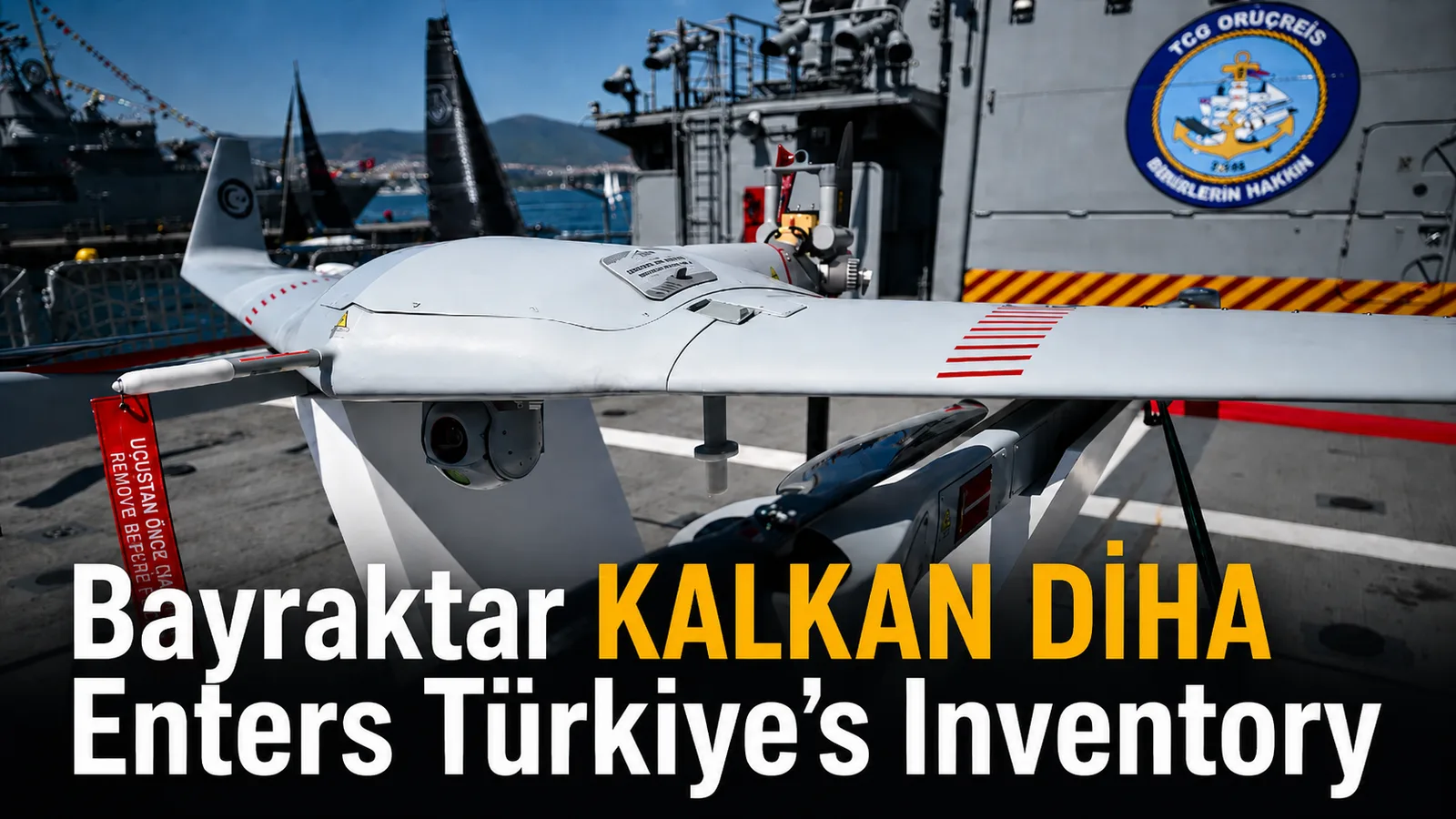
This is a more significant milestone than simply displaying the aircraft on a warship. KALKAN had already been formally accepted into Türkiye’s inventory during a ceremony aboard TCG Oruçreis on 20 August 2026. The 26 August tests show the programme moving immediately into practical naval evaluation.
Public statements do not specify whether the latest activity constitutes full shipborne qualification, an operational acceptance trial or a more limited development test. Defence Agenda therefore treats it as a successful shipboard flight-test milestone rather than declaring KALKAN fully qualified across the Turkish fleet.
Testing on Two Very Different Ships Matters
The most important operational feature of the test campaign is that KALKAN was evaluated on two very different naval platforms.
TCG Anadolu is Türkiye’s largest warship and a multi-purpose amphibious assault ship designed to support aviation, amphibious operations, command-and-control and power projection.
TCG Burgazada, by contrast, is the third Ada-class corvette built under the MİLGEM programme. It represents a much smaller surface combatant with a fundamentally different deck layout and mission profile.
Testing the same VTOL aircraft on both platforms suggests that the Turkish Navy is exploring a distributed maritime-UAV concept rather than limiting uncrewed aviation to TCG Anadolu.
That distinction is strategically important. A compact VTOL aircraft able to operate from frigates, corvettes and larger amphibious vessels could extend organic surveillance across a far greater portion of the fleet.
KALKAN Occupies a Different Tier From Bayraktar TB3
KALKAN should not be viewed as a substitute for Bayraktar TB3.
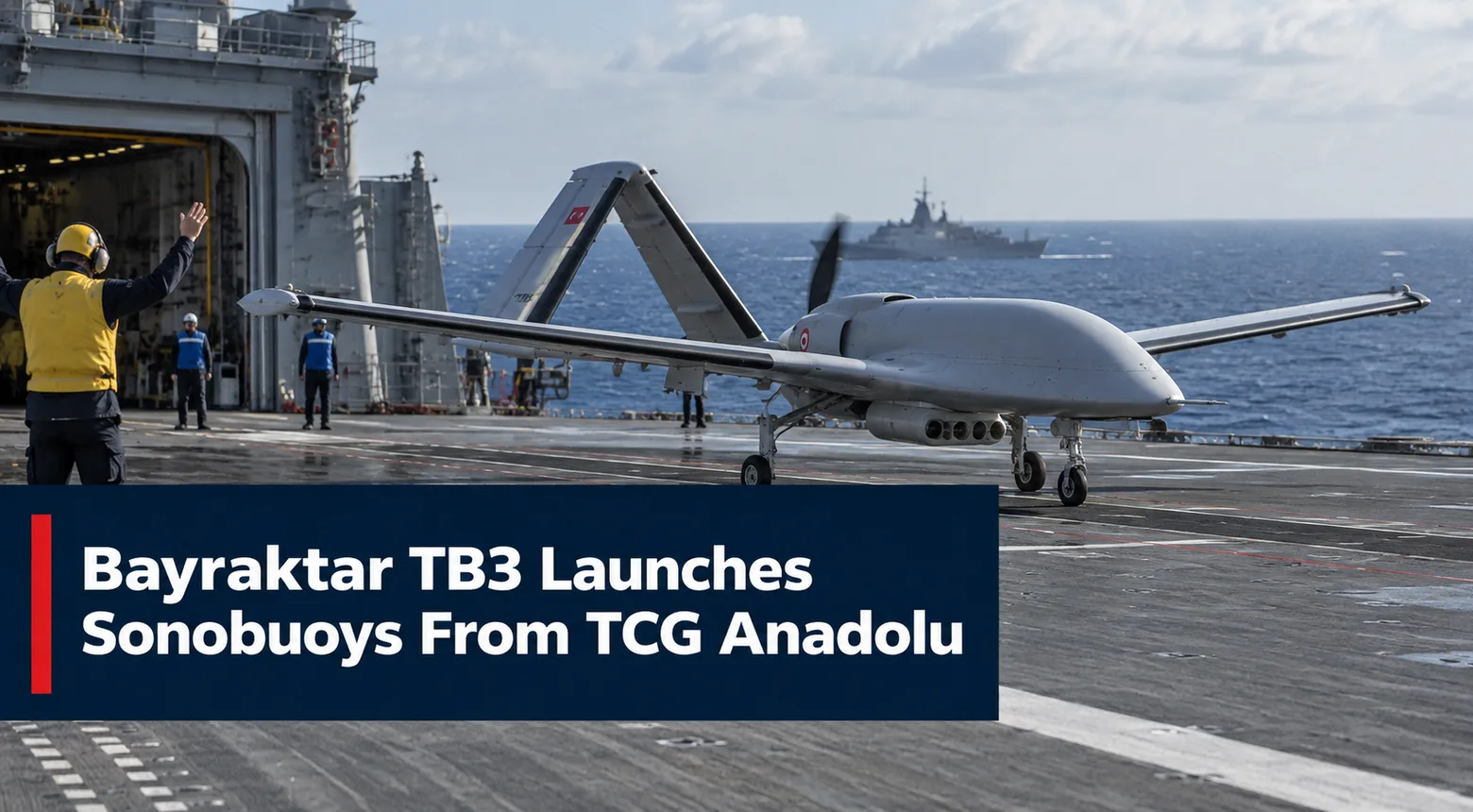
TB3 is a much larger short-runway UCAV designed for long-duration missions, weapons carriage and operations from aviation-capable ships such as TCG Anadolu. It has already demonstrated autonomous take-off and landing from the ship and conducted operationally relevant missions during NATO’s Steadfast Dart 2026 exercise.
KALKAN occupies a lighter tactical tier. Its vertical take-off and landing architecture eliminates the requirement for a runway or ski-jump and reduces the deck area needed for launch and recovery.
This allows a different force-structure model: TB3 can provide longer-range surveillance and strike from large aviation ships, while KALKAN can potentially distribute shorter-range ISR capability across smaller combatants.
The two systems are therefore complementary.
Baykar Designed KALKAN Around Runway Independence
Baykar describes KALKAN as a VTOL UAV designed primarily for intelligence, reconnaissance and surveillance.
The aircraft uses four electric motors during vertical take-off and landing and an internal-combustion engine for forward cruise. This hybrid architecture allows the UAV to transition from rotor-borne vertical flight into more efficient fixed-wing cruise.
Baykar’s current product page lists a maximum take-off weight of 78 kg, a 5-metre wingspan and a 3 kg payload capacity.
Published endurance is six hours, with a 10,000 ft service ceiling, 6,000 ft operational altitude, 48 KIAS cruise speed and 55 KIAS maximum speed.
The current dedicated product page lists communications range at more than 70 km.
BG160 Provides the Primary ISR Payload
KALKAN can carry Baykar’s BG160 electro-optical and infrared sensor payload with laser range-finding capability.
Baykar says the platform can conduct automatic route following, object tracking, loitering and return-to-home functions and can detect, identify and track multiple targets.
The UAV’s relatively light payload means it is better suited to tactical ISR, target detection, artillery adjustment and battle-damage observation than to the heavier sensor and weapons missions assigned to larger aircraft such as TB3 or AKINCI.
In the maritime domain, that sensor package could support surface surveillance, visual identification, horizon extension and tactical reconnaissance for a ship or task group.
The ministry did not disclose the exact sensor configuration used during the TCG Anadolu and TCG Burgazada tests.
Maritime Operations Create Different Flight-Control Challenges
Shipboard VTOL operations impose requirements that are not present during land-based flight.
A moving ship creates a continuously changing landing reference. Deck motion, wind over deck, turbulence around the ship’s superstructure, salt exposure and restricted recovery areas all complicate autonomous take-off and landing.
A lightweight UAV can also be more sensitive to local wind and turbulence than a larger aircraft.
Successful testing on operational naval platforms therefore provides information that cannot be obtained from a fixed land pad alone.
The Ministry of National Defence specifically linked the activity to testing KALKAN under sea conditions, supporting the interpretation that maritime operating characteristics were a central part of the evaluation.
TCG Burgazada Is the More Revealing Platform
TCG Anadolu is already central to Türkiye’s shipborne unmanned-aircraft strategy, so testing another UAV from the vessel is consistent with its established aviation role.
TCG Burgazada may be the more strategically revealing part of the test.
As an Ada-class corvette, Burgazada does not have the large flight deck of TCG Anadolu. Demonstrating KALKAN on a corvette-sized vessel indicates the Navy is investigating whether a compact VTOL aircraft can provide organic airborne sensing to ships that cannot operate TB3.
This could increase the sensor reach of individual surface combatants without requiring a conventional helicopter for every reconnaissance task.
It could also reduce the cost of routine surveillance sorties and preserve helicopters for missions requiring greater payload, range, speed or personnel transport.
A Distributed UAV Layer Could Change Naval ISR
The larger operational implication is distribution.
A fleet in which multiple frigates, corvettes and amphibious ships each carry one or more tactical VTOL UAVs can generate a denser surveillance network than one relying only on shore-based aircraft, helicopters and a small number of large UAVs.
Individual ships could launch local reconnaissance missions while remaining connected to the wider task-group command network.
If sensor data is shared through combat-management and tactical-data systems, the aircraft’s value extends beyond its host ship.
Türkiye is already moving in this direction on TCG Anadolu. HAVELSAN has integrated the ADVENT Combat Management System with Bayraktar TB3, allowing UAV-derived imagery and mission information to enter the ship’s command-and-control architecture and be shared with other naval assets.
No public source confirms equivalent KALKAN-to-ADVENT integration, so that capability should not yet be assumed for the new VTOL UAV.
KALKAN Entered Inventory Only Days Before the Naval Test
The test timeline is unusually compressed.
On 20 August 2026, KALKAN was formally accepted into Türkiye’s inventory during TEKNOFEST Mavi Vatan at Gölcük Naval Shipyard Command. The acceptance ceremony was held aboard TCG Oruçreis.
Six days later, the Ministry of National Defence announced successful flight tests on TCG Anadolu and TCG Burgazada.
The sequence suggests that maritime evaluation is not a distant follow-on concept but an immediate part of the system’s post-acceptance development path.
However, neither the acceptance announcement nor the shipboard-test statement identifies the number of KALKAN aircraft procured or the specific Turkish Armed Forces unit that will operate them.
Inventory Acceptance Did Not Initially Prove Shipborne Qualification
The location of the 20 August acceptance ceremony created an important analytical distinction.
A ceremony aboard TCG Oruçreis demonstrated naval relevance but did not itself prove that KALKAN had flown from a warship.
The 26 August tests close part of that gap by providing official confirmation that the UAV has now conducted flight activity on two naval platforms.
Even so, one successful campaign does not automatically establish unrestricted operational qualification across every sea state, ship class or mission profile.
Further testing would normally be expected before a fleet-wide deployment standard can be established.
TCG Anadolu Is Becoming an Uncrewed Aviation Node
KALKAN joins a broader transformation already underway aboard TCG Anadolu.
Bayraktar TB3 first completed autonomous take-off and landing from the ship in November 2024. By 2026, TB3 was participating in NATO exercises from the vessel, conducting real-time reconnaissance and armed missions.
The Ministry of National Defence confirmed that during Steadfast Dart 2026, TB3 launched from TCG Anadolu, provided real-time intelligence, surveillance and reconnaissance over the target area and supported the amphibious operation.
Adding a smaller VTOL platform creates the possibility of a layered uncrewed air group in which different aircraft are assigned different mission durations, sensor loads and deck requirements.
KALKAN’s test does not by itself confirm permanent deployment aboard TCG Anadolu, but it broadens the range of unmanned aircraft demonstrated from the platform.
Smaller Warships Could Gain Organic Airborne Sensors
The operational case for KALKAN becomes stronger when viewed from the perspective of ships such as TCG Burgazada.
Corvettes and frigates have limited aviation space and may need to prioritise helicopters for anti-submarine warfare, transport or other complex missions.
A small VTOL UAV can potentially conduct routine electro-optical surveillance without consuming the same deck footprint, fuel or maintenance resources.
Potential roles include surface-picture extension, littoral surveillance, visual classification of contacts, route reconnaissance, search support and post-engagement assessment.
These are mission possibilities consistent with the aircraft’s published sensor role; the Ministry of National Defence has only explicitly confirmed reconnaissance, surveillance and intelligence testing.
Network Integration Will Determine Operational Value
A shipborne UAV becomes significantly more useful when its sensor data can be fused into the naval combat system.
The host ship needs to receive imagery and target information with sufficiently low latency for tactical use, while command systems need to distribute that information to other units when required.
Türkiye already has an architectural precedent through ADVENT and TB3 integration.
If KALKAN is later integrated into ADVENT or another naval C2 system, smaller warships could use the UAV as an organic extension of the ship’s sensor horizon while passing information across the task group.
There is currently no public confirmation that this integration has been completed.
Electronic Warfare and Data-Link Resilience Remain Critical
The maritime environment also exposes the limitations of small UAVs.
Line-of-sight communications can be affected by range, terrain, ship structures and electronic attack. A contested environment may include jamming, spoofing and attempts to disrupt navigation or control links.
Baykar describes KALKAN as using digital data and video links and a fault-tolerant system architecture.
The company’s public specifications do not disclose military waveform characteristics, encryption, anti-jam performance or the exact maritime-control architecture used during the August tests.
Operational effectiveness in a high-threat environment will depend on these elements as much as on basic flight performance.
Navalisation Requires More Than Successful Flight
Long-term deployment at sea also creates sustainment requirements.
Saltwater corrosion, storage, deck handling, battery management, fuel storage, maintenance space and safe operations around other aircraft all influence whether a UAV can become a routine shipboard system.
A compact aircraft reduces some of those burdens but does not eliminate them.
The Ministry of National Defence has not disclosed whether the current tests included long-duration embarked operations, maintenance trials, deck-storage assessment or high-sea-state recovery.
The current milestone should therefore be understood as an important step in navalisation rather than proof that every shipboard-support requirement has been completed.
Industrial Significance for Baykar
KALKAN expands Baykar’s product portfolio into a category that has strong naval export potential.
Many navies operate corvettes, frigates, patrol vessels and amphibious ships that lack the deck space or aviation infrastructure required for larger fixed-wing UAVs.
A compact VTOL ISR aircraft can address those platforms without requiring major ship modification.
The use of the same aircraft on both TCG Anadolu and an Ada-class corvette gives Baykar a broader naval reference than a test confined to one specialised aviation ship.
No export contract for a naval KALKAN configuration has been publicly linked to the August tests.
Limitations and Counterpoint
The Ministry of National Defence confirmed successful test flights but did not publish the detailed test profile.
Public sources do not disclose the number of take-offs or recoveries, whether the ships were moving during every phase, sea-state limits, wind conditions or flight duration.
The tests should not automatically be described as full naval operational qualification.
No fleet deployment quantity, ship allocation or permanent embarked detachment has been announced.
The exact sensor payload used during the tests is also undisclosed.
Finally, KALKAN’s published performance is substantially below that of larger maritime UAVs and helicopters in payload and mission radius. Its value lies in low-footprint tactical ISR rather than replacing every shipborne aviation capability.
Implications / Next
The first indicator to watch is whether the Navy conducts additional KALKAN trials from frigates, corvettes or other ship classes.
The second is formal integration with a naval combat-management system such as ADVENT. That would move KALKAN from an organic video sensor toward a networked task-group ISR asset.
The third is procurement quantity. Fleet-scale deployment would require enough aircraft, ground/control equipment and trained operators to support multiple ships simultaneously.
The fourth is maritime endurance testing. Longer embarked periods and operations in more demanding sea states would provide stronger evidence of operational naval qualification.
The fifth is whether KALKAN develops additional payloads for communications relay, electronic support or other maritime missions beyond its current EO/IR ISR role.
Conclusion
KALKAN’s flight tests on TCG Anadolu and TCG Burgazada move the aircraft beyond inventory acceptance into a practical naval-development phase.
The most important feature is not that the UAV flew from Türkiye’s largest warship, but that it was also tested on an Ada-class corvette. That points toward a distributed concept in which compact VTOL UAVs could provide organic ISR to a much broader range of Turkish Navy ships.
The milestone does not yet prove fleet-wide operational qualification, permanent shipboard deployment or combat-system integration.
But together with TB3 operations from TCG Anadolu, it shows that Türkiye’s naval unmanned-aircraft strategy is expanding from one carrier-like platform toward a layered architecture spanning both large aviation ships and smaller surface combatants.