Global commercial aircraft orders rose by 88% year on year in the third quarter of 2026, while the outstanding orderbook reached a record 17,058 aircraft, according to ADS Group’s 16 November 2026 release. The industry association reported 506 orders during Q3, taking the first nine months of the year to 1,837 orders, alongside 1,034 deliveries. For aerospace manufacturers and their suppliers, the central issue is no longer simply the strength of airline demand: it is whether factories, skilled workforces and component supply chains can convert a historically large backlog into reliable deliveries. The numbers concern civil commercial aircraft, not new military aircraft procurement or a defence spending programme.
Q3 Aircraft Orders and Deliveries: What the ADS Figures Show
ADS reported 506 new commercial aircraft orders in July–September 2026, an 88% increase against Q3 2025. The percentage is a quarterly year-on-year comparison; it must not be applied to the full nine-month order total. For January–September 2026, the association counted 1,837 orders, up 28% from the comparable 2025 period. Aerospace industry publication ADS Advance repeated the trade association’s findings on 17 November 2026 and identified 1,431 orders in the first nine months of 2025.
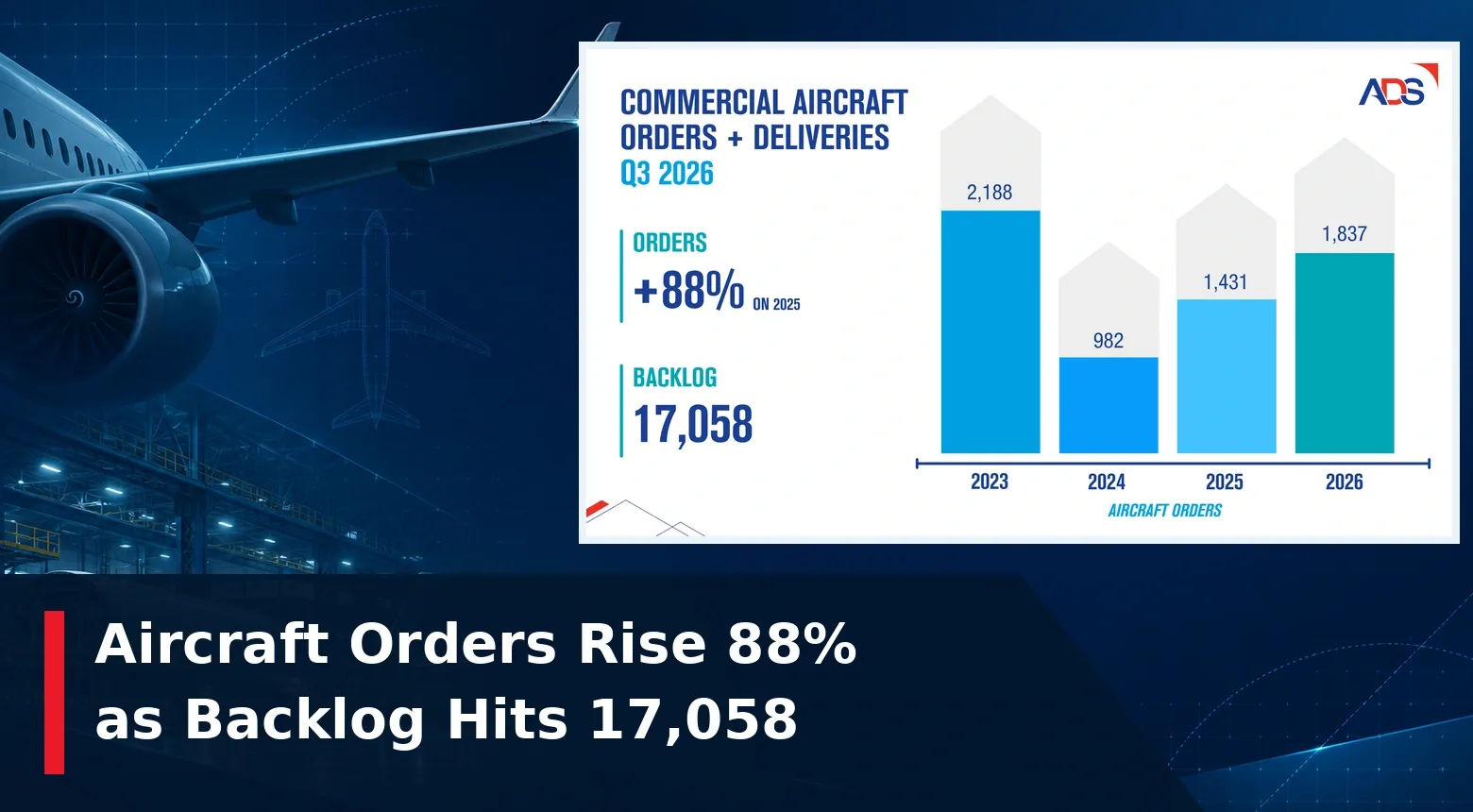
The accompanying ADS infographic, supplied with this report, provides additional historical perspective. It displays 2,188 orders in January–September 2023, 982 in 2024, 1,431 in 2025, and 1,837 in 2026. The rise in 2026 is therefore substantial relative to 2024 and 2025, but the year-to-date volume remains below the 2023 comparator. Claims that 2026 order intake itself has reached an all-time record would be misleading: the record referred to in the headline is the undelivered backlog.
Single-aisle aircraft accounted for much of the recovery. ADS recorded 1,456 narrowbody orders over the first nine months of 2026, an increase of 77% year on year. These aircraft represented approximately 79% of reported nine-month orders, calculated from the ADS totals. Narrowbody models dominate airline replacement and short- to medium-haul fleet expansion, making their production cadence especially important to airframe assemblers, wing manufacturers, avionics suppliers and aftermarket specialists.
Delivery performance improved without eliminating the gap between demand and output. ADS recorded 361 deliveries in Q3 2026, the third-highest third-quarter total in its dataset. The figure comprised a record 309 single-aisle aircraft and 52 widebody aircraft. From January through September, 1,034 aircraft were delivered, the second-highest nine-month delivery volume after 2018. The record for a particular quarter is not the same as an annual record or proof that every scheduled delivery was completed on time.
The longer-term trend was visible before Q3. In an 31 August 2026 update, ADS said the undelivered orderbook first exceeded 17,000 aircraft in July, reaching 17,037. Its 25 September update showed 17,010 aircraft outstanding in August. The new 17,058 Q3 value is thus a further high in a sequence of elevated backlog measurements, rather than a sudden one-quarter accumulation of 17,058 new orders.
Aerospace Supply Chains: A £396.5bn Opportunity With Risks
ADS estimated that the existing global commercial aircraft backlog could represent up to £396.5 billion in potential work for the UK aerospace industry, assessed at current production rates. It described the backlog as equivalent to more than 12 years of work on the same basis. This is a conditional industry opportunity estimate, not an amount already awarded to UK contractors, an assured export receipt or a valuation of every aircraft on the global orderbook. Actual UK economic value depends on how much design, manufacturing, assembly, maintenance and support work is captured domestically.
One supporting indicator comes from Airbus’s nine-month 2026 financial results, published on 28 October 2026. Airbus reported 547 commercial aircraft deliveries in the first nine months of the year and an order backlog of 9,310 aircraft at the end of September. It also reported 1,105 net commercial aircraft orders, after cancellations. These Airbus-specific gross and net order measures should not be added uncritically to ADS’s industry figures, whose classification and reporting cut-offs may differ.
Boeing’s 13 October 2026 deliveries release reported 161 commercial aircraft deliveries in Q3 and 475 in the first nine months. Airbus and Boeing’s publicly reported year-to-date deliveries therefore sum to 1,022, compared with the 1,034 aircraft in ADS’s global delivery dataset. The 12-aircraft difference is a warning against assuming identical fleet coverage, aircraft classification or reporting methodology, and does not in itself establish an error by any publisher. ADS’s totals are used consistently in the headline and key facts.
Production responses are under way at the major manufacturers. Airbus announced a manufacturing investment at Broughton in the UK on 21 September 2026 to support its A321 wing-production ramp-up. Airbus also stated in its October results that it expected to reach a rate of 70–75 A320-family aircraft per month by the end of 2027, with subsequent stabilisation at 75. Boeing’s new Everett 737 production line, described in July 2026, represents a separate attempt to add capacity and increase predictability. These are company plans or reported investments, not proof that all intended future rates will be achieved.
The ADS modest-growth scenario envisages 1,490 aircraft deliveries for 2026. Against 1,034 delivered by 30 September, that would require a further 456 deliveries in October–December, or an average of 152 per month. By comparison, the Q3 average was about 120 per month (361 over three months). The implied Q4 monthly pace is roughly 26% above the Q3 average; this is a Defence Agenda calculation, not a separate ADS forecast. The scenario is achievable only if manufacturers and their supply chains sustain an appropriate acceleration.
| Reporting measure | ADS Q3 / nine-month 2026 figure | Interpretation |
|---|---|---|
| Q3 new orders | 506 (+88% YoY) | Quarterly demand indicator |
| Jan–Sep orders | 1,837 (+28% YoY) | New orders over nine months |
| Jan–Sep single-aisle orders | 1,456 (+77% YoY) | Around 79% of nine-month orders |
| Q3 deliveries | 361 (309 narrowbody; 52 widebody) | Aircraft handed over in the quarter |
| Jan–Sep deliveries | 1,034 | Realised output, not year-end total |
| Outstanding backlog | 17,058 aircraft | Undelivered orders; not cash receipts |
| UK industrial opportunity | Up to £396.5bn | Conditional opportunity, not confirmed revenue |
| ADS 2026 delivery scenario | 1,490 | Outlook rather than delivered aircraft |
The industry challenge extends beyond final assembly. Specialist castings, forgings, engines, landing gear, high-tolerance machining, electronics, workforce availability and certification capacity can constrain higher production even when airlines and leasing companies are ready to take aircraft. Defence Agenda’s reporting on Honeywell Aerospace supply-chain pressure illustrates related stresses at a major aerospace supplier. Aircraft manufacturers can increase nominal line capacity only to find that shortages elsewhere in the production system determine completed deliveries.
Demand visibility does not remove commercial risk. Airlines may defer deliveries, switch configurations or face financing constraints; manufacturers can encounter labour shortages, quality-control setbacks and certification delays. Supply-chain investment also creates a timing problem: firms must hire people and buy equipment ahead of the revenue associated with additional production. Defence Agenda’s Farnborough 2026 coverage provides earlier context on orders and industrial capacity, while its Airbus U740 Valkyrie programme report illustrates a separate defence-aerospace market that should not be conflated with ADS’s commercial-aircraft orderbook.
Implications / Next: Analysts and procurement managers should track full-year 2026 orders and deliveries, the conversion of individual OEM delivery-rate plans into accepted aircraft, the stability of parts supply and the share of higher production captured by UK companies. Crucially, an expanding backlog may support long-term investment but also intensify delivery risk if output fails to catch up. As of 23 November 2026, the ADS release provides a strong commercial demand signal, not a guarantee that its 1,490-aircraft delivery scenario or its £396.5 billion UK opportunity will be realised.
Further Reading
- ADS Group — Q3 2026 aircraft orders and record backlog (16 November 2026)
- ADS Group — July backlog exceeds 17,000 (31 August 2026)
- Airbus — Nine-Month 2026 Results (28 October 2026)
- Boeing — Third Quarter 2026 Deliveries (13 October 2026)
- Airbus — Broughton manufacturing investment (21 September 2026)
- Defence Agenda — Farnborough Airshow 2026: defence and commercial demand
- Defence Agenda — Honeywell aerospace supply-chain pressures
- Defence Agenda — Airbus U740 Valkyrie first European flight