The Italian Air Force is acquiring six Astore Levante unmanned aircraft from LBA Systems, the 50:50 joint venture between Leonardo and Baykar. Italian Air Force Chief of Staff General Antonio Conserva confirmed that the contract is already in place and covers three systems, with two aircraft assigned to each system.
Certification is expected to conclude between the end of 2026 and the beginning of 2027. The order turns Astore Levante from a newly launched Europeanised Bayraktar TB3 derivative into an active Italian procurement programme.
Three Systems Will Deliver Six Aircraft
Rivista Italiana Difesa reported that each system includes two UAVs and that one ground control station can control both aircraft. The acquisition structure therefore gives the Italian Air Force six air vehicles across three system sets rather than six completely independent control packages.
The contract value has not been publicly disclosed. Neither RID nor the Italian Air Force statement cited in the report provides a delivery schedule beyond the certification window, so production phasing and operational acceptance dates remain open.
Astore Levante Is a Europeanised Bayraktar TB3
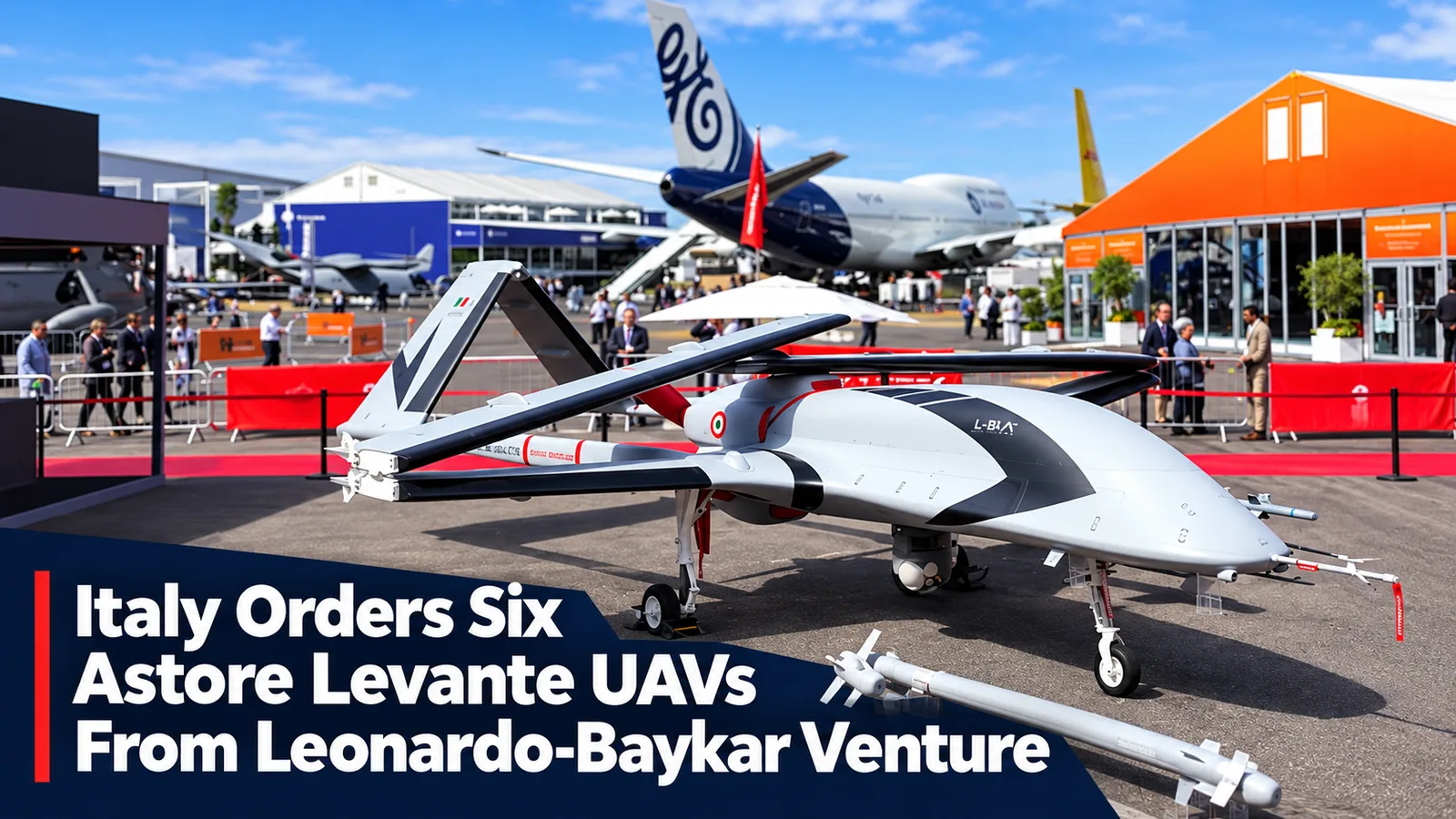
LBA Systems unveiled Astore Levante at the Farnborough International Airshow in July 2026 as its first product. The aircraft combines the Bayraktar TB3 platform with Leonardo sensors, mission systems and a ground control station, positioning the system for Italian, European and NATO requirements.
Production of the first aircraft was already under way in Italy by the time of the Farnborough launch. Reporting around the joint venture identified Leonardo’s Ronchi dei Legionari facility as a production site, while the partners said first deliveries to an Italian end-user were expected by the end of 2026.
The Weapons Package Is Still Open
General Conserva said the Italian Air Force has not yet selected the Astore Levante’s final armament package. The aircraft was displayed at Farnborough alongside Turkish munitions, including ROKETSAN’s MAM family and Baykar’s KEMANKES 1 mini cruise missile, making Turkish weapons the most mature reference configuration shown publicly.
However, the Air Force is also holding discussions with MBDA and Italian small and medium-sized defence companies. That creates the possibility of a more European weapons package, but no specific MBDA missile, bomb or Italian munition has been publicly selected.
European Weapons Could Broaden Astore Levante’s Market Position
A European effector package would give LBA Systems more flexibility in NATO and EU competitions where customers may prefer locally supported weapons, existing stockpiles or nationally certified integration paths. It could also reduce the need for customers to establish an entirely new munitions supply chain around the aircraft.
At the same time, Turkish weapons remain relevant because the underlying TB3 architecture has already been developed around Baykar and ROKETSAN effectors. The final Italian configuration will therefore show how far the Leonardo-Baykar partnership can combine a proven Turkish unmanned airframe with European sensors, certification and weapons integration.
The Italian Air Force Plans Armed, ISR and Training Roles
Conserva said Astore Levante will be used for armed missions close to the Forward Line of Troops, as well as intelligence, surveillance and reconnaissance and training of remotely piloted aircraft crews. That mission set is broader than a simple MQ-1 replacement and gives the aircraft both operational and force-generation roles.
The armed-support requirement is particularly notable because Italy’s Predator fleet was historically used primarily for ISR. Astore Levante therefore adds a more explicit tactical strike function while preserving persistent surveillance and training utility.
Astore Levante Is Intended to Replace the Predator MQ-1
The Italian Air Force chief described Astore Levante as the effective replacement for the Predator MQ-1. That gives the acquisition a clear fleet-renewal logic even as Italy separately expands its MQ-9A Block 5 Reaper fleet through the U.S. Foreign Military Sales channel.
The two acquisitions should therefore not be treated as competing one-for-one programmes. MQ-9A remains a larger, longer-endurance remotely piloted aircraft, while Astore Levante offers a smaller European-integrated platform with short-runway and naval-derived design characteristics inherited from the TB3.
The Order Validates the LBA Systems Industrial Model
LBA Systems became fully operational in July 2026 after Leonardo and Baykar completed regulatory approvals and formalised the joint venture. Leonardo contributes European certification expertise, advanced sensors, electronics and mission-system integration, while Baykar contributes unmanned aircraft design, production methods and an established platform family.
A confirmed Italian Air Force acquisition gives that model an anchor customer. It also provides LBA Systems with a domestic reference programme that can support export campaigns in Europe, where procurement authorities often place significant weight on certification status, local industrial content and endorsement by a NATO air force.
Certification Is the Next Immediate Milestone
The aircraft is expected to complete certification between late 2026 and early 2027. European certification is central to the programme because Astore Levante is being positioned specifically for customers that require compliance with European military-airworthiness and integration standards.
The next major indicators will be certification completion, formal delivery of the first aircraft, selection of the weapons package and confirmation of initial operational use. Until those milestones occur, the procurement is best described as contracted but still moving through certification and integration.