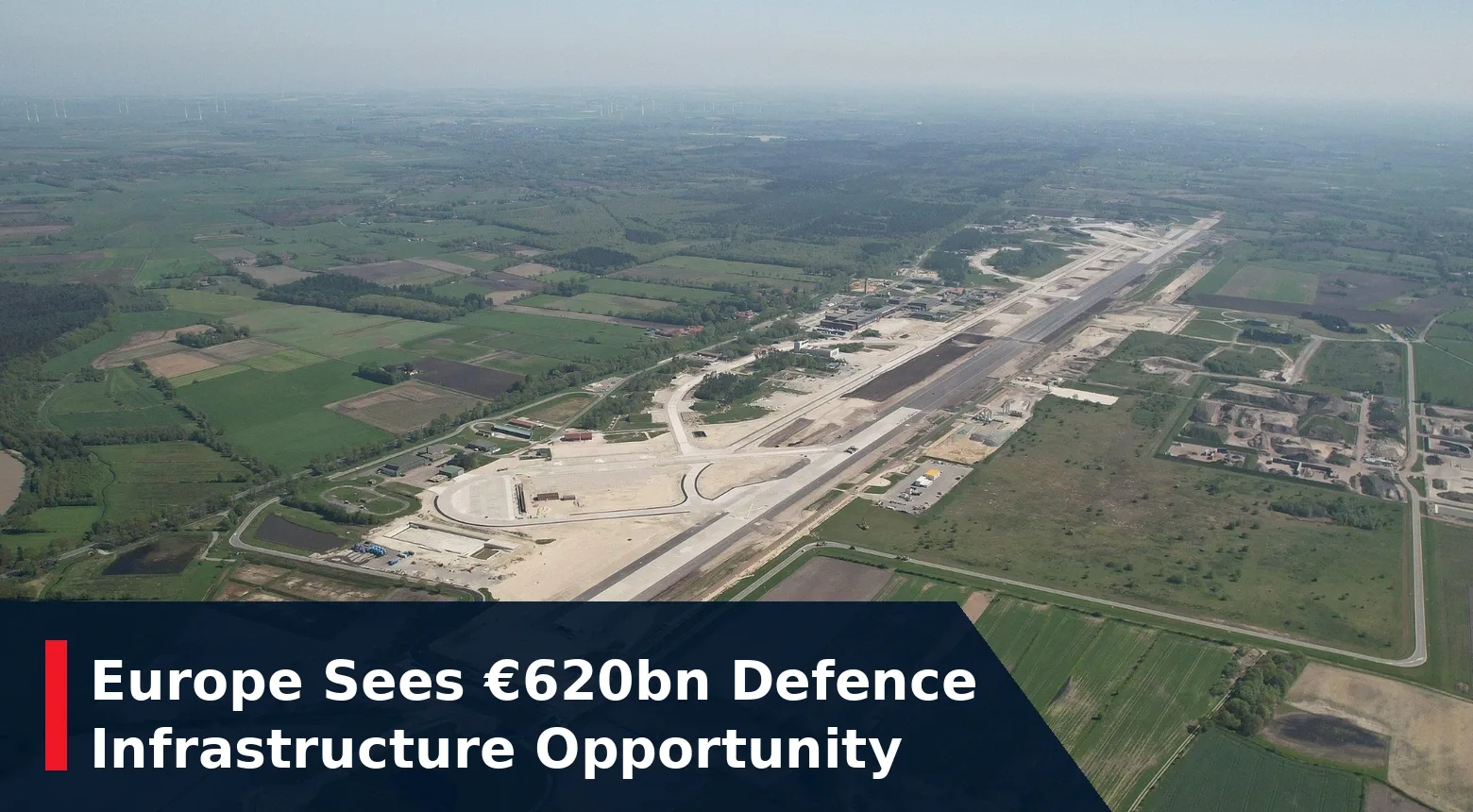
Europe defence infrastructure could generate as much as €620 billion in construction and related investment opportunities between 2026 and 2035, according to a 21 November 2026 Financial Times report citing Boston Consulting Group (BCG) estimates. European builders and suppliers are preparing for possible demand for military airfields, bases, ammunition stores, logistics networks and dual-use transport systems as NATO governments raise spending ambitions. The €620 billion is a forecast of potential activity, not a funded procurement programme, an approved budget or awarded contracts. For defence planners and industrial contractors, the decisive challenge is turning higher investment targets into buildable, secure and maintainable infrastructure.
Europe’s €620bn Infrastructure Forecast: Scope and Market Drivers
The Financial Times report presents the €620 billion figure as the combination of two categories with different coverage and intended uses. About €320 billion is estimated for direct military infrastructure across Europe, including the United Kingdom and Türkiye but excluding Ukraine, during 2026–2035. A further €300 billion is projected for broader defence and security-related infrastructure investment in Germany, France and Poland, including the resilience and military utility of civilian infrastructure. The headline figure should therefore not be presented as €620 billion of new EU budget allocations, or as an EU-27-only statistic.
The projected direct military component includes infrastructure that enables armed forces to operate and sustain deployments: barracks, ammunition facilities, naval bases, airfields, training grounds, command facilities and secure maintenance capacity. The wider dual-use category may encompass reinforced bridges, heavy-transport corridors, ports, power supply and communications systems. Unlike a combat platform, many of these assets serve commercial and civilian users in peacetime. Their military value depends on load standards, redundancy, access arrangements, security controls and whether they connect into actual reinforcement plans.
The industrial interest extends beyond traditional defence contractors. In the FT account, ACS, STRABAG and Vinci discuss military and security construction prospects, while CRH, Holcim and Heidelberg Materials are identified among suppliers watching demand for construction materials. The reported development of dedicated defence teams, specialist materials and security-cleared workforces indicates positioning for an emerging market. It does not establish that all these companies have received contracts equivalent to their projected opportunity or that their forecasts share identical scope.
A useful comparison is the European Defence Agency’s 16 July 2026 defence data release, which reports €418 billion in total EU-27 defence expenditure during 2025 and €454 billion projected for 2026. Those figures cover overall defence budgets, including personnel, equipment and other functions; they are not annual military-construction expenditure. Accordingly, they should not be added to BCG’s forecast, or treated as independent confirmation of the €320 billion infrastructure estimate. Budget classification, national reporting and the pace of project mobilisation remain separate questions.
The policy driver is NATO’s 25 June 2025 Hague Summit Declaration. Allies committed to spending 5% of GDP annually by 2035, comprising at least 3.5% for core defence requirements and up to 1.5% for wider defence- and security-related purposes, including critical infrastructure, networks and civil preparedness. This is a national investment target, not a central NATO construction fund. The 1.5% category cannot simply be booked in full as new military building works, and the national budgetary measures required to meet the pledge differ widely.
The European Commission’s military mobility framework adds a further operational dimension. Its planned EU-wide military mobility area aims to simplify movement rules and coordinate land, air and maritime routes by 2027. Infrastructure upgrades have to address practical bottlenecks: bridge capacity, rail loading gauge, airport access, port handling, protected communications and movement across national borders. The related Defence Agenda review of the EU military mobility plan discusses why permits, route data and physical upgrades must be addressed together. A new bridge or runway is strategically valuable only if forces can actually use the wider network.
| Segment | FT-reported estimate, 2026–2035 | Scope and interpretation |
|---|---|---|
| Direct military infrastructure | €320bn | Military-specific facilities in Europe including Türkiye and the UK, excluding Ukraine |
| Wider defence and resilience infrastructure | €300bn | Additional dual-use / security-related investments forecast in Germany, France and Poland |
| Combined headline opportunity | €620bn | Illustrative market projection; not a central EU or NATO budget, contracts or allocated funding |
Defence Infrastructure Contracts, Programme Risks and Outlook
Company examples illustrate how defence infrastructure contracting already works. On 19 January 2022, STRABAG announced that its ZÜBLIN subsidiary and Gilbane Germany had secured an €859 million joint-venture contract for a new military medical centre at Weilerbach, near Ramstein Air Base. The planned site features approximately 90,000 square metres, nine operating rooms and 120 examination rooms. The signed agreement is tangible evidence of major military-facilities work, but it is not a contract awarded in November 2026, nor does it validate a €620 billion future market by itself.
The FT also reports that ACS has completed 154 defence and security projects in Europe, and is pursuing work such as military-airfield modernisation and support services. It cited a company forecast for worldwide annual defence infrastructure spending to approach €120 billion by 2030, compared with €68 billion in 2026, including Europe rising from €19 billion to as much as €30 billion. These are company market expectations, not independently audited future revenues. Defence Agenda’s coverage of NATO industrial production ambitions provides the related defence-supply context, but the pace of a military construction project is governed by different environmental, planning and procurement processes than the manufacture of ammunition or aircraft.
There is also an important difference between a programme pipeline and the ability to execute it. Defence construction requires site access, planning consent, land acquisition or remediation, qualified contractors, security requirements, specialist equipment, utility connections and finance. Airfield pavements designed for high aircraft loads, protected storage sites and resilient power systems may need bespoke standards and assurance. For suppliers, the opportunity can shift from initial works to decades of maintenance and support, but those lifecycle commitments need to be funded and contractually specified.
The principal counterargument to optimistic market forecasts is the gap between commitments and completed projects. Fiscal deficits, election cycles and public procurement challenges can slow investment; moreover, the same civil engineering and materials capacity is needed for housing, energy and commercial transport projects. Construction inflation, permitting delays and shortages of suitably cleared labour can lift costs even when nominal spending increases. Because some projects perform both civilian and military roles, double-counting between defence budgets, infrastructure programmes and security-resilience estimates is also a material analytical risk.
The growth opportunity for contractors should not overshadow the issue of operational resilience. European military mobility depends on maintaining viable alternatives if a port, airfield, rail node, energy supply or communications hub becomes unavailable. Programme offices therefore have to evaluate redundancy, rapid repair, distributed logistics, physical and cyber protection, and the ability of infrastructure owners to restore services. The UK Atlantic Net surveillance initiative covered by Defence Agenda is a related example of investment in maritime situational awareness, but it is a distinct programme and must not be counted as part of a verified European construction contract total.
A further complication is geography. The direct military forecast cited by FT includes Türkiye and the United Kingdom and excludes Ukraine, whereas the wider €300 billion component focuses on Germany, France and Poland. The €620 billion figure therefore should not be relabelled as a single EU spending plan. It is a consultancy estimate across differing territorial and expenditure categories, and governments may fund projects under national defence, transport, energy or resilience portfolios depending on their purpose and applicable accounting rules.
Implications / Next: The most meaningful indicators through 2027–2035 will be appropriated national budgets for specific infrastructure works, published tender notices, actual signed contract values, project permitting, construction progress, completion and readiness testing. Contractors will also need to demonstrate security compliance and whole-life maintenance capacity. As of 21 November 2026, the evidence supports an expanding potential market for defence infrastructure, but not a concluded €620 billion procurement programme or a guaranteed construction cycle.
Further Reading
- Financial Times — European builders target defence infrastructure opportunity, 21 November 2026
- NATO — The Hague Summit Declaration, 25 June 2025
- European Defence Agency — EU defence expenditure, 16 July 2026
- European Commission — Future of European Defence and military mobility
- STRABAG — Weilerbach military medical centre joint venture
- BCG — Opportunity for nondefence companies, 24 June 2025 (different estimate)
- Defence Agenda — EU Military Mobility Plan
- Defence Agenda — NATO Urges Defence Industry to Scale Up Production
- Defence Agenda — UK Announces £90M Atlantic Net Undersea Surveillance