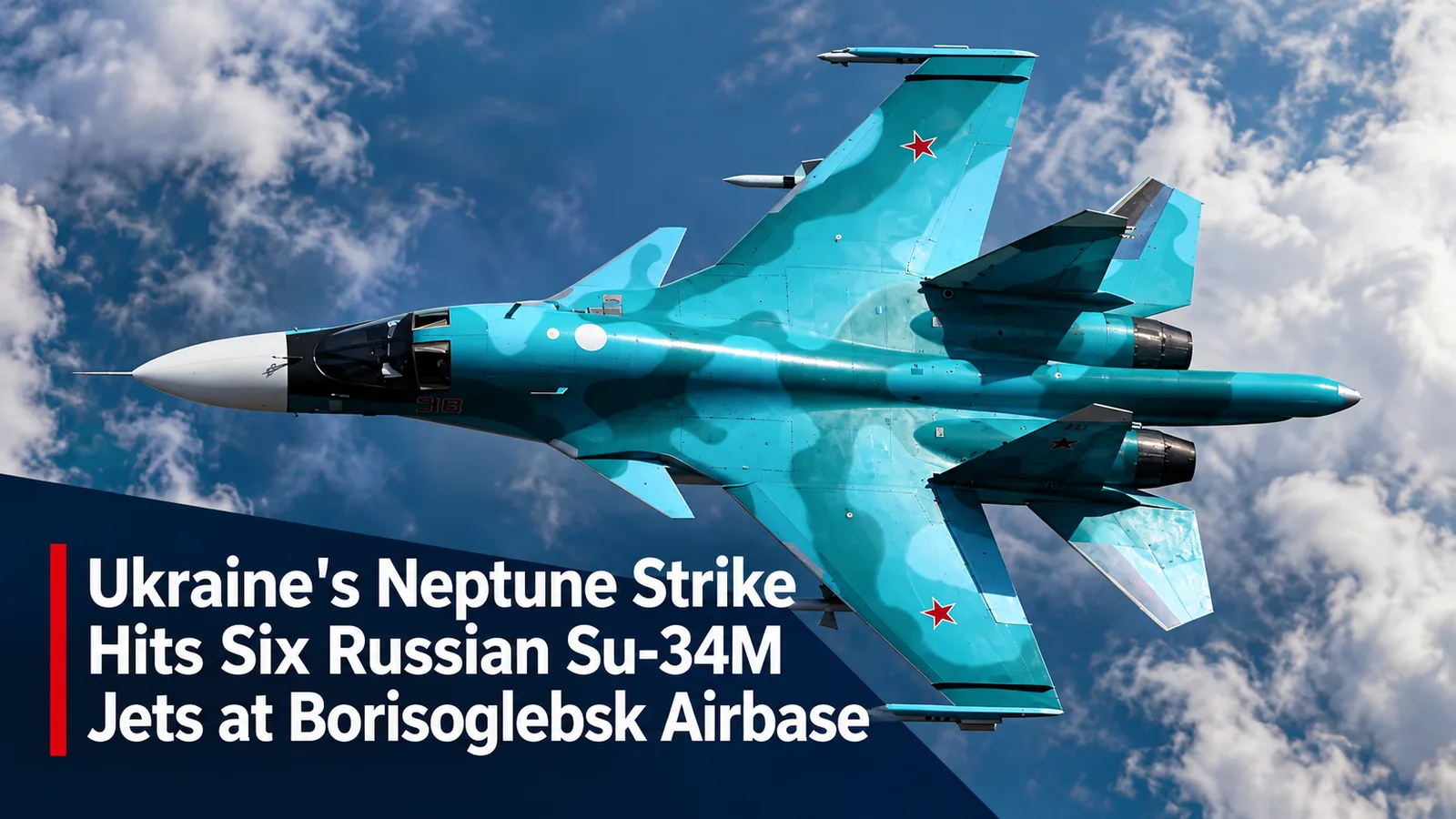
Ukraine says its Naval Forces struck six Russian Su-34M fighter-bombers at the Borisoglebsk military airfield in Voronezh Oblast during the night of 14–15 October 2026. Kyiv reported using the Neptune coastal missile system in an attack that also affected aviation ground-support equipment and caused secondary explosions and a fire at the base.
The claims have evolved as the assessment has progressed. Ukraine's General Staff said six Su-34 aircraft had sustained varying degrees of damage. President Volodymyr Zelenskyy subsequently described four aircraft as destroyed and two as damaged. Satellite imagery verified by Reuters showed evidence of destruction at the airfield, but an independently confirmed aircraft-by-aircraft loss inventory has not been established.
Ukrainian Navy Reports Neptune Strike on Borisoglebsk
In its initial announcement, the Ukrainian Navy said it used the shore-based Neptune system against the airfield in Russia's Voronezh region. The statement identified six Su-34M bombers as affected and said technical equipment used to support aviation operations was also hit.
The Navy added that repeat detonations and a fire had been recorded on the airfield. It said the information was still being clarified, a qualification that matters when distinguishing aircraft struck, aircraft damaged and aircraft confirmed as destroyed.
Ukraine's General Staff Confirms Damage to Six Aircraft
A separate update published by the Armed Forces of Ukraine on 15 October reported that six Su-34 multirole fighter-bombers had sustained varying degrees of damage. It also reported explosions and fire at Borisoglebsk. The General Staff release did not describe all six aircraft as destroyed and did not provide serial numbers, individual repair assessments or a detailed damage table.
Ukraine's president later gave a more specific breakdown of four destroyed and two damaged aircraft. That is a consequential claim, but it remains a Ukrainian official assessment rather than an independently completed forensic accounting. Defence Agenda therefore uses 'hit' or 'damaged' for the overall six-aircraft finding and attributes the four-plus-two breakdown directly to Zelenskyy.
Satellite Imagery Shows Destruction, Not a Complete Loss Inventory
Reuters said satellite imagery obtained on 15 October and verified by its journalists showed evidence of destruction at the airfield. Specialist analyses and photographs published after the attack have also drawn attention to damaged aircraft positions. However, imagery showing destruction at the installation should not automatically be converted into a verified count of six total write-offs.
A precise assessment would need consistent before-and-after imaging, identification of the individual airframes, and evidence distinguishing repairable damage from irrecoverable loss. These details are not available in the sources used for this article.
Why Su-34 Losses Matter to Russia's Air Campaign
The Su-34 family is one of Russia's principal tactical strike platforms. The aircraft are frequently used to release guided glide bombs against Ukrainian defensive positions and communities near the front line. Su-34M modernisation is associated with improvements to avionics, electronic warfare and precision-weapon employment, although public reports do not identify the precise configuration of each airframe hit at Borisoglebsk.
Multiple aircraft being put out of action at a single airfield could reduce local sortie generation and force reassignment of aircraft or maintenance capacity. Any broader effect, however, depends on how many jets were actually lost, the length of repairs, Russia's reserve fleet and the ability of production and sustainment facilities to replenish combat units.
Neptune's Land-Attack Role Extends Beyond Coastal Defence
Neptune was developed as a Ukrainian coastal anti-ship missile system, but the country has also used adapted variants for land-attack missions. The Navy described the Borisoglebsk operation as a Neptune strike on land-based aviation assets, showing how the system's operational role has expanded beyond maritime targets.
The Ukrainian statement does not identify the exact missile variant, number launched, engagement route or individual target coordinates. Those technical details should not be inferred from the fact that a Neptune system was credited with the attack.
Aircraft Support Equipment Was Also Reportedly Hit
The Ukrainian Navy said equipment used to support flying operations had been damaged alongside the aircraft. Such infrastructure can be important to aircraft preparation and maintenance. The statement does not specify which ground-support systems were affected or whether the loss of that equipment will cause a prolonged interruption to airfield activity.
The reported secondary explosions and fire suggest that the attack affected more than parked aircraft, but no independently verified inventory of destroyed support assets has been released.
What Remains Unconfirmed
No independent assessment has verified the exact number of airframes written off, their repairability, total monetary losses or the resulting change in Russian sortie rates. A public Russian aircraft-loss breakdown for this incident was not available in the sources reviewed.
The next credible indicators will be identifiable high-resolution satellite imagery, an airframe-by-airframe damage account, independent investigations and evidence of reduced operations or airfield repairs. For now, the established reporting is that Ukrainian authorities say six Su-34 aircraft were hit, while their own assessments distinguish varying damage from four claimed destructions and two claimed additional damages.