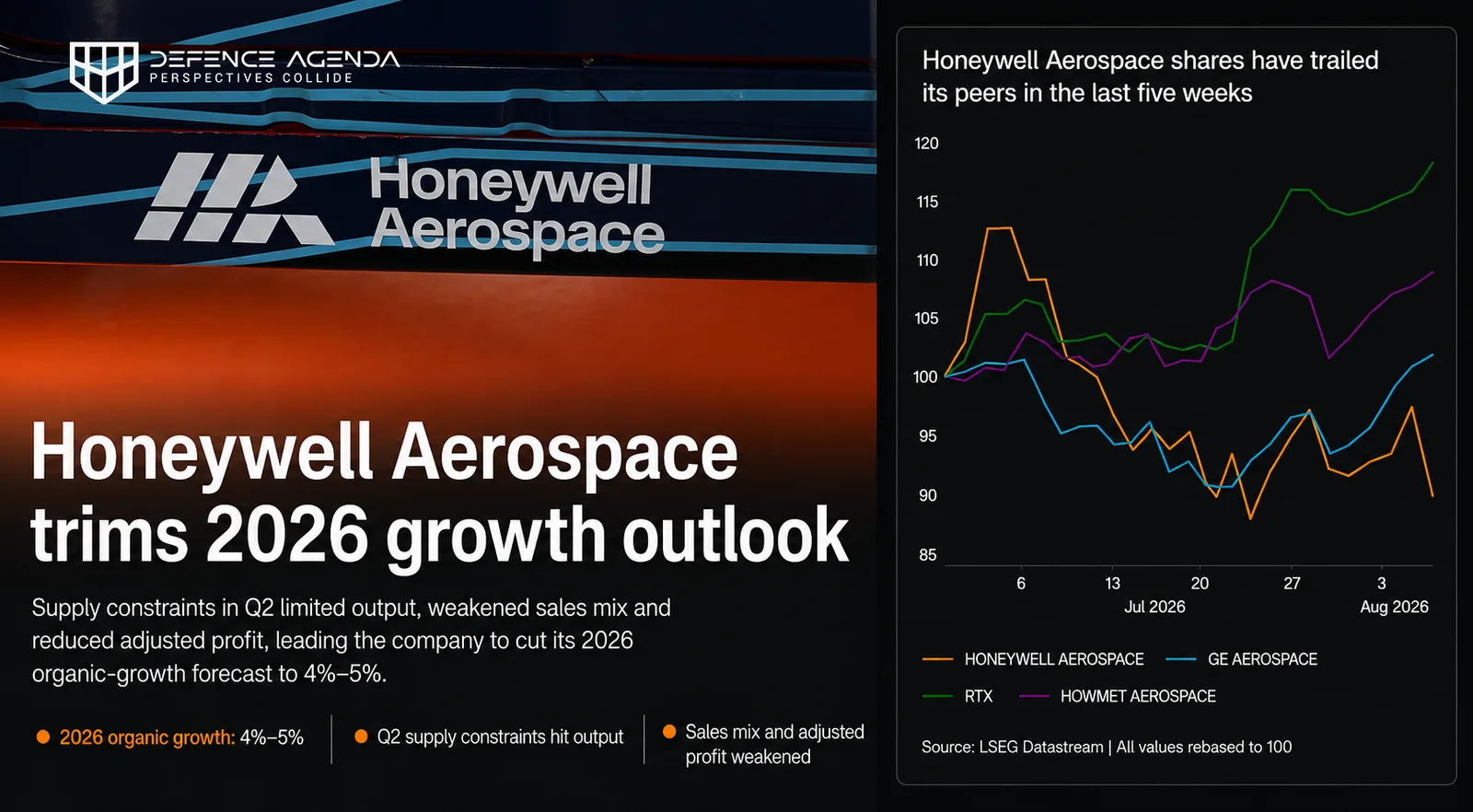
Honeywell Aerospace’s 2026 outlook has been reduced after persistent supply-chain constraints limited production growth, weakened the company’s sales mix and contributed to a sharp decline in its newly listed shares.
The aerospace and defence supplier now expects organic sales to grow between 4% and 5% during 2026, compared with its previous forecast of 7% to 9%.
Reuters reported on 6 August that Honeywell Aerospace shares fell as much as 26% during trading after the company lowered its forecast and issued annual adjusted earnings guidance below the analyst consensus.
The company’s official second-quarter results showed sales of $4.522 billion, an increase of 5%, while adjusted earnings per share fell 32% to $1.87.
Honeywell Aerospace said demand remained strong but the supply base had not produced the output increase expected earlier in the year. Management has therefore reset the full-year forecast to reflect demonstrated supplier capacity rather than projected improvements.
Key Facts
- Company: Honeywell Aerospace.
- Nasdaq ticker: HONA.
- Spin-off completed: 29 June 2026.
- Second-quarter sales: $4.522 billion.
- Sales growth: 5% reported and organic.
- Net income: $256 million, down 70%.
- Adjusted EBIT: $995 million, down 7%.
- Adjusted EPS: $1.87, down 32%.
- Quarter-end backlog: $18.154 billion, up 9%.
- Trailing 12-month orders: Up 8%.
- Previous organic-growth guidance: 7%–9%.
- Current organic-growth guidance: 4%–5%.
- Revised adjusted EBIT guidance: $4.35–$4.45 billion.
- Adjusted EPS guidance: $7.60–$7.90.
- Second-half free-cash-flow guidance: Unchanged at $1.0–$1.5 billion.
- Maximum intraday share decline reported by Reuters: 26%.
What Did Honeywell Aerospace Report for the Second Quarter?
Second-quarter sales increased by $233 million to $4.522 billion.
The increase reflected continued demand across commercial aviation, defence and space markets, but profitability did not rise with revenue.
| Financial Indicator | Q2 2026 | Q2 2025 | Change |
|---|---|---|---|
| Sales | $4.522 billion | $4.289 billion | +5% |
| Net income | $256 million | $852 million | -70% |
| Adjusted EBIT | $995 million | $1.066 billion | -7% |
| Earnings per share | $0.78 | $2.66 | -71% |
| Adjusted earnings per share | $1.87 | $2.75 | -32% |
| Backlog | $18.154 billion | $16.600 billion | +9% |
Sales and backlog continued to increase, indicating that customer demand remained present. The principal problem was converting that demand into sufficient production and a favourable mix of deliveries.
Why Did Honeywell Aerospace Cut Its 2026 Forecast?
Management had expected supplier improvements to produce a stronger increase in output during 2026.
That improvement did not occur at the required rate during the second quarter. Honeywell Aerospace therefore aligned its guidance with the production capability demonstrated by the supply chain at the end of June.
The company faces constraints in mechanical components and castings, which can limit the completion of engines, auxiliary power systems, avionics and control equipment even when demand and factory capacity are available.
A missing component can prevent delivery of an otherwise nearly completed assembly. This can delay revenue recognition and force management to allocate constrained parts between customers and business lines.
How Much Was the Guidance Reduced?
| 2026 Guidance Indicator | Previous Guidance | Current Guidance |
|---|---|---|
| Organic sales growth | 7%–9% | 4%–5% |
| Pro forma standalone adjusted EBIT | $4.65–$4.75 billion | $4.35–$4.45 billion |
| Adjusted EBIT growth | 7%–10% | Flat to 3% |
| Pro forma standalone adjusted EPS | Not previously issued in the comparable table | $7.60–$7.90 |
| Second-half free cash flow | $1.0–$1.5 billion | $1.0–$1.5 billion |
The midpoint of the adjusted EBIT range was reduced by $300 million.
The unchanged second-half free-cash-flow range indicates that management has not reduced every financial objective, but the cash-flow forecast remains a non-GAAP, forward-looking estimate.
Why Is Honeywell Prioritising Boeing and Airbus Deliveries?
Boeing and Airbus are attempting to increase commercial-aircraft production, creating demand for Honeywell Aerospace equipment installed during aircraft assembly.
Reuters reported that supply constraints are forcing Honeywell Aerospace to prioritise original equipment deliveries to the two manufacturers.
Meeting aircraft-production schedules can protect long-term customer relationships and prevent Honeywell components from delaying completed aircraft.
The trade-off is that constrained parts and labour may be redirected away from the commercial aftermarket, where repairs, spare parts, retrofits and upgrades can generate higher revenue and margins.
Why Does the Sales Mix Matter?
Two companies can report the same total sales but produce different profits depending on the products and services included in those sales.
Honeywell Aerospace’s aftermarket business benefits from a large installed base and demand for maintenance, replacement parts and upgrades.
Original equipment deliveries are strategically important but can have a different margin profile, particularly during production ramp-ups involving higher costs and constrained components.
Reuters also reported that the company is prioritising domestic defence and space programmes over typically higher-margin international work.
The combined effect is a less favourable expected mix during the second half of 2026, even though demand remains strong across the portfolio.
How Did Honeywell Aerospace’s End Markets Perform?
| End Market | Q2 2026 Sales | Q2 2025 Sales | Growth |
|---|---|---|---|
| Commercial Original Equipment | $679 million | $640 million | 6% |
| Commercial Aftermarket | $2.026 billion | $1.881 billion | 8% |
| Defense and Space | $1.817 billion | $1.768 billion | 3% |
Commercial Aftermarket remained the largest end-market category and recorded the strongest percentage growth.
Commercial Original Equipment growth was supported by higher commercial-air-transport shipments as deliveries moved closer to customer build schedules.
Defense and Space sales increased as higher US domestic volumes were partly offset by lower international output and the wind-down of a restricted government programme.
How Did Honeywell Aerospace’s Three Segments Perform?
| Segment | Q2 Sales | Sales Growth | Adjusted EBIT | EBIT Change |
|---|---|---|---|---|
| Electronic Solutions | $1.774 billion | 8% | $459 million | -3% |
| Engines and Power Systems | $1.406 billion | 1% | $174 million | -32% |
| Control Systems | $1.342 billion | 7% | $389 million | 8% |
Why Did Engines and Power Systems Profit Fall 32%?
Engines and Power Systems generated only 1% sales growth during the quarter.
Higher commercial original-equipment shipments were offset by lower defence and space shipments.
The company said an unfavourable product mix and higher costs more than offset pricing benefits, reducing segment adjusted EBIT from $256 million to $174 million.
This division therefore represented the largest segment-level profit decline and helps explain why total adjusted EBIT fell despite higher group sales.
Why Did Control Systems Perform Better?
Control Systems sales increased by 7%, led by commercial aftermarket activity.
Segment adjusted EBIT increased by 8% to $389 million because pricing more than offset higher costs.
The performance demonstrates that supply and cost pressures did not affect all Honeywell Aerospace businesses in the same way.
Why Did Net Income Fall More Than Adjusted EBIT?
Net income fell 70%, substantially more than the 7% decline in adjusted EBIT.
The company’s financial tables include transaction costs, interest and other financial charges, amortisation, stock compensation and environmental expenses that are treated differently in the adjusted measure.
Honeywell Aerospace reported $329 million in second-quarter transaction costs and $200 million in interest and other financial charges.
Adjusted EBIT should therefore not be treated as interchangeable with GAAP net income.
What Was the Market Reaction?
Honeywell Aerospace shares fell as much as 26% on 6 August, according to Reuters.
The shares were last down approximately 20% at the time of the Reuters report and were on course for their worst trading day since the company’s Nasdaq listing if those losses were maintained.
The reported percentages were intraday market values rather than an official closing result.
Reuters said the company’s adjusted EPS guidance of $7.60 to $7.90 was below the LSEG analyst consensus of $8.86.
J.P. Morgan reduced its share-price target from $255 to $235, while Jefferies also published a $235 target. Analyst targets represent opinions and are not forecasts issued by Honeywell Aerospace.
What Is Honeywell Aerospace Doing to Improve Supply?
- Qualifying more than 50 new suppliers
- Planning to qualify another 50 suppliers during the second half
- Increasing supplier-tooling expenditure by 20% in the second half compared with the first half
- Planning to double supplier-tooling expenditure between 2025 and 2027
- Directing approximately 70% of tooling investment towards castings
- Increasing the number of multi-sourced parts by more than 15% during 2026
- Expanding multi-sourcing and in-sourcing programmes
- Implementing the Honeywell Aerospace Operating System across the company
Adding a second source can reduce dependence on one supplier, but qualification may require engineering reviews, testing, regulatory approval and production validation.
The announced measures should therefore not be interpreted as an immediate elimination of every constraint.
Does the Company Still Have Strong Demand?
The available indicators suggest that demand remains stronger than current supply capability.
- Backlog increased 9% to $18.154 billion.
- Trailing 12-month orders increased 8%.
- Commercial aftermarket sales grew 8%.
- Commercial original-equipment sales grew 6%.
- Defense and Space sales grew 3%.
- Year-to-date new wins reached an estimated lifetime value of $15 billion.
The $15 billion new-wins figure represents estimated lifetime value rather than recognised revenue, near-term orders or cash received during 2026.
What Did the First Half Results Show?
| Six-Month Indicator | H1 2026 | H1 2025 |
|---|---|---|
| Net sales | $8.874 billion | $8.363 billion |
| Net income | $898 million | $1.638 billion |
| Net cash provided by operating activities | $346 million | $1.025 billion |
| Capital expenditure | $260 million | $234 million |
The six-month data show that sales increased but net income and operating cash generation were substantially below the previous-year period.
These figures include the financial effects of preparing Honeywell Aerospace to operate as an independent company.
How Does the Spin-Off Affect Comparability?
Honeywell Aerospace became an independent public company on 29 June 2026.
The second-quarter reporting period ended on 27 June, meaning the operating period was completed before the legal separation.
For periods before the spin-off, the company calculated earnings per share using approximately 317 million shares, reflecting the number outstanding at the separation date.
Guidance for adjusted EBIT and adjusted EPS is presented on a pro forma standalone basis and includes assumptions about the costs of operating independently.
Comparisons with the former Honeywell Aerospace Technologies segment may therefore be affected by corporate-cost allocations, separation expenses, financing and the treatment of transactions between the two companies.
What Do the Results Not Prove?
- The decline in the share price does not establish a permanent company valuation.
- The maximum 26% decline was an intraday movement, not a confirmed closing result.
- Higher backlog does not guarantee that every order will become revenue on schedule.
- The $15 billion of new wins is estimated lifetime value, not 2026 sales.
- Organic-growth guidance is a forecast rather than a guaranteed outcome.
- Adjusted EBIT and adjusted EPS are not GAAP net income and EPS.
- Strong demand does not prove that supplier constraints will be resolved quickly.
- Prioritising Boeing and Airbus does not mean aftermarket demand has weakened.
- Lower international defence output does not establish a decline in global demand.
- Supplier-qualification announcements do not mean every new supplier is already producing at full rate.
What Should Be Watched Next?
- Qualification of the additional 50 suppliers planned for the second half
- Availability of castings and other constrained mechanical components
- Evidence of higher production output during the third and fourth quarters
- Commercial aftermarket growth and margin performance
- Delivery rates to Boeing and Airbus
- Recovery in Engines and Power Systems profitability
- International Defense and Space sales
- Conversion of the $18.154 billion backlog into revenue
- Progress towards the revised $4.35–$4.45 billion adjusted EBIT range
- Achievement of the $1.0–$1.5 billion second-half free-cash-flow range
- Further separation-related expenses
- Updated 2027 supply-chain and financial guidance
Conclusion
Honeywell Aerospace’s first standalone earnings update presents a company with strong demand but insufficient supply-chain output.
Second-quarter sales increased by 5% and backlog rose by 9%, but adjusted EBIT declined by 7% and adjusted earnings per share fell by 32%.
The company reduced its 2026 organic-growth forecast from 7%–9% to 4%–5% and lowered its pro forma standalone adjusted EBIT range by $300 million.
Supply constraints are forcing management to prioritise original-equipment deliveries to Boeing and Airbus and US defence programmes over parts of the higher-margin aftermarket and international portfolio.
The resulting forecast reset prompted an intraday share decline of as much as 26% on 6 August.
The central test for the remainder of 2026 will be whether supplier qualification, tooling investment and multi-sourcing can produce a measurable increase in output without further weakening margins or cash generation.
Further Reading
- Reuters: Honeywell Aerospace shares fall after forecast reduction
- Reuters: Honeywell Aerospace cuts 2026 forecast on supply-chain constraints
- Honeywell Aerospace: Second-quarter 2026 results and updated outlook
- Honeywell Aerospace Investor Relations
- Honeywell Aerospace: Form 10 filing and standalone company structure