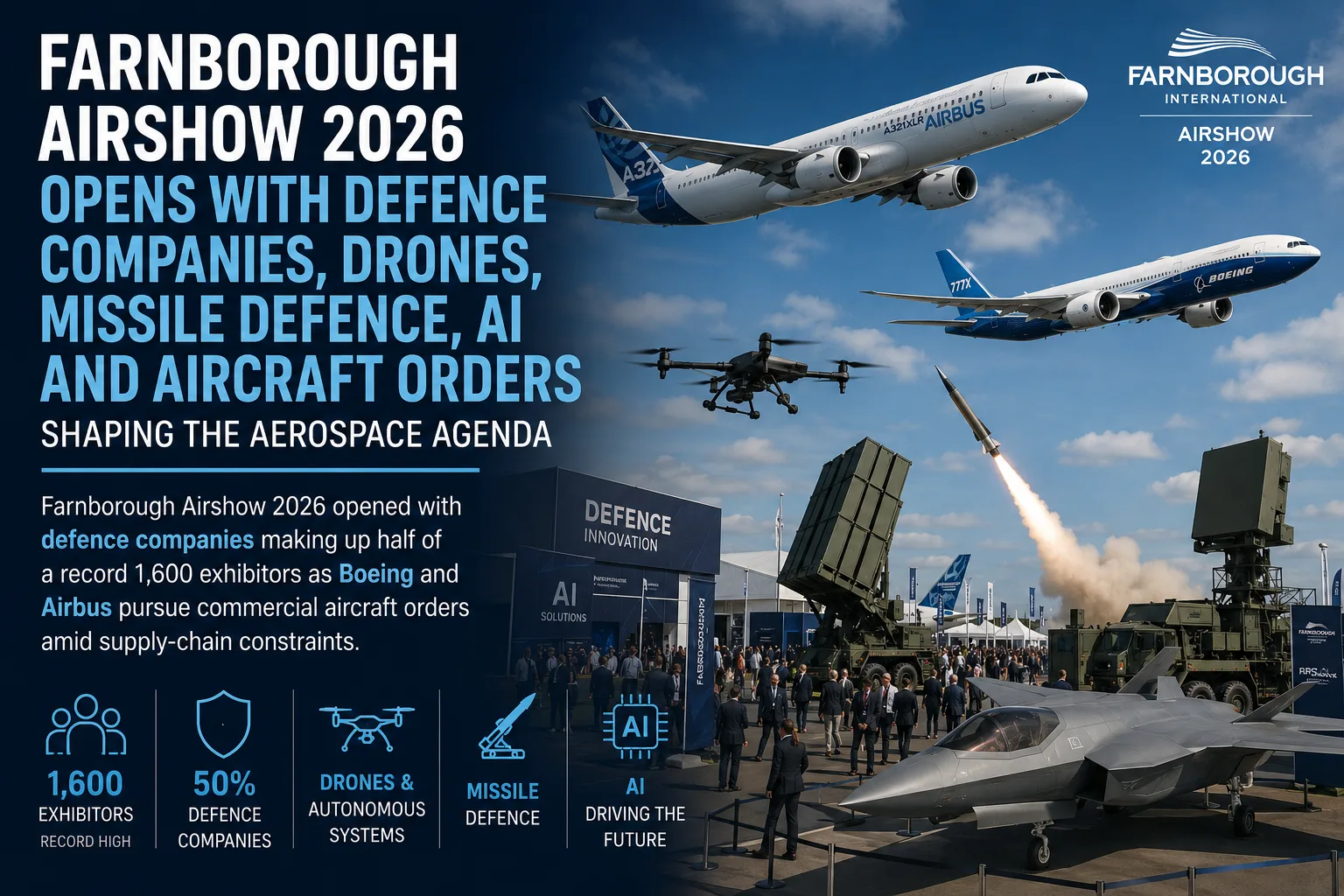
Farnborough Airshow 2026 opened with defence companies, aircraft orders and conflict-driven aerospace demand shaping the agenda for one of the world’s most important aviation events.
According to Reuters, Boeing and Airbus are pursuing aircraft deals during the July 20–24 event, while defence firms are competing for a larger share of rising military budgets. Organisers say defence companies account for half of a record 1,600 exhibitors at the show.
The shift highlights how Farnborough is no longer only a commercial aviation showcase. Conflicts in Ukraine and the Middle East have pushed drones, missile defence, artificial intelligence and autonomous systems into the centre of the aerospace agenda.
Farnborough Airshow 2026 Reflects a Defence-Heavy Aerospace Market
Farnborough Airshow 2026 shows how defence demand is reshaping the aerospace industry. The event began in 1948 as a showcase for British aerospace technology. Today, it is also a marketplace for unmanned systems, missile-defence technologies, autonomous software and next-generation airpower concepts.
This reflects a wider change in government priorities. European and allied countries are increasing defence budgets, rebuilding stockpiles and looking for technologies that can respond to lessons from recent wars.
For defence companies, Farnborough now offers a platform to position systems not only as future concepts but as operational answers to urgent requirements.
Drones, Missile Defence and AI Move to the Foreground
Reuters notes that conflicts have accelerated demand for unmanned fighter jets, kamikaze drones and autonomous AI software. These areas are now central to procurement planning because they affect how forces find targets, strike at range and protect critical assets.
Drones are changing the cost equation in air defence. Low-cost unmanned systems can saturate sensors and force defenders to spend expensive interceptors on cheaper targets. As a result, counter-drone systems and affordable air-defence effectors are becoming major industry priorities.
Missile defence is also rising in importance. Ukraine’s experience has shown that modern air defence must be layered, integrated and supported by large interceptor stockpiles. This is increasing demand for radars, command-and-control systems, interceptors and electronic warfare capabilities.
Commercial Aircraft Orders Remain Important
Commercial aviation remains a major part of Farnborough. Reuters reported that Airbus and Boeing are together expected to secure a little over 300 aircraft orders unless late negotiations add more deals.
However, the expected total is below some analyst forecasts of 800 aircraft or more. The main reason is supply-chain pressure. Aircraft manufacturers are still working through production constraints that limit how quickly they can deliver aircraft.
This gives the show a dual character. Airlines and lessors still need new aircraft, but manufacturers must balance order announcements with production discipline and delivery reliability.
Boeing and Airbus Face Production Pressure
Boeing and Airbus enter Farnborough with strong demand but constrained output. Both companies continue to face supply-chain challenges across engines, aerostructures, skilled labour and certification processes.
Reuters reported that the head of Boeing’s commercial airplane unit said the company is focused on increasing and improving aircraft production rather than prioritising order announcements.
This message is important. In the current market, order books are already deep. Airlines need delivery certainty as much as they need headline orders.
SMBC, Riyadh Air and Turkish Airlines in the Spotlight
Among the expected commercial announcements, Reuters reported that Irish leasing company SMBC Aviation Capital could order around 100 narrowbody aircraft from each of the two major manufacturers.
Other airlines discussing orders include Riyadh Air and Philippine Airlines. Reuters also noted that there were no immediate signs of a breakthrough in talks between Turkish Airlines and engine makers over long-term maintenance agreements linked to a planned purchase of 150 Boeing 737 MAX jets.
These discussions show that engine support, maintenance economics and long-term fleet strategy are now as important as aircraft pricing in major airline procurement decisions.
Farnborough’s Defence Shift Mirrors Global Spending Trends
The defence-heavy character of Farnborough Airshow 2026 mirrors broader market conditions. Governments are spending more on air defence, long-range strike, unmanned systems, secure communications and space-enabled capabilities.
For European industry, this creates both opportunity and pressure. Companies must scale production while adapting to fast-changing requirements from Ukraine, NATO and national defence ministries.
The result is a more integrated aerospace-defence market. Commercial aircraft, military aircraft, drones, AI, space systems and missile defence are increasingly discussed together because they rely on overlapping supply chains and engineering capacity.
Conclusion
Farnborough Airshow 2026 opens at a moment when aerospace priorities are being reshaped by war, supply-chain pressure and rising defence budgets. Commercial aircraft orders still matter, but defence technologies are now central to the event’s strategic relevance.
The main question is whether industry can convert demand into output. Aircraft manufacturers must improve production performance, while defence companies must deliver scalable systems for drones, missile defence, AI-enabled operations and future air combat.
For further Defence Agenda coverage, read our aerospace, defence industry and drones sections. Related analysis includes NATO’s $40 billion counter-drone investment, Europe’s deep precision strike initiative and ITAR-free defence products in Europe.