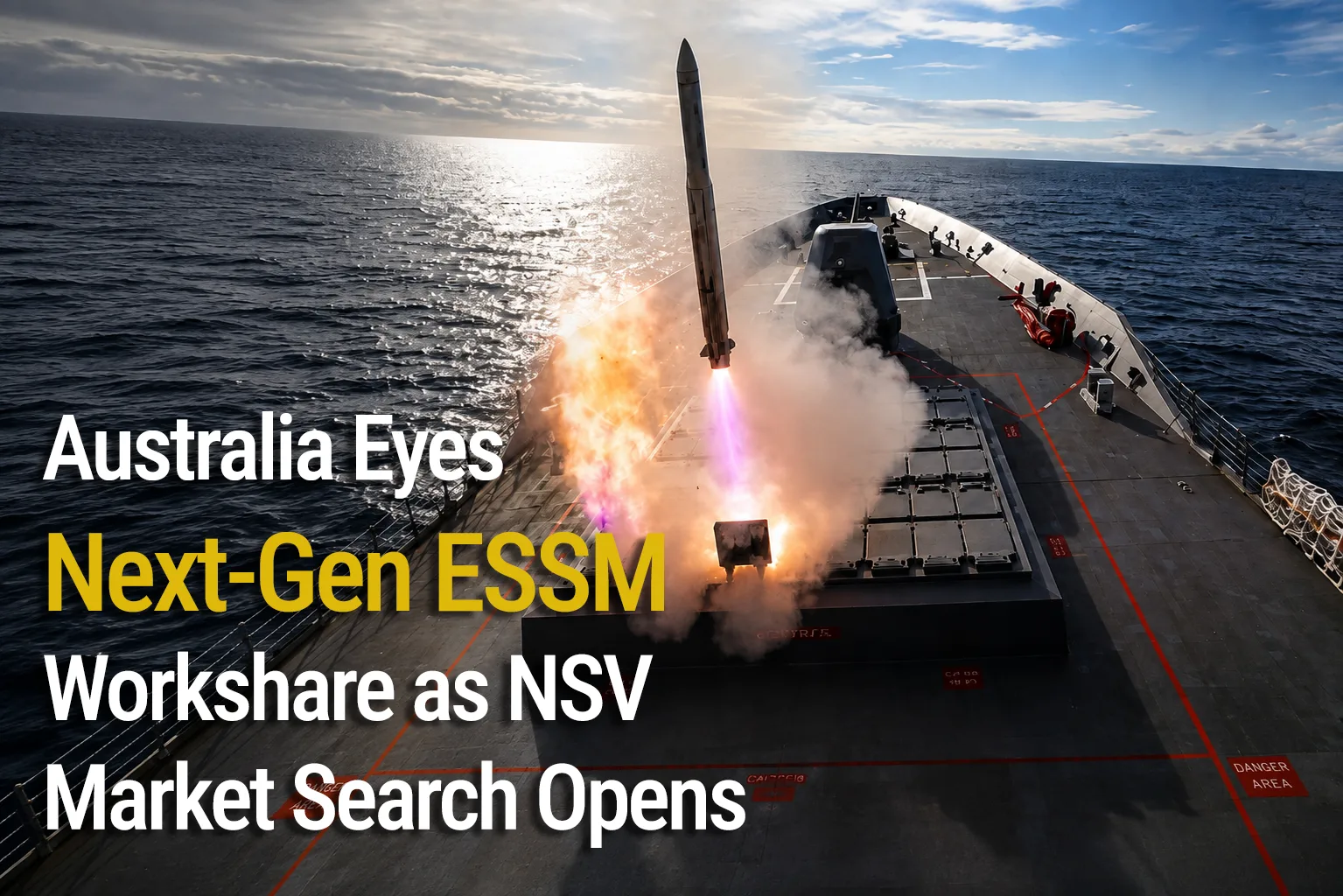
Australian defence companies have been invited to compete for development and production work on the Next Significant Variant (NSV) of the Evolved SeaSparrow Missile, as the NATO SeaSparrow Project Office begins market research for the missile family that will follow ESSM Block 2.
The U.S. Navy’s 20 August 2026 Sources Sought notice, N00024-26-R-5445, seeks complete Guided Missile Assembly concepts as well as subsystem proposals covering propulsion, seekers, guidance and navigation, control actuation, communications, software, kill mechanisms, advanced manufacturing and systems engineering. Australia is one of 12 NATO SeaSparrow consortium nations, and the notice requires the resulting missile and associated technical data to be releasable across the entire consortium. Responses are due on 19 October 2026.
Key Facts
- Programme: Evolved SeaSparrow Missile Next Significant Variant
- Notice: N00024-26-R-5445
- Issuing organisation: NATO SeaSparrow Project Office / U.S. Naval Sea Systems Command
- Notice type: Sources Sought / market research
- Posted: 20 August 2026
- Response deadline: 19 October 2026
- Launcher constraint: 10-inch missile diameter compatible with Mk 41 VLS quad-pack canister
- Australian status: Full consortium member and existing ESSM industrial contributor
- Current procurement status: No RFP, contract award or programme funding announced through this notice
The Opportunity Is Market Research, Not an Award
The most important procurement distinction is that the NSV notice is not a Request for Proposal and does not establish a funded missile-development contract.
The NATO SeaSparrow Project Office says the Sources Sought activity is intended to identify industry capabilities and help shape a possible future acquisition. The office may later use a conventional Federal Acquisition Regulation contract or a prototype Other Transaction, but the August notice itself carries no funding and creates no commitment to procure a particular design.
For Australian companies, this means the current opportunity is to influence the future architecture, demonstrate technical maturity and position for later prime- or subcontractor work rather than compete for an already-defined production contract.
Failure to respond does not formally prevent participation in a later solicitation, but early engagement gives companies an opportunity to establish relevant technology, exportability and industrial readiness before the NSV acquisition strategy is fixed.
NSV Must Remain Quad-Pack Compatible
The most consequential physical constraint is continuity with the Mk 41 Vertical Launching System.
The NSPO requires the NSV to remain within a 10-inch diameter so that four missiles can fit in a Mk 41 tactical module using a quad-pack canister or an equivalent launching arrangement.
This preserves one of ESSM’s most important fleet-level advantages: magazine density. A destroyer or frigate can dedicate one Mk 41 cell to four ESSMs rather than one larger interceptor.
The design challenge is therefore to increase performance while preserving the missile’s compact envelope. The notice specifically asks industry to minimise weight while maximising performance.
That constraint makes subsystem efficiency particularly important. Propulsion, seekers, control systems, power, datalinks, processors and the warhead all compete for limited internal volume.
The Threat Requirement Is Broader Than Block 2
The NSV is intended to operate against current and future threats across a wide range of velocities, altitudes, manoeuvre profiles and signatures.
The Sources Sought notice calls for performance from low-speed to high-speed threats, from sea-skimming profiles to high-diving trajectories and from non-manoeuvring targets to high-G manoeuvring threats.
It also requires operation in complex and contested radio-frequency, electro-optical and infrared environments.
Of particular importance, the missile must be able to discriminate and resolve multiple closely spaced targets and provide threat-track measurements that support guidance, navigation and lethality functions.
The missile is also expected to handle threat countermeasures. The public notice does not disclose specific classified target sets or minimum engagement ranges.
Seeker Technology Is a Major Workshare Opportunity
The seeker is one of the clearest areas for international industry participation.
Earlier in 2026, the NSPO separately sought concepts for a releasable seeker assembly for the NSV. That market research emphasised an open, modular and standards-driven architecture capable of being shared among all 12 consortium nations.
The broader August notice now invites both full missile solutions and subsystem proposals. Seeker responses are expected to address search performance, operating environments, sensing modality and the number of seekers that could operate simultaneously without seeker-to-seeker interference.
This is relevant because ESSM Block 2 already moved beyond Block 1’s purely semi-active terminal guidance by introducing active and semi-active guidance. NSV is therefore being designed for another generation of sensor, processing and discrimination improvement rather than a simple continuation of the current Block 2 seeker.
Propulsion Must Increase Performance Without Breaking the Envelope
Propulsion is another explicit focus area.
ESSM Block 2 retained the propulsion section of Block 1 while introducing a larger 10-inch guidance section and a new dual-mode seeker. The NSV market research creates the opportunity to revisit the missile more broadly, including propulsion technology.
Companies proposing propulsion subsystems must explain how their technology meets the missile’s dimensional limits and the required engagement envelope.
For Australian industry, this area aligns with Canberra’s broader effort to build sovereign rocket-motor capability under the Guided Weapons and Explosive Ordnance enterprise. However, the NSV notice does not guarantee Australian propulsion workshare or identify any Australian company as a selected supplier.
The industrial opportunity exists because subsystem-focused responses are explicitly encouraged.
Open Architecture Is a Core Acquisition Requirement
The NSPO is placing unusually strong emphasis on Modular Open Systems Approach principles and government data rights.
The missile is expected to use a modern, flexible and modular design so future upgrades can be inserted without redesigning the entire weapon.
Respondents must identify proprietary restrictions, data-rights limitations and components that would not be government-owned or open-source licensed. The government is seeking extensive rights in technical data, software, source code, design artefacts and interface specifications.
The notice also calls for a Level 3 Technical Data Package sufficient for a competent manufacturer to reproduce the physical, interface and functional characteristics of the delivered item.
This requirement has major industrial implications. A future NSV supplier must offer not only performance but also an architecture that prevents one proprietary subsystem from becoming an upgrade bottleneck for the 12-nation consortium.
Releasability Across All 12 Nations Is Non-Negotiable
Any missile, subsystem or associated technical data proposed for NSV must be releasable to Australia, Belgium, Canada, Denmark, Germany, Greece, the Netherlands, Norway, Portugal, Spain, Türkiye and the United States.
That creates both an opportunity and a constraint for Australian industry.
Australian-developed technology can enter a multinational production system with access to multiple navies, but companies must be able to manage ITAR, EAR and other export-control requirements while accepting that relevant technical information may need to be shared across the consortium.
The NSPO specifically asks respondents to identify any risks associated with disclosing their technologies to all member nations.
This favours companies with prior experience in multinational defence programmes and mature export-control processes.
Australia Already Has an ESSM Industrial Base
Australia is not entering the SeaSparrow industrial ecosystem for the first time.
The Australian Guided Weapons and Explosive Ordnance Plan identifies BAE Systems Australia as the national industry lead for ESSM and says Australian companies have manufactured and supplied missile sub-assemblies into the multinational programme.
BAE Systems Australia has participated in ESSM since the Engineering and Manufacturing Development phase in the 1990s and continued into Block 1 production and Block 2 development.
Under a 2022 full-rate production contract, BAE Systems Australia and its local supply network supported Block 2 with thrust-vector-control hardware, aerodynamic control fins, fuselage and internal structural elements, telemetry systems and pitch-over autopilot algorithms.
That previous work gives Australian industry a credible entry point for NSV because the Sources Sought specifically asks respondents to document recent missile-system experience, manufacturing readiness, international programme performance and model-based systems engineering capability.
Australian SMEs Have Already Entered the ESSM Supply Chain
Australia’s existing contribution extends beyond a single prime contractor.
BAE Systems Australia has previously identified local suppliers including RUAG Australia, Ronson Gears and Astute Electronics, while additional ESSM Block 2 work has involved Australian firms across mechanical, electronics and manufacturing activities.
The 2022 Block 2 production programme was expected to involve up to 33 Australian SMEs in the broader network.
The NSV process creates a route for that ecosystem to expand into new technologies rather than simply continue legacy component manufacture.
Subsystems explicitly identified in the new notice include airframe, propulsion, guidance/navigation/control, seeker, kill mechanism, control actuation, datalink, communications and software architecture.
Australia’s GWEO Strategy Makes NSV Industrially Relevant
The timing aligns directly with Australia’s national guided-weapons strategy.
The Australian Guided Weapons and Explosive Ordnance Plan states that Australia intends to progress from having no dedicated guided-missile manufacturing factories to at least two purpose-built missile factories by 2029 and a dedicated solid-rocket-motor manufacturing facility by 2030.
The plan also identifies more than A$500 million for Australian industry uplift so domestic companies can manufacture components and subsystems for guided weapons.
From 2026–2030, the plan emphasises production of selected weapon subsections and components, including rocket motors and warheads, as well as broader industrial capability for future weapons.
NSV therefore arrives at a time when Australia is actively seeking multinational co-development and co-production pathways rather than limiting sovereign capability to final assembly.
ESSM Remains Central to Australia’s Naval Air Defence
The industrial opportunity is strengthened by the missile’s operational importance to the Royal Australian Navy.
Australia’s official GWEO Plan identifies ESSM as a medium-range surface-to-air missile used to protect warships from anti-ship cruise missiles and other airborne threats.
It identifies the Mk 41 Vertical Launching System on the Anzac-class frigates, Hobart-class destroyers and future Hunter-class frigates as ESSM launch platforms.
The combination of an existing national inventory, multinational programme membership and domestic industrial workshare means Australia is both an operational customer and a production participant.
That differs from a conventional foreign military sale in which Australian companies may have limited influence over future design changes.
Block 2 Provides the Technical Baseline
ESSM Block 2 entered Initial Operational Capability in 2021 and introduced active guidance while retaining semi-active capability.
RTX says the active-seeker architecture reduces dependence on shipboard target illumination and provides significant digital-processing margin for software upgrades.
The missile is integrated with multiple combat systems and launcher configurations and is designed for ship self-defence against high-speed, low-altitude anti-ship cruise missiles and other threats.
NSV should not be described simply as “ESSM Block 3” because the NATO SeaSparrow Project Office’s public terminology is Next Significant Variant.
The final designation, production configuration and relationship to future Block 2 upgrades have not been publicly established.
Magazine Density Is Becoming More Valuable
The quad-pack requirement reflects a broader naval-warfare problem: modern warships need more defensive engagements than their vertical-launch magazines can easily support.
Large interceptors can provide greater range and capability, but one missile per Mk 41 cell limits the total number of shots available without rearming in port.
ESSM’s compact size allows four missiles in one cell, making it a central layer between point-defence weapons and larger fleet-air-defence interceptors.
The NSV requirement seeks to preserve that density while improving performance against increasingly complex threats.
This creates a difficult engineering trade. Greater range, larger seekers, more computing power and improved manoeuvrability normally demand more volume, mass or energy. NSV must gain capability without losing the architecture that makes ESSM operationally attractive.
The Notice Creates Opportunities Beyond Hardware
Australian participation does not have to be limited to physical missile components.
The NSPO specifically requests capabilities in software and firmware development, modelling and simulation, model-based systems engineering, digital engineering, system integration, verification and validation.
This expands the relevant Australian industrial base to companies working in aerospace software, autonomy, modelling, digital engineering and high-end systems integration.
The notice also asks companies to describe maintainability, reliability, recertification and test approaches that avoid dependence on proprietary test equipment or algorithms.
Lifecycle-support capability could therefore become an industrial workshare area alongside design and manufacturing.
No Australian Company Has Yet Won NSV Work
The opportunity should not be overstated.
The Sources Sought notice does not identify BAE Systems Australia, Raytheon Australia or any Australian SME as a selected NSV contractor.
It also does not guarantee that workshare will be allocated according to each consortium member’s procurement share or previous Block 2 participation.
Companies must demonstrate technology readiness, manufacturing readiness, cost, schedule, exportability and technical performance.
NSPO may decide to pursue a complete missile from one integration team, multiple subsystem suppliers or another acquisition structure after reviewing industry submissions.
Limitations and Counterpoint
The NSV remains at market-research stage. There is no current RFP, funded development contract, production quantity, unit cost or fielding date in the public notice.
Detailed performance requirements beyond the publicly released summary are controlled and require an NDA/Terms of Use Agreement before access.
The public notice does not provide specific range, speed, seeker frequency, warhead performance or target-set requirements.
Australian industry’s established Block 2 workshare provides relevant experience but does not automatically transfer into the NSV.
Likewise, Australia’s planned sovereign rocket-motor and guided-weapons manufacturing investments create possible industrial alignment, but no source reviewed for this article confirms that NSV propulsion will be manufactured in Australia.
Implications / Next
The first milestone is the 19 October 2026 response deadline. The scale and quality of consortium-industry responses will shape whether NSPO moves toward a prime-led complete missile solution or a more distributed subsystem architecture.
The second indicator will be any subsequent RFP or prototype Other Transaction. That document would clarify development schedule, evaluation criteria, funding and workshare structure.
The third is Australian industry participation. Confirmation that BAE Systems Australia or another Australian supplier submits seeker, propulsion, control, software or structural technology would show whether Australia is attempting to move beyond its existing ESSM workshare.
The fourth is the intersection with Australia’s domestic GWEO investments. If future rocket-motor, warhead or missile-component factories qualify for NSV production, the programme could become an export-driven anchor workload rather than only a Royal Australian Navy procurement.
Conclusion
The ESSM Next Significant Variant Sources Sought notice gives Australian industry a genuine opportunity to influence the next generation of one of the Royal Australian Navy’s most important ship-defence missiles.
The opportunity is broader than traditional component manufacture. NSPO is seeking technologies across propulsion, seekers, guidance, communications, software, control systems, kill mechanisms and digital engineering, while requiring an open architecture and releasability across all 12 consortium nations.
Australia enters the process with an advantage: it is already a SeaSparrow consortium member with decades of ESSM industrial participation and a national policy to expand guided-weapons manufacturing.
But the programme remains pre-acquisition. The next test is whether Australian companies can translate existing Block 2 experience and new sovereign GWEO investment into competitive technology proposals that earn workshare in the missile that follows ESSM Block 2.