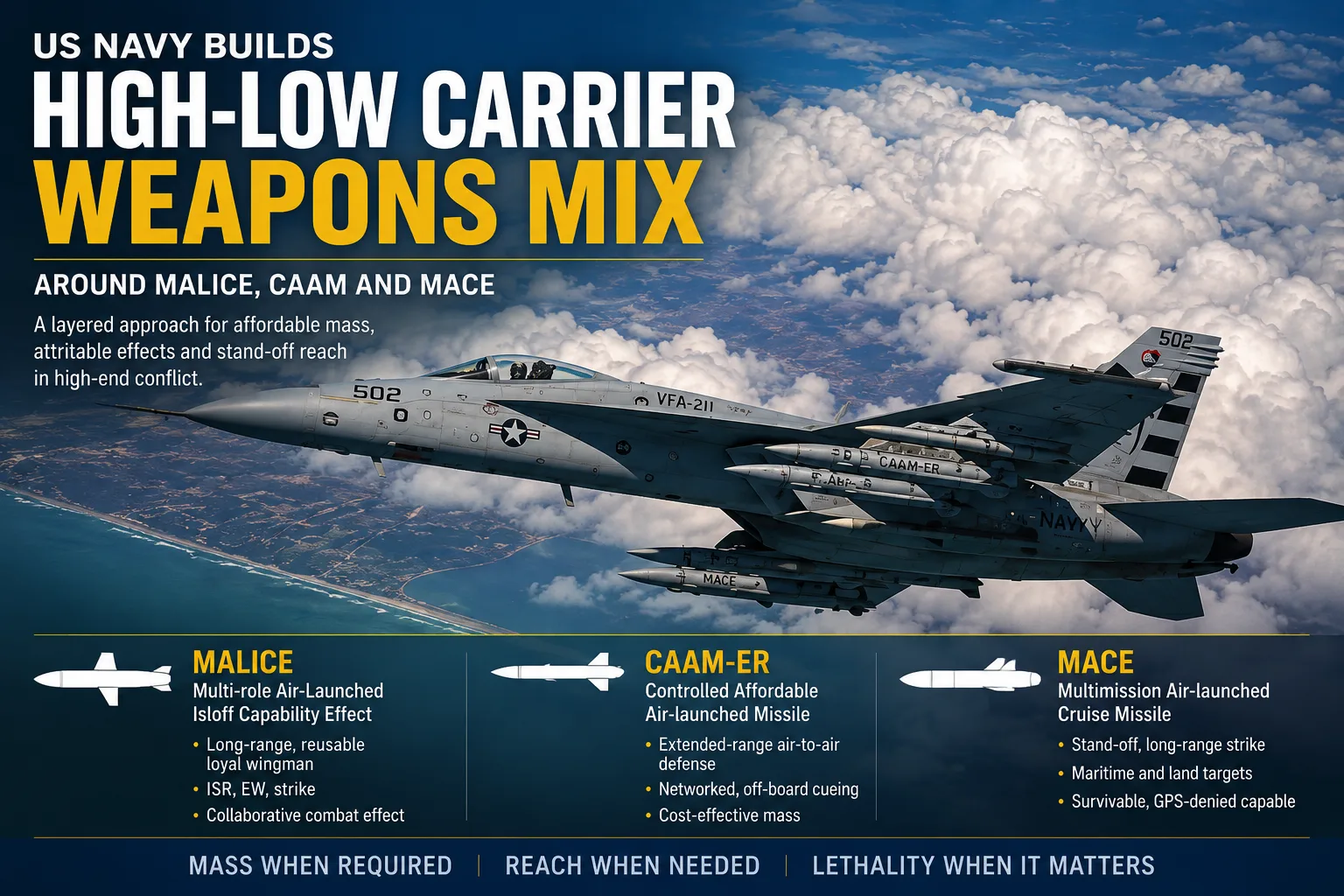
The U.S. Navy is bringing a new high-low weapons architecture into view for its carrier air wings, combining the AIM-424 Malice very-long-range air-to-air missile, a proposed Compact Air-to-Air Missile (CAAM) for close engagements and deeper magazines, and the MACE/Blackbeard low-cost hypersonic strike programme for affordable long-range offensive mass.
Aviation Week’s 28 August 2026 analysis describes a three-part munitions strategy intended to extend both carrier magazine depth and the distance from which naval aircraft can defend the fleet. The subscription-protected article preview does not expose the full three-programme discussion, so this Defence Agenda package reconstructs the publicly verifiable picture using related Aviation Week reporting from the same week, official U.S. Navy releases, Navy budget statements, Department of War contracts and manufacturer disclosures.
Key Facts
- Strategic concept: High-low carrier-air-wing weapons mix
- High-end air-to-air: AIM-424 LRAAM “Malice”
- Malice range: In excess of 250 nautical miles / 463 km
- Close-range / magazine-depth concept: Compact Air-to-Air Missile (CAAM)
- CAAM status: Requirements under Navy evaluation; no production award announced
- Low-cost hypersonic strike: MACE / Castelion Blackbeard
- Blackbeard near-term path: F/A-18E/F integration and Early Operational Capability
- FY2027 Navy weapons request: $22.6 billion for more than 4,600 all-up rounds across the portfolio
A Three-Layer Carrier-Air-Wing Weapons Strategy
The Navy’s emerging plan addresses three different problems rather than trying to solve every engagement with one premium missile.
At the outer end, AIM-424 Malice is intended to push the defensive counter-air engagement zone hundreds of nautical miles away from the carrier. At the inner end, CAAM is being examined as a compact weapon for extremely short-range engagements where conventional air-to-air missiles can face minimum-range limitations. In the strike role, MACE/Blackbeard aims to add hypersonic speed without accepting the small inventories traditionally associated with expensive hypersonic weapons.
The common logic is magazine economics. Carrier aircraft can only carry a finite number of weapons, carriers only store a finite number of reloads, and the Navy must preserve enough high-end rounds for targets that justify them while fielding cheaper or more compact weapons for other engagements.
This is especially relevant in the Indo-Pacific, where carrier air wings may need to defend against aircraft, cruise missiles and unmanned systems while also generating long-range offensive strikes across very large distances.
AIM-424 Malice Pushes Fleet Defence Beyond 250 Nautical Miles
The most visible new system is the AIM-424 Long Range Air-to-Air Missile, officially named Malice. The Navy publicly revealed the programme at the Tailhook Symposium on 22 August 2026 after flight testing had already begun.
The Navy’s official fact file identifies Raytheon as the contractor and gives Malice a range in excess of 250 nautical miles, or 463 km. The missile is 13.5 feet long, 13.5 inches in diameter, weighs approximately 1,500 lb and uses a solid-propellant rocket motor with a blast-fragmentation warhead.
The Navy says Malice is designed for fourth-, fifth- and sixth-generation aircraft. Public imagery shows testing on the F/A-18E Super Hornet and fit checks or integration work involving the F-35C.
The missile’s importance is not only nominal range. A very-long-range air-to-air weapon allows carrier fighters to threaten enemy aircraft before those aircraft can reach favourable launch positions for their own anti-ship weapons.
Malice Extends the Defensive Perimeter Around the Carrier
Carrier defence increasingly requires defeating the launch platform rather than only intercepting the weapon after launch.
Long-range bombers and tactical aircraft can carry anti-ship cruise missiles or other standoff weapons capable of being released well outside the immediate defensive envelope of a carrier strike group. If naval fighters can threaten those aircraft at more than 250 nautical miles, the engagement can move outward before the attacker releases its weapons.
This creates an additional defensive layer ahead of ship-launched Standard Missiles, Evolved SeaSparrow Missiles, Rolling Airframe Missiles, guns and electronic warfare.
Malice therefore contributes to fleet air defence even though it is carried by aircraft rather than ships. The carrier air wing becomes an extension of the strike group’s defensive missile architecture.
Malice Does Not Replace Every Existing Air-to-Air Missile
A 1,500-lb weapon with a 250-plus-nautical-mile envelope is not the correct economic or tactical solution for every aerial target.
Naval fighters still need weapons for conventional beyond-visual-range engagements and short-range combat. The Navy also fields the AIM-174B Gunslinger, an air-launched configuration derived from SM-6, while the AIM-120 AMRAAM and AIM-9X Sidewinder continue to cover other engagement zones.
The emerging portfolio should therefore be understood as layered. Malice creates a premium long-range option, while other weapons fill medium- and short-range roles at different costs and carriage densities.
The Navy has not publicly disclosed Malice unit cost, procurement quantity, Initial Operational Capability date or detailed seeker and guidance architecture.
CAAM Addresses the Opposite End of the Engagement Envelope
The Compact Air-to-Air Missile sits at the other end of the high-low architecture.
Aviation Week reported on 25 August that Navy officials are assessing requirements for CAAM as a future “inner boundary weapon.” The concept appeared publicly on a Tailhook briefing slide three days earlier.
The inner boundary is the minimum distance within which a missile may not have enough time or space to complete launch, arming, guidance and fuzing functions before reaching the target.
A compact missile designed specifically for this geometry could give a fighter another engagement opportunity against a target that has penetrated too close for a conventional air-to-air weapon.
The Navy has not announced a selected contractor, final design, range, weight, production quantity or operational date for CAAM.
CAAM Could Increase F-35C Magazine Depth
Compact size can create a second benefit: more weapons per aircraft.
Fifth-generation aircraft preserve low observability by carrying weapons internally. Internal bay volume therefore becomes a hard limit on missile capacity.
A smaller air-to-air missile could allow an F-35C or future stealth platform to carry more interceptors without using external pylons. This would be especially useful against massed lower-cost threats, including some classes of unmanned aircraft, where using a very-long-range premium missile would create an unfavourable cost exchange.
Aviation Week notes that CAAM could require lock-on-after-launch functionality if carried internally. Earlier Navy acquisition planning also linked the concept to highly loaded grain solid-propellant technology intended to increase total impulse within a compact volume.
Those technical concepts remain developmental. The public Navy position is that CAAM requirements are still being evaluated.
Malice and CAAM Solve Different Magazine Problems
Malice increases the distance at which one missile can influence the battlespace. CAAM aims to increase how many useful defensive engagements can be carried inside a fighter’s limited weapon volume.
Together they illustrate why “high-low” should not be reduced simply to expensive versus cheap.
The high end may buy range, speed, seeker sophistication and the ability to threaten strategically important aircraft. The low or compact end may buy quantity, better cost exchange and more shots before an aircraft must return to rearm.
The ideal mix depends on target type and engagement geometry. A carrier air wing facing a small number of high-value airborne launch platforms has a different requirement from one defending against large numbers of drones or missiles.
MACE Adds a Low-Cost Hypersonic Strike Layer
The third major element is offensive rather than defensive.
The Navy’s Multi-mission Affordable Capacity Effector programme is moving Castelion’s Blackbeard hypersonic weapon toward operational integration on the F/A-18E/F.
The Department of War awarded Castelion $49.998 million in February 2026 for prototypes, flight testing, integration and early operational capability work. In April, the Navy added a $104.999 million modification for final EOC requirements, F/A-18 integration, certification and live-fire testing in the Indo-Pacific Command area.
Castelion says the programme is targeting Early Operational Capability in 2027.
The programme’s strategic premise is that hypersonic strike should not remain limited to very small inventories of extremely expensive weapons.
Blackbeard Is Moving Into Operationally Relevant Quantities
The Navy’s Blackbeard activity accelerated throughout 2026.
A June order covered 50 Early Operational Capability pre-production prototypes and associated containers. On 25 August, the Navy awarded another $89.997 million SBIR Phase III order to advance Blackbeard to EOC, provide 50 weapons, incorporate Defense Exportability Features and support transition to a Navy Program of Record.
These contract actions should not simply be added together and described as several independent production buys. They represent sequential development, integration, certification and early-production steps within the same transition pathway.
The important point is scale. The Navy is moving from flight-test articles toward dozens of operationally relevant rounds while building the integration and manufacturing infrastructure required for larger procurement.
MACE Tests Whether Hypersonic Speed Can Become Affordable Mass
Traditional hypersonic programmes have generally been associated with high unit costs, complex materials and relatively small planned inventories.
Blackbeard is intended to challenge that model through vertically integrated production and a design optimised for manufacturing scale.
The Department of War has established a broader production framework under which Blackbeard could move to at least 500 missiles annually after testing and validation. That future production rate remains conditional and should not be described as a currently funded annual Navy purchase.
The strategic attraction is clear: a carrier air wing with hundreds of lower-cost high-speed strike weapons has a different operational effect from one possessing only a small number of exquisite hypersonic rounds.
F/A-18 Integration Keeps the Near-Term Plan Grounded in the Existing Fleet
One notable feature of the weapons plan is that it does not wait for F/A-XX.
Malice is already being tested on F/A-18E aircraft, and Blackbeard is being integrated on the Super Hornet for a planned 2027 EOC. CAAM is a future concept that could also benefit current and future carrier aircraft depending on final requirements.
This allows the Navy to improve carrier-air-wing lethality before a sixth-generation fighter enters service.
The approach also reduces programme coupling. Delays to F/A-XX do not automatically delay every new weapon intended for the future carrier air wing.
F-35C Internal Carriage Is a Second Design Driver
The F-35C introduces a different requirement from the Super Hornet because low-observable operations favour internal carriage.
The Navy’s Malice fact file says the missile is designed for fifth-generation platforms, while public Navy imagery demonstrates internal-bay compatibility work on the F-35C.
CAAM may benefit even more from compact internal carriage because the operational goal includes increasing defensive magazine depth.
MACE/Blackbeard is currently centred on F/A-18 integration in publicly confirmed Navy contracting. No equivalent operational F-35C Blackbeard integration programme was identified in the public sources reviewed for this package.
The FY2027 Budget Makes Magazine Depth an Industrial Policy
The emerging weapons architecture is backed by a much larger procurement push.
During the FY2027 budget rollout, Navy leadership said the service requested $22.6 billion for weapons procurement, enough to fund more than 4,600 all-up rounds across the portfolio.
The Navy also said it was investing an additional $1.6 billion in the weapons industrial base in FY2027 after approximately $1.5 billion the previous year. The objective is to raise production rates for systems including Standard Missile, Tomahawk, AMRAAM and PAC-3 while strengthening lower-tier suppliers.
Another $370 million was identified for innovative systems including MACE, CHAOS and RAPTOR.
The strategy therefore combines new missile designs with production-line expansion for existing weapons. Magazine depth is not achieved by inventing more missile types alone; factories must also be able to manufacture and replenish them at wartime-relevant rates.
The Navy Is Expanding Its Low-Cost Strike Portfolio Beyond MACE
MACE is not the only affordable-strike programme in the Navy portfolio.
The Navy’s CHAOS programme is developing exportable and scalable maritime strike weapons with CoAspire and Zone 5. The service has described CHAOS as a way to provide lower-cost precision strike capability to allies and partners while broadening the industrial base.
The FY2027 budget statement groups MACE, CHAOS and RAPTOR as examples of lower-cost alternatives and new suppliers.
This indicates that the high-low weapons strategy extends beyond the three programmes highlighted around Tailhook. It is part of a wider acquisition policy designed to diversify suppliers, increase competition and avoid using the most expensive weapon against every target.
Why the Indo-Pacific Drives the Architecture
The geography of the Indo-Pacific rewards both range and quantity.
Aircraft carriers may need to operate at significant distance from shore-based threats. Their aircraft therefore need weapons that extend the effective reach of the air wing, while the fleet must also carry enough rounds to sustain repeated defensive and offensive engagements.
Very-long-range air-to-air missiles can push enemy aircraft away from the carrier. Compact defensive weapons can increase the number of intercepts available per sortie. Lower-cost hypersonic strike weapons can expand the number of high-speed offensive shots available against defended targets.
That combination is more resilient than relying on one premium weapon family for every mission.
Magazine Depth Is Also a Cost-Exchange Problem
Modern warfare increasingly exposes the economic mismatch between expensive interceptors and cheaper threats.
A million-dollar-class or higher interceptor may be tactically justified against a threatening aircraft or missile, but repeatedly using premium weapons against low-cost drones can exhaust inventories faster than industry can replace them.
CAAM’s compact concept and the wider Navy push toward affordable munitions address this problem at the carrier-air-wing level.
Blackbeard approaches the issue from the offensive side. Instead of treating hypersonic strike as a scarce strategic asset, MACE attempts to make high-speed weapons numerous enough to influence operational campaign planning.
Limitations and Counterpoint
The full Aviation Week article is subscription-protected. Its publicly accessible preview confirms the high-low framing and says three late-August missile developments clarify the Navy’s plan, but it does not expose the complete body text. This package therefore distinguishes the source preview from the related same-week Aviation Week reports and official Navy documents used to reconstruct the public programme picture.
CAAM remains particularly immature. The Navy says requirements are being evaluated, so any claim about final dimensions, seeker type, contractor, range, price or fielding schedule would be premature.
Malice is further advanced and already in flight testing, but procurement quantities and IOC remain undisclosed.
Blackbeard has multiple contracts and a defined EOC path, but the much larger 500-per-year production framework remains conditional on testing, validation and subsequent procurement actions.
Finally, a deeper missile magazine does not solve the entire carrier survivability problem. Aircraft availability, aerial refuelling, sensing, targeting, electronic warfare, command-and-control and the carrier’s own position all determine how effectively those weapons can be used.
Implications / Next
The first major indicator is Malice’s transition from flight testing into a formal procurement programme, including public quantity and schedule data.
The second is CAAM requirements definition. An industry solicitation or down-select would show whether the Navy prioritises extreme compactness, internal carriage, counter-UAS economics, very-short-range geometry or a broader combination of those characteristics.
The third is Blackbeard’s 2027 EOC. Successful F/A-18 integration, carrier certification and live-fire testing would establish whether MACE can move from low-cost hypersonic concept to deployable carrier-air-wing weapon.
The fourth is industrial throughput. The Navy’s $22.6 billion FY2027 weapons request only creates meaningful magazine depth if missile, rocket-motor, seeker, warhead and electronics suppliers can translate funding into delivered rounds.
Conclusion
The U.S. Navy’s emerging weapons plan is becoming less about finding one perfect missile and more about constructing a portfolio across engagement distance, cost and magazine density.
AIM-424 Malice pushes the carrier’s defensive reach beyond 250 nautical miles. CAAM aims at the opposite problem: a compact inner-boundary weapon that could increase defensive shots and preserve stealthy internal carriage. MACE/Blackbeard seeks to bring the same affordability-and-quantity logic to hypersonic strike.
Together, these programmes show how the Navy is attempting to extend both the physical reach and endurance of the carrier air wing. The decisive test will be whether the service can convert promising designs into production quantities large enough to sustain a high-intensity campaign rather than merely demonstrate technical performance.