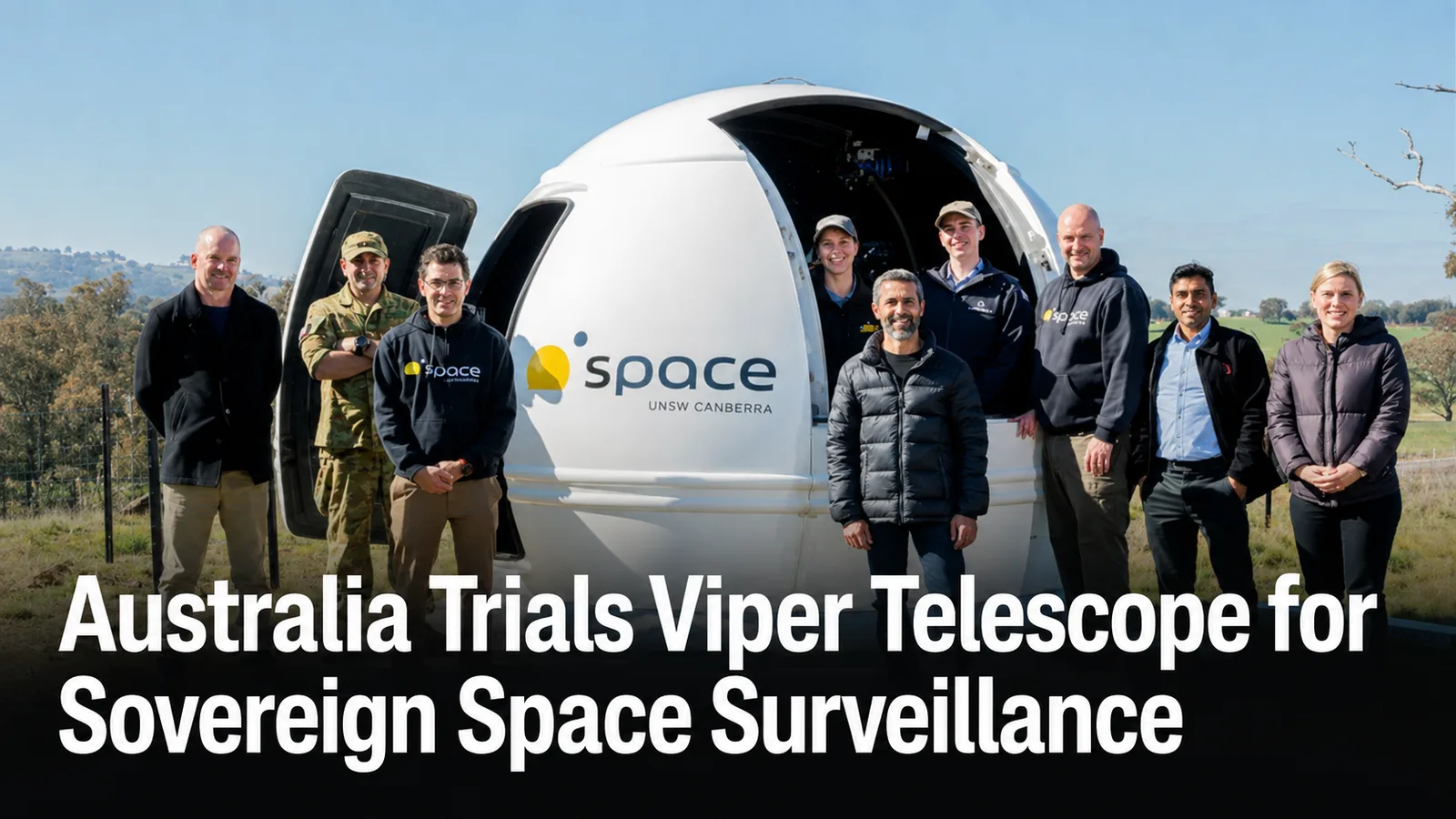
The Australian Defence Force is trialling the Viper optical telescope operated by UNSW Canberra Space to test how directly tasked, automated ground-based sensors could strengthen Australia’s sovereign space domain awareness network.
The 27 August 2026 Defence announcement focuses less on the telescope itself than on the operational model around it: Defence wants to understand how military operators can directly request observations, retask a sensor as priorities change and automate parts of the tasking and data-analysis process. Viper is a 14-inch, f/2.2, off-grid wide-angle telescope built by UNSW Canberra Space in 2020, making the project a relatively low-cost test of command, control and sensor-network concepts rather than a new major space-surveillance acquisition.
Key Facts
- Sensor: UNSW Canberra Space Viper telescope
- Operator: UNSW Canberra Space
- ADF role: Trial partner for space domain awareness
- Sensor type: Ground-based optical telescope
- Aperture: 14 inches / 0.36 metres
- Optics: f/2.2 wide-angle configuration
- Operating model: Off-grid, remotely operable observatory
- Core trial focus: Direct tasking, automated retasking and data analysis
- Programme value: Not publicly disclosed
The Trial Is About Sensor Command and Automation
The Australian Defence article defines the trial around an operational question: how can Defence move from receiving externally provided space-tracking data to directly tasking and controlling a sensor against objects of military interest?
Commercial space-tracking services can already provide orbital data, but those services do not necessarily give a military operator direct control over when, where and how a specific observation is made. In a contested or rapidly changing space environment, that distinction matters.
A directly tasked sensor can be pointed at a priority object when commanders need updated information rather than waiting for a pre-planned commercial collection cycle. The trial is therefore exploring how Defence could request observations, rapidly alter priorities and obtain data in support of integrated-force requirements.
Defence is also examining automation in sensor tasking and data analysis. Increased automation could reduce operator workload, improve availability and allow the system to retask more quickly when an object manoeuvres, a new launch occurs or another orbital event becomes operationally relevant.
What Viper Actually Is
UNSW Canberra Space describes Viper as an off-grid optical observatory owned and operated by the university. It uses a 14-inch, wide-angle telescope with very fast f/2.2 optics and is hosted by Cingulan Space near ground-station infrastructure around Yass, New South Wales.
The telescope was designed and built by UNSW Canberra Space in 2020 using predominantly commercial off-the-shelf equipment supplemented by bespoke elements. Its principal research objectives include generating high-quality space-surveillance tracking data for artificial satellites, supporting Defence education in space domain awareness and contributing to international asteroid research.
Technical literature identifies the optical system as a 0.36-metre Rowe-Ackermann Schmidt Astrograph mounted on a robotic telescope mount. Its wide field of view is useful for surveying and tracking resident space objects over a comparatively broad portion of the sky.
The Defence trial does not disclose a military detection range, limiting magnitude, tracking accuracy, catalogue performance or classified target set for Viper. Those values should not be inferred from generic astronomical telescope performance.
Why Optical Sensors Matter in Space Domain Awareness
Space domain awareness requires more than knowing where satellites are expected to be. Military operators need to detect, track, identify and characterise objects, understand manoeuvres and determine whether observed activity is routine, hazardous or potentially hostile.
Optical telescopes contribute by collecting reflected light from satellites and debris. They can help refine orbital tracks, identify unexpected movement and provide observations of objects at altitudes where some radar systems become less effective.
Their limitations are equally important. Optical sensors depend on viewing geometry, lighting and weather and generally cannot provide the same all-weather persistence as radar. A cloud layer can prevent useful collection even when the orbital geometry is favourable.
This is why Australia is building a multi-phenomenology architecture rather than relying on one type of sensor.
Viper Complements Australia’s Radar and RF Trials
The Viper project follows another sovereign Australian SDA trial announced on 23 July 2026. Defence is conducting a 12-month evaluation of Quasar Satellite Technologies’ SkyDome passive radio-frequency sensor in South Australia.
SkyDome uses passive RF technology derived from CSIRO research to observe satellites and other orbital objects without transmitting. Defence says the trial will examine how the system could be used operationally and how it could integrate with existing capabilities.
Viper and SkyDome therefore test different parts of the same problem. Viper collects optical observations. SkyDome detects radio-frequency emissions. Combining different phenomenologies can improve object custody and reduce dependence on one sensor type or environmental condition.
The distinction is operationally significant. An object that is difficult to observe optically may still be detected through RF emissions, while a radio-silent satellite can still produce an optical or radar track under favourable conditions.
Australia Already Operates Larger Allied SDA Systems
The Viper trial sits below a much larger set of existing and planned Australian space-surveillance assets.
Australia and the United States jointly operate the C-Band Radar and Space Surveillance Telescope near Exmouth in Western Australia. The Space Surveillance Telescope reached Final Operational Capability in August 2025 after being relocated from New Mexico.
The telescope provides broad-area search and tracking of faint objects in deep space and helps fill a geographic gap in the wider allied Space Surveillance Network. Defence says it contributes to detecting, tracking, cataloguing and identifying objects in geostationary orbit and to predicting possible collisions.
The third major layer is the Deep-space Advanced Radar Capability, or DARC, being developed with the United States and United Kingdom under AUKUS. Australia’s site is planned near Exmouth and has been scheduled to enter service in 2026, with the full three-site architecture intended to provide continuous all-weather deep-space coverage once all partner locations are operational.
No authoritative source reviewed for this package confirms that the Australian DARC site had reached operational status by 27 August 2026, so it should not yet be described as operational solely because earlier plans targeted 2026.
The Strategic Value Is Sovereign Tasking
Australia already receives substantial space-tracking data from allies and commercial providers. The Viper trial addresses a different requirement: sovereign control over collection priorities.
Direct sensor tasking can be particularly important during military operations. If a satellite makes an unexpected manoeuvre, approaches an Australian or allied spacecraft, or changes its behaviour around a sensitive event, operators may need a rapid observation rather than routine catalogue data.
The ability to allocate a national sensor against that object gives commanders greater confidence that collection priorities reflect Australian operational needs.
This does not mean Australia intends to replace allied data. Defence explicitly frames its space posture around both sovereign capabilities and cooperation with trusted partners. Sovereign sensing adds resilience and national decision authority inside a wider coalition network.
Automation Can Shorten the Observe-to-Decision Cycle
The trial’s automation component may be more important than the size of the telescope.
Space surveillance generates large volumes of data, and the value of that data depends on how quickly it can be turned into an updated track, object characterisation or warning. Manual scheduling and analysis can become a bottleneck as the number of active satellites and debris objects rises.
Automated tasking can allow a sensor network to prioritise observations based on orbital uncertainty, threat relevance or changes in behaviour. Automated analysis can then flag anomalies for human operators instead of requiring personnel to manually review every observation.
Defence’s language remains cautious: the trial is examining whether automation can improve availability and responsiveness. It does not claim that Viper currently provides a fully autonomous military SDA capability.
Australia Is Building a Dedicated Space Workforce
Sensor automation is only one side of the system. Australia is also creating the human workforce needed to conduct military space operations.
In May 2026, 16 Navy, Army and Air Force personnel completed the ADF’s first joint Space Initial Employment Training Course. Defence says the new space-operations workforce covers satellite communications, positioning and navigation, SDA, space control and missile-warning effects.
Personnel posted to 1 Space Surveillance Unit operate telescopes and radar to track orbital objects and contribute to space situational awareness using Australian and allied capabilities.
This workforce development is important because a sovereign sensor is operationally useful only when operators understand orbital mechanics, collection planning, sensor limitations, data fusion and the military significance of the observed behaviour.
Operation Dyurra Connects National Sensors to Allied Operations
Australia’s operational space posture is also linked to Operation Dyurra, which integrates ADF space operations with partners through the U.S.-led Operation Olympic Defender.
Defence says the operation is intended to improve allied cooperation, deterrence and interoperability and uses space domain awareness to support global multi-domain operations.
Australia and the United States reinforced this relationship in June 2026 through a new Statement of Intent on military space cooperation. The two countries identified resilient, secure and operationally effective space capabilities as foundational to modern conflict.
Viper should therefore be viewed as a sovereign collection experiment inside a heavily networked allied operating environment, not as an isolated national telescope programme.
The United Kingdom Adds Another SDA Integration Path
Australia is simultaneously deepening space-domain cooperation with the United Kingdom. At the June 2026 AUKMIN consultations, the two governments agreed to expand SDA data sharing, interoperability and joint analytical work.
The statement also identifies future sensing concepts including neuromorphic sensors, multi-phenomenology sensing and fusion and long-baseline multistatic radar.
That language closely matches the logic behind Australia’s current sensor trials. Viper optical data and SkyDome passive-RF data provide small-scale opportunities to test the tasking, processing and fusion methods that a larger heterogeneous sensor network will require.
The 2026 Investment Programme Gives Space a Larger Budget Context
Australia’s 2026 Integrated Investment Program allocates a broad funding range of AUD$27–38 billion to space and cyber capability over the programme horizon.
The identified investment areas include resilient multi-orbit satellite communications, space sensors, space control and electronic warfare.
The Viper trial does not have a publicly disclosed value and should not be presented as a major portion of that AUD$27–38 billion envelope. Its significance is primarily architectural: it helps Defence test how smaller sovereign sensors could be tasked, automated and integrated into the future network.
Commercial Data and Sovereign Sensors Are Complementary
The Defence article contrasts direct tasking with reliance on commercially provided space-tracking data, but the two models are not mutually exclusive.
Commercial SDA providers can offer wide geographic coverage, persistent catalogue maintenance and access to sensors Australia does not own. Sovereign sensors give Defence control over collection priorities and can provide data that is not dependent on a commercial service agreement.
A resilient SDA architecture is therefore likely to combine government-owned or government-tasked sensors, allied networks, academic research infrastructure and commercial data.
The policy challenge is ensuring those sources can exchange observations using common standards, preserve data provenance and operate at the classification level required for military decision-making.
Limitations and Counterpoint
Viper is a research-grade telescope, not a newly fielded military surveillance system. Defence describes the activity as a trial intended to inform future operational requirements.
The programme value, trial duration, Defence funding contribution and exact command-and-control software are not disclosed.
No public source reviewed for this article provides military performance data such as limiting magnitude, detection probability, track accuracy, response time or the orbital regimes prioritised in the Defence trial.
Optical sensing also remains dependent on weather and lighting conditions. It cannot replace all-weather radar or passive RF surveillance.
Finally, the trial’s use of the word “sovereign” should not be interpreted as Australia seeking an independent standalone space catalogue. Defence continues to operate SDA as a combined national and allied mission.
Implications / Next
The first indicator to watch is whether Defence moves from experimental direct tasking to a repeatable operational sensor-control process. That would require integration with military mission planning, data handling and command systems rather than only successful telescope observations.
The second is multi-sensor fusion. The combination of Viper optical observations, SkyDome passive RF data and larger allied radar/telescope systems provides a natural pathway toward a national sensor network that can maintain custody through multiple phenomenologies.
The third is procurement. Defence says insights from current space-surveillance trials will inform future capability options under the Integrated Investment Program. A future acquisition for Australian-built optical, passive RF or data-fusion systems would be the clearest sign that these trials are transitioning into operational capability.
The fourth is DARC. Confirmation that the Western Australian site reaches operational status would add a major all-weather deep-space radar layer alongside the existing Space Surveillance Telescope and smaller sovereign sensor experiments.
Conclusion
The Viper trial is a small sensor experiment with larger command-and-control implications.
Australia already has access to major allied space-surveillance radars and telescopes. What Viper is testing is whether Defence can directly control a sovereign optical sensor, rapidly retask it against priority objects and automate the processing needed to turn observations into operationally relevant information.
Combined with the SkyDome passive-RF trial, Australia’s existing Exmouth sensors, DARC and deeper U.S.-UK cooperation, the project points toward a layered SDA architecture in which optical, RF and radar observations are fused across sovereign and allied networks.
The measure of success will therefore not be the performance of one 14-inch telescope. It will be whether the trial helps Australia build a responsive sensor-tasking and data-fusion architecture capable of supporting military decisions in an increasingly contested and congested orbital environment.