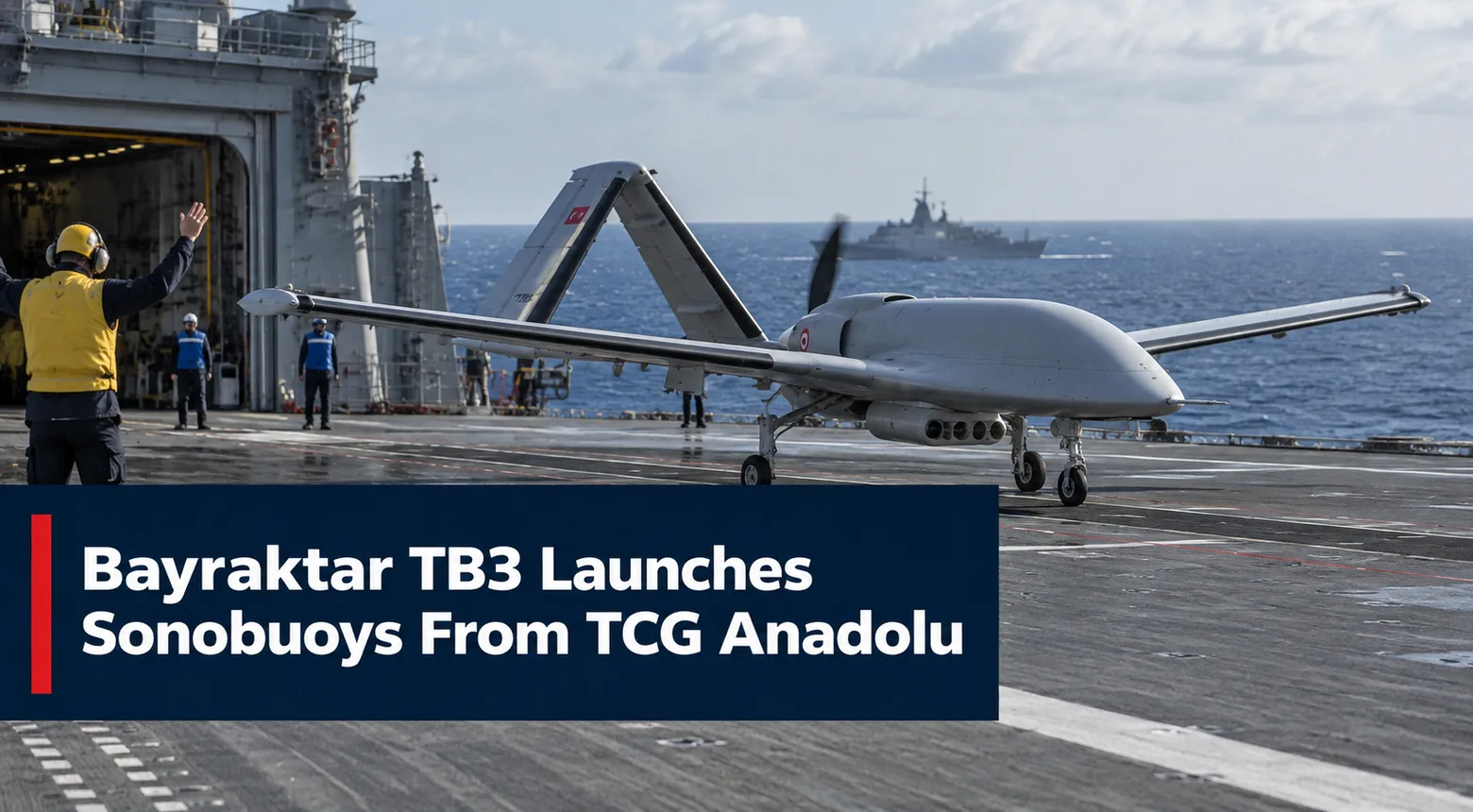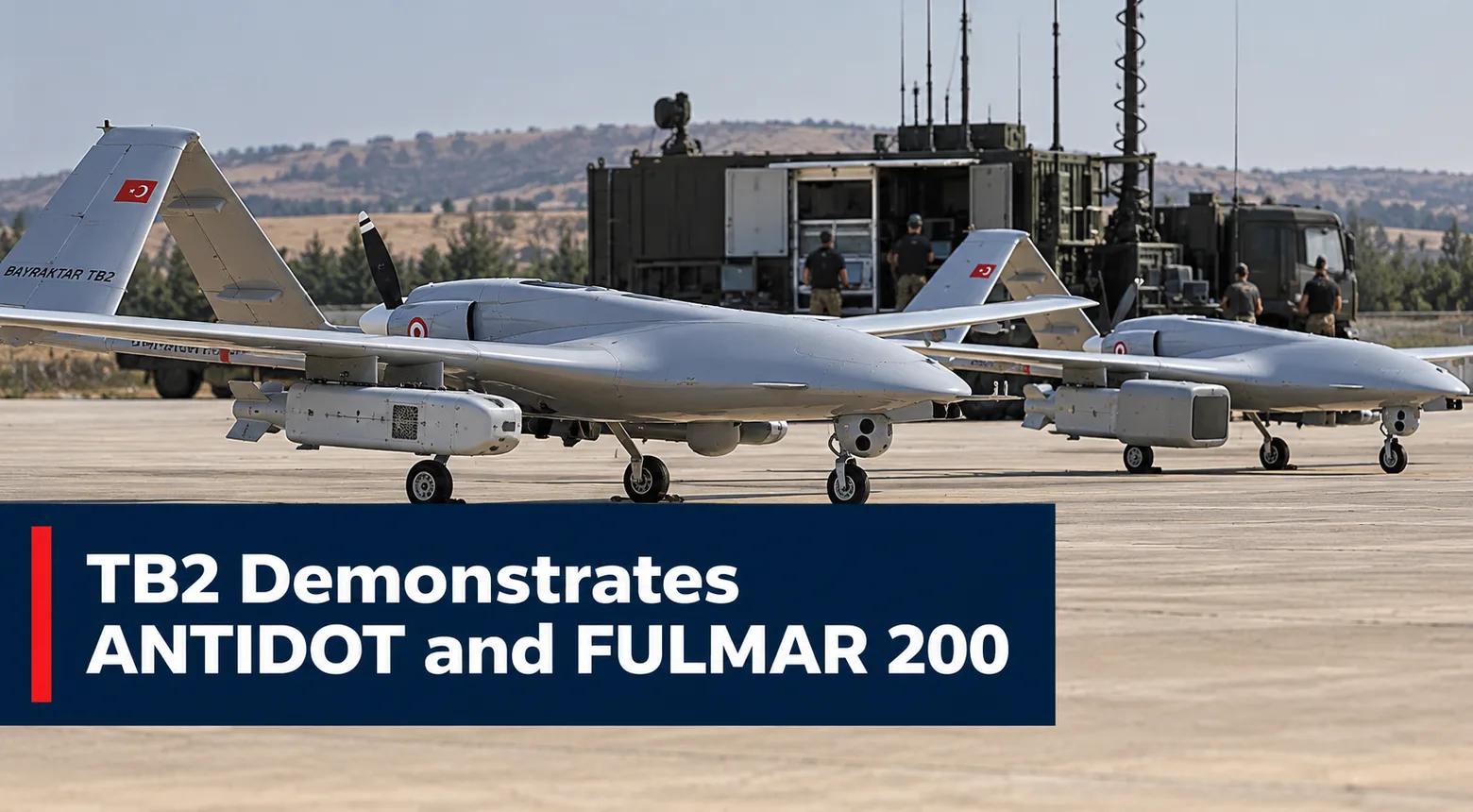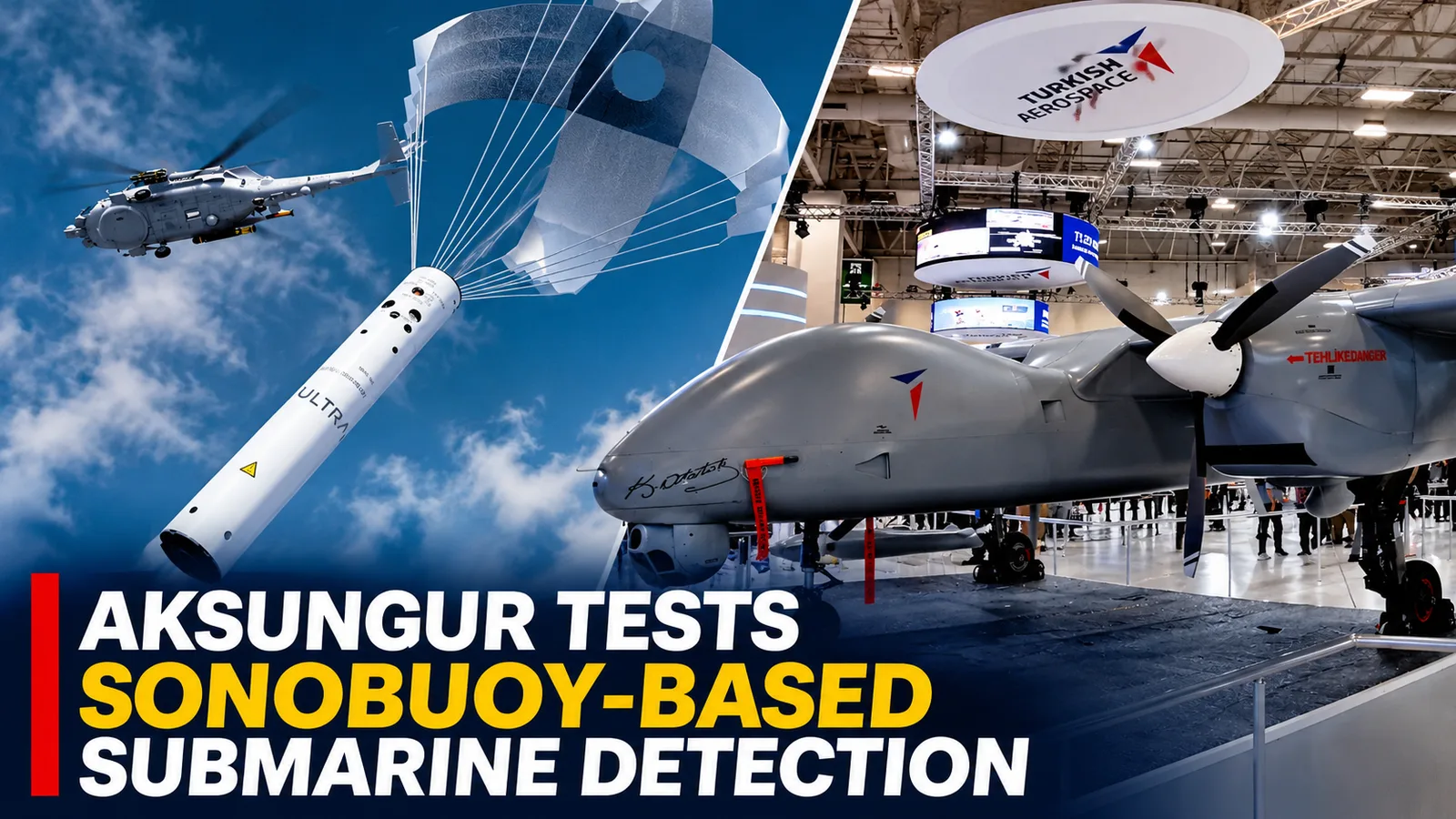
TUSAŞ’s AKSUNGUR unmanned aircraft carried out an acoustic sensor deployment and listening mission off Antalya during TURNAs-26 on 24 October 2026, using ASELSAN’s aselBUOY 100P technology. The test links a long-endurance airframe to an underwater surveillance chain and offers a measurable step towards unmanned anti-submarine missions.
The exercise mission and what was demonstrated
Anadolu Agency reported that AKSUNGUR departed Ankara, flew to its maritime operating area under satellite control and descended to approximately 1,000 feet to release sensors through a carried pod. Its load was described as three ASELSAN aselBUOY 100P passive acoustic systems and one additional sonobuoy. The aircraft then climbed to about 6,000 feet for signal monitoring.
The operation used TEI’s domestically developed PD170 engine. Those reported details establish an airborne deployment and subsequent listening sequence, but public reporting does not supply a verified contact range, acoustic classification confidence, target identity or time required to locate a submarine. It would therefore be premature to describe the sortie as a validated operational kill chain.
How sonobuoys change the UAV mission
Passive sonobuoys carry hydrophones and communications equipment that allow aircraft and other units to listen to underwater acoustic activity after deployment. They extend the surveillance footprint beyond sensors mounted on the aircraft itself and can be positioned around a search area. Their effectiveness depends on local acoustic conditions, buoy placement and the ability to process weak or ambiguous signals.
An unmanned carrier offers a different endurance and crew-risk trade-off from a helicopter or maritime patrol aircraft. Persistent coverage could make more frequent surveys feasible, while mixed aircraft-and-ship networks could share detections with operators who have other sensors and weapons. However, exploiting acoustic observations still requires trained analysis, secure links and rules for corroboration.
Production and integration remain separate milestones
ASELSAN previously described serial production of its sonobuoy technology after securing a Turkish Naval Forces production contract. That industrial status is relevant because expendable acoustic sensors must be replenished after training and operations. It does not automatically mean every unmanned aircraft has been qualified to deploy and process the buoys.
The October demonstration therefore concerns integration on AKSUNGUR: carriage, release, communications and listening activity within a naval exercise. Further software and sensor-fusion work may be necessary before the platform can serve as a routinely tasked part of a wider submarine-detection network, particularly when multiple sensors and environmental data must be compared.
Operational implications for Türkiye’s naval force
Türkiye is investing in indigenous airborne and underwater sensing, naval combat-system integration and uncrewed platforms. Combining these areas could provide additional search capacity across the Eastern Mediterranean and other maritime approaches without assigning a crewed aircraft to every acoustic patrol. The key operational value is a larger distributed sensor network, not a claim that an unarmed UAV can independently complete the entire anti-submarine mission.
The stronger follow-on proof would include repeatable exercises against known underwater targets, detection-to-track validation, integration with shipboard combat systems and acceptance of mission equipment by the naval operator. None of those outcomes should be inferred from a single reported deployment and listening sequence.
An anti-submarine search also depends on decisions made before the aircraft launches. Operators must decide the geometry of an acoustic sensor pattern, account for bathymetry and likely environmental noise, and ensure the communications architecture can return observations to trained analysts. These are operational requirements that cannot be solved by flight endurance alone. Demonstrating the placement of four acoustic devices illustrates part of a wider process, but identifying a contact consistently requires analysis of multiple acoustic indications and often confirmation from another platform. A useful follow-up report would distinguish raw received audio, an automated classification and a target track corroborated by naval operators. It would also document whether the data was processed on board AKSUNGUR or elsewhere in the network. Those distinctions determine the maturity of an unmanned aircraft's contribution to maritime awareness and avoid overstating the outcome of a release-and-listen demonstration.
Implications / Next
Watch for further trial reports detailing acoustic performance, repeatability, sensor numbers, track fusion and formal Navy user acceptance. The 24 October exercise is a meaningful integration demonstration, but no new aircraft order, weapon employment or anti-submarine IOC has been disclosed.