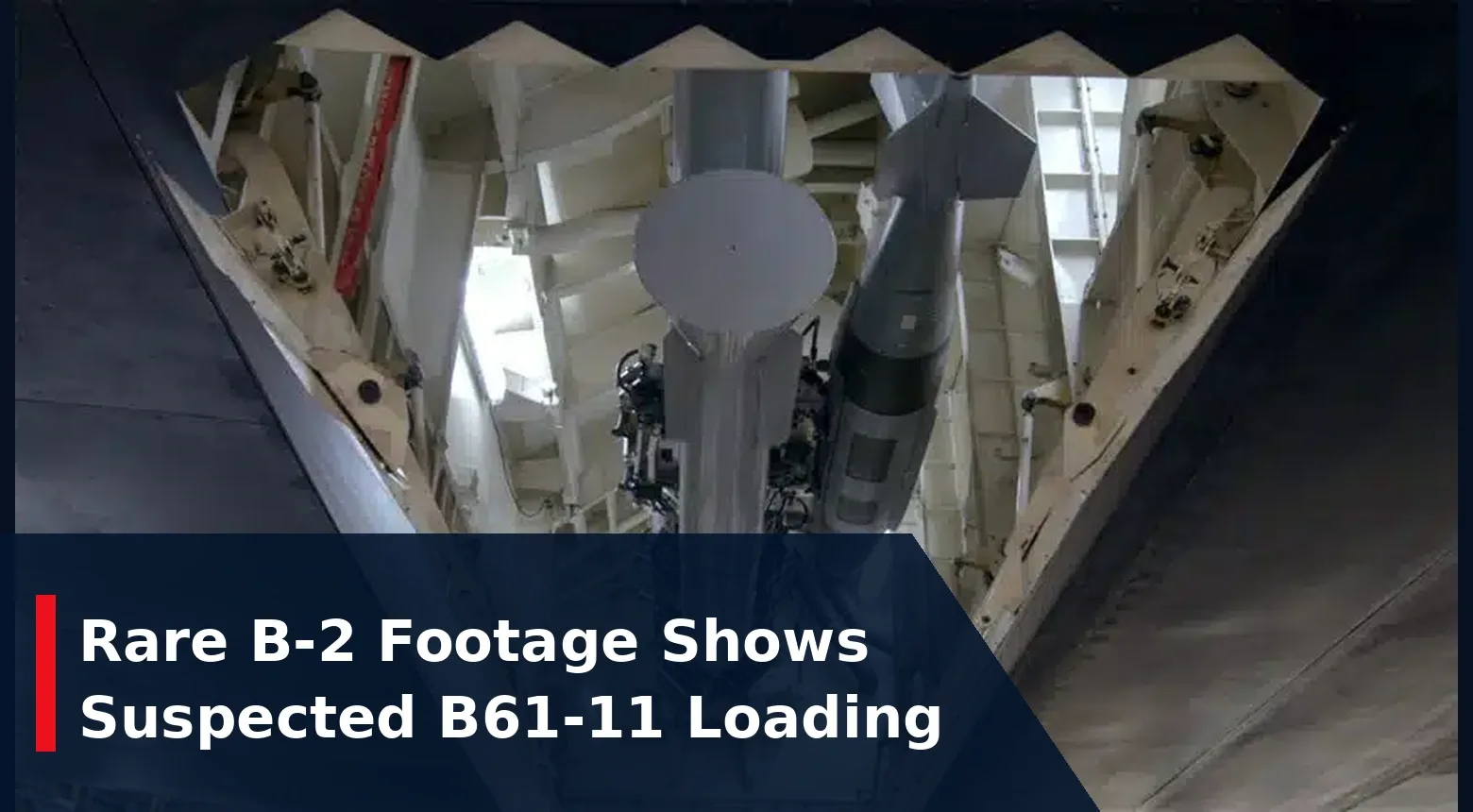
Rare B-2 Spirit footage from the documentary series The Watch: America's Nuclear Mission appears to show a B61-11 nuclear gravity bomb being positioned on the stealth bomber's internal rotary launcher. The sequence was examined by The Aviationist on 16 November 2026, whose identification relies on the weapon's visible appearance rather than a separately published U.S. Air Force confirmation. It offers a new public view of a sensitive aspect of the bomber's nuclear mission, but it does not establish that the weapon shown was armed, that a live nuclear load was deployed, or that the aircraft gained a new capability in 2026.
What the B-2 Footage Shows—and What Remains Unconfirmed
The reported sequence appears in The Watch: America's Nuclear Mission, a documentary project developed by filmmaker Jeff Bolton through NFN Productions. The six-part series covers personnel and facilities associated with the American nuclear deterrent, including bomber crews, ballistic-missile forces, submarine operations and strategic command infrastructure. The production's official description and its October 2026 release announcement establish that the project was built around authorised access to military settings. Neither source independently certifies every weapon-model identification made by outside viewers of the footage.
The Aviationist's examination focuses on a short view into the B-2's weapons bay. A long, cylindrical gravity bomb is shown near or attached to the aircraft's rotary launcher assembly. Based on visible characteristics, the publication assesses the bomb as probably being a B61-11, a legacy member of the B61 nuclear bomb family. That is an informed visual assessment; the accessible public record does not include a clear accompanying serial identification or an official statement confirming the specific modification seen in the documentary.
The film's access and release also require careful description. Bolton told The Aviationist that the relevant footage was captured for the documentary and underwent a sensitive clearance process. That establishes the production context as described by its creator; it does not mean the public can infer the nuclear status of the object shown. Documentary shots of loading activity may involve training, test or inert items. Without positive confirmation, the presence of a weapon-shaped object on a loading device is not evidence that an operational nuclear warhead was present during filming.
A second object visible on the assembly is described by The Aviationist as possibly a conventional precision-guided bomb, with a tentative comparison to a GBU-56 Laser JDAM. The publication itself flags this identification as uncertain and notes that the claimed combination would require additional verification. Defence Agenda therefore does not treat that object as a confirmed GBU-56 installation, a newly certified B-2 weapon integration or evidence of a mixed combat loadout. The main news value is the unusual access to the bomber's internal carriage area, not a substantiated new weapons configuration.
The documentary's timing is distinct from the timing of the footage. The production company announced special IMAX engagements beginning 22 October 2026; The Aviationist published its technical assessment on 16 November 2026. Those dates establish public exhibition and reporting milestones. They do not identify the exact date of the loading sequence or place it within a particular operational deployment. Any description of the event as a November 2026 nuclear loading exercise would exceed the evidence available from the published material.
The wider series is important because it documents the daily work that makes strategic deterrence possible. The publicly described production includes B-2 and B-52 aircraft as well as command-and-control and submarine-related material. Its makers say filming involved access across multiple military environments. The documentary is an editorial project, however, not an official test report, stockpile inventory disclosure or public certification of the weapons shown.
B61-11, the B-2 Nuclear Mission and Programme Implications
The B61-11 and B61-12 should not be treated as interchangeable systems. The earlier B61-11 is associated with a specialised earth-penetrating mission against hardened targets, whereas the B61-12 is a more recent modernised family variant. The U.S. Department of Energy's FY2026 weapons activities documentation lists both legacy B61-7/11 modifications and the B61-12 among the programme's relevant stockpile systems. That official documentation supports the distinction between variants; it does not independently identify the item photographed for The Watch.
The B-2 has an established nuclear mission and uses internal weapons bays to maintain its low-observable design. Public U.S. Air Force reporting predating the documentary includes an August 2009 Combat Sledgehammer evaluation at Whiteman Air Force Base. That exercise examined the broader system of aircraft preparation, weapons handling, command procedures and simulated employment. It was an evaluation of the existing mission, not the origin of a new role disclosed by the 2026 film.
Another verified point of comparison is the June 2022 B61-12 Joint Test Assembly activity. The U.S. Air Force reported a non-nuclear B61-12 test assembly associated with B-2 loading and flight testing, followed by a capstone release demonstration. The 2022 event concerned a specified test article and evaluation programme. The 2026 documentary, by contrast, supplies visually informative footage but no public test report, performance measurements or weapon-certification outcome. Confusing those evidence types would distort the significance of each event.
For airpower planners, the film illustrates a broader operational reality: the credibility of a strategic bomber force involves trained maintainers, reliable aircraft, secure procedures and accountable command arrangements, not merely a platform's advertised payload options. Public access to previously little-seen ground activity can help explain this complexity. It does not reveal the aircraft's current alert status, nuclear release authority, mission readiness rate or the quantity of any specific B61 modification available to the force.
The comparison is also relevant to the transition to newer bomber systems. The B-2 remains part of the U.S. strategic aviation force while the B-21 Raider programme progresses through development and testing. The appearance of legacy equipment in a documentary should therefore be interpreted as historical and operational context, rather than as a procurement announcement or proof of a changed B-21 transition schedule. The material does not provide new contract values, sortie projections or service-life decisions.
Operational and analytical limitations. Weapon identification from a short public video is subject to camera angle, protective coverings, visual similarity between shapes and the absence of accompanying official metadata. Documentary editing may combine shots recorded at different times. A knowledgeable visual interpretation can be valuable without reaching the threshold of an independently authenticated weapons-inventory declaration. Equally, a statement that filming was cleared by military authorities does not mean every technical deduction made later by outside observers was endorsed by those authorities.
There is an alternative interpretation of the footage's strategic importance. It may contribute to public awareness of U.S. nuclear deterrence, but public visibility is not itself a measure of deterrent effectiveness. Views of maintenance and loading are less informative about readiness than actual validated training outcomes, the reliability of secure command-and-control, and decisions published by responsible government organisations. The documentary was made for public storytelling; its evidentiary role should be evaluated in that context.
Defence Agenda has previously reported on other parts of U.S. bomber modernisation. Its B-52 radar procurement coverage documents a separate acquisition programme, while the B-52 F130 re-engining overview addresses the sustainment of a different strategic aircraft. Neither development should be interpreted as a direct response to the documentary footage, but together they place the B-2 sequence within the larger industrial question of maintaining a credible long-range bomber force as technology and fleets evolve.
Implications / Next. The clearest next point of verification would be a U.S. Air Force or documentary-production clarification identifying the exact bomb modification and whether the item shown was a training or non-nuclear assembly. Any subsequent official publication describing the loading sequence's date or purpose would further narrow uncertainty. In the absence of that information, the defensible conclusion as of 17 November 2026 is that The Watch provides unusually close public footage of B-2 weapons-bay activity, with a probable but unconfirmed B61-11 identification. It should not be presented as a new nuclear deployment, weapon certification or live-warhead demonstration.
Further Reading
- The Aviationist — Rare Footage Shows B61 Nuclear Bomb on B-2 Stealth Bomber's Rotary Launcher, 16 November 2026
- The Watch: America's Nuclear Mission — Official production overview
- U.S. Air Force — 72nd TES evaluates B-2 nuclear mission capabilities, 26 August 2009
- U.S. Air Force — B-2 B61-12 capstone test, July 2022
- U.S. Department of Energy — FY2026 weapons activities, B61 stockpile systems
- Defence Agenda — USAF awards Raytheon a B-52 AESA radar contract
- Defence Agenda — B-52 re-engining and long-term bomber sustainment