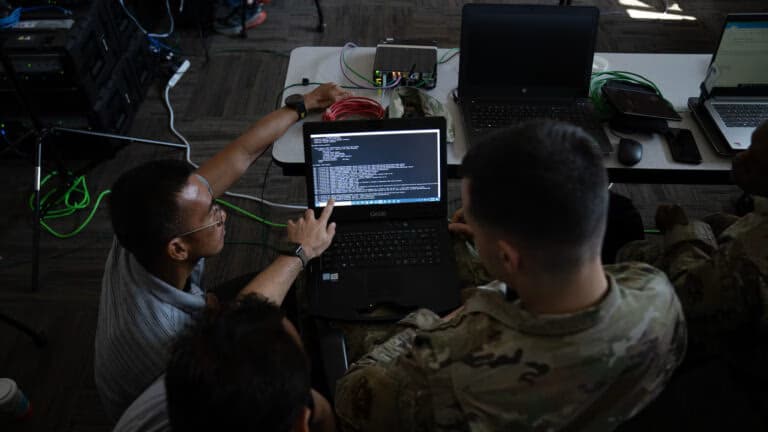
NATO Deputy Secretary General Radmila Shekerinska called for closer cooperation between Allied governments, technology companies and defence manufacturers on 17 November 2026, arguing that escalating cyber threats require defence systems and the civilian infrastructure supporting them to remain functional during crises and conflict. Speaking at NATO Edge 2026 in İzmir, Türkiye, she linked cyber resilience to the Alliance’s wider investment, innovation and operational-readiness agenda. Her remarks, reported by Anadolu Agency, matter to suppliers because secure networks, recoverable services and government–industry coordination increasingly shape how digital defence capabilities can be delivered and sustained.
Shekerinska Links Cyber Defence to Critical Infrastructure
Shekerinska described a security environment in which military effectiveness depends not only on aircraft, ships or land platforms, but also on the energy, communications, transport and digital services supporting them. According to Anadolu Agency's report, she warned that cyberattacks can affect civilians and the civil infrastructure used by military organisations. The immediate message was a call for collaboration, not the announcement of a new NATO cyber incident or a newly awarded contract.
Her appearance in İzmir is independently supported by NATO's 16 November media advisory, which listed her participation in NATO Edge on 17 November. The NATO Communications and Information Agency (NCIA) describes the 17–19 November event as a mechanism for bringing operational requirements, NATO authorities and technology suppliers into closer contact. The event is organised around improving the delivery of capabilities rather than simply displaying equipment.
The Deputy Secretary General's comments place particular weight on the difference between having a digital system and being able to operate it after disruption. Military command networks rely on connectivity, identity and access controls, protected information flows, electricity and commercially provided technology. These dependencies create common failure points with civilian networks. In a crisis, the quality of recovery procedures, support contracts and cross-border coordination can be as important as the sophistication of the original system.
NATO has already set out that direction in its Alliance Digital Strategy of 13 January 2026. The document calls for secure, resilient and interoperable digital capabilities and for a more systematic approach to data, identity and human–machine collaboration. It also envisages cooperation between civilian and military organisations, subject to Allied approval. Those established objectives provide the policy context for Shekerinska's appeal; the İzmir speech did not itself establish a completely new Alliance-wide technical standard.
Anadolu Agency also reported her warning that artificial intelligence introduces opportunities and vulnerabilities. AI may help cyber defenders identify weaknesses and prioritise responses, while malicious actors can use increasingly capable systems to accelerate reconnaissance, exploitation or deception. That does not mean a particular NATO AI product has been approved for operational deployment. Any credible acquisition case still depends on testing, human oversight, interoperability and controls over sensitive data.
For defence industry executives, this translates into a growing need to demonstrate more than performance claims. Cyber-secure design, evidence of update and maintenance processes, supply-chain visibility, supportability and timely incident reporting are relevant throughout a system's service life. Shared infrastructures and suppliers make cooperation necessary, but they also create the challenge of defining responsibilities when an incident crosses several administrative or commercial boundaries.
NATO Industry Cooperation, Procurement and Next Steps
The operational relevance of Shekerinska's argument is illustrated by the NATO Integrated Cyber Defence Centre (NICC), established as an Alliance initiative in 2024 to strengthen situational awareness and support protection of networks. In a related NCIA procurement notice updated on 16 October 2026, the Agency sought industry feedback for technology supporting the Centre's future capability. The notice is a request for information and pre-competitive market engagement, including an engagement opportunity at NATO Edge. It is not evidence that a vendor has been selected or a contract has been signed.
A second practical reference is training. NCIA reported NATO participation with Norway and Iceland in Locked Shields from 21 to 23 April 2026, a cyber defence exercise organised by the NATO Cooperative Cyber Defence Centre of Excellence. Such exercises can evaluate coordination and decision-making under simulated pressure. They should not be represented as proof that all real networks are protected against every class of attack or that a newly tested tool has entered general service.
The industrial dimension also cuts across national boundaries. Governments control security policy, sensitive requirements and procurement approvals; companies often own important software, cloud services, specialist components and technical expertise. Neither side can eliminate dependencies by acting alone. However, greater integration can increase concentration risk if several systems depend on the same third-party provider. That is why alternative communications paths, independent security assessment, configuration management and recovery arrangements remain important alongside faster procurement.
Defence Agenda's reporting on EUCOM's November 2026 vigilance campaign offers a related, but distinct, example of personnel-level security measures. The campaign emphasised awareness and reporting rather than the acquisition of new equipment. Its connection to the İzmir discussion is the wider need for operational discipline and coordination, not a shared procurement budget or a joint programme announcement.
A different industry risk is illustrated by the reported Quantum Systems cyber incident, which raised questions about software-update trust and the disruption of military unmanned-aircraft operations. The reported incident should not be treated as evidence of an attack on NATO Edge or linked to Shekerinska's remarks as a specific trigger. It does show why update integrity, transparent incident handling and supply-chain assurance matter when military users rely on commercial technology. Similarly, Germany's MissionOSBw source-code transfer concerns software ownership and long-term integration authority rather than this NATO cyber initiative.
The central qualification is that public speeches are policy signals, not acquisition milestones. Shekerinska did not announce a quantified new cyber budget, a delivery schedule, the award of a NICC contract or an immediately binding common certification regime at İzmir. Any firm commercial implications would have to be traced through official notices, tenders, contract awards and NATO or national implementation plans. Presenting the call as a confirmed purchase would overstate the available evidence.
Implications / Next: The measurable next steps will be the evolution of NICC procurement requirements, NATO and national reporting on cyber exercises, and evidence that new technical standards can be implemented across different military and commercial systems. Suppliers should distinguish pre-market dialogue from contractual obligations, while military planners will need to assess recoverability and assurance under realistic disruption. As of 17 November 2026, the confirmed development is Shekerinska's call for government–industry cooperation and resilient defence networks—not an announced award or completed cyber capability rollout.
Further Reading
- Anadolu Agency — Shekerinska urges cooperation against cyber threats (17 November 2026)
- NATO — Deputy Secretary General visit to Türkiye (16 November 2026)
- NCIA — NATO Edge industry cooperation programme (30 September 2026)
- NCIA — NICC industry request for information (updated 16 October 2026)
- NATO — Alliance Digital Strategy (13 January 2026)
- Defence Agenda — EUCOM Vigilance Campaign amid Hybrid Threats
- Defence Agenda — Quantum Systems Cyberattack
- Defence Agenda — Helsing MissionOSBw Software Transfer