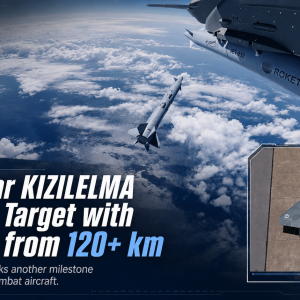
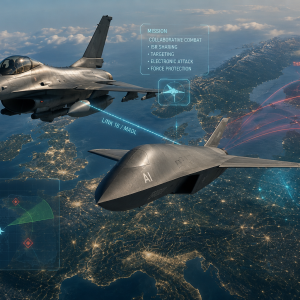
Bayraktar KIZILELMA has completed a new live-fire milestone by striking a sea target with Roketsan’s JET-230 supersonic air-to-ground missile from more than 120 km.
The test marks another step in the weapons-integration campaign for Türkiye’s first unmanned combat aircraft. According to Anadolu Agency, the firing involved the S2 serial-production model of Bayraktar KIZILELMA and took place after deployment activities at Merzifon 5th Main Jet Base.
Baykar’s unmanned combat aircraft departed from the AKINCI Flight Training and Test Center in Çorlu on 8 July. It then transferred to Merzifon for the live-fire campaign. After preparation and test activities, the aircraft took off on 11 July with two JET-230 missiles under its wings.
The aircraft then fired one JET-230 missile at a target over the sea. The missile hit the target with high accuracy from a range of more than 120 km. As a result, Bayraktar KIZILELMA demonstrated a new air-to-ground strike capability with supersonic ammunition.
Bayraktar KIZILELMA Expands Its Strike Envelope
The JET-230 test strengthens the role of Bayraktar KIZILELMA as a jet-powered unmanned combat aircraft designed for high-end missions. The platform has already completed firing tests with several Turkish munitions. These include GÖKDOĞAN air-to-air missile, TOLUN, TEBER-82 KGK and LGK-82.
The latest test adds a different layer. JET-230 gives the aircraft a stand-off air-to-ground strike option. Therefore, KIZILELMA can support missions against surface targets while remaining outside some short-range threat envelopes.
This matters because unmanned combat aircraft are moving beyond surveillance and light-strike roles. They now need air-to-air capability, precision strike, networked mission systems and survivability in contested airspace. Bayraktar KIZILELMA is being developed in that direction.
JET-230 Integration Adds Supersonic Air-to-Ground Capability
JET-230 is an air-to-ground supersonic missile developed by Roketsan. Its integration with Bayraktar KIZILELMA gives the aircraft a fast-response strike option against surface targets. Moreover, the use of a supersonic missile can reduce target reaction time after launch.
The test also supports a wider Turkish defence industry trend. Baykar aircraft are increasingly being integrated with domestically developed missiles, guided bombs, sensors and mission systems. This approach reduces external dependency and gives Turkish platforms a broader export and operational profile.
From Air-to-Air Milestones to Surface Strike
The new test follows earlier milestones in the KIZILELMA programme. In previous tests, the aircraft demonstrated air-to-air engagement capability with GÖKDOĞAN. It also conducted autonomous close-formation flight using smart fleet autonomy algorithms.
These milestones show a clear development path. First, Baykar validated flight and autonomy performance. Then it moved into sensor and air-to-air integration. Now the programme is expanding into stand-off air-to-ground strike with JET-230.
Consequently, Bayraktar KIZILELMA is becoming a multi-role unmanned combat aircraft rather than a single-mission drone. It can support future missions as a strike platform, loyal wingman, sensor node or autonomous combat asset.
Why the Test Matters for Türkiye’s Combat Air Roadmap
Türkiye is building a layered combat-air ecosystem. Crewed aircraft, unmanned combat aircraft, precision munitions, AESA radars, air-to-air missiles and stand-off weapons are being developed in parallel. Bayraktar KIZILELMA sits inside this wider shift.
The JET-230 test is important because it links unmanned airpower with long-range precision strike. In addition, it shows how domestic weapons can be integrated across new-generation aircraft without waiting for foreign approval cycles.
For export customers, this could become a decisive factor. Countries that acquire unmanned combat aircraft increasingly want local control, flexible payload options and rapid weapons integration. Bayraktar KIZILELMA’s test campaign directly supports that market logic.
Unmanned Combat Aircraft Are Entering a New Phase
The test also fits a broader global trend. Air forces are investing in unmanned combat aircraft, collaborative combat aircraft and autonomous wingman systems. These platforms can increase combat mass, reduce pilot risk and add new options in contested environments.
However, weapons integration remains the key test. A jet-powered unmanned aircraft becomes operationally more relevant when it can carry, release and guide advanced munitions. Therefore, each successful firing test moves the platform closer to real combat utility.
For further Defence Agenda coverage, read our unmanned systems, air warfare and defence technology sections. Related analysis includes wingman aircraft and Europe’s rearmament debate and Shield AI’s Hivemind partnership with UAV Navigation–Grupo Oesía.
Bayraktar KIZILELMA Moves Toward Multi-Role Combat Use
Bayraktar KIZILELMA’s JET-230 firing test shows how quickly unmanned combat aircraft roles are expanding. The aircraft is no longer being tested only as a flight platform. It is now adding mission-specific weapons that can support both air and surface operations.
The next phase will depend on continued testing, serial-production maturity and operational integration. Still, the JET-230 strike gives the programme another clear milestone in Türkiye’s move toward autonomous and unmanned combat aviation.