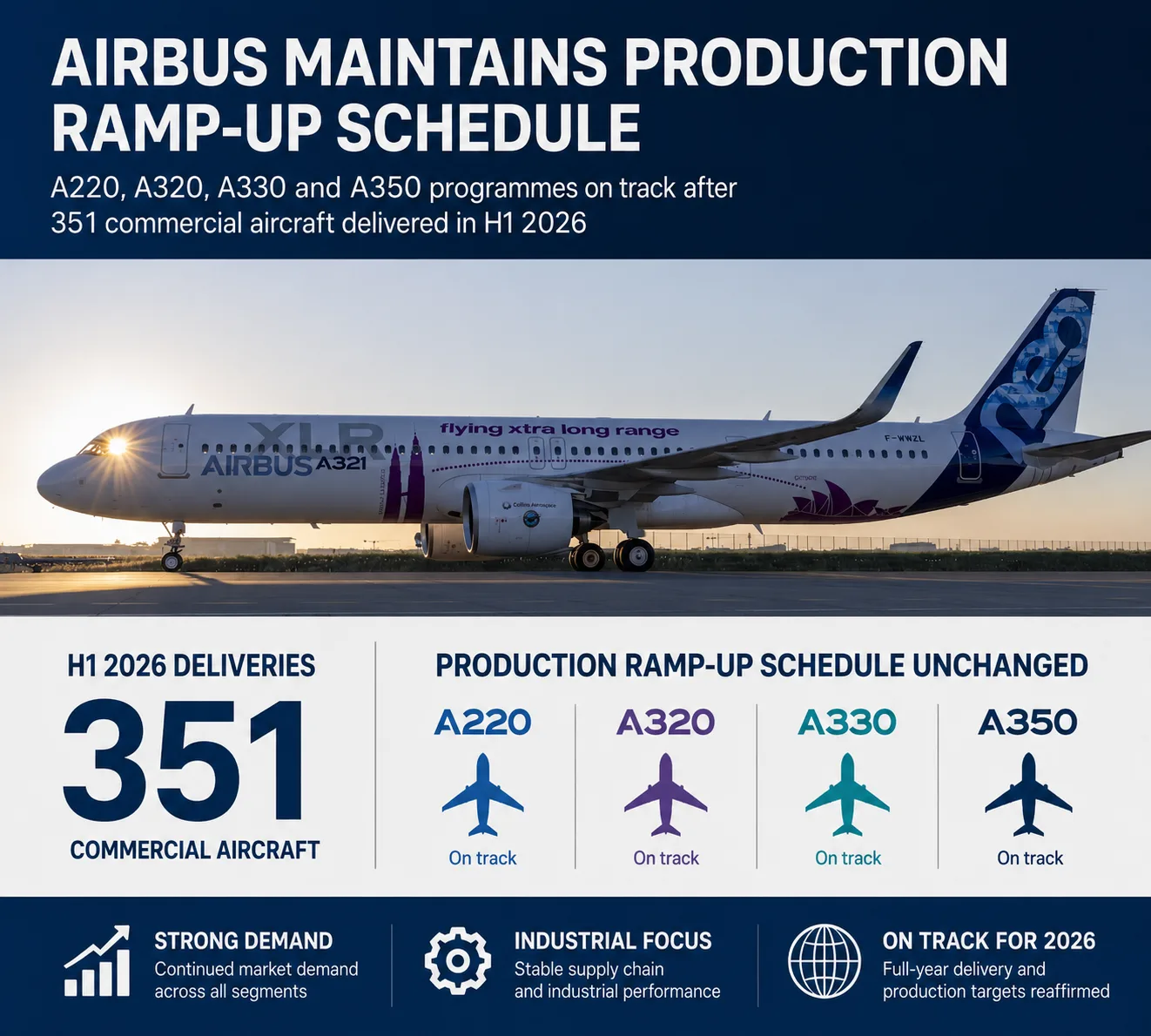
Airbus production ramp-up targets remain unchanged after the European aircraft manufacturer delivered 351 commercial aircraft during the first half of 2026 and recovered from a comparatively weak opening quarter with record second-quarter output.
The production update was reported by FlightGlobal following the release of Airbus’s half-year financial and operational results.
In its official H1 2026 results, Airbus confirmed that its monthly production-rate objectives for the A220, A320 Family, A330 and A350 had not changed.
The company continues to target 13 A220s per month in 2028, between 70 and 75 A320 Family aircraft per month by the end of 2027, five A330s per month in 2029 and 12 A350s per month in 2028.
Airbus also maintained its full-year 2026 guidance of around 870 commercial-aircraft deliveries, adjusted EBIT of approximately €7.5 billion and free cash flow before customer financing of approximately €4.5 billion.
Key Facts
- H1 2026 commercial-aircraft deliveries: 351 aircraft.
- H1 2025 deliveries: 306 aircraft.
- Year-on-year delivery increase: Approximately 14.7%.
- Q2 2026 deliveries: A record 237 aircraft.
- A220 deliveries: 44 aircraft.
- A320 Family deliveries: 271 aircraft.
- A321 deliveries: 167 aircraft, representing 62% of A320 Family deliveries.
- A330 deliveries: 10 aircraft.
- A350 deliveries: 26 aircraft.
- 2026 delivery guidance: Around 870 commercial aircraft.
- A220 production target: 13 aircraft per month in 2028.
- A320 Family target: 70–75 aircraft per month by the end of 2027.
- A320 stabilised target: 75 aircraft per month thereafter.
- A330 production target: Five aircraft per month in 2029.
- A350 production target: 12 aircraft per month in 2028.
- Commercial-aircraft backlog: 9,222 aircraft at the end of June 2026.
- H1 net orders: 821 aircraft.
What Production Targets Did Airbus Confirm?
Airbus retained the production schedule previously communicated for each of its four commercial-aircraft families.
| Aircraft Programme | Target Monthly Rate | Target Date | Status at H1 2026 |
|---|---|---|---|
| A220 | 13 aircraft | 2028 | Target unchanged; production ramp-up continues |
| A320 Family | 70–75 aircraft | End of 2027 | Target unchanged; rate 75 expected thereafter |
| A330 | Five aircraft | 2029 | Target unchanged |
| A350 | 12 aircraft | 2028 | Target unchanged despite demand supporting potentially higher output |
Keeping the schedule unchanged indicates that Airbus considers its current industrial plan capable of absorbing the supply-chain, engine and integration challenges affecting the programmes.
It does not mean that production has already reached the listed monthly rates. These are future objectives that require successive increases across suppliers, structural assembly, final assembly, flight testing and delivery operations.
How Many Aircraft Did Airbus Deliver in H1 2026?
Airbus delivered 351 commercial aircraft to 77 customers during the six months ending 30 June 2026.
The total was 45 aircraft higher than the 306 delivered during the first half of 2025, representing year-on-year growth of approximately 14.7%.
| Aircraft Family | H1 2026 Deliveries | Share of Total | Production Context |
|---|---|---|---|
| A220 | 44 | Approximately 12.5% | Ramp-up toward rate 13 in 2028 |
| A320 Family | 271 | Approximately 77.2% | Primary contributor to Airbus delivery volume |
| A330 | 10 | Approximately 2.8% | Ramp-up toward rate five in 2029 |
| A350 | 26 | Approximately 7.4% | Ramp-up toward rate 12 in 2028 |
| Total | 351 | 100% | Delivered to 77 customers |
The A320 Family represented more than three-quarters of total deliveries. Airbus delivered 167 A321s, equivalent to 62% of all A320 Family aircraft handed over during the period.
Why Was the Second Quarter Important?
Airbus delivered a record 237 commercial aircraft during the second quarter.
The stronger quarter enabled the company to recover from low delivery volume during the first three months of 2026.
Aircraft production and aircraft delivery are related but are not identical measures. An aircraft may pass through structural and final assembly before remaining temporarily undelivered because of certification documentation, customer acceptance, cabin completion, engine availability or quality work.
The second-quarter improvement therefore reflected both continued production and the release of aircraft that had been held back by earlier constraints.
Can Airbus Still Deliver Around 870 Aircraft in 2026?
Airbus retained its guidance of around 870 commercial-aircraft deliveries for the full year.
Chief executive Guillaume Faury explained during the earnings call that Airbus interprets “around 870” as approximately 20 aircraft above or below the stated figure.
This creates an indicative guidance range of about 850–890 deliveries rather than an exact requirement to deliver precisely 870 aircraft.
Having delivered 351 aircraft in the first half, Airbus would need another 519 deliveries during the second half to reach the 870-aircraft midpoint.
The requirement illustrates the back-loaded nature of the annual delivery plan. Airbus and other large aircraft manufacturers typically record higher delivery volumes later in the year, but the remaining workload still depends on uninterrupted production and customer acceptance.
What Happened to the A320 Panel Quality Issue?
Airbus said the panel quality issue that affected its A320 Family production and delivery flow was largely behind the company at the end of the first half.
During the earnings call, Faury subsequently described the issue as resolved.
The company has not publicly released a complete aircraft-by-aircraft breakdown of the affected components or all rework conducted during the period.
Resolution of the issue is important because the A320 Family is responsible for most Airbus commercial-aircraft volume and is central to the target of reaching 70–75 monthly aircraft by the end of 2027.
Were the Delayed Airbus Deliveries to China Resolved?
Airbus confirmed that an administrative delay affecting the delivery of nearly 20 aircraft to Chinese customers had been resolved.
The aircraft were subsequently delivered, contributing to the sharp improvement in second-quarter output.
The delay demonstrates why monthly delivery totals may fluctuate even when the underlying industrial production rate is comparatively stable.
Administrative, certification or customer-acceptance constraints can create a temporary gap between completed production and recognised delivery.
Are Missing Engines Still Holding Back Completed Aircraft?
Airbus said it did not have aircraft ready for delivery that were waiting exclusively for engines at the end of the first half.
Such engineless or engine-delayed aircraft are sometimes described informally within the industry as “gliders”.
Faury said Airbus was in a normalised position in this respect. The company did not have a surplus buffer of Pratt & Whitney engines, but it also did not have completed aircraft prevented from delivery solely because engines were missing.
This does not mean that engine supply has ceased to influence Airbus planning.
The engine quantities agreed with Pratt & Whitney remain part of the assumptions supporting the company’s 2026 guidance and production trajectory. Airbus also continues discussions concerning the downward revision of engine volumes for 2026 and 2027.
Why Is the A320 Production Target Still 70–75 Aircraft?
Airbus modified its A320 Family ramp-up objective earlier in 2026 after it was unable to secure all the Pratt & Whitney engine commitments required for the previous trajectory.
The current plan is to reach between 70 and 75 aircraft per month by the end of 2027 and then stabilise at 75 aircraft per month.
Airbus has increased final-assembly capacity to support this objective.
The company’s global A320 Family industrial network now includes final assembly operations in Toulouse, Hamburg, Mobile and Tianjin.
A second modernised A320 Family line inaugurated in Toulouse in June 2026 brought Airbus’s planned global network to ten A320 Family final assembly lines.
Additional assembly infrastructure creates capacity, but achieving the production objective still requires engines, aerostructures, cabin equipment, landing gear, electronics and other components to arrive at matching rates.
What Is Happening With the A220 Ramp-Up?
Airbus delivered 44 A220 aircraft during the first half and retained its target of producing 13 aircraft per month in 2028.
The programme’s industrial progression is linked partly to the integration of former Spirit AeroSystems work packages.
Airbus said integration work at the locations supporting the A220 and A350 was challenging but aligned with the planned production ramps.
The company has not published a precise monthly step-by-step schedule showing when each intermediate A220 rate will be achieved before 2028.
Why Is Airbus Keeping the A330 Target at Five Per Month?
Airbus delivered 10 A330 aircraft during the first half of 2026 and continues to target a monthly production rate of five aircraft in 2029.
The A330neo remains positioned as a lower-capacity widebody complement to the larger A350 Family.
Airbus said the rate-five target was intended to meet customer demand. It did not announce an acceleration or delay to the existing schedule at the half-year point.
Is the A350 Still Targeting 12 Aircraft Per Month?
Airbus continues to target 12 A350 aircraft per month in 2028.
The company delivered 26 A350s in the first half and said strong market demand could support production above the currently approved target in the longer term.
No decision to increase the official rate beyond 12 aircraft per month was announced in the half-year results.
Airbus explained that the A350 supply chain must operate ahead of final assembly during the ramp-up. Structural suppliers manufacture components before aircraft reach the final assembly station, and final assembly itself occurs before delivery.
As a result, a supplier operating at a higher apparent monthly rate does not mean Airbus has already reached the same rate in final assembly or customer deliveries.
What Is the Difference Between Production Rate and Delivery Rate?
Production rate, final-assembly rate and delivery rate represent different stages of the manufacturing process.
| Industrial Measure | What It Represents | Why It May Differ |
|---|---|---|
| Supply-chain rate | Components and aerostructures entering production | Suppliers must work ahead of Airbus assembly stations |
| Final-assembly rate | Aircraft progressing through major assembly milestones | Aircraft require further testing, painting and cabin work |
| Delivery rate | Aircraft formally transferred to customers | Certification, documentation, financing and customer acceptance can delay handover |
Airbus measures important elements of production progression before delivery. Temporary differences between the measures are normal, particularly during rapid ramp-up.
How Large Is Airbus’s Commercial Aircraft Backlog?
Airbus ended June 2026 with a backlog of 9,222 commercial aircraft.
The company recorded 886 gross orders and 821 net orders during the first half after accounting for 65 cancellations.
The A320 Family backlog stood at 7,467 aircraft during the earnings call, with approximately 75% represented by the A321.
The backlog provides long-term demand visibility but also increases pressure on Airbus to improve production without compromising quality.
At current output levels, customers may wait several years for newly ordered aircraft, particularly for high-demand A321neo and A350 configurations.
How Is Airbus Funding the Production Increase?
Airbus is building inventory and increasing capital expenditure to prepare its factories and supply network for higher output.
Free cash flow before customer financing was negative €1.17 billion during the first half, although this was an improvement from negative €1.61 billion during the corresponding period of 2025.
The company said the cash outflow primarily reflected working-capital movements and planned inventory accumulation supporting ramp-up across its businesses.
Inventory buffers can reduce the risk that one delayed part immediately stops an assembly line. They also tie up cash before completed aircraft are delivered and customer payments are received.
What Did H1 2026 Mean for Airbus Financial Performance?
Higher deliveries contributed to stronger first-half revenue and earnings.
- Group revenue: €33.2 billion, up 12% year on year
- Group adjusted EBIT: €2.73 billion, up 24%
- Commercial-aircraft revenue: €23.9 billion, up 15%
- Commercial-aircraft adjusted EBIT: €1.99 billion, up 16%
- Reported net income: €2.24 billion
- Net cash position: €8.4 billion at the end of June
Airbus cautioned that the first-half earnings profile was partly front-loaded and should not be extrapolated directly across the remainder of the year.
What Could Still Disrupt the Ramp-Up?
Keeping the published production targets unchanged does not remove execution risk.
- Pratt & Whitney and CFM engine availability
- Aerostructure and fuselage-section supply
- Spirit AeroSystems work-package integration
- Cabin-equipment and seat shortages
- Quality escapes and required rework
- Certification and regulatory delays
- Customer-specific configuration changes
- Skilled-labour recruitment and training
- Logistics across the global final-assembly network
- Currency movements and tariff changes
- Political or trade restrictions
- Unexpected interruptions to internal operations
Airbus’s guidance assumes that no additional major disruptions affect global trade, the world economy, air traffic, its supply chain, internal operations or the company’s ability to deliver products and services.
What Should the Industry Watch During the Second Half?
The key test will be whether Airbus can sustain the delivery momentum achieved during the second quarter.
- Monthly and quarterly A320 Family delivery volume
- Progress toward the 850–890 indicative delivery range
- Pratt & Whitney engine delivery performance
- Output from the expanded Toulouse, Mobile and Tianjin assembly networks
- Progress integrating former Spirit AeroSystems activities
- A220 production stability
- A350 final-assembly and supplier output
- Inventory conversion into completed deliveries
- New quality or certification constraints
The absence of a schedule revision at the half-year mark indicates confidence in the existing industrial plan, but delivery performance during the final months of 2026 will provide the clearest evidence of whether the plan remains achievable.
Conclusion
Airbus has kept its commercial-aircraft production ramp-up schedule unchanged after a strong second quarter lifted first-half deliveries to 351 aircraft.
The manufacturer continues to target rate 13 for the A220 in 2028, between 70 and 75 A320 Family aircraft per month by the end of 2027, rate five for the A330 in 2029 and rate 12 for the A350 in 2028.
The resolution of delayed Chinese handovers and the A320 panel issue supported the second-quarter recovery, while Airbus reported no completed aircraft waiting exclusively for missing engines.
Engine commitments, supplier readiness, inventory management and Spirit AeroSystems integration nevertheless remain important constraints.
To reach the midpoint of its unchanged guidance, Airbus must deliver another 519 aircraft during the second half. The rate at which inventory is converted into accepted customer aircraft will therefore be as important as the underlying speed of the assembly lines.
For related coverage, visit Defence Agenda’s aerospace section. Related reports include Airbus MARS networked UAV autonomy, Anduril YFQ-44A production at Arsenal-1 and the British Army’s Tekever AR5 acquisition.
Further Reading
- FlightGlobal: Airbus keeps ramp-up schedule unchanged at half-year mark
- Airbus: Half-Year 2026 financial results and earnings materials
- Airbus: Commercial aircraft orders and deliveries
- Airbus: New A320 Family final assembly line in Toulouse
- Airbus: 2026 annual press conference and programme ramp-up targets