Tekever AR5 British Army procurement plans will replace the ageing Watchkeeper surveillance-drone fleet with a new medium-endurance uncrewed aircraft designed for persistent intelligence gathering and battlefield reconnaissance.
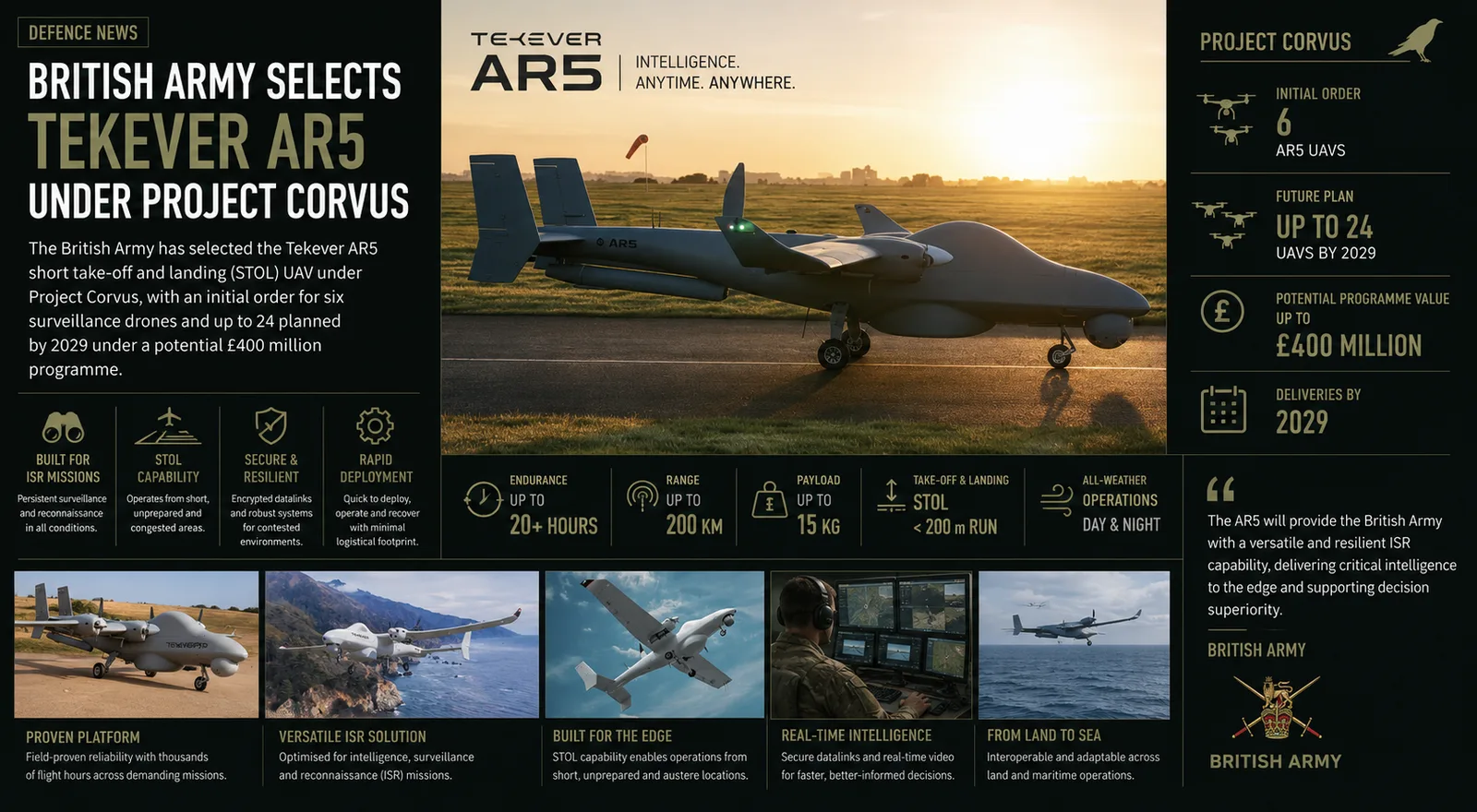
According to the UK Ministry of Defence announcement, the Army will initially receive six Tekever AR5 aircraft, with up to 24 expected to be delivered by 2029. The potential ten-year programme is valued at up to £400 million.
The acquisition forms part of Project Corvus, the British Army programme intended to provide a persistent Land Tactical Deep Find capability. Subject to contract signature and final approvals, the new system is expected to begin entering service later in 2026.
The official Tekever AR5 product page lists an endurance of 20 hours, a 50 kg payload capacity and launch and recovery from unprepared airstrips. By comparison, the British Army’s Watchkeeper information lists a 14-hour endurance and a 150 km operating range from its ground station.
Key Facts
- Selected platform: Tekever AR5 medium-endurance surveillance UAV.
- Programme: Project Corvus, supporting the British Army’s Land Tactical Deep Find requirement.
- Initial order: Six AR5 aircraft.
- Planned fleet: Up to 24 aircraft delivered by 2029.
- Potential value: Up to £400 million over ten years.
- Replacement: Watchkeeper, which has been in British Army service since 2014.
- AR5 endurance: 20 hours, according to Tekever.
- AR5 payload: Up to 50 kg of cameras, sensors and other mission equipment.
- Manufacturing: The aircraft is expected to be built at Tekever’s new Swindon facility.
- Service entry: Planned to begin later in 2026, subject to contract signature and final approvals.
- Operational reference: The UK Ministry of Defence states that the AR5 has been used by Ukraine’s Armed Forces.
Why Has the British Army Selected the Tekever AR5?
The British Army selected the AR5 to provide longer-endurance surveillance, improved sensor capacity and greater reliability than the systems it is intended to replace.
The aircraft will support round-the-clock intelligence gathering and provide commanders with real-time information about enemy activity, terrain and developing battlefield conditions.
Its principal role will be intelligence, surveillance, target acquisition and reconnaissance. Information collected by its sensors could help commanders protect deployed troops, identify targets and coordinate long-range fires.
The selection also reflects the British Army’s wider effort to increase its use of autonomous systems, digital connectivity and battlefield data.
What Is Project Corvus?
Project Corvus is the British Army programme to procure a new uncrewed air system for persistent tactical surveillance.
The requirement was originally described as an Army Land Tactical Deep Find capability capable of providing 24-hour persistent surveillance. The programme includes the aircraft, mission systems, ground equipment, training, support and future capability development.
The UK Government’s Defence Investment Plan identifies Project Corvus as one of the principal uncrewed-aircraft programmes supporting the Army’s modernisation.
The plan calls for up to 24 surveillance drones to replace Watchkeeper and conduct intelligence, surveillance, target-acquisition and reconnaissance missions.
How Many AR5 Drones Will the British Army Receive?
The first order is expected to cover six AR5 aircraft. The programme could subsequently expand to a fleet of up to 24 aircraft by 2029.
The government announcement does not provide a detailed annual delivery schedule or clarify how many complete ground-control systems, data terminals, sensor packages or training systems will be acquired.
The stated value of up to £400 million should therefore not be divided by the number of aircraft to estimate a unit price. The potential ten-year value includes the wider capability and support arrangement rather than only the air vehicles.
Support is expected to continue for at least five years, with options to extend the arrangement.
What Are the Tekever AR5 Specifications?
Tekever describes the AR5 as a medium-altitude, medium-endurance fixed-wing uncrewed aircraft intended to monitor large land and maritime areas.
The manufacturer publishes the following baseline specifications:
- Dimensions: 7.3 by 4.0 metres
- Endurance: 20 hours
- Payload capacity: 50 kg
- Cruise speed: 100 km/h
- Launch: Unprepared airstrip
- Recovery: Unprepared airstrip
- Published communications range: Described by the manufacturer as unlimited
Tekever does not publish a complete military configuration for Project Corvus on the cited product page. The final British Army aircraft may therefore use customer-specific sensors, communications, data processing and cybersecurity systems.
The government announcement confirms that the aircraft will be capable of carrying up to 50 kg of surveillance equipment, including cameras and sensors.
Tekever AR5 and Watchkeeper Comparison
The following comparison uses publicly available specifications from Tekever, the British Army and the UK Ministry of Defence. Some values are not directly comparable because the organisations publish different levels of technical detail.
| Capability Area | Tekever AR5 | Watchkeeper | Programme Significance |
|---|---|---|---|
| Primary role | Persistent land and maritime surveillance | Intelligence, surveillance, target acquisition and reconnaissance | AR5 will continue the Army’s deep-surveillance mission with a newer platform |
| Endurance | 20 hours | 14 hours | Longer missions may reduce the number of launches required for persistent coverage |
| Payload capacity | Up to 50 kg | No payload-weight figure published on the cited British Army page | Provides capacity for cameras, radar, communications or other mission sensors |
| Dimensions | 7.3 by 4.0 metres | 6.5 metres long with a 10.9-metre wingspan | The aircraft use different airframe and deployment concepts |
| Cruise speed | 100 km/h | 77 knots | Speed values are published in different units and do not by themselves determine mission effectiveness |
| Communications range | Manufacturer describes communications range as unlimited; supporting architecture is not detailed on the cited page | 150 km from the ground station | Beyond-line-of-sight communications could expand the operational area, subject to the selected configuration |
| Published altitude | Not stated on the cited Tekever page | Up to 16,000 feet | The Project Corvus operating-altitude requirement has not been disclosed |
| Take-off weight | Not stated on the cited Tekever page | 485 kg | No direct weight comparison can be made from the cited public data |
| Launch and recovery | Unprepared airstrip | Not specified on the cited British Army equipment page | AR5 is intended to operate without a fully developed permanent runway |
| Operational history | Used by Ukraine’s Armed Forces, according to the UK Ministry of Defence | British service since 2014 and operational use in Afghanistan | The replacement combines recent battlefield experience with a new UK support model |
| UK programme status | Selected under Project Corvus, subject to contract signature and final approvals | Approaching the end of its operational life | Marks the transition to a new Army deep-surveillance capability |
Why Is Watchkeeper Being Replaced?
Watchkeeper entered British Army service in 2014 and is approaching the end of its planned operational life.
The platform provides the Army’s Land Tactical Deep Find capability and supports intelligence, surveillance, target acquisition and reconnaissance missions during the day and at night.
Its sensor suite includes radar, day and night cameras and laser functions for range finding, target marking and target designation. The system can transmit intelligence to commanders, analysts, ground forces and strike assets.
The Army states that Watchkeeper has accumulated close to 4,000 flying hours since its first flight in 2010 and was used operationally in Afghanistan.
The Ministry of Defence says the AR5 offers improved endurance, sensor capability and reliability. However, detailed customer-specific performance data has not yet been released.
What Sensors Could the British Army AR5 Carry?
The final Project Corvus sensor configuration has not been publicly disclosed.
The government announcement states that the AR5 will carry up to 50 kg of surveillance equipment, including cameras and sensors.
A complete military intelligence package could potentially include electro-optical and infrared cameras, radar, communications-relay equipment or signals-intelligence payloads. These possibilities should not be treated as confirmed Project Corvus equipment unless announced by the Ministry of Defence or Tekever.
The choice of payload will determine the aircraft’s ability to identify targets, track moving vehicles, operate in poor weather and provide coordinates for long-range weapons.
How Could AR5 Support British Army Operations?
AR5 could support commanders by maintaining surveillance over routes, assembly areas, artillery positions and other locations beyond the immediate front line.
Potential British Army tasks include:
- Persistent battlefield surveillance
- Target detection and identification
- Tracking vehicles and troop movements
- Supporting long-range fires
- Battle-damage assessment
- Route and area reconnaissance
- Force-protection surveillance
- Communications relay
- Border and infrastructure monitoring
- Intelligence distribution to commanders and ground units
The exact mission set will depend on the sensors, communications systems, software and operational approvals included in the final Army configuration.
What Does the Ukraine Reference Mean?
The UK Ministry of Defence states that the AR5 has been used by Ukraine’s Armed Forces during the war with Russia.
This gives the platform an operational reference in a conflict involving electronic warfare, contested airspace and rapidly changing surveillance requirements.
The government announcement does not provide details about the number of aircraft used, mission success rates, survivability, losses or the exact Ukrainian configuration.
The phrase “proven in Ukraine” should therefore be understood as confirmation of operational use rather than independent verification of every performance claim associated with the platform.
Where Will the British Army AR5 Be Built?
The aircraft is expected to be manufactured at Tekever’s new facility in Swindon.
The 254,000-square-foot site is designed to support rapid prototyping, manufacturing, system integration, research and development and the wider drone-production lifecycle.
The facility is intended to bring core AR5 production to the United Kingdom for the first time and expand production of Tekever’s smaller AR3 family.
The Project Corvus contract is expected to sustain and create hundreds of jobs across Tekever’s UK sites. The government announcement highlights employment and industrial benefits in South West England and Wales.
Tekever also operates at West Wales Airport, which the company acquired to expand its UK flight-testing and autonomous-systems capabilities.
Why Does the Contract Matter for UK Defence Manufacturing?
The AR5 selection links an operational Army requirement with the expansion of domestic drone production.
The UK Government increasingly treats defence procurement as an instrument for industrial growth, supply-chain resilience and sovereign capability.
Producing AR5 aircraft in Britain could provide greater control over maintenance, upgrades, software changes and future production increases.
The arrangement may also allow the Army and Tekever to introduce capability upgrades through spiral development rather than retaining one fixed configuration throughout the programme.
Tekever describes Corvus as a partnership intended to maintain a continuous cycle of capability evolution. The precise contractual mechanisms for future upgrades have not been published.
How Does Corvus Fit Into the UK Drone Strategy?
Project Corvus is part of a broader UK investment in uncrewed and autonomous systems.
The Defence Investment Plan allocates more than £5 billion to military drone programmes over four years. These investments cover surveillance aircraft, collaborative combat systems, electronic warfare, logistics and uncrewed ground vehicles.
Alongside Corvus, Project NYX is intended to develop autonomous aircraft capable of operating with British Army Apache attack helicopters.
The Royal Air Force is also developing uncrewed electronic-warfare and collaborative combat-air capabilities.
Corvus therefore represents the Army’s persistent surveillance element within a wider transition toward networked, autonomous and software-defined systems.
When Will the Tekever AR5 Enter British Army Service?
The new capability is expected to begin entering service later in 2026.
This timeline remains subject to contract signature and final approvals. It may also depend on manufacturing readiness, aircraft acceptance, sensor integration, regulatory certification and operator training.
The initial six aircraft are expected to provide an early operational capability before the fleet expands toward the planned total of up to 24 by 2029.
The Ministry of Defence has not disclosed a specific in-service date, receiving unit, training location or initial operational deployment.
What Are the Main Programme Risks?
The selection establishes the intended direction of the programme, but several implementation risks remain.
- Completion of the contract and final government approvals
- Opening and scaling the new Swindon production facility
- Transferring AR5 manufacturing processes into the United Kingdom
- Integrating the British Army’s selected sensor package
- Securing resilient battlefield communications
- Operating under electronic warfare and navigation disruption
- Training operators, analysts, engineers and ground crews
- Integrating intelligence with Army command and fires networks
- Maintaining delivery schedules through 2029
- Managing the transition from Watchkeeper without a surveillance-capability gap
The final operational value of the programme will depend on the complete system rather than the aircraft alone. Sensors, data links, processing software, ground equipment, training and support will determine how effectively AR5 contributes to Army operations.
Conclusion
The selection of the Tekever AR5 marks the planned replacement of the British Army’s Watchkeeper surveillance system and the beginning of a new Land Tactical Deep Find capability.
The initial acquisition covers six aircraft, with the fleet expected to grow to as many as 24 by 2029 under a programme potentially worth up to £400 million over ten years.
AR5 offers a published endurance of 20 hours and capacity for up to 50 kg of surveillance equipment. Its operational use in Ukraine and planned UK production are central to the government’s case for the selection.
The next milestones will be contract signature, final approvals, completion of the Swindon production capability and the beginning of British Army service later in 2026.
For related coverage, visit Defence Agenda’s unmanned systems, C4ISR and land warfare sections. Related reports include Airbus MARS networked UAV missions, ANKA III’s upgraded production configuration and BETA MV250 hybrid-electric military VTOL.
Further Reading
- UK Ministry of Defence: Tekever AR5 selected for the British Army
- UK Government: Defence drone transformation and Project Corvus
- Tekever: AR5 official product information
- British Army: Watchkeeper Uncrewed Air System
- UK Government: Tekever’s Swindon drone-manufacturing facility
- Tekever: UK production expansion in Swindon