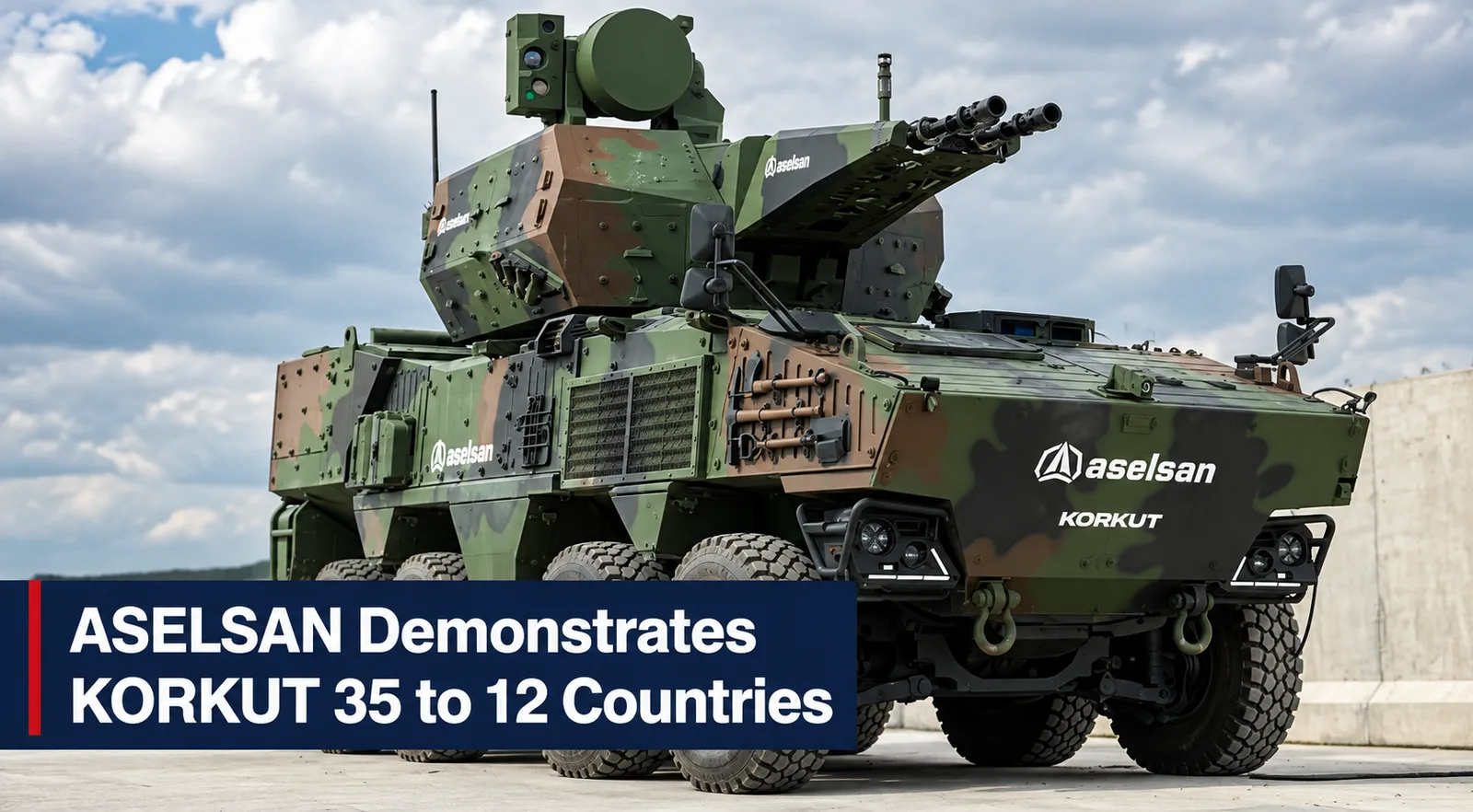
ASELSAN demonstrated its KORKUT 35 mobile air-defence gun system at Karapınar before military delegations from 12 countries, engaging multiple drone profiles and a moving ground target. The activity was a live-fire demonstration rather than a new procurement or fielding announcement.
KORKUT moves from product data to a customer-facing live-fire event
ASELSAN used the Karapınar firing range to put KORKUT 35 in front of military delegations from 12 countries, shifting the message from brochure specifications to an observed live-fire demonstration. Anadolu Agency reported that the system engaged fixed-wing, delta-wing and mini-UAV targets and also struck a moving ground target while the vehicle itself was in motion. That combination is relevant for a mobile very-short-range air-defence system because the practical problem is not simply hitting a target from a prepared position, but maintaining a sensor-to-shooter cycle while manoeuvring with supported formations.
The event should nevertheless be described carefully. It was a demonstration, not an announced export contract, acceptance test for a named customer or evidence of a new Turkish Armed Forces delivery. No quantity, customer, price or follow-on procurement schedule was disclosed. The strongest verified point is therefore that ASELSAN presented KORKUT’s current capabilities to a multinational military audience under live-fire conditions.
The counter-UAS role is increasingly central to KORKUT’s value proposition
KORKUT was developed as a self-propelled gun-based air-defence system for mechanised formations, but the operational environment has pushed counter-UAS performance to the centre of the system’s export case. Small fixed-wing drones, delta-wing one-way attack systems and mini-UAVs create different tracking and engagement problems from conventional aircraft. A 35 mm gun system with programmable airburst ammunition offers a different cost and magazine-depth proposition from missile-only short-range air defence.
Defence Agenda’s earlier review of KORKUT 140/35 noted ASELSAN’s published configuration of a stabilised twin-35 mm turret, radar and electro-optical tracking, and a platoon architecture linking gun vehicles to command-and-control. Those published characteristics explain the system logic, but they should not be used to infer performance beyond the demonstrated scenarios. The September event adds observed engagement activity; it does not by itself define a full probability-of-kill figure, saturation capacity or electronic-warfare resilience.
The demonstration also supports the broader Steel Dome export narrative
ASELSAN increasingly presents individual air-defence products as components of a connected architecture rather than isolated weapons. In that context, KORKUT sits in the lower layer of Türkiye’s Steel Dome concept alongside radars, command-and-control systems, electronic-warfare effectors, missiles and newer directed-energy or counter-drone systems. A live-fire demonstration before foreign delegations therefore has both a product-level and an architecture-level purpose: it shows the gun system while also supporting a broader integrated-air-defence sales proposition.
For prospective operators, integration questions will matter as much as the gun itself. The issues to watch include interoperability with national air pictures, rules for target classification and engagement, ammunition logistics, sensor cueing from external nodes and the ability to operate in a contested electromagnetic environment. None of those questions was resolved by the public demonstration, but they are likely to shape whether interest progresses into formal procurement activity.
Implications / Next
The next meaningful milestones would be a named export customer, a signed procurement agreement, customer-specific acceptance testing or a disclosed delivery schedule. Additional demonstrations against larger target sets, simultaneous raids or electronic-warfare conditions would also add evidence about the system’s operational envelope.
Until then, the September event should be treated as a multinational live-fire marketing and capability demonstration. It strengthens the evidence base for KORKUT’s counter-UAS role, but it does not establish a new order or fielding event. Defence Agenda will continue to separate public demonstration evidence from procurement and fielding claims. Future reporting should be updated only when the responsible authority, end user or manufacturer discloses a concrete milestone with a date, quantity or contractual status that can be independently checked. This avoids turning marketing language or programme intent into an unsupported statement about operational capability.