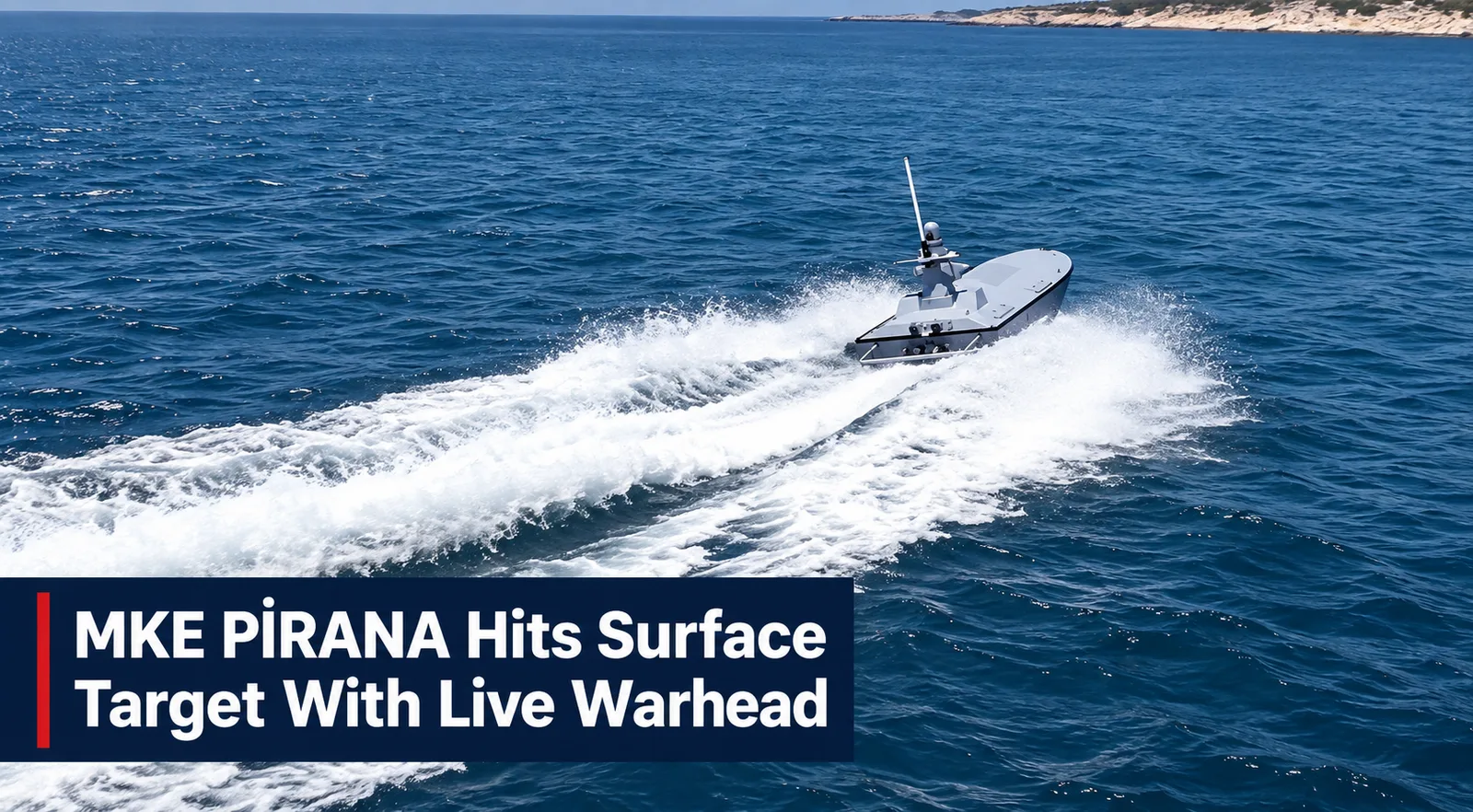
MKE’s PİRANA one-way unmanned surface vehicle struck a surface target with a live warhead during a 2026 naval exercise, moving the programme from public display and sea trials into a live-effect test. The event is a test milestone; public sources reviewed do not establish operational fielding or a production order.
The live-warhead hit advances PİRANA beyond a mobility demonstration
MKE’s PİRANA one-way unmanned surface vehicle has struck a surface target with a live warhead during a 2026 naval exercise, according to European Security & Defence. That event is materially more significant than a static unveiling or a basic sea-mobility trial because it exercises the strike chain through terminal approach and warhead effect. It therefore deserves to be recorded as a live-effect test milestone.
It should not, however, be described as operational fielding unless MKE or the Turkish authorities explicitly confirm that status. Public reporting reviewed for this article does not establish a production quantity, a customer acceptance event or an inventory-entry date. The appropriate maturity language is that PİRANA has demonstrated a live-warhead engagement against a surface target under exercise or test conditions.
One-way surface vehicles are becoming a distinct naval effector class
The rapid spread of unmanned surface craft in recent conflicts has changed how navies think about close-range maritime strike. A relatively small one-way vehicle can threaten ships, harbour infrastructure or coastal targets while exposing no crew aboard the attacking craft. The concept also creates defensive challenges because low-profile surface vehicles can approach from multiple directions and may be combined with airborne or subsurface threats.
PİRANA places MKE in this emerging category. The programme complements Türkiye’s wider work on reusable unmanned surface vessels, kamikaze surface craft and autonomous underwater systems. The operational value will depend on navigation accuracy, communications resilience, terminal guidance, target discrimination and the ability to function when satellite navigation or data links are contested.
The test also shows how Türkiye is diversifying maritime strike options
Türkiye’s naval unmanned-systems ecosystem now includes platforms from multiple industrial actors with different mission philosophies. Some are reusable ISR and electronic-warfare vessels; others are intended for one-way attack. Defence Agenda has separately tracked ASELSAN’s TUFAN and MKE’s naval TOLGA integration, illustrating how the same industrial base is developing both offensive autonomous craft and defensive counter-UAS or close-in systems.
PİRANA’s live-warhead test fits that pattern of rapid iteration from concept to physical trials. The challenge now is moving from a successful controlled engagement to a robust operational system. That means validating launch and control procedures, sea-state tolerance, target identification, communications under jamming and the safety architecture needed to deploy live one-way systems around friendly traffic.
Implications / Next
The next programme indicators should be official disclosure of acceptance testing, serial-production decisions, inventory entry or integration into a specific naval unit. Additional tests against moving targets and under degraded communications would provide a stronger indication of operational maturity than a single surface-target hit.
For now, the live-warhead engagement is a credible development milestone. It shows that PİRANA has progressed into destructive testing, but it does not yet prove that the system is fielded at scale. Defence Agenda will continue to separate public demonstration evidence from procurement and fielding claims. Future reporting should be updated only when the responsible authority, end user or manufacturer discloses a concrete milestone with a date, quantity or contractual status that can be independently checked. This avoids turning marketing language or programme intent into an unsupported statement about operational capability.
The economics of one-way maritime systems will also matter. Their attraction is partly the possibility of creating credible strike effects with smaller and cheaper craft than crewed combatants or conventional anti-ship missile platforms. But cost-effectiveness depends on more than the vehicle price: launch infrastructure, sensors, communications, mission planning, training, storage, warheads and attrition all contribute to the real cost per mission. A successful live-warhead test is therefore necessary but not sufficient evidence for scalable operational use. The programme will become more strategically significant when MKE discloses production arrangements, inventory acceptance or repeatable testing across a wider set of sea states and target behaviours.