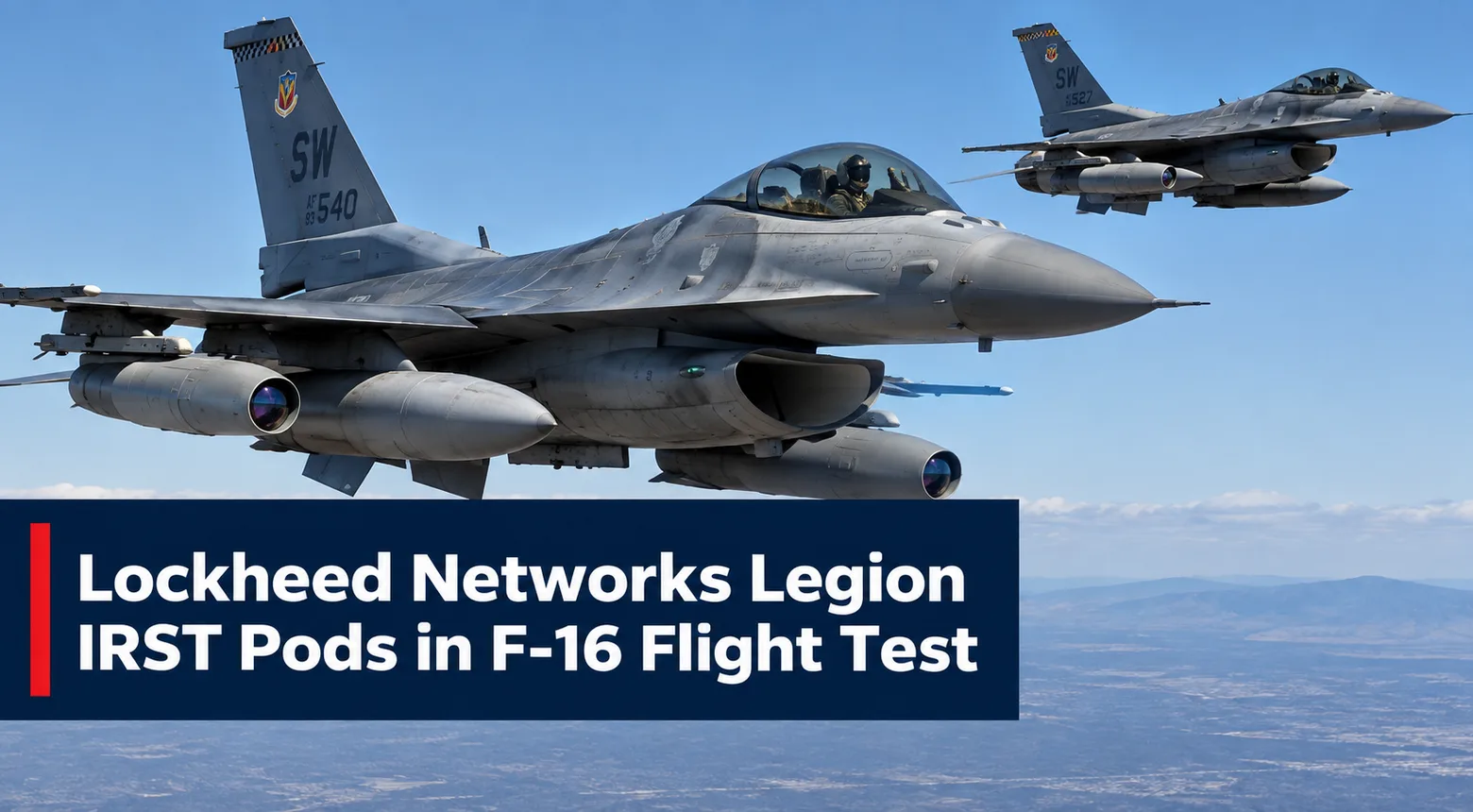
Lockheed Martin has flight-tested a dedicated pod-to-pod data link between two Legion infrared search-and-track systems carried by F-16s. Using a pre-production L3Harris HiveLink connection, the sensors shared track data to improve accuracy and generate faster passive range solutions against airborne targets.
Two IRST pods have been turned into a distributed sensor pair
Lockheed Martin has demonstrated a dedicated data link between two Legion infrared search-and-track pods during F-16 flight testing, allowing the sensors to share tracking information in real time. The company announced the result on 16 September 2026 following tests with the U.S. Air National Guard and Air Force Reserve Test Center at Morris Air National Guard Base in Tucson, Arizona.
The aircraft carried Legion systems enhanced with a pre-production version of L3Harris’ HiveLink data link. According to Lockheed Martin, connecting the pods increased track accuracy and enabled near-instantaneous ranging solutions for multiple airborne targets. The significance is architectural: two passive sensors viewing the same target from different positions can create a more complete geometric solution than either aircraft can generate alone.
Passive networking addresses an IRST limitation
Infrared search-and-track systems detect heat signatures without emitting radar energy, which can be valuable in environments where aircraft want to minimise their electromagnetic signature or where radar is jammed. The trade-off is that a passive sensor does not inherently provide range information in the same way as an active radar. Networking separate lines of sight can help overcome that limitation through triangulation and data fusion.
Lockheed describes the effect as giving aircrews faster “depth perception” across several contacts. In operational terms, that could shorten the time required to classify and prioritise targets while leaving aircraft radar and communications capacity available for other tasks. The test does not, however, establish engagement performance against every threat class or prove that the system can maintain the same network quality under all jamming conditions.
HiveLink is the new element under evaluation
Legion itself is not a new prototype. The sensor, formerly known as IRST21, is already fielded and in production in a podded configuration and has been integrated across F-15 and F-16 applications. The new milestone is the dedicated inter-pod network. L3Harris’ HiveLink is described as supporting resilient line-of-sight and beyond-line-of-sight connectivity, mesh networking and multiple waveform options.
The company specifically calls the tested HiveLink version pre-production. That maturity label should be preserved. A successful flight test demonstrates feasibility and performance in a controlled campaign, but production configuration, qualification, fleet retrofit and operational tactics remain separate steps.
Open architecture keeps the sensor relevant to future teaming
Lockheed Martin positions Legion around a modular open-systems architecture that can accept new data links and gateways without redesigning the entire sensor package. Future work cited by the company includes software-defined radios, multi-waveform gateways and support for manned-unmanned teaming. That direction aligns with wider U.S. combat-air efforts to distribute sensing across crewed fighters and collaborative aircraft.
For programme offices, the key value is not simply greater sensor range. A networked passive architecture can let aircraft contribute measurements to a common track while remaining geographically separated. The technical challenge will be maintaining timing accuracy, data quality and secure connectivity under contested electromagnetic conditions without adding unacceptable integration burden.
Programme maturity and verification
For acquisition and programme-management teams, the milestone is most useful when separated from the claims that usually surround it. The confirmed event establishes technical or contractual progress, while production scale, operational availability, unit adoption and future performance still require their own evidence. That distinction keeps the programme baseline stable as new announcements arrive.
Implications / Next
Watch for a production-standard HiveLink configuration, additional F-16 and F-15 integration events, testing with uncrewed aircraft and any formal operational acceptance of the networked feature. The current milestone is a successful flight test, not fleet-wide fielding.