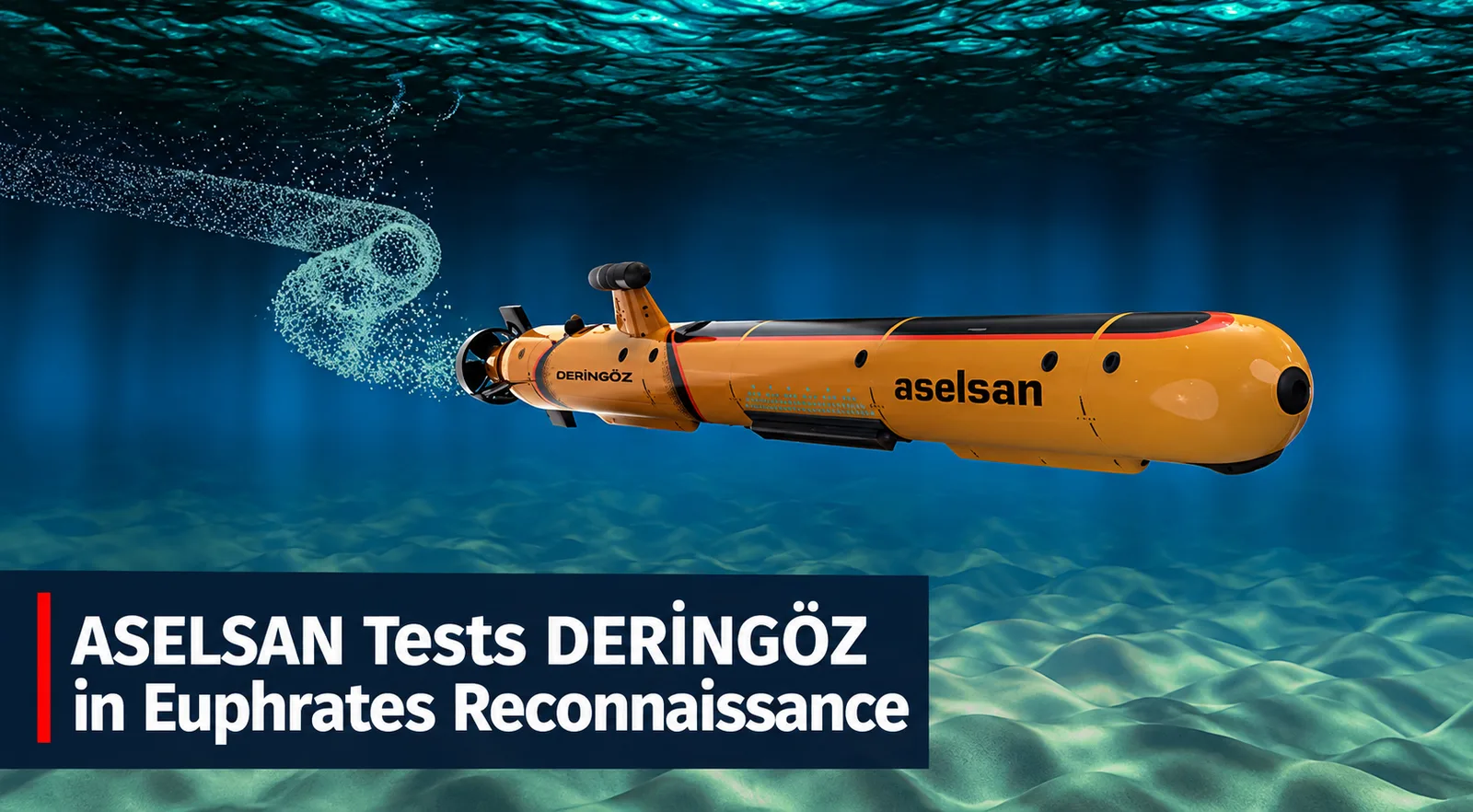
ASELSAN’s DERİNGÖZ autonomous underwater vehicle conducted a reconnaissance activity in the Euphrates River around Halfeti, adding a riverine demonstration to the programme’s earlier controlled diving and naval-shipyard trials. The event is another test/demonstration milestone, not a new inventory announcement.
Halfeti adds a different environment to DERİNGÖZ testing
ASELSAN’s DERİNGÖZ autonomous underwater vehicle has conducted a reconnaissance activity in the Euphrates River around Halfeti in Şanlıurfa, according to Anadolu Agency. The demonstration adds an inland river environment to a programme that has already been shown in controlled diving trials and during the TEKNOFEST Mavi Vatan event at Gölcük Naval Shipyard Command. The immediate significance is therefore environmental diversification rather than a first-ever dive or a new customer delivery.
Riverine conditions can differ substantially from open-water test areas. Currents, shallow sections, variable visibility, confined geometry and the presence of civilian infrastructure can complicate navigation and sensing. A successful demonstration in such an environment provides useful evidence about mission flexibility, but it does not by itself define the full operating envelope or certify performance under every river or littoral condition.
DERİNGÖZ is designed around modular sensing and autonomy
ASELSAN positions DERİNGÖZ as a modular autonomous underwater vehicle for surveillance, reconnaissance, seabed and infrastructure monitoring and other underwater missions. Public product information lists a sensor and navigation architecture that can be configured with sonar, cameras and different navigation aids. That modularity is central to the programme because an AUV intended for mapping or infrastructure inspection may need a different payload from one used for military reconnaissance.
Defence Agenda previously reported that DERİNGÖZ demonstrated autonomous navigation and scanning at TEKNOFEST Mavi Vatan. The Halfeti activity should be read as an extension of that development path. It shows the programme being exercised outside a naval-base demonstration setting, but there is no public statement that the vehicle has reached a new production or inventory milestone as a result of this specific event.
Underwater autonomy is becoming a broader Turkish capability area
DERİNGÖZ sits within a rapidly expanding Turkish portfolio of unmanned maritime systems. ASELSAN is developing reusable surveillance vehicles, expendable underwater strike concepts and unmanned surface platforms alongside sonar and communications technologies. Other Turkish companies and public institutions are pursuing parallel work in autonomous surface and subsurface systems. The result is an emerging system-of-systems approach rather than a single-drone programme.
For defence planners, autonomous underwater vehicles offer persistence without putting crews directly into hazardous water. They can also support inspection of pipelines, cables, port approaches and other critical infrastructure. The same autonomy and sensing technologies therefore have relevance in military, security and civil missions. Demonstrations such as Halfeti help show that the vehicle can be moved between mission environments, even though each new use case still requires its own operational validation.
Implications / Next
The next milestones to watch are additional trials at greater depth, longer-duration missions, multi-vehicle operations, customer-specific payload demonstrations and confirmed procurement or delivery announcements. Integration into a wider command-and-control or maritime-domain-awareness network would also be significant because autonomous vehicles become more useful when their data can be fused with other sensors.
For now, the Halfeti activity is best described as another reconnaissance and environmental demonstration for DERİNGÖZ. It broadens the programme’s public test record without changing the distinction between demonstration and fielding. Defence Agenda will continue to separate public demonstration evidence from procurement and fielding claims. Future reporting should be updated only when the responsible authority, end user or manufacturer discloses a concrete milestone with a date, quantity or contractual status that can be independently checked. This avoids turning marketing language or programme intent into an unsupported statement about operational capability.
The Halfeti demonstration is also relevant to civil-security and resilience missions. Rivers, reservoirs and flooded environments contain bridges, intakes, pipelines, energy infrastructure and submerged structures that can require inspection after natural disasters or security incidents. An AUV able to carry different sonars and cameras can support these missions without exposing divers to the same level of risk. That dual-use potential may broaden the programme’s customer base, but it should not obscure the military maturity question. A public reconnaissance demonstration shows environmental adaptability; it does not confirm that a specific operational unit has accepted DERİNGÖZ or that the system has entered serial service in the configuration shown.