The SLCM-N nuclear cruise missile programme has moved another step towards prototype demonstrations after Raytheon, an RTX business, announced on 24 November 2026 that the U.S. Navy had awarded it an Other Transaction Authority (OTA) agreement for design maturation and subsystem integration. The company said it would work with Anduril Rocket Motor Systems, Divergent and Williams International. The selection adds momentum to a programme intended to provide a nuclear-armed sea-launched cruise missile for the U.S. Navy, but the individual agreement value, prototype test dates and production quantities have not been disclosed. It is a development-phase award rather than evidence that a new weapon has completed testing or entered service.
Raytheon Moves the SLCM-N Design into Development
The announcement, published by RTX on 24 November 2026, describes a move beyond initial concept work. Raytheon’s Advanced Technology team is responsible for maturing the missile design, connecting major subsystems and preparing for later prototype demonstrations. The company describes its approach as composable, using qualified or previously developed building blocks wherever appropriate rather than starting every subsystem from a blank design. This is an industrial design strategy, not a claim that a complete nuclear-capable missile has already been built or qualified. Neither the company announcement nor the contemporaneous Naval News report provides a new production award, signed deployment plan or individual dollar value.
The newly identified industrial team includes Anduril Rocket Motor Systems, Divergent and Williams International. The combination illustrates the Navy’s effort to bring established missile manufacturers and newer industrial suppliers into a common development effort. Raytheon did not release a detailed division of work, production allocations or a confirmed engine or propulsion architecture for each subcontractor. The presence of a specialist in a team must therefore not be treated as proof that a particular component has been selected or tested. Final design choices, integration arrangements and manufacturing scale remain to be established through subsequent programme decisions.
An OTA is a procurement mechanism used by U.S. defence agencies to support innovative prototyping and development outside the structure of conventional Federal Acquisition Regulation contracts. That flexibility can allow the Navy to engage suppliers earlier and to assess competing technologies, while retaining the need for documented test outcomes and government acceptance. An OTA development announcement does not by itself specify the total programme cost. It also does not establish that the recipient has become sole production prime for any eventual fleet-wide procurement. Those distinctions are material for both industrial investors and defence programme offices assessing how much risk has actually been retired.
The 24 November announcement comes after an earlier competitive phase. According to Naval Today’s report of the Navy’s October announcement, five prototype agreements were awarded on 23 September 2026, with work scheduled through 31 December 2027. The group included suppliers working on missile development and flight-system integration as well as launcher canisters. That five-agreement package was reported at approximately $743.6 million combined. The figure must not be presented as the disclosed value of the later Raytheon development announcement, which does not identify its stand-alone amount.
Other SLCM-N contracts address different elements of the wider system. The Navy’s Strategic Systems Programs (SSP) announcement of 20 November 2025 covered separate launcher and canister prototype awards to Northrop Grumman Mission Systems and Pacific Engineering. The declared value for those earlier agreements was $26.24 million, and the Navy said work was linked to integration with Virginia-class submarine launch arrangements. The timing and contracting scope are not interchangeable with the new Raytheon agreement. Defence Agenda has separately covered a $194.1 million fire-control modification for General Dynamics, which concerns submarine systems integration rather than new missile rounds.
Nuclear Deterrence, Funding and Programme Risks
The SLCM-N concept is intended to give U.S. decision-makers an additional regional nuclear-deterrence option from naval platforms. That political purpose is distinct from the existing submarine-launched ballistic-missile force, which provides a core element of the strategic nuclear triad. An attack-submarine-launched cruise missile would carry different requirements for nuclear command and control, crew procedures, certification, custody and infrastructure. The programme therefore involves more than development of the missile body: it also relies on launch compatibility, fire-control assurance, warhead-related work and fleet support arrangements. Changes in any of those areas can affect schedule and cost even when the underlying missile design progresses.
Programme financing has been subject to close congressional attention. As Janes reported on 25 November 2026, Navy officials said they would continue the SLCM-N effort despite the absence of a dedicated line for it in the proposed fiscal 2027 Navy budget. Previous reconciliation legislation provided approximately $2 billion for missile development and a further $400 million for related nuclear-warhead work. These appropriations are programme-level funding streams: they are not a valuation of Raytheon’s new agreement. The budget position underscores a practical risk for contractors if design work advances faster than a predictable sequence of future appropriations and integration decisions.
The public schedule also requires careful interpretation. Legislation and reporting have referred to a limited capability target in September 2032, while earlier statutory planning and programme assessments have used 2034 for initial operational capability. These markers describe different milestones, not proof that operational deployment has occurred. Raytheon’s 24 November announcement gives no date for a first prototype demonstration and does not update all programme milestones. In procurement analysis, a planned demonstration should not be conflated with completed qualification, a manufacturing contract or certification for nuclear service.
A potential benefit of modular development is faster design iteration and access to a broader supplier base. However, using diverse industrial partners can also introduce configuration-control, quality-assurance, security and delivery-synchronisation challenges. An aggressive schedule may be difficult to reconcile with the stringent assurance needed for a nuclear-capable weapon and the limitations of submarine maintenance and weapons-handling facilities. Similarly, the demands of adapting attack submarines for a new nuclear mission could affect conventional payload capacity and operational planning. Those are programme risks and trade-offs rather than announced technical defects or measured performance shortfalls.
There is a strategic debate over whether a sea-launched, non-strategic nuclear option increases deterrence flexibility or complicates escalation management. Supporters argue that a more diverse set of delivery options could strengthen regional deterrence and Allied assurance. Critics question the costs, potential ambiguity associated with dual-use-looking launch platforms, and the implications of moving nuclear weapons onto submarines that are normally tasked with conventional operations. The present award does not settle that debate. It establishes an industrial development step, leaving questions of doctrine, deployment policy and long-term affordability to later government decisions.
Defence Agenda’s reporting on the Trident II D5LE2 design effort provides context for the separate ballistic-missile leg of naval nuclear deterrence. Its analysis of lower-cost, conventionally armed containerised munitions explores a different procurement trade-off: weapon affordability and industrial scale. Those programmes should not be merged with SLCM-N, which has a nuclear-specific mission, acquisition chain and safety requirements. The combination nonetheless shows how the Navy and wider U.S. defence sector are managing distinct pressures to modernise deterrence and increase production capacity.
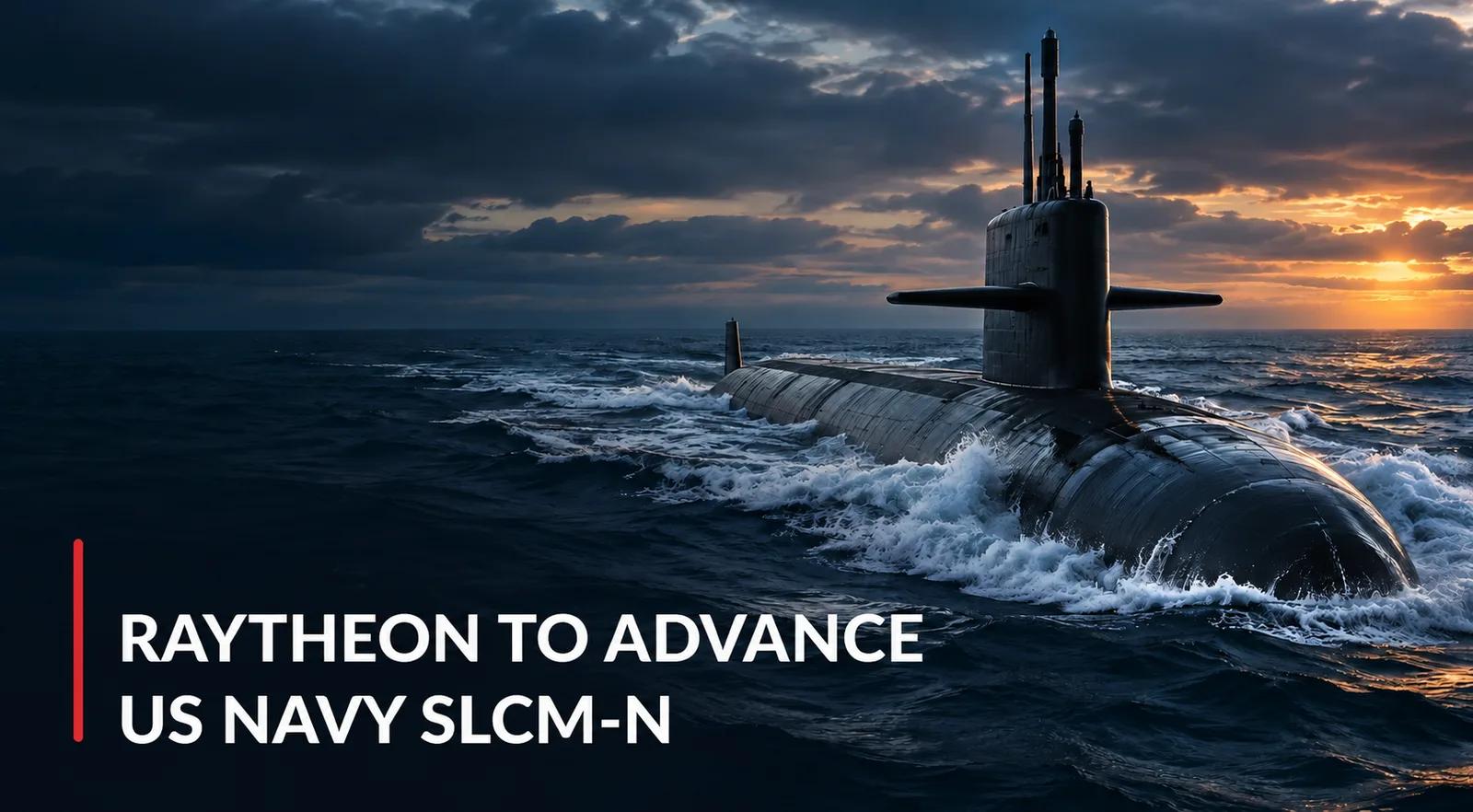
Implications / Next: The next credible milestones will be a disclosed test and demonstration schedule, verified subsystem-integration progress, confirmation of funding for subsequent programme phases, and evidence of shipboard compatibility and nuclear certification work. Public reporting should distinguish a concept or prototype selection from final production authority, and should keep financial figures attached to the specific awards they describe. As of 25 November 2026, Raytheon’s OTA advances the SLCM-N development effort but does not establish a completed missile flight test, fleet fielding date or production quantity. The image used with this article is an illustrative naval missile launch, not verified footage of an SLCM-N test.
Further Reading
- RTX / Raytheon — SLCM-N development agreement, 24 November 2026
- Naval News — U.S. Navy taps Raytheon, 24 November 2026
- Janes — U.S. Navy OTA development-phase reporting, 25 November 2026
- U.S. Navy SSP — SLCM-N prototype launcher agreements, 20 November 2025
- General Dynamics Mission Systems — SLCM-N fire-control programme, 19 October 2026
- General Dynamics Gets $194.1M SLCM-N Fire-Control Modification
- US Navy Adds $76.6M to Trident II D5LE2 Design
- US Navy Battleship Programme Cost Study