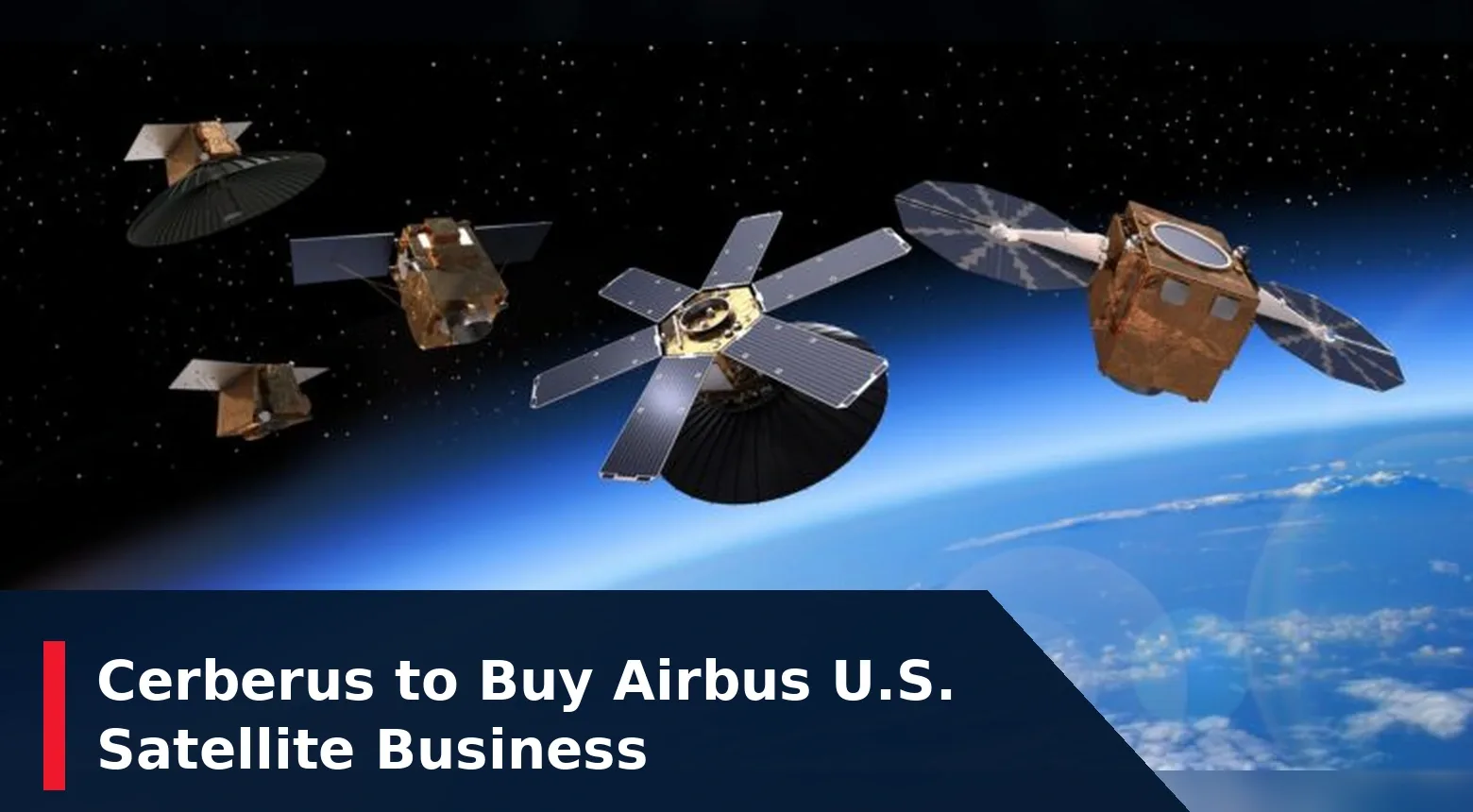
Cerberus Airbus satellite acquisition plans advanced on 24 November 2026, when Cerberus Capital Management announced an agreement to buy the U.S. Space Systems business of Airbus U.S. Space & Defense. The targeted asset operates a satellite manufacturing facility in Merritt Island, Florida, near Kennedy Space Center, and has a record of more than 650 satellites produced and launched, according to the buyer. Completion is expected by the end of 2026, subject to closing conditions; neither a purchase price nor a completed transfer has been announced. The proposed change of control matters for defence procurement because the facility provides serial satellite manufacturing and systems integration capacity for U.S. national-security and commercial space missions.
Cerberus Acquisition Targets a Florida Satellite Manufacturing Platform
The buyer's 24 November 2026 announcement identifies the target precisely as the U.S. Space Systems business of Airbus U.S. Space & Defense, rather than the entirety of Airbus's American subsidiary or the broader Airbus Defence and Space group. Cerberus-managed funds and accounts have signed an acquisition agreement. The company expects to close the transaction before the end of 2026, provided customary closing conditions are met. Breaking Defense reported the proposed sale on 24 November, while Kirkland & Ellis, counsel to Cerberus, separately confirmed the agreement and expected completion period.
Cerberus describes the business as possessing a roughly 200,000-square-foot production site adjoining Kennedy Space Center, combining engineering, spacecraft manufacturing, assembly, integration, testing and launch preparation. It credits the operation with producing and launching more than 650 satellites. That number is a cumulative industrial track record, not a single-year output figure, a new procurement order or a forecast of production under Cerberus. The company has not provided a valuation, fresh funding commitment, planned factory expansion timetable, workforce total or individual customer order quantities attributable to this acquisition.
The location and production history are material to the deal. Merritt Island sits within Florida's Space Coast industrial ecosystem, where launch infrastructure, payload suppliers, test services and specialist technical labour are concentrated. A satellite bus manufacturer can benefit from that proximity, but operational value also depends on secured components, repeatable quality, cyber and information assurance, and alignment with the launch and acceptance schedule of each customer. Ownership alone does not automatically increase the number of spacecraft that can be delivered each month.
The production operation has roots in the Airbus OneWeb Satellites arrangement. On 29 January 2024, Airbus U.S. announced completion of its acquisition of Eutelsat OneWeb's 50% interest in that satellite joint venture. That earlier transaction brought the manufacturing venture fully into the Airbus U.S. structure. It was not the Cerberus deal, and its consideration should not be interpreted as the price of the latest sale. The OneWeb production heritage helps explain the facility's experience with comparatively high-volume spacecraft assembly.
The American unit also has a documented national-security supply-chain role. In July 2022, Airbus U.S. stated it had been contracted to supply 42 satellite platforms and associated services to Northrop Grumman for the U.S. Space Development Agency's Tranche 1 Transport Layer. The manufacturer described its ARROW-derived bus architecture and the use of the Merritt Island production line for assembly, integration and testing. That older announcement establishes relevant experience; it does not itself verify that all 42 platforms are part of the assets being sold or specify the treatment of existing contracts after closing.
Similarly, the company's ARROW450 spacecraft bus description presents modular satellite technology intended for proliferated low-Earth-orbit networks. It identifies applications spanning communications, sensing and demonstration payloads. These are capabilities the seller has marketed, not a disclosure that each ARROW product, associated intellectual-property licence or international programme automatically transfers with the transaction. Definitive asset schedules and contract novations were not published in the announcement.
What U.S. Ownership Could Mean for Defence-Space Supply Chains
Cerberus frames the purchase as part of its Supply Chain investment strategy, under which it seeks to develop industrial capability in sectors relevant to U.S. and allied security. The company said it intends to invest in engineering, product development and the domestic supplier network. Craig Brooks, co-head of Cerberus Supply Chain, emphasised national-security and commercial satellite missions. Retired General John W. 'Jay' Raymond, the former first Chief of Space Operations of the U.S. Space Force and a Cerberus senior managing director, highlighted the demand for resilient orbital systems. These statements express the buyer's strategy, not an approved capital budget or guaranteed new government contract.
Proliferated constellations create a different industrial problem from single high-value spacecraft. Customers need a consistent supply of satellite buses, payload accommodation, electrical and thermal subsystems, integration slots and test capacity across many spacecraft. The potential benefit of a specialist U.S.-owned manufacturer is the ability to develop a repeatable product line and compete for national-security missions without depending solely on vertically integrated prime contractors. Yet lower unit costs and faster delivery require actual engineering standardisation, supplier throughput and customer orders—not merely a new financial owner.
There are also qualification and security considerations. Airbus U.S. has previously described its operations under a U.S. Special Security Agreement, as set out on its governance and customer information page. Cerberus says the acquisition would establish U.S. ownership of the business. However, the public transaction statement does not explain any resulting security approvals, export-licensing changes or contract-transfer requirements. It would be premature to claim that domestic ownership automatically removes regulatory controls, makes the business eligible for every classified programme, or transfers all government contracts without further approvals.
The seller's other activities need to be kept outside the scope of this transaction. Airbus U.S. Space & Defense also operates in military aircraft, rotary-wing systems, uncrewed aviation and related defence services. Its satellite-business divestment should not be reported as the sale of all Airbus operations in the United States. The distinction is equally important when comparing the deal with the proposed Airbus–Thales–Leonardo European space combination. That separate European restructuring has its own ownership plan, regulatory process and industrial objectives; it is not the legal transaction signed by Cerberus on 24 November.
The broader military-space environment explains why manufacturing capacity is attracting attention. Defence Agenda's reporting on the changing military satellite market and U.S. Space Force data-network supplier selection highlights requirements for resilience, connectivity, rapid replenishment and interoperability. These trends offer context for the potential role of a serial satellite producer. They do not prove that Cerberus has secured a follow-on order, won a particular U.S. Space Force competition, or achieved a production increase at Merritt Island.
One argument in favour of the acquisition is that a focused owner may direct more investment towards the satellite operation and pursue customers across multiple programmes. The counterargument is that private-equity ownership can introduce capital-allocation pressure, acquisition-integration work and uncertainty over workforce retention or long-term investment horizons. Neither outcome can be established from the sale announcement. Procurement agencies should judge the business on independently documented financial stability, security compliance, delivery performance, cost, support obligations and the competitive availability of alternatives.
Implications / Next: The first verifiable milestone is a completed closing, expected by 31 December 2026, subject to the announced conditions. Subsequent evidence would include the final ownership structure, any publicly disclosed asset or contract transfers, named new orders, capital spending, hiring and sustained output from the Florida facility. Until those records appear, the defensible headline remains an agreement to acquire—not a completed purchase, a disclosed billion-dollar deal, or the award of a new satellite constellation contract.
Further Reading
- Cerberus — Announcement of agreement to buy U.S. Airbus Space Systems business
- Breaking Defense — Cerberus to buy space business of U.S. Airbus arm, 24 November 2026
- Kirkland & Ellis — Legal advisory on the acquisition
- Airbus U.S. — SDA Tranche 1 Transport Layer satellite platform contract
- Airbus U.S. — 2024 Airbus OneWeb Satellites consolidation
- Defence Agenda — Airbus, Thales and Leonardo's separate European space venture
- Defence Agenda — Space warfare and military satellite manufacturing
- Defence Agenda — U.S. Space Force data network suppliers