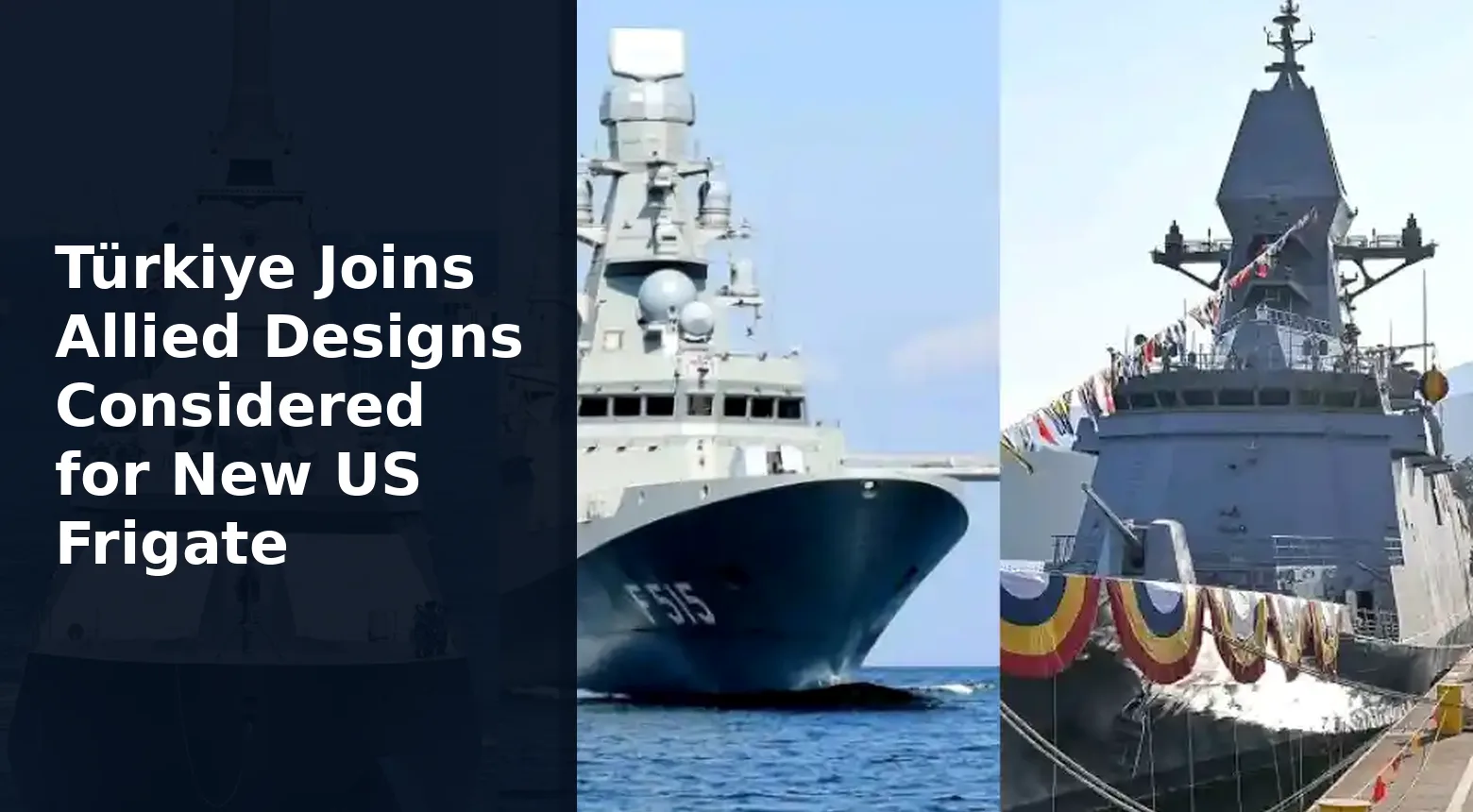
The White House and U.S. Navy are considering frigate designs from Türkiye, Japan and South Korea as part of an international shipbuilding study due on 12 November 2026. Reporting identifies the İstanbul, Mogami export and Chungnam classes; no formal competition, design selection or construction contract has been announced. For Türkiye, consideration of the İstanbul-class design is a strategic opening into the U.S. naval industrial base rather than a conventional export opportunity. The larger prize would be technology transfer, local investment and a durable U.S. shipyard role after initial foreign construction.
The proposal remains an options study
USNI News reported that the Navy is evaluating international combatants after a White House national-security memorandum opened a waiver path for limited foreign construction. Officials have not issued a formal request for proposals or named a preferred design. Shephard’s later analysis focuses on industrial access, not a new contract milestone.
The İstanbul class gives Türkiye a credible reference
Türkiye has delivered the lead frigate TCG İstanbul and is expanding domestic construction under the MİLGEM family. A U.S. variant would still require American combat-system, weapons, standards and shipyard integration. The existing Turkish ship cannot simply be reproduced unchanged for U.S. service.
Industrial transition is central to the model
Reporting describes the possibility of building up to two ships abroad before moving construction to U.S. yards. That structure could accelerate early delivery while using allied investment and know-how to expand domestic capacity. Workshare, design authority and intellectual-property terms would determine whether the approach actually improves throughput.
Congressional resistance is a material risk
Draft legislation has sought to restrict the executive branch’s ability to fund foreign-built U.S. warships. Even a technically attractive design may therefore face legal and budget barriers. Political support, shipyard partnerships and a credible localisation plan are as important as platform performance.
Programme and procurement context
This development must be read at its exact maturity level. The White House and U.S. Navy are considering frigate designs from Türkiye, Japan and South Korea as part of an international shipbuilding study due on 12 November 2026. Reporting identifies the İstanbul, Mogami export and Chungnam classes; no formal competition, design selection or construction contract has been announced. Defence programmes pass through distinct stages: policy announcement, requirement definition, competition, contract, testing, production, delivery, acceptance and operational fielding. Collapsing those stages into a single claim can overstate both near-term military utility and industrial certainty.
For acquisition teams, the decisive evidence is funded scope, customer acceptance, integration responsibility and a supportable schedule. For Türkiye, consideration of the İstanbul-class design is a strategic opening into the U.S. naval industrial base rather than a conventional export opportunity. The larger prize would be technology transfer, local investment and a durable U.S. shipyard role after initial foreign construction. Public announcements rarely resolve every dependency. Training, secure data, range access, infrastructure, export approval and supplier capacity can delay useful capability even after a technically successful milestone.
Source discipline is equally important. Company releases naturally emphasise momentum; government notices may describe only funded scope; exercise reports show activity without proving full readiness. Values should be labelled as contract ceilings or estimates when appropriate, performance figures as manufacturer claims until independently demonstrated, and dates as targets unless a customer confirms completion. Later primary records should replace early reporting as the programme matures.
The operational question is not whether the technology can be shown once, but whether users can employ it repeatedly under representative conditions. That requires realistic testing, configuration control, trained personnel, spares and an accountable command chain. Industrial significance also depends on repeatable production and quality assurance rather than prototype output alone.
Implications / Next
Track the 12 November assessment, any Navy solicitation, congressional language, selected U.S. yard partners and Turkish government or industry confirmation. Do not describe the İstanbul class as shortlisted or selected unless the Navy formally uses those terms.
This item remains a draft pending final image-rights review, CMS media assignment and canonical publication data. A later report should be treated as a separate update only if it materially changes the programme status described here.
Further Reading
HAVELSAN FLEETSTAR Forms MİLGEM Digital Backbone