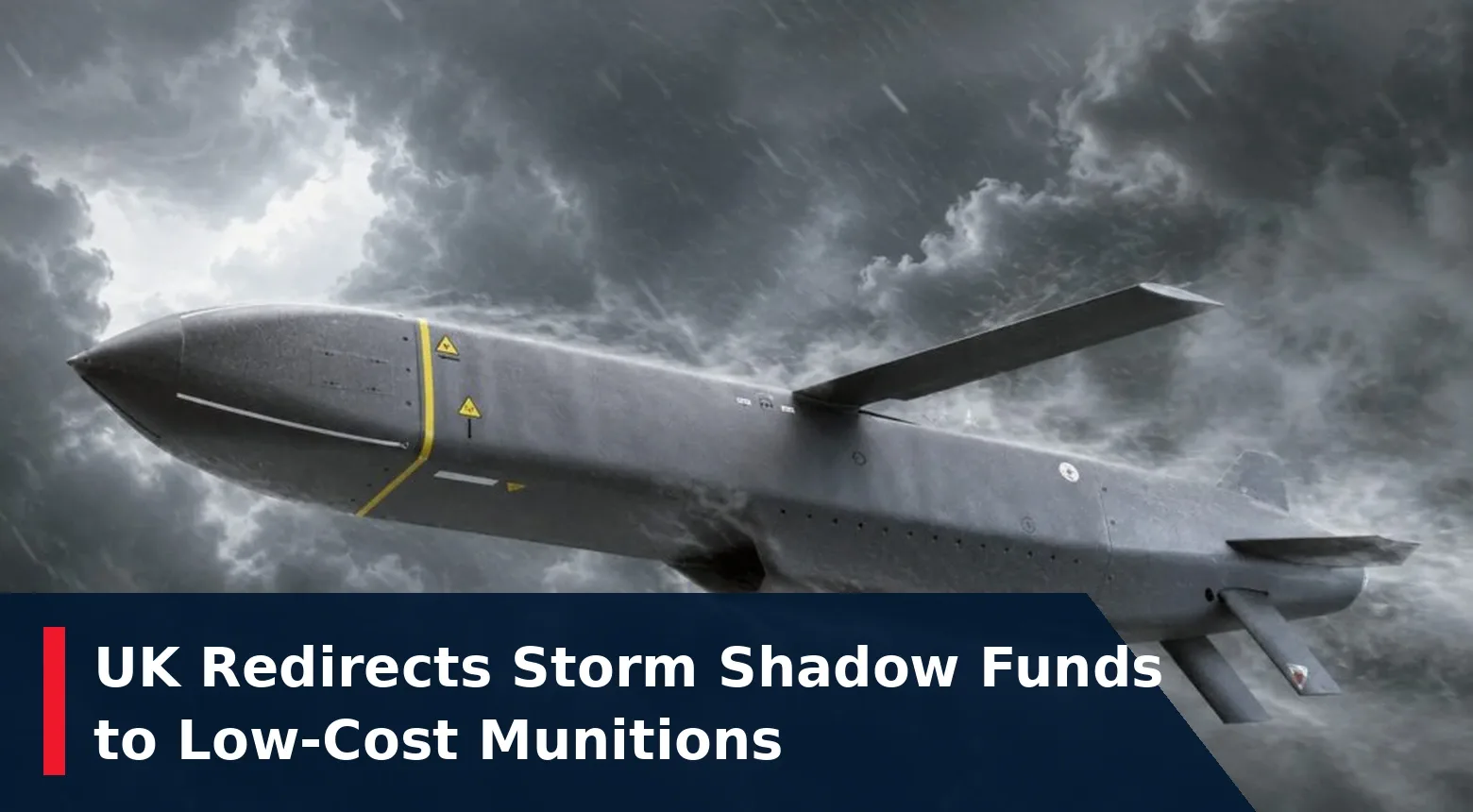
Storm Shadow funding for a proposed new production run has been redirected towards lower-cost munitions that can be manufactured in Britain, according to comments by Air Marshal Tim Jones, the UK’s Deputy Chief of the Defence Staff for Force Development, reported on 24 November 2026. The decision illustrates a defence procurement shift from buying more of a highly capable but expensive cruise missile towards building larger stocks of affordable weapons. It does not mean that existing Storm Shadow missiles have been withdrawn from service, nor does it identify a newly awarded contract or a disclosed amount transferred between programmes. The key industrial question is whether the United Kingdom can increase the volume of deployable strike effects while retaining the specialised capabilities required against heavily defended targets.
Storm Shadow Procurement: New Build Is Not In-Service Withdrawal
The latest explanation appeared in UK Defence Journal’s 24 November report. Air Marshal Jones told the House of Commons Defence Committee that the department had reserved substantial funding for new-build Storm Shadow missiles but made a difficult decision to allocate resources instead to lower-cost, mass-produced munitions. He identified the need to rebalance spending that had been concentrated on sophisticated weapons available in relatively small numbers. This is a statement about prioritising additional procurement, not evidence that the missiles already in inventory are being removed from the force. The report does not state the precise sum reassigned, the new quantity of cheaper weapons to be acquired or any delivery schedule for those weapons.
The policy choice predates the November coverage. In a 7 July 2026 written parliamentary answer, Defence Minister Luke Pollard said the Defence Investment Plan moved away from a joint UK–France procurement of new-build Storm Shadow and SCALP Mark 2 missiles, towards next-generation low-cost cruise missiles and STRATUS, the future complex-weapons programme. Oral evidence from 8 July 2026 likewise discussed the high–low balance between advanced munitions and more affordable systems. The new reporting supplies further explanation of the budget trade-off; it should not be described as a completely new procurement cancellation issued on 24 November.
Storm Shadow remains a separate operational category. In an answer published on 19 October 2026, Pollard said the long-range precision cruise missile would remain in British service for the foreseeable future. His response also identified £1.4 billion in planned investment in STRATUS, intended to provide longer-range strike capability for the Royal Navy and Royal Air Force in the 2030s. Consequently, a withdrawal from a proposed new-production programme and the eventual replacement of existing weapons are different events, potentially separated by years of development and fielding.
The House of Commons Library’s Defence Investment Plan briefing provides the spending context. It describes £11 billion for weapons and munitions, including measures to grow stockpiles and adjust the capability mix, alongside a £6 billion munitions commitment during the current Parliament. Those figures describe broader frameworks with different scopes and time horizons. Neither should be presented as the exact sum removed from Storm Shadow or as a contract value for an individual low-cost weapon. The precise Storm Shadow reallocation remains undisclosed in the publicly cited reporting.
Low-Cost Mass, Industrial Capacity and STRATUS Trade-Offs
The operational case for cheaper mass is closely linked to experience in Ukraine. Expensive long-range missiles can be important against difficult or well-protected targets, but producing and storing enough of them for sustained operations can be financially and industrially challenging. An affordable weapon that can be manufactured more quickly may increase the number of available strike opportunities and reduce pressure on the high-end inventory. It is not necessarily equivalent in reach, survivability, accuracy or effectiveness against advanced defences. The outcome depends on mission requirements and the mix of systems acquired, rather than on unit cost alone.
The Defence Investment Plan therefore sets out a layered approach: lower-cost cruise missiles and other scalable strike systems for volume, alongside STRATUS for complex and demanding long-range engagements. UK Defence Journal has also reported on Project Brakestop, a low-cost strike initiative developed initially around Ukrainian requirements. The existence of such an initiative does not establish that Brakestop is the sole recipient of the Storm Shadow funding, that it has entered British operational service or that its final unit price and manufacturing output have been approved. Programme-level contracts and acceptance results remain necessary to verify those outcomes.
The manufacturing question is significant for MBDA and the wider British precision-weapons supply chain. A move away from planned additional Storm Shadow purchases may change near-term demand assumptions, while a future programme such as STRATUS requires sustained engineering, qualification and manufacturing capability. Separate export, support, reconditioning or partner-country activities should not be confused with a new-build procurement decision for the British Armed Forces. The reported reallocation does not by itself specify which industrial contracts will be amended or how suppliers will transition their production work.
The policy also interacts with broader UK investment in energetic materials and component supply. Defence Agenda recently examined the UK’s capital grant competition for domestic munitions facilities, which can support qualifying manufacturing projects but does not guarantee completed missiles or a new weapons contract. Factory capacity is useful only when components, qualified labour, testing, integration and military acceptance can keep pace. Scaling production also requires credible multiyear demand rather than brief spikes in orders. These constraints may become as important as the price of the individual weapon.
Budgeting for quantity creates an additional risk. Procurement officials may be able to buy considerably more inexpensive systems for the same nominal allocation, but smaller or less sophisticated weapons may require different launch platforms, target data, communications arrangements and support concepts. They might be suitable for some missions and inappropriate for others. A successful high–low portfolio needs explicit operational categories, comparative test evidence, adequate stockpiles and training. The assumed cost advantage should be evaluated at the mission level, including support and attrition, rather than simply by comparing catalogue prices.
A related issue is the risk of a capability gap during transition. The Ministry of Defence has said Storm Shadow will remain in service while STRATUS is developed, but maintaining existing stocks and achieving a reliable successor are separate tasks. If low-cost missiles do not provide the same ability to penetrate sophisticated defences, the UK could become more dependent on its finite stock of high-end weapons before the next generation arrives. On the other hand, allocating every marginal pound to complex missiles can limit inventory depth during prolonged conflict. Both risks need to be assessed together.
Defence Agenda’s analysis of Europe’s deep precision strike programmes outlines STRATUS within the wider collaborative weapons portfolio. Its report on the economics of low-cost weapons in modern warfare illustrates why industrial scale is increasingly a defence-planning concern. A separate UK low-cost air-defence interceptor programme reflects similar cost-exchange logic on the defensive side, but such interceptors are not substitutes for long-range offensive cruise missiles. These cases offer context; they are not directly comparable weapons specifications or verified alternative suppliers for the Storm Shadow reallocation.
Implications / Next: The next meaningful milestones are a disclosed programme-level allocation for the cheaper strike systems, identified industrial suppliers, binding orders, production and acceptance schedules, and evidence of how STRATUS development progresses towards the 2030s. Parliamentary scrutiny may clarify how much of the proposed new-build Storm Shadow budget has actually been reassigned and what new stockpile targets are supported. As of 25 November 2026, the public record supports a strategic procurement shift and continuing Storm Shadow service, but not a confirmed replacement quantity, delivery date, unit price or cancellation of every Storm Shadow-related industrial activity.
Further Reading
- UK Defence Journal — New-build Storm Shadow funding redirected (24 November 2026)
- UK Parliament — Storm Shadow/SCALP procurement written answer (7 July 2026)
- UK Parliament — Storm Shadow service status and STRATUS funding (19 October 2026)
- House of Commons Library — Defence Investment Plan, key decisions
- UK Defence Journal — Project Brakestop and UK service discussion
- Defence Agenda — Deep Precision Strike Initiative
- Defence Agenda — UK £45m Munitions Factory Grants
- Defence Agenda — Drone Wars and Low-Cost Weapons
- Defence Agenda — UK Low-Cost Air Defence Interceptors