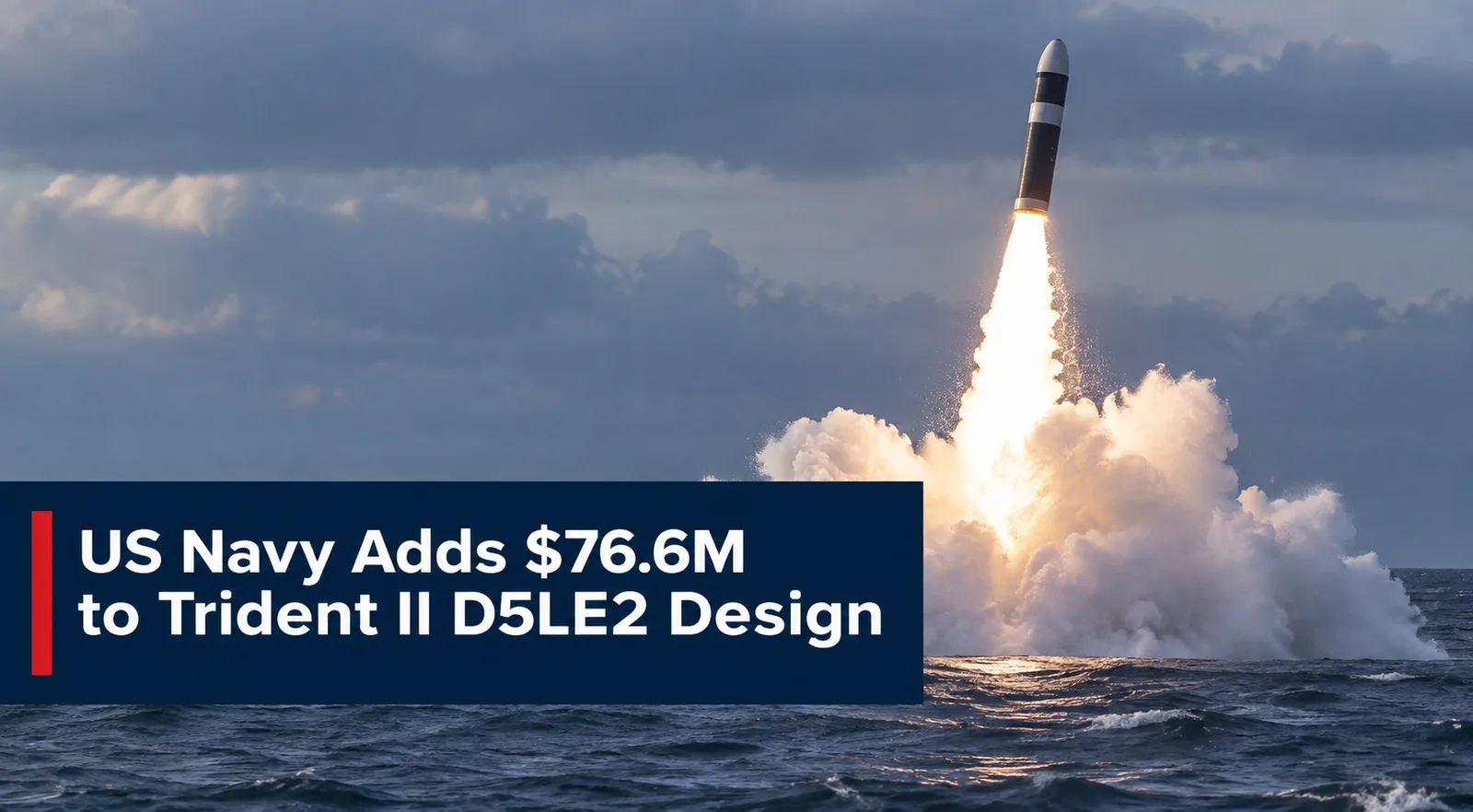
The U.S. Navy’s Strategic Systems Programs has added $76.56 million to Lockheed Martin Space’s Trident II D5 Life Extension 2 development contract for continued advanced design and development work. Unlike several ceiling-based awards announced in the same contracting cycle, the full $76,562,774 modification value was obligated at award using fiscal 2026 Navy weapons-procurement funding, making this a funded design-development action rather than an unfunded ordering vehicle.
Modification P00032 funds D5LE2 advanced design and development
The Department of Defense identifies the action as modification P00032 to contract N0003024C0100. It uses a cost-plus-incentive-fee structure and supports Strategic Systems Programs Alteration Advanced Design and Development for Trident II D5 Life Extension 2. Work is distributed across multiple U.S. locations and is scheduled to continue through 30 September 2030.
The funding status is unusually clear: $76,562,774 in fiscal 2026 weapons-procurement funds was obligated at the time of award. That means the modification amount can be reported as committed funding, not merely as a maximum ceiling. However, the action remains design and development work; it is not a production award for a disclosed number of missiles and should not be presented as fielding of D5LE2.
D5LE2 is intended to extend the sea-based deterrent beyond current life-extension work
The Trident II D5 family is the U.S. Navy’s submarine-launched ballistic-missile backbone for the sea-based leg of the nuclear deterrent. Life-extension programmes are designed to preserve the weapon system as submarine platforms and supporting infrastructure remain in service over long timelines. D5LE2 represents the next engineering phase required to sustain that capability into the future rather than a clean-sheet replacement announced as a separate operational missile fleet today.
Strategic weapons development is governed by unusually demanding reliability, safety, command-and-control and certification standards. Design progress therefore includes extensive systems engineering and qualification before a new life-extension configuration can be described as operational. A funded design modification is meaningful because it keeps that engineering pathway moving, but it does not by itself establish production quantities, deployment dates or inventory levels.
The award links missile modernisation to submarine programme timelines
Sea-based deterrence modernisation depends on synchronisation between the missile, fire-control architecture, warhead-related interfaces, launch systems and the submarines that carry them. The Columbia-class ballistic-missile submarine programme will operate across decades, so missile life-extension engineering has to remain aligned with ship delivery and sustainment schedules. Delays in one element can create integration pressure elsewhere because strategic systems cannot be treated as independent commercial products.
The distributed workshare in the contract notice also shows the breadth of the industrial base behind the programme. Strategic-missile production and design depend on specialised propulsion, guidance, structures, electronics and test capabilities that are difficult to reconstitute quickly. Funding continuity therefore has an industrial-preservation function alongside the immediate engineering task.
The contracting path also underscores how strategic-modernisation programmes can carry procurement appropriations well before an item is in serial production. Weapons-procurement funding can support engineering tied directly to a future weapon configuration, but the appropriation label should not be mistaken for evidence that production lots have begun. The public notice names advanced design and development as the purpose of the modification. For analysts, the cleaner indicator of a production transition would be a contract that identifies manufacturing scope, production hardware, lot quantities or delivery schedules. None of those elements is disclosed in this action, so the maturity remains development despite the use of procurement funds.
Implications / Next
The next programme milestones will be later design reviews, test activity, production decisions and any government disclosure on transition from engineering into manufacturing. Those events should be assessed separately from the current modification, which funds design work through the end of fiscal 2030.
The key reporting distinction is that $76.56 million is obligated now, while missile quantity and operational fielding remain undisclosed. Defence Agenda will track whether subsequent awards move D5LE2 from advanced development toward production and how that schedule aligns with the Columbia-class deterrent enterprise.