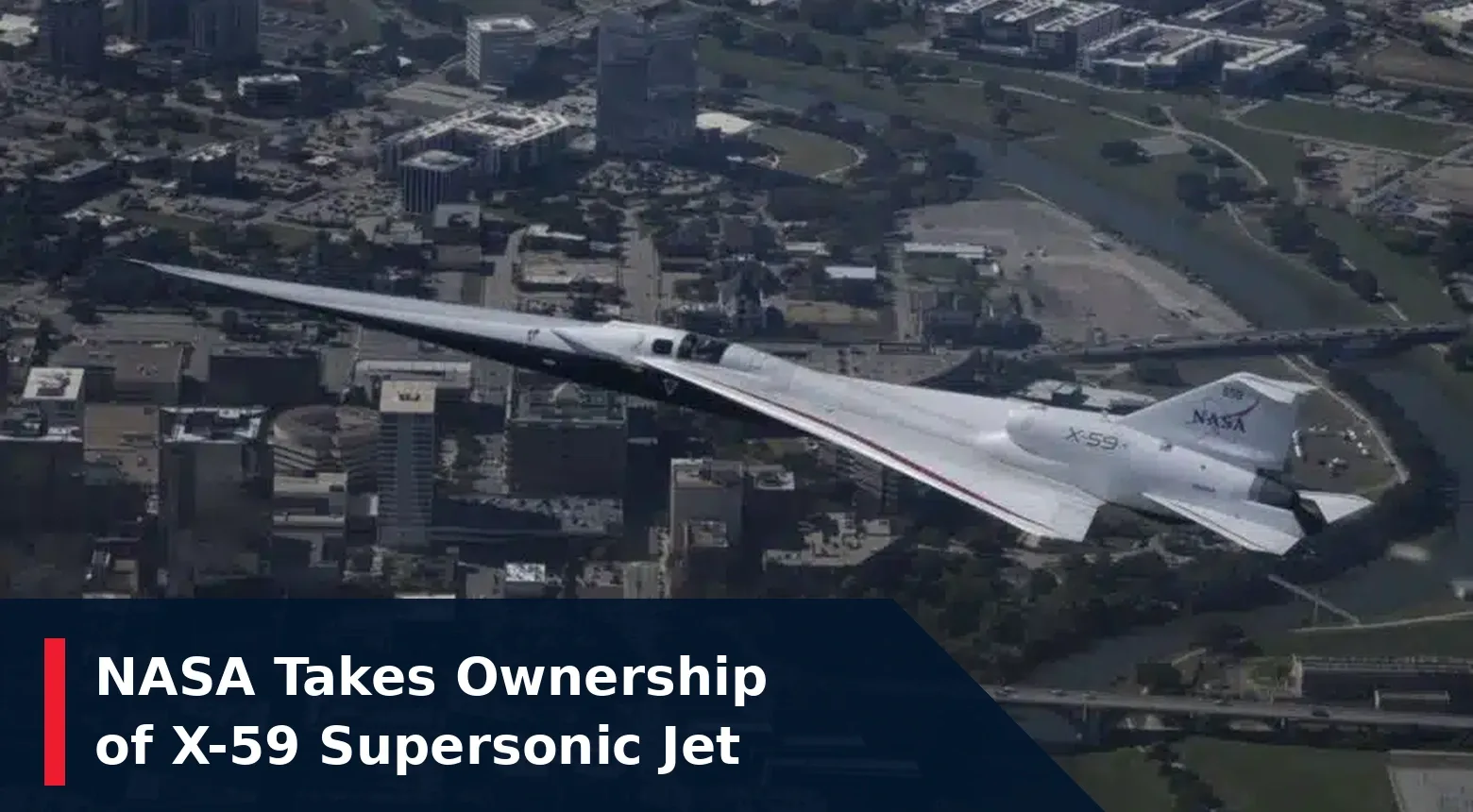
NASA X-59 ownership has formally transferred from Lockheed Martin Skunk Works to the US space agency following an acceptance review completed on 18 November 2026. NASA announced the milestone on 23 November, confirming that its purpose-built quiet supersonic research aircraft will continue flight testing under direct agency ownership at NASA Armstrong Flight Research Center in Edwards, California. The transfer is a contractual and programme-management milestone for the Quesst mission, not proof that the X-59 has finished acoustic validation or that regulators have authorised routine commercial supersonic flight over land. It matters because the aircraft can now move through the remaining research stages with NASA responsible for the asset and Lockheed Martin providing support when needed.
NASA Accepts X-59 as Flight Testing Continues
The NASA announcement of 23 November 2026 specifies 18 November as the date of the formal transfer. Lockheed Martin remained the aircraft’s legal owner during the earlier flight-test campaign while the two organisations completed an aircraft acceptance review. NASA describes that review as an important element of closing out the Skunk Works contract for vehicle construction and testing. Acceptance of the aircraft does not mean all experimental objectives have been met, and the agency explicitly expects further flight testing with supplemental contractor support as required.
The distinction between the physical handover and a first flight is important. Lockheed Martin’s Palmdale, California, facility launched the X-59 on its maiden sortie on 28 October 2025, when it flew to NASA Armstrong at Edwards. The aircraft has been based there for flight research since that flight. The ownership transfer was therefore not a newly delivered, unflown prototype; it followed a sustained test programme intended to progressively establish aircraft controllability, performance and safety across its flight envelope.
The flight campaign has produced quantifiable results. NASA said that on 5 June 2026 the X-59 first exceeded the speed of sound, and that a flight on 12 June 2026 reached Mach 1.4 at approximately 55,000 ft, the intended reference condition for future low-boom community work. An October NASA report described six flights in one week and a recorded speed of Mach 1.53 during the September flight-test campaign. These milestones establish aircraft performance and envelope expansion; they must not be confused with certified acoustic results at ground level.
NASA’s X-59 has a distinctive configuration shaped around the propagation of pressure waves. The single-seat aircraft is approximately 99.7 ft (30.4 m) long with a wingspan close to 29.5 ft (9.0 m), according to NASA's engineering explainer. Its long, slender nose, swept surfaces and engine installation above the fuselage are designed to minimise the concentration of shock waves reaching people below. A sensor-based eXternal Vision System (XVS) replaces the conventional forward-facing windscreen, which the aerodynamic configuration cannot accommodate in the usual location.
These features make the X-59 a research instrument rather than an airline demonstrator being readied for passenger service. It does not carry paying passengers and is not intended to establish the economics, dispatch reliability or certification of a commercial supersonic aircraft. Its primary product will be measured acoustic and community-response data that can help regulators decide whether future overland supersonic operations should be permitted under defined noise limits. The aerospace supply chain may eventually benefit from successful validation, but there is no production order, airline commitment or regulatory approval embedded in the November ownership announcement.
Quesst Acoustic Tests and the Regulatory Path Ahead
The Quesst mission framework separates the programme into three broad stages: design and build the X-59 with initial flight testing; validate its low-boom acoustic signature; and conduct flights above selected US communities to gather responses to the sound. The November handover reflects contractual acceptance of the research aircraft as testing continues. It is not an announcement that Phase 2 acoustic validation or Phase 3 community-response surveys have been completed. Dates for individual campaigns remain subject to flight readiness, data quality and operating approvals.
Acoustic validation is necessary because supersonic speed alone does not establish low-boom performance. The aircraft must be evaluated at controlled atmospheric conditions, altitudes and flight attitudes, with ground and airborne sensors recording the pressure-wave signature. NASA’s 12 June 2026 test update notes that traditional supersonic chase aircraft can complicate sound measurements by producing their own booms. Dedicated instrumentation and a measured flight profile will therefore be essential before researchers can compare observed acoustic levels with the design predictions.
If the flight-test team confirms the desired signature, NASA plans to expose communities to the quieter supersonic events and gather evidence about what people actually hear and how acceptable they find the sound. The project targets a sonic thump rather than the sharp double boom associated with conventional supersonic aircraft. That phrase describes a design objective, not a final public-perception finding. Atmospheric variability, background noise, repeated exposure and the statistical representativeness of survey responses will all affect how useful the eventual evidence is to regulators.
This evidence has potential implications for civil aviation policy, but the steps between research and commercial service are substantial. Regulators would have to examine acoustic thresholds, safe operating conditions and certification frameworks, while aircraft manufacturers would still need to address fuel use, environmental requirements, range, airport compatibility and life-cycle costs. NASA's project will not by itself overturn restrictions on routine supersonic overland operations, nor will a quiet-boom demonstration prove that a viable new commercial market already exists.
From an industrial perspective, the asset transfer demonstrates how a government research customer can take over a highly specialised flight-test platform while preserving a limited support relationship with the prime contractor. Programme managers will watch whether the agency can maintain test tempo, manage configuration control and translate experimental findings into reusable design and certification guidance. That differs from procurement activity on the Hermeus Quarterhorse high-speed aircraft family or development of GE's XA102 adaptive engine hardware; these are separate programmes with distinct military or industrial objectives, cited here solely for wider high-speed aerospace context.
A further distinction concerns international transferability. Any future commercial supersonic aircraft seeking access to multiple markets would encounter civil regulators beyond the United States. NASA has stated that its eventual evidence will be shared with US and international regulatory bodies, but those authorities will independently determine whether the research supports specific standards or exemptions. The outcome depends on repeatable measurements and risk assessments, not simply the formal ownership of the research aircraft.
Implications / Next: The next measurable milestones are completion of outstanding envelope-expansion work, published acoustic validation results, carefully managed community overflights, and the presentation of noise and perception data to regulators. NASA's 18 November 2026 acquisition of title to the aircraft is a real programme milestone and a clear division of responsibilities with Lockheed Martin; it is not an operational certification, passenger-service launch or conclusion of the Quesst mission. Industry and policy observers should assess subsequent evidence against those distinct thresholds rather than equating a transfer of ownership with fulfilment of the programme’s final research objective.
Further Reading
- NASA — Officially Takes Ownership of X-59 Supersonic Aircraft (23 November 2026)
- The Aviationist — NASA Takes Ownership of X-59 QueSST (24 November 2026)
- NASA — X-59 Reaches Mission Speed and Altitude (12 June 2026)
- NASA — X-59 Completes Six Flights in One Week (2 October 2026)
- NASA — Quesst: The Mission and Three Phases
- NASA — X-59 Design and Sonic-Boom Reduction
- Defence Agenda — Hermeus Quarterhorse and Anduril Lattice
- Defence Agenda — GE XA102 Adaptive Engine Hardware
- Defence Agenda — First Turkish Air Force HÜRJET Maiden Flight