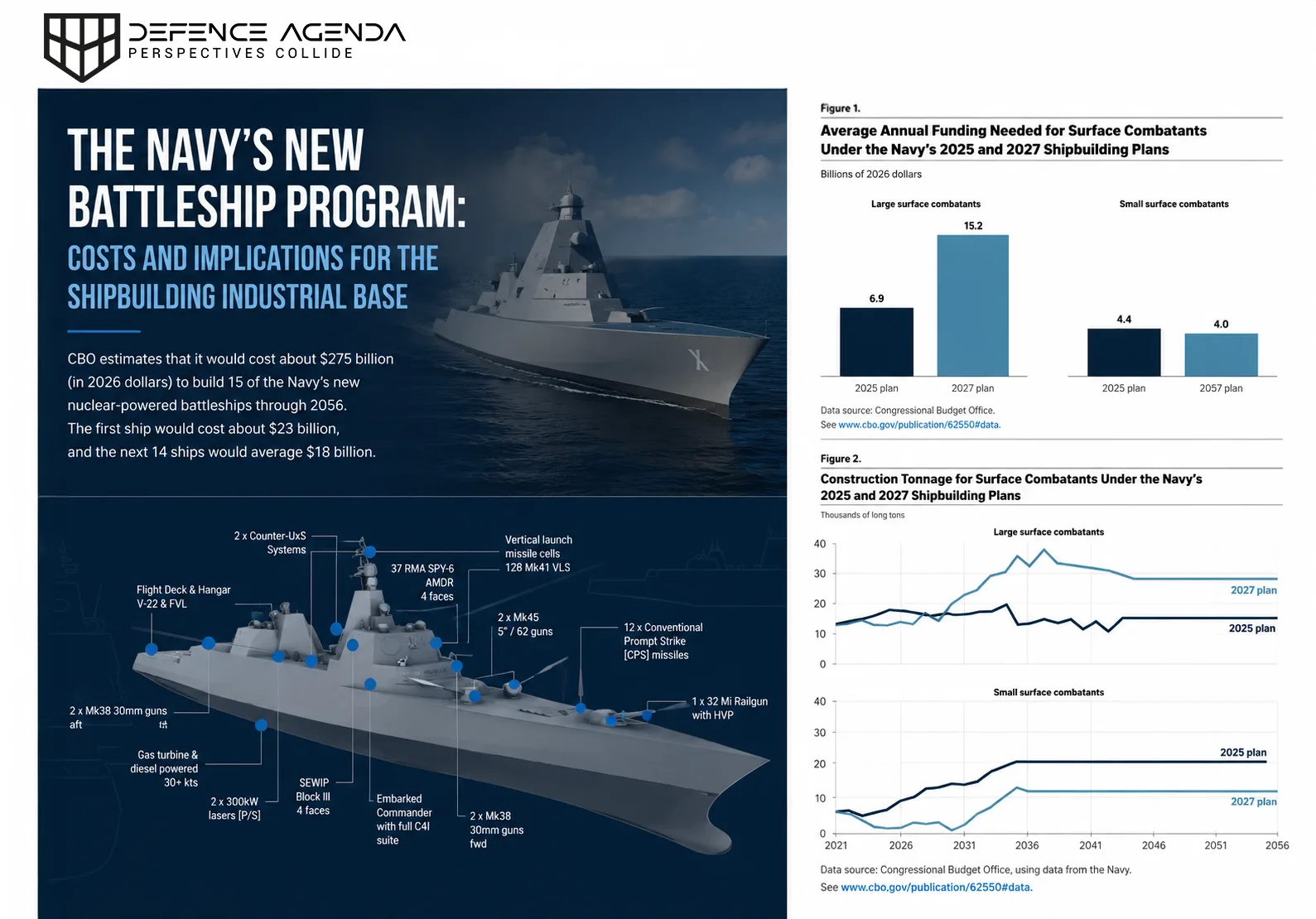
The Congressional Budget Office estimates that the US Navy battleship cost could reach approximately $275 billion for a planned fleet of 15 nuclear-powered guided-missile battleships.
The estimate appears in CBO’s August 2026 report, The Navy’s New Battleship Program: Costs and Implications for the Shipbuilding Industrial Base.
CBO calculates that the first ship would cost $23.4 billion in constant 2026 dollars. The remaining ships would cost an average of approximately $18 billion each.
The assessment also warns that the programme would significantly increase demand on a US naval shipbuilding sector already affected by workforce constraints, extended construction schedules and delays across destroyer, submarine and aircraft-carrier programmes.
Key Facts
- Programme: Nuclear-powered guided-missile battleship, designated BBGN.
- Class designation used by the Navy: Trump class.
- Lead ship: BBGN-1 Defiant.
- Planned quantity: 15 ships in the 2027 shipbuilding plan.
- Procurement period: 2028–2056.
- CBO programme-cost estimate: Approximately $275 billion in 2026 dollars.
- Lead-ship estimate: $23.4 billion.
- Average follow-on cost: $18.0 billion per ship.
- Conventionally powered alternative: Approximately $243 billion.
- Nuclear cost premium: Approximately 13% at the construction level.
- Assumed full-load displacement: 35,000 long tons.
- CBO-estimated lightship displacement: 28,000 long tons.
- Expected length: 840–880 feet.
- Expected crew: 650–850 personnel.
- Planned VLS capacity: 128 Mark 41 cells.
- Planned CPS capacity: 12 hypersonic missiles in four tubes.
- Expected final-assembly shipyard: Newport News Shipbuilding.
- Estimated construction period for the lead ship: Eight years under the Navy’s planning assumption.
How Much Would the US Navy’s New Battleship Cost?
CBO estimates that the 15-ship nuclear-powered BBGN programme would cost approximately $275 billion between 2027 and 2056.
The first ship, planned for authorisation in 2028, would cost approximately $23.4 billion. The 14 follow-on vessels would average approximately $18 billion each.
The total should not be divided by 15 to produce a representative unit price because the lead ship includes substantial non-recurring design, engineering and programme-establishment costs.
CBO estimates that one-time expenses associated with the lead ship would total slightly more than $5 billion.
| Cost Element | CBO Estimate | Important Qualification |
|---|---|---|
| Lead nuclear-powered BBGN | $23.4 billion | Includes lead-ship and non-recurring programme costs |
| Follow-on BBGNs | Average of $18.0 billion | Average across ships purchased over several decades |
| Fifteen-ship nuclear programme | Approximately $275 billion | Expressed in constant 2026 dollars |
| Fifteen-ship conventional alternative | Approximately $243 billion | Assumes the same 35,000-ton full-load displacement |
How Does CBO’s Estimate Compare With the Navy’s Estimate?
The Navy had previously estimated that the first ship would cost $15.1 billion and that the second and third ships would average $10.2 billion.
Those figures applied to an earlier conventionally powered version of the ship. The Navy subsequently changed the planned design to nuclear propulsion.
CBO’s estimate for an equivalent conventionally powered ship is also substantially higher than the Navy’s initial projection.
| Estimate | Lead Ship | Follow-On Ships | Propulsion Assumption |
|---|---|---|---|
| Original Navy budget estimate | $15.1 billion | Ships two and three averaged $10.2 billion | Conventional |
| CBO conventional estimate | $21.3 billion | Average of $15.9 billion | Conventional |
| CBO nuclear estimate | $23.4 billion | Average of $18.0 billion | Nuclear |
CBO’s higher estimate reflects historical lead-ship costs, expected shipbuilding inflation, current industrial-base difficulties and the additional cost of nuclear propulsion.
Does the $275 Billion Include Operating Costs?
No. The estimate principally concerns the cost of constructing and procuring the ships.
It does not represent a complete lifecycle-cost estimate covering crews, maintenance, reactor support, weapons, modernisation and disposal over the ships’ expected service lives.
CBO notes that nuclear propulsion would eliminate the need to purchase conventional fuel and could reduce operating costs over time.
The agency did not quantify those savings because the final propulsion design and the conventional system that would otherwise have been installed have not been defined in sufficient detail.
What Is the Planned BBGN Battleship?
The planned ship is a clean-sheet nuclear-powered large surface combatant designated BBGN.
The Navy has identified the class as the Trump class and the lead ship as BBGN-1 Defiant.
The publicly described characteristics were originally developed for a conventionally powered version. Moving to nuclear propulsion could alter dimensions, weight distribution, internal arrangements and final cost.
| Characteristic | Publicly Described BBGN Configuration |
|---|---|
| Full-load displacement | Approximately 35,000 long tons; budget documents indicate a possible range up to 41,000 tons |
| Length | 840–880 feet |
| Beam | 105–115 feet |
| Draft | 24–30 feet |
| Sustained speed | More than 30 knots |
| Crew | 650–850 |
| Mark 41 VLS cells | 128 |
| Conventional Prompt Strike missiles | 12 missiles in four large tubes |
| Five-inch guns | Two |
| High-powered lasers | Two planned systems |
| Rail gun | One planned system |
| Nuclear cruise missile capability | Planned compatibility with SLCM-N |
These are programme descriptions rather than final construction specifications. The Navy could reserve space and electrical power for technologies that are not sufficiently mature when construction begins.
How Does the Battleship Compare With Existing US Navy Ships?
At 35,000 tons, the BBGN would be more than three and a half times the full-load displacement of an Arleigh Burke Flight III destroyer and more than twice the displacement of a Zumwalt-class destroyer.
Its expected cost would be comparable to a nuclear-powered aircraft carrier. CBO estimates that future Ford-class carriers in the 2027 plan would cost approximately $22 billion each.
A new DDG-51 destroyer costs more than $3 billion. CBO observes that approximately five destroyers could be purchased for the average construction cost of one BBGN.
The comparison is not a direct measure of military value. Five destroyers would require more crews, maintenance and conventional fuel, while the BBGN would concentrate more weapons and capability in one hull.
How Did CBO Calculate the Cost?
CBO built its estimate from historical shipbuilding data rather than accepting the Navy’s preliminary budget figure.
- It assumed a 35,000-ton full-load displacement.
- It estimated lightship displacement at 80% of full-load displacement, producing a 28,000-ton figure.
- It examined the lead ships of the Ticonderoga, Arleigh Burke and Zumwalt classes.
- It calculated an average historical lead-ship cost of $485 million per 1,000 tons of lightship displacement.
- It added more than $5 billion in non-recurring lead-ship engineering and programme costs.
- It adjusted later ships for learning and production efficiency.
- It applied a shipbuilding cost-growth factor that increases the 15-ship programme estimate by an average of 16%.
- It increased the estimate by 12% to reflect current shipbuilding-industrial-base difficulties.
CBO also assumed that one shipyard would perform final assembly while other facilities constructed sections, modules and components.
What Could Make the Battleship Less Expensive?
- A displacement lower than 35,000 tons
- A lower ratio of lightship to full-load displacement
- A design optimised for producibility and modular construction
- More space between machinery and internal systems
- Reduced workforce turnover
- Improved supplier capacity
- Automation and advanced manufacturing
- Digital engineering and artificial-intelligence-assisted design tools
- Avoiding construction before the design is sufficiently mature
CBO calculates that a reduction from 35,000 to 30,000 tons could reduce the estimated cost by approximately 13%.
A lightship-to-full-load ratio closer to the Ticonderoga class’s 73%, rather than CBO’s 80% assumption, could reduce the estimate by approximately 8%.
What Could Increase the Cost?
- Growth from 35,000 to 41,000 tons
- A heavier nuclear-ship lightship configuration
- Additional survivability and protection requirements
- Integration of numerous advanced weapons and sensors
- Immature laser or rail-gun technologies
- Workforce and supplier shortages
- Starting construction before the design is complete
- Competition for nuclear-qualified shipyard capacity
- Longer-than-planned construction schedules
CBO estimates that increasing the ship’s displacement from 35,000 to 41,000 tons would raise the lead-ship estimate by approximately 16%.
Using a lightship ratio of 85%, similar to the Zumwalt class, would increase the estimate by approximately 6%.
Historical US nuclear-powered cruisers had an average lightship-to-full-load ratio of 87%, indicating that CBO’s 80% central assumption could prove optimistic.
Can Construction Begin in 2028?
The 2027 shipbuilding plan assumes that the first BBGN will be authorised and begin construction in 2028.
CBO considers that schedule uncertain because the ship remains in an early design phase.
The report notes that the smaller DDG(X) design had already faced the prospect of moving its construction start from 2032 to 2034 because the design might not have been ready.
A 35,000-ton nuclear-powered clean-sheet design would require substantially more engineering work and more detailed digital models.
Starting construction before the design is mature could create concurrency, in which engineering changes are made after shipyard work has already begun. CBO identifies concurrency as a significant source of delays and cost growth in earlier shipbuilding programmes.
Where Would the Battleship Be Built?
Bath Iron Works and Ingalls Shipbuilding have built the Navy’s large surface combatants during the past four decades and are expected to contribute design work, hull sections or modules.
Neither yard is currently certified to perform nuclear-propulsion-related construction work.
Senior Navy officials have indicated that final assembly would take place at Newport News Shipbuilding, the only new-construction shipyard already certified to build nuclear-powered surface ships.
The work would use Dock 12, which is currently associated with aircraft-carrier construction.
CBO warns that Newport News is already managing delays involving aircraft carriers and submarines. Adding BBGN final assembly could affect the battleship, carrier and submarine schedules.
What Existing Shipbuilding Delays Concern CBO?
CBO reports that funded DDG-51 destroyer deliveries are delayed by an average of five years.
Navy budget documentation indicates that the average period between appropriation and destroyer delivery has increased to 11 years. The comparable average between 2000 and 2009 was five years.
Attack submarines, destroyers and large amphibious ships now generally require between nine and 11 years to build, compared with five to six years during the first decade of the 2000s.
Those trends indicate that the challenge is not limited to the size or technology of the BBGN. It reflects broader workforce, supplier, design and production constraints.
How Does the 2027 Shipbuilding Plan Differ From the 2025 Plan?
| Category | 2025 Plan | 2027 Plan |
|---|---|---|
| Large surface combatants | 51 ships | 72 ships |
| DDG-51 Flight III | 23 | 57 |
| DDG(X) | 28 | 0 |
| BBGN | 0 | 15 |
| Small surface combatants | 81 | 79 |
| Frigate strategy | FFG-62 | Smaller FF(X) |
The new plan replaces the proposed DDG(X) destroyer with a much larger battleship while extending production of the DDG-51 Flight III.
It also replaces most of the planned FFG-62 frigates with a smaller general-purpose FF(X) based on the Coast Guard’s Legend-class national security cutter.
How Much Annual Funding Would the Plan Require?
| Ship Category | 2025 Plan | 2027 Plan |
|---|---|---|
| Large surface combatants | $6.9 billion annually | $15.2 billion annually |
| Small surface combatants | $4.4 billion annually | $4.0 billion annually |
| Total surface combatants | Approximately $11.3 billion annually | Approximately $19.2 billion annually |
The increase is driven mainly by the larger number of major combatants and the high cost of the BBGN rather than by a substantial increase in the inflation-adjusted unit cost of the DDG-51.
What Would the Plan Mean for Shipbuilding Tonnage?
CBO uses lightship tonnage under construction as an indicator of the burden placed on the industrial base.
Across the full 30-year planning periods, the 2027 plan would require approximately 12% more total surface-combatant tonnage than the 2025 plan.
Large-combatant tonnage would increase by approximately 60% over 30 years and would more than double by 2035.
The annual large-combatant workload would rise from approximately 16,000 long tons to 35,000 long tons by 2035.
The 15 BBGNs alone would represent approximately 420,000 tons of lightship construction work. The 28 DDG(X)s in the earlier plan represented approximately 345,000 tons.
Would the New Frigate Reduce Industrial Pressure?
The smaller FF(X) would partially offset the added industrial burden created by the battleship programme.
CBO estimates the FF(X) at approximately 3,700 tons lightship and 4,800 tons full-load, making it about 60% as large as the cancelled FFG-62 design.
Moving from FFG-62 to FF(X) would reduce required frigate-production tonnage by approximately 40% in 2035 and by 45%, or 227,000 tons, over the 30-year period.
The Navy also intends to distribute FF(X) production across additional shipyards. That could expand capacity, although new builders would face significant learning and start-up challenges.
What Does the CBO Report Not Establish?
- Congress has not appropriated the full $275 billion.
- No construction contract for all 15 ships has been awarded.
- The final BBGN design has not been completed.
- The 35,000-ton displacement is not guaranteed.
- The 2028 construction start is not assured.
- The complete weapon and sensor configuration remains undecided.
- The rail gun and laser systems are not confirmed as operational equipment.
- The number of SLCM-N weapons carried has not been disclosed.
- The report does not calculate full lifecycle costs.
- The report does not determine whether one battleship offers greater operational value than several destroyers.
- The report does not guarantee that all 15 planned ships will be ordered.
What Should Be Watched Next?
- Completion of the BBGN preliminary and detailed design
- Confirmation or delay of the 2028 procurement date
- Final displacement and nuclear-propulsion configuration
- Selection of shipyards responsible for modules and hull sections
- Formal confirmation of Newport News final assembly
- Dock 12 infrastructure and scheduling decisions
- Impact on Ford-class aircraft-carrier construction
- Impact on Virginia- and Columbia-class submarine production
- Congressional appropriations for design and advance procurement
- Development status of lasers and the rail gun
- Final Mark 41 and Conventional Prompt Strike arrangement
- Updated CBO estimates after the design matures
- Changes to the number of planned BBGNs
- Performance of the wider shipbuilding workforce and supplier base
Conclusion
CBO’s $275 billion estimate illustrates the scale of the US Navy’s planned return to a battleship-sized surface combatant.
The first nuclear-powered BBGN could cost approximately $23.4 billion, while follow-on vessels could average $18 billion each.
The financial challenge is accompanied by an industrial one. The Navy would need to build 15 battleships while more than doubling planned DDG-51 procurement and maintaining aircraft-carrier and submarine production.
The 2027 plan would raise annual large-surface-combatant funding from $6.9 billion to $15.2 billion and increase annual construction tonnage to approximately 35,000 tons by 2035.
The estimate remains highly uncertain because the BBGN is still in the early design phase. Changes in displacement, survivability, propulsion, weapon integration and construction timing could materially change the final cost.
The next decisive milestone will not be a weapons demonstration or ship-naming announcement. It will be evidence that the Navy can complete a mature design, secure nuclear-qualified production capacity and begin construction without repeating the concurrency and delay problems experienced by other recent ship programmes.
Further Reading
- Congressional Budget Office: The Navy’s New Battleship Program
- CBO: Full August 2026 battleship report
- CBO: Report data and supplemental information
- CBO: Analysis of the Navy’s 2025 Shipbuilding Plan
- CBO: Challenges Facing Navy and Coast Guard Shipbuilding Programs
- CBO: How CBO Estimates the Costs of New Ships