French shipbuilder Naval Group has again placed its Blacksword Barracuda submarine in the European procurement spotlight following its presentation at Euronaval 2026, held from 3 to 6 November 2026. The 82-metre conventionally powered design is also being proposed for Greece’s future submarine programme, which is intended to replace ageing Type 209 vessels. Naval Group first detailed its Greek offer in April 2026, following a late-2025 request for information; the November exhibition is a renewed presentation, not a fresh Greek order or a signed acquisition. The platform’s proposed long endurance, lithium-ion battery system and substantial weapons load make the design relevant to Mediterranean submarine procurement and European industrial cooperation.
Blacksword Barracuda: Design and Underwater Capabilities
Naval Group’s exhibition material describes a diesel-electric ocean-going attack submarine derived from the wider Barracuda design family. Unlike the French Navy’s nuclear-powered Suffren-class boats, Blacksword Barracuda is intended to use conventional diesel generators, an electric propulsion motor and lithium-ion batteries. An industry overview published on 2 November 2026 confirmed that the manufacturer planned to display the submarine at Euronaval alongside its Scorpène, FDI and other naval systems. The design remains an industrial product family, and particular weapons, sensors and levels of national manufacturing participation depend on the customer configuration.
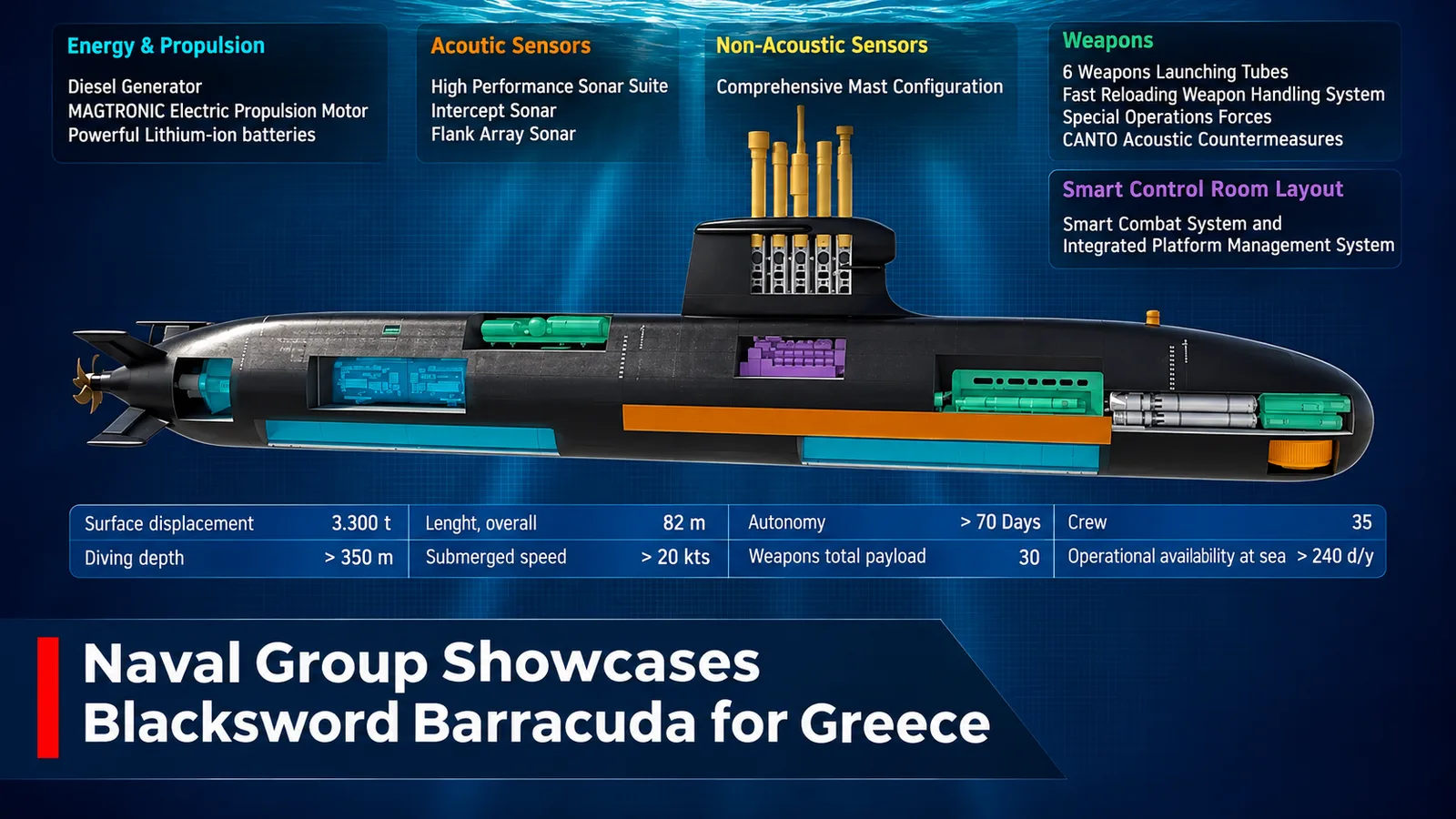
The manufacturer-linked technical graphic supplied with the report shows a hull approximately 82 metres long, with a cited displacement of 3,300 tonnes, a 35-person crew, six weapon-launching tubes and up to 30 weapons. It also depicts a diving-depth figure above 350 metres, a submerged-speed figure above 20 knots and more than 70 days of autonomy. These are design or marketing values, not measurements from sea trials of a delivered Greek submarine. Equipment labels include a high-performance sonar suite, intercept sonar, flank-array sonar, mast sensors, a smart control-room configuration and an integrated platform-management system.
Specifications reported in earlier publications are not entirely identical. In its 8 April 2026 report on the Greek proposal, Naval News cited approximately 20 knots and endurance of up to 70 days. The more recent illustration uses greater-than symbols for those thresholds. Separately, Defence Review’s 10 November Euronaval account describes the vessel as a 3,000-tonne design. These presentations should not be treated as independent test data or as proof of a single final displacement and performance baseline. The difference may reflect reporting conventions or evolving configurations; Naval Group has not published a publicly reconciled Greek-specific specification in the material reviewed.
The proposed arrangement includes an acoustic detection system for submarine and surface contacts, complemented by non-acoustic surveillance from the mast. Such sensors are significant for a submarine that may undertake intelligence, surveillance, reconnaissance, anti-submarine, anti-surface and special-forces operations. They do not by themselves establish the detection range or classification accuracy available in a particular operating environment. Water conditions, target signatures, crew proficiency and the processing chain would all influence real-world performance. For procurement authorities, the requirement is therefore not simply a list of sonars but a verified detection-and-engagement capability.
Blacksword Barracuda’s lithium-ion battery architecture is positioned by Naval Group as an alternative to conventional submarine arrangements using air-independent propulsion (AIP). Lithium-ion storage can support high electrical power demands and flexible underwater operations, subject to battery capacity, charging requirements and operating conditions. It does not make the boat nuclear-powered or remove the need to manage energy reserves, diesel-generator operation and exposure during recharging. The engineering trade-off also includes thermal control, battery-safety provisions, redundancy, maintenance procedures and life-cycle replacement costs. Those parameters are central to comparing the design against alternative AIP-equipped or lithium-ion submarine offers.
Naval News described the proposed armament as six 533 mm launch tubes and capacity for up to 30 weapons. Potential weapons were said to include F21 heavyweight torpedoes, tube-launched anti-ship missiles, land-attack cruise missiles, mines and unmanned underwater systems, depending on integration and export approval. The exact mix will affect payload space, reload arrangements and mission endurance. A graphic showing capacity for 30 weapons does not confirm that Greece has ordered any of them or that all candidate weapons have completed qualification on a Greek-configured vessel.
Greece’s Procurement Competition and the Dutch Orka Programme
Naval Group has already advanced a separate, firm acquisition with the Netherlands. On 30 September 2024, the Dutch Ministry of Defence confirmed an agreement for four Orka-class submarines from Naval Group, along with industrial participation arrangements. The order provides a programme reference for the French builder, but the Dutch configuration, contract and delivery commitments must not be confused with the Greek requirement. The Dutch ministry’s official announcement makes clear that the four boats belong to the Royal Netherlands Navy acquisition programme.
The Dutch programme has progressed through additional weapon integration arrangements. On 16 June 2026, the Dutch defence ministry confirmed a contract with Naval Group for F21 torpedoes to equip the future Orka class. The ministry described the programme as being in its engineering phase, with first-steel cutting then scheduled for 2027 and first delivery expected in 2033. These are Dutch milestones, not a construction schedule for Greece. A common industrial design family may create opportunities for shared training, components and supplier experience, although national configuration and certification requirements can limit the practical degree of commonality.
For Greece, the relevant requirement is a planned acquisition of four new submarines to replace ageing Type 209 vessels. The Hellenic Navy issued a request for information at the end of 2025, and Naval Group subsequently identified Blacksword Barracuda as its candidate. In the April reporting, Naval Group’s country director David Pinot described Greek participation as a central element of the proposal, pointing to cooperation with Skaramangas Shipyards and METLEN. Proposed arrangements would potentially involve locally produced hull sections and final assembly, but the extent of local construction remains subject to negotiations and government decisions.
Naval Group indicated that the first Greek boat could be delivered roughly five to six years after contract signature under its proposed schedule. This is an industrial estimate contingent on the selected configuration, contract timing, the shipbuilding approach and the available supply chain. It is not a binding delivery deadline. No Greek contract signature, order value, down payment, keel-laying date or confirmed delivery schedule was established in the reviewed public sources as of 24 November 2026. The key procurement milestones remain a finalised requirement, formal request for proposals, industrial participation terms, source selection and a signed agreement.
The competitive landscape is not limited to Naval Group. In the April procurement coverage, TKMS, Saab, Hanwha Ocean and Fincantieri were identified as possible or likely participants, although that list was not an official record of qualified final bidders. German-origin platforms already have a significant support and training footprint in the Greek submarine force. An acquisition authority may therefore weigh the promised payload and endurance of a larger ocean-going submarine against fleet commonality, basing infrastructure, local workshare, operating cost and the risks of introducing new systems.
It is also important to distinguish proposed performance advantages from evaluated programme results. A platform optimised for extended-range missions might require more maintenance capacity, crew training, shore support or infrastructure investment than a smaller submarine. Conversely, a design with greater space for weapons, sensors and special operations personnel may better support certain mission requirements. Without a published Greek evaluation matrix, a verified whole-life cost and final configuration, it would be premature to declare a technical or commercial winner. The Netherlands’ selection establishes that Naval Group has a related contract; it does not determine Greece’s choice.
Defence Agenda has examined Naval Group’s SCX 26 surface-combatant concept and a separate French UCUV demonstrator programme. These developments illustrate the company’s wider naval systems work but do not change the procurement status of the Blacksword proposal. Our report on ASELSAN’s MERCAN 100 submarine optronic mast provides additional context on the importance of sensor integration to modern submarines, without implying that MERCAN 100 is selected for Blacksword Barracuda.
Implications / Next: The next evidence-based developments to watch are Greece’s formal competition documents, the requested industrial workshare, integration and combat-system options, any officially released cost estimate and a government contract decision. Separately, the Dutch Orka project’s design maturation, steel-cutting and F21 integration will provide observable evidence on the wider Blacksword Barracuda family’s progress. For now, the November 2026 Euronaval presentation demonstrates the design’s continued marketing to European customers; the Greek acquisition remains a proposal rather than an awarded submarine programme.
Further Reading
- Naval News — Naval Group offers Blacksword Barracuda to Greece, 8 April 2026
- Defence Review — Euronaval 2026 submarine features, 10 November 2026
- Naval Group Euronaval 2026 programme overview, 2 November 2026
- Dutch Ministry of Defence — Four Orka-class submarines contracted, 30 September 2024
- Dutch Ministry of Defence — F21 torpedo contract, 16 June 2026
- Euronaval — Official 2026 exhibition dates
- Defence Agenda — Naval Group SCX 26 warship concept
- Defence Agenda — France orders UCUV demonstrator
- Defence Agenda — ASELSAN MERCAN 100 submarine mast