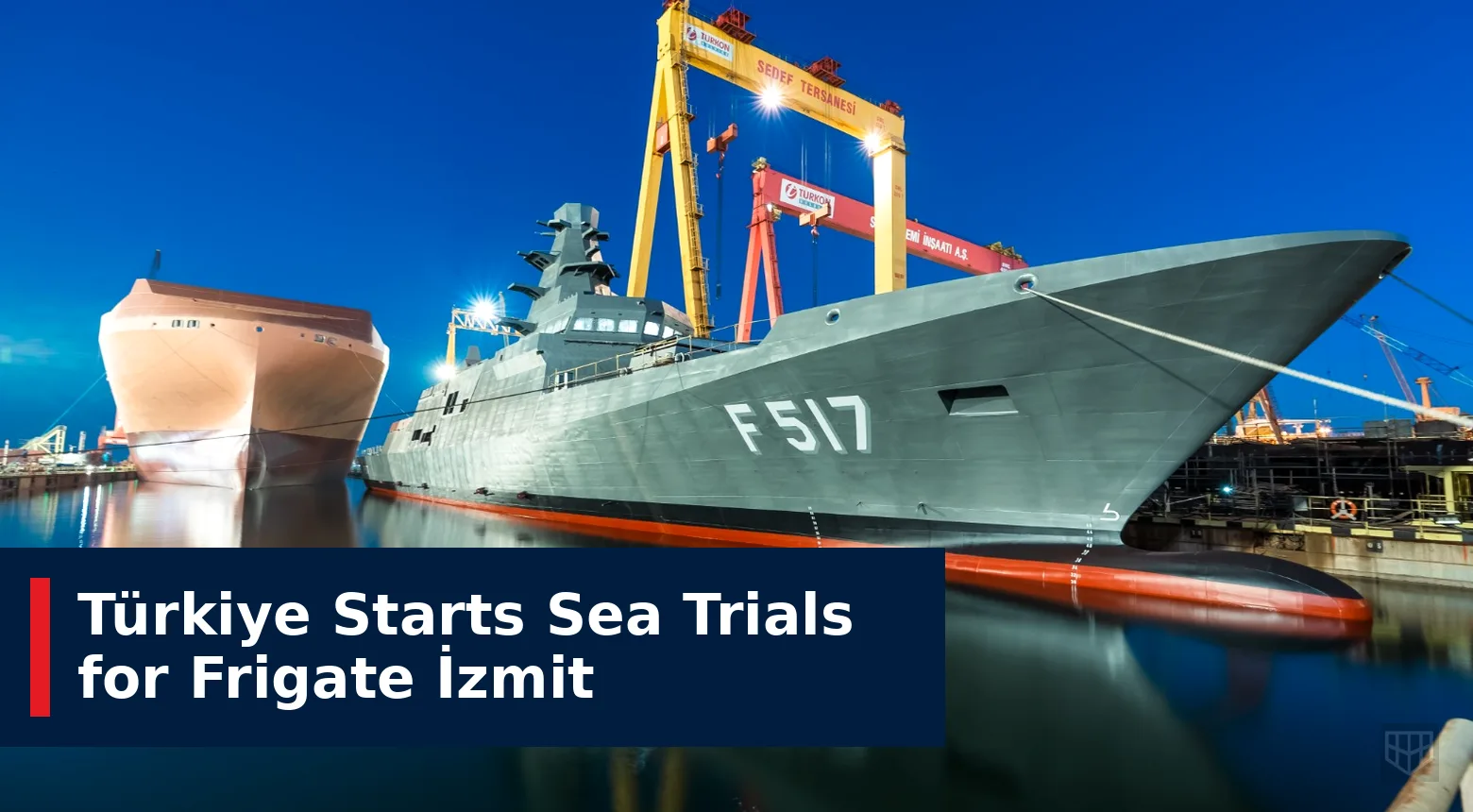
Türkiye's third İstif-class frigate, İzmit, began sea acceptance trials on 15 September as the MİLGEM serial-production programme advances.
Sea acceptance trials begin
The Turkish Ministry of National Defence has announced that İzmit, the third İstif-class frigate, started sea acceptance trials on 15 September 2026. Construction and outfitting are continuing through Sedef Shipyard under the MİLGEM 6-12 Ships Procurement Project. Trials take the ship from quay-side completion into a programme of checks under way, where propulsion, navigation, sensors, communications and combat-system interfaces can be verified.
This milestone is not a commissioning or service-entry event. Sea acceptance trials may reveal discrepancies that require rectification and repeat testing before the customer signs final acceptance. The ministry did not publish a detailed trial schedule or delivery date for İzmit in the briefing. Any year-end fleet plan remains a target dependent on satisfactory completion of the test and acceptance process.
Serial production across several yards
İzmit follows first-of-class TCG İstanbul, delivered to the Turkish Naval Forces in January 2024. The next ships, İzmir, İzmit and İçel, are being built through the TAİS joint venture formed by Anadolu, Sedef and Sefine shipyards with STM playing a central design and integration role. İzmir began its first sea acceptance trials on 10 August 2026, creating an overlap between ships in the test phase.
Concurrent construction and trials can shorten fleet delivery time and preserve skilled labour across multiple yards. It also demands disciplined configuration management so that lessons from one ship are incorporated without disrupting the others. A defect found during İzmir's trials may require inspection or modification of İzmit and İçel, while a mature common baseline can reduce repeat work and improve acceptance speed.
A larger MİLGEM combatant
The İstif class is the frigate development of the MİLGEM family, enlarging the Ada-class corvette design to accommodate greater range, payload and weapons. Publicly reported characteristics include a length of about 113.2 metres, displacement near 3,000-3,150 tonnes, a maximum speed above 29 knots and a range of roughly 5,700 nautical miles at 14 knots.
The additional volume supports a national vertical-launch system and a broader sensor and combat-system fit, including the CENK-S active electronically scanned-array radar on later ships. Exact delivered configuration must be confirmed ship by ship because equipment can change during serial production. A platform entering trials has its major systems installed, but successful integration and firing evidence remain more meaningful than a catalogue of intended equipment.
Delivery targets and programme significance
Turkish reporting says three İstif-class frigates are planned to enter the inventory by the end of 2026 and that seven ships are in simultaneous construction activity. Two frigates are associated with an export plan for Indonesia, with replacement hulls to maintain the Turkish requirement. These plans demonstrate programme scale, but acceptance dates can move as trials and customer decisions progress.
The next milestones for İzmit are completion of propulsion and combat-system trials, correction of findings, final acceptance and commissioning. Tracking those events separately avoids overstating maturity. The 15 September sortie is still important: it shows another national frigate has reached the at-sea verification stage and provides a practical measure of whether distributed shipyard production can deliver several complex warships on an overlapping schedule.
Editorial assessment
At-sea testing should establish more than maximum speed. Endurance, machinery vibration, radar performance, data-link operation and the combat-management system's ability to coordinate weapons all matter to acceptance. Helicopter operations and replenishment procedures may also require separate trials before the ship can perform the full mission set expected of the class.
Serial construction makes lessons learned unusually valuable. A design correction introduced quickly across several hulls can improve the class, while a late discovery can create costly rework in multiple yards. İzmit's trial results will therefore affect not only one delivery but also the efficiency and configuration of the broader MİLGEM 6-12 programme.