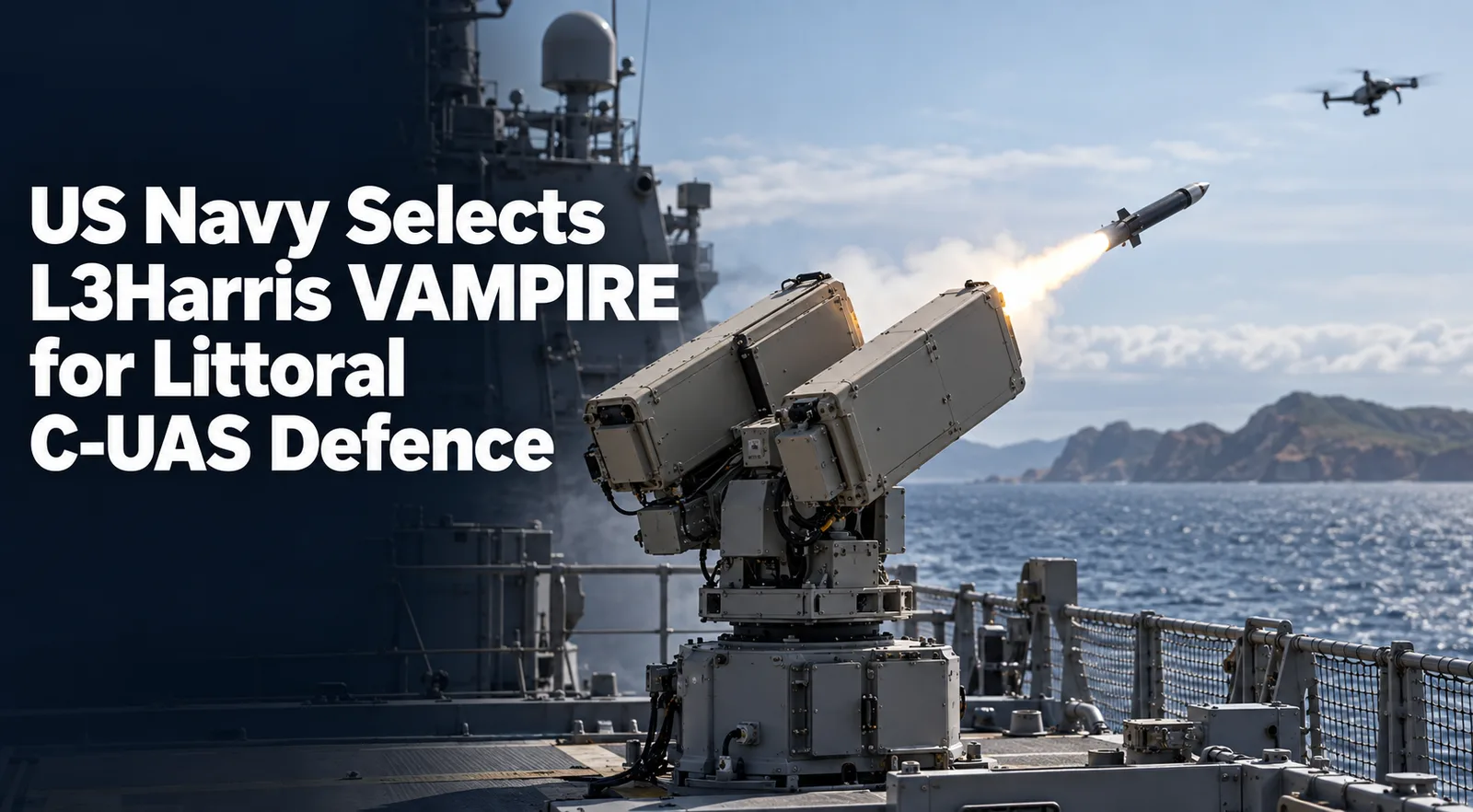
L3Harris announced on 8 September 2026 that the U.S. Navy has selected its VAMPIRE counter-unmanned system for littoral defence. The company describes VAMPIRE as a self-contained architecture combining reconnaissance and precision engagement against drones and remotely piloted platforms. L3Harris says it is adapting the system to the Navy’s operating environment and ruggedising it against maritime environmental stresses.
The Navy Is Bringing VAMPIRE Into the Littoral Counter-Drone Mission
The announcement confirms selection but does not disclose contract value, quantity or delivery schedule. Those omissions matter because they prevent a reliable estimate of fielding scale. The correct programme status is therefore a Navy selection and planned delivery of VAMPIRE systems, not evidence that a fleet-wide deployment has already occurred.
VAMPIRE Uses a Modular Sensor-and-Rocket Approach
The baseline VAMPIRE architecture is designed around modular installation and laser-guided rocket engagement, historically using APKWS-class munitions with electro-optical sensing. L3Harris has expanded the product family with additional sensors, electronic effects and configurations for land, maritime and other domains. That modularity allows the company to tailor the system without redesigning an entire shipboard combat suite.
For littoral operations, the attraction is the ability to engage small drones with a weapon whose cost and magazine footprint can be lower than many conventional shipborne surface-to-air missiles. The system can also provide an independent sensor-and-effector package that may be easier to deploy on smaller platforms or shore positions than a large naval air-defence installation.
Maritime Ruggedisation Is a Real Integration Challenge
Moving a land-oriented counter-UAS system into a maritime environment requires more than corrosion-resistant paint. Salt, vibration, spray, ship motion, electromagnetic interference and restricted deck space can affect sensors, launchers and electronics. Engagement geometry also changes when both shooter and target are moving against a cluttered sea and shoreline background.
L3Harris says VAMPIRE is being engineered for those stresses, but the public announcement does not describe the specific Navy configuration or host platforms. Integration with ship command systems, rules of engagement and existing electronic-warfare or gun layers will determine whether the system functions as a stand-alone defensive package or part of a broader layered architecture.
Quantity, Platforms and Acceptance Trials Are the Next Questions
L3Harris is already delivering VAMPIRE to the U.S. Army, and the system has accumulated operational experience in European combat use. That record reduces some technology risk, but the Navy mission introduces a different environmental and tactical context. Maritime acceptance testing will therefore be a meaningful milestone rather than a formality.
The next publication-grade evidence will be a disclosed contract value or delivery order, named host platforms, live maritime testing and first operational fielding. Until those events are confirmed, the selection should be treated as an expansion of VAMPIRE into Navy littoral C-UAS requirements with scope still partly undisclosed.
A further programme-management issue is the relationship between the announced milestone and the supporting infrastructure needed to turn it into repeatable capability. Training, maintenance, software configuration, supply-chain availability and acceptance standards can all become schedule drivers after the public announcement. For that reason, Defence Agenda will track follow-on evidence from the customer, supplier and relevant government authority rather than treating the initial milestone as the end of the acquisition cycle.
The Navy selection also gives VAMPIRE a pathway into a mission set where compact counter-UAS systems may need to protect ports, expeditionary bases, amphibious forces and smaller vessels as well as larger combatants. That broader littoral context makes modularity important, because commanders may need to move the same sensor-effector architecture between shore and maritime positions as the threat changes.
Implications / Next
The next Defence Agenda update should be tied to a dated, independently verifiable event that changes programme maturity: a delivery, exercised option, completed test, production milestone, operational acceptance or new contract action. Until that occurs, the current announcement should remain the baseline and should not be extrapolated into undisclosed quantities, performance or fielding status.