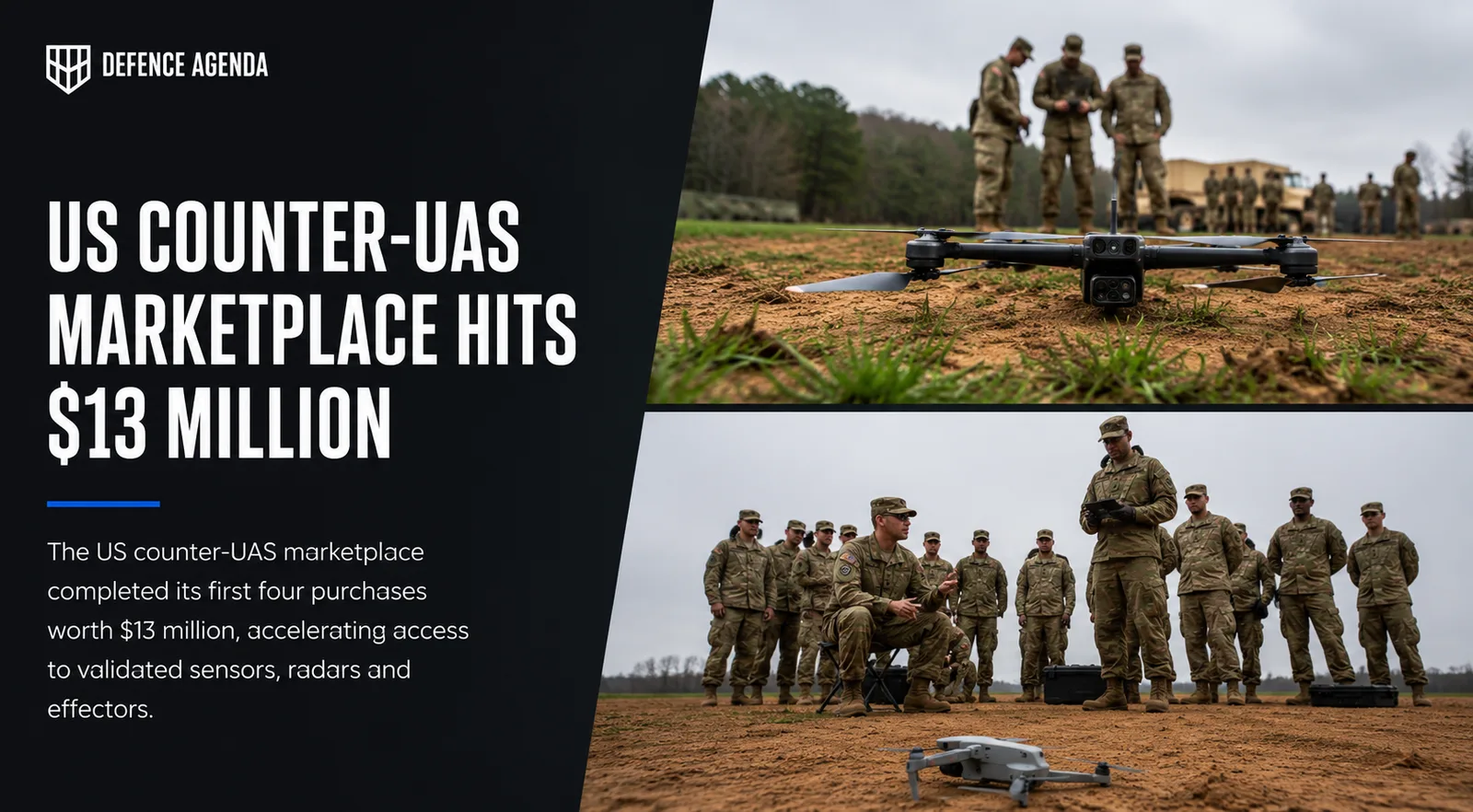
The US counter-UAS marketplace has completed its first four purchases, awarding a combined $13 million for systems intended to protect deployed forces, homeland-defence missions and the southern border.
Joint Interagency Task Force 401 announced the purchases on 15 April 2026, describing them as the first transactions completed through its newly launched counter-unmanned aircraft systems procurement platform.
The orders include low-collateral defeat effectors, sensors, radars and electronic-warfare systems. The capabilities are being provided to US Central Command, military services supporting homeland-defence missions and Joint Task Force Southern Border.
The announcement did not identify the suppliers, individual products, quantities, delivery schedules or value of each order.
Key Facts
- Purchasing organisation: Joint Interagency Task Force 401.
- Number of initial purchases: Four.
- Combined value: $13 million.
- Announcement date: 15 April 2026.
- Marketplace status: Initial operational capability announced in February 2026.
- Acquisition platform: Common Hardware Systems electronic catalogue.
- Contract mechanism: Established US Army indefinite delivery/indefinite quantity contract.
- Equipment categories: Low-collateral defeat effectors, sensors, radars and electronic-warfare systems.
- Recipients: US Central Command, services with homeland-defence missions and Joint Task Force Southern Border.
- Initial catalogue: Approximately a dozen counter-UAS systems.
- Additional catalogue content: Components and repair parts.
- Eligible users: Authorised War Department and federal-agency customers.
- Supplier names: Not publicly disclosed in the announcement.
- Quantities and delivery dates: Not publicly disclosed.
What Did the Counter-UAS Marketplace Purchase?
The first four transactions covered several elements required for layered counter-drone defence rather than one single equipment type.
| Capability Category | Typical Counter-UAS Function | Information Disclosed |
|---|---|---|
| Sensors | Detect or identify unmanned aircraft and provide information to the wider defence system | Category confirmed; model and quantity undisclosed |
| Radars | Search, track and classify aerial objects across a protected area | Category confirmed; performance and supplier undisclosed |
| Electronic-warfare systems | Detect, disrupt or deny command, navigation or communications links where legally and operationally authorised | Category confirmed; techniques and frequencies undisclosed |
| Low-collateral defeat effectors | Defeat a drone while reducing risk to nearby people, infrastructure or friendly forces | Category confirmed; effector type and engagement method undisclosed |
The source does not state that all four customers received every category. It also does not identify whether an individual purchase combined several sensors and effectors into one integrated package.
Who Will Receive the New Counter-Drone Systems?
The purchases support three broad operational customer groups.
- US Central Command: Counter-UAS capabilities for forces and critical platforms operating within the command’s area of responsibility.
- Military services with homeland-defence missions: Systems intended to support protection of US installations, infrastructure and domestic military activities.
- Joint Task Force Southern Border: Counter-drone equipment supporting the military mission along the southern US border.
The announcement does not provide a financial or equipment breakdown for the individual recipients.
It should therefore not be assumed that the $13 million was divided equally or that every recipient received the same configuration.
How Does the Counter-UAS Marketplace Work?
The marketplace is hosted within the Common Hardware Systems electronic catalogue and uses an existing Army indefinite delivery/indefinite quantity contracting mechanism.
This arrangement allows authorised customers to select validated equipment and place orders without starting an entirely new procurement process for every requirement.
Users can review available systems, examine technical information, compare contract options and use validated performance information to support purchasing decisions.
The marketplace is not an unrestricted commercial website. Access is intended for authorised users across the War Department and participating government agencies through government-issued credentials.
What Is an IDIQ Contract?
An indefinite delivery/indefinite quantity contract establishes terms, suppliers and a maximum contractual framework before every individual requirement is known.
Customers can subsequently place task or delivery orders under that framework as specific needs emerge.
For the counter-UAS marketplace, the established contract provides a route for acquiring approved systems without repeating the complete contract-development process for each purchase.
| Area | Standalone Procurement | Marketplace Using an Existing IDIQ |
|---|---|---|
| Contract preparation | May require a new acquisition package and solicitation | Uses an established contractual framework |
| Product discovery | Conducted separately for each requirement | Catalogue presents available validated options |
| Technical comparison | Customer assembles data from multiple sources | Customers can compare catalogue and test information |
| Ordering speed | Can involve a longer pre-award process | Orders can be placed through existing terms and procedures |
| Flexibility | Requirement tied to one procurement action | Catalogue can expand as additional validated systems become available |
Why Is Counter-UAS Acquisition Difficult?
The small-drone threat changes more quickly than many traditional military acquisition programmes.
Commercial aircraft, flight controllers, communications links, navigation methods and autonomous functions can be modified rapidly. Countermeasures must therefore be updated and fielded on shorter timelines.
Counter-UAS systems must also operate in different environments and against different threat profiles.
- Single commercial quadcopters
- First-person-view attack drones
- Fixed-wing reconnaissance aircraft
- Autonomous or pre-programmed systems
- Multiple coordinated aircraft
- Drones using jam-resistant or alternative communications
- Systems operating around civilian infrastructure
No one sensor or effector is suitable for every environment. The marketplace is therefore intended to support selection of layered combinations rather than impose one universal counter-drone system.
What Does “Validated Counter-UAS Equipment” Mean?
The marketplace is designed to include equipment that has completed an applicable validation or assessment process.
JIATF 401 has stated that users will be able to consider real-world performance data and verified capabilities when comparing systems.
Validation should not be interpreted as proof that one product will perform identically against every drone, in every environment and under every operational restriction.
Customers must still match a system’s detection range, engagement method, collateral-risk profile, electronic-warfare compatibility and logistics requirements to the mission.
How Will Test Data Support Marketplace Purchases?
The marketplace is intended to connect acquisition decisions with a common counter-UAS test and evaluation repository.
In May 2026, JIATF 401 supported standardised assessment of more than 20 systems during Project Flytrap 5.0 in Lithuania.
The exercise applied common test standards so that performance information could be shared across participating military services and government agencies.
This approach is designed to reduce repeated testing and help customers compare technologies using consistent evidence.
The public announcement does not disclose which Project Flytrap systems were subsequently listed in the marketplace or provide the underlying test results.
What Was Available When the Marketplace Launched?
When initial operational capability was announced in February 2026, the specialised counter-UAS section included approximately a dozen systems.
The wider Common Hardware Systems electronic catalogue already contained more than 1,600 items.
JIATF 401 said the counter-UAS selection would expand as new systems completed validation and companies requested inclusion.
The catalogue also includes components that can be ordered as repair parts, allowing customers to support fielded systems without establishing an unrelated supply route.
Does the Marketplace Include Programs of Record?
The launch announcement stated that JIATF 401 intended to add validated counter-UAS equipment that was not already designated as a programme of record.
This creates an acquisition route for emerging systems that have demonstrated relevant capability but may not yet be part of a traditional long-term service procurement programme.
The marketplace does not eliminate the need for programmes of record, sustainment planning or formal requirements where those structures are appropriate.
It provides a faster complementary channel for urgent, specialised or evolving operational needs.
How Does the $13 Million Purchase Relate to Wider Counter-UAS Spending?
The four marketplace purchases form one relatively small part of a wider counter-drone acquisition effort.
JIATF 401 announced on 6 April 2026 that it had committed more than $600 million for counter-UAS requirements supporting overseas operations, homeland defence and major domestic security missions.
In May, the task force awarded a separate three-year IDIQ contract with a $500 million ceiling to Perennial Autonomy for AI-enabled counter-UAS systems, including Merops interceptors, Bumblebee quadcopters and Hornet mid-range strike drones.
These figures should not be added together as confirmed spending without reviewing the underlying funding and contract structure. An IDIQ ceiling is a maximum potential value, not a guarantee that the full amount will be ordered.
| Announcement | Value | Meaning |
|---|---|---|
| First marketplace purchases | $13 million | Four completed purchases through the specialised marketplace |
| Broader JIATF 401 commitments | More than $600 million | Funding committed across multiple counter-UAS operational priorities |
| Perennial Autonomy IDIQ | $500 million ceiling | Maximum potential value of a separate three-year contractual framework |
What Is a Low-Collateral Counter-Drone Effector?
A low-collateral effector is intended to stop or disable a drone while reducing the risk of unintended damage around the engagement area.
This is particularly important near military bases, populated areas, public events, border infrastructure and civilian airspace.
The term does not identify one specific technology. Depending on the system and legal authority, the category could include electronic, kinetic, interceptor-based or other defeat methods.
The April announcement does not disclose which type was purchased. No specific technology should therefore be attributed to the four orders.
Why Are Repair Parts Included in the Marketplace?
Rapid procurement is of limited value if a fielded system cannot be maintained.
Listing repair components through the same catalogue can allow customers to replace damaged or consumed items without building a separate supply arrangement.
This is relevant for systems deployed in demanding environments, where sensors, antennas, batteries, launch components and interceptors may require frequent replacement.
The source does not identify which repair parts are available or the sustainment terms associated with individual products.
Can Other US Agencies Use the Marketplace?
Yes. The platform is intended for authorised users across the War Department and other participating federal agencies.
This reflects the fact that hostile or unauthorised drones affect more than conventional military operations.
- Military-installation protection
- Border security
- Critical-infrastructure defence
- Major public-event security
- Protection of government facilities
- Support to authorised federal law-enforcement missions
Access to equipment does not automatically provide every agency with authority to employ every counter-UAS effect. Operational use remains subject to applicable law, airspace coordination, safety requirements and agency authorities.
Is the Marketplace Available to US Allies?
The initial marketplace announcement focused on US military and federal-agency customers.
A subsequent May 2026 announcement stated that Australia, Poland and South Korea had signed arrangements enabling access to counter-small UAS technologies through the marketplace.
JIATF 401 also referred to existing cooperation with the United Kingdom and Romania.
Expanding allied access can aggregate demand, support interoperability and provide US manufacturers with larger production volumes.
The public announcement does not disclose the individual systems, prices or delivery schedules associated with allied purchases.
What Are the Main Advantages of the Marketplace?
- Faster ordering through an established contract
- Centralised access to validated systems
- Comparison of technical and performance information
- Pre-negotiated contractual options
- Shared test data across participating organisations
- Access to sensors, effectors and repair parts through one platform
- Ability to expand the catalogue as technology evolves
- Potential aggregation of demand across services, agencies and allies
- Improved visibility of operationally relevant commercial technology
What Risks and Limitations Remain?
- Catalogue inclusion does not guarantee effectiveness against every threat
- Rapidly changing drones may outpace completed assessments
- Systems from different suppliers may not integrate automatically
- Electronic-warfare systems may face spectrum and legal restrictions
- Kinetic or interceptor systems require safe engagement procedures
- Customers still need training, sustainment and mission-command integration
- Contract speed does not eliminate manufacturing lead times
- Catalogue capacity does not guarantee sufficient industrial output
- Public information remains limited because of operational and security concerns
The marketplace can accelerate the contracting stage, but suppliers must still manufacture, test, deliver and support the equipment.
What Information Has Not Been Released?
- Names of the four suppliers
- Names of the purchased systems
- Number of units
- Individual order values
- Delivery schedule
- Specific receiving units
- Operational deployment locations
- System performance data
- Engagement ranges
- Electronic-warfare techniques
- Whether the systems were purchased as complete integrated packages
- Whether the orders included training and sustainment
These gaps prevent a detailed comparison of the purchased systems or an assessment of the price paid per unit.
Counter-UAS Marketplace Timeline
| Date | Milestone | Significance |
|---|---|---|
| 24 February 2026 | Initial operational capability announced | Marketplace becomes available to authorised US government users |
| 6 April 2026 | JIATF 401 reports more than $600 million in wider counter-UAS commitments | Demonstrates the scale of urgent operational and homeland-defence demand |
| 15 April 2026 | First four marketplace purchases announced | $13 million in transactions validates the procurement model |
| 12 May 2026 | Standardised JIATF 401 assessment used at Project Flytrap 5.0 | Shared testing supports evidence-based comparison of systems |
| 18 May 2026 | Separate $500 million-ceiling counter-UAS IDIQ awarded | Creates a route for scaling AI-enabled interceptor capabilities |
| 20 May 2026 | Allied access agreements announced | Australia, Poland and South Korea gain a route to marketplace technologies |
What Should Be Watched Next?
- Expansion of the catalogue beyond the initial dozen systems
- Publication of additional purchase values
- Disclosure of selected suppliers or equipment categories
- Integration of standardised test data into catalogue entries
- Evidence that contracting speed translates into faster field delivery
- Availability of interoperable sensors, effectors and mission-command systems
- Follow-on orders from US military and federal customers
- Purchases by allied marketplace users
- Industrial-base expansion in response to aggregated demand
- Sustainment and repair-part performance for deployed systems
- Results from directed-energy counter-drone pilot installations
- Operational feedback from CENTCOM and homeland-defence missions
Conclusion
The first $13 million in counter-UAS marketplace purchases represents an early test of a new acquisition model rather than a complete solution to the drone threat.
By using the Common Hardware Systems catalogue and an established Army IDIQ contract, JIATF 401 is attempting to shorten the route between validated technology and an operational customer.
The first four orders cover sensors, radars, electronic-warfare systems and low-collateral defeat capabilities for overseas, homeland-defence and southern-border missions.
The announcement does not identify the purchased products or suppliers, making it impossible to determine quantities, unit costs or individual delivery schedules.
The marketplace’s longer-term value will depend on whether it can maintain reliable test data, integrate rapidly changing technologies, aggregate demand and convert faster contracting into timely production and fielding.
For related reporting, visit Defence Agenda’s unmanned systems, defence industry and cyber and electronic-warfare sections.
Further Reading
- US Department of War: First counter-UAS marketplace purchases total $13 million
- US Department of War: Counter-UAS marketplace reaches initial operational capability
- US Department of War: JIATF 401 commits more than $600 million to counter-UAS requirements
- US Department of War: Separate $500 million-ceiling counter-UAS IDIQ contract
- US Department of War: Standardised Project Flytrap counter-UAS assessment
- US Department of War: Allied access to the counter-drone marketplace
- US Department of War: Directed-energy counter-drone pilot locations