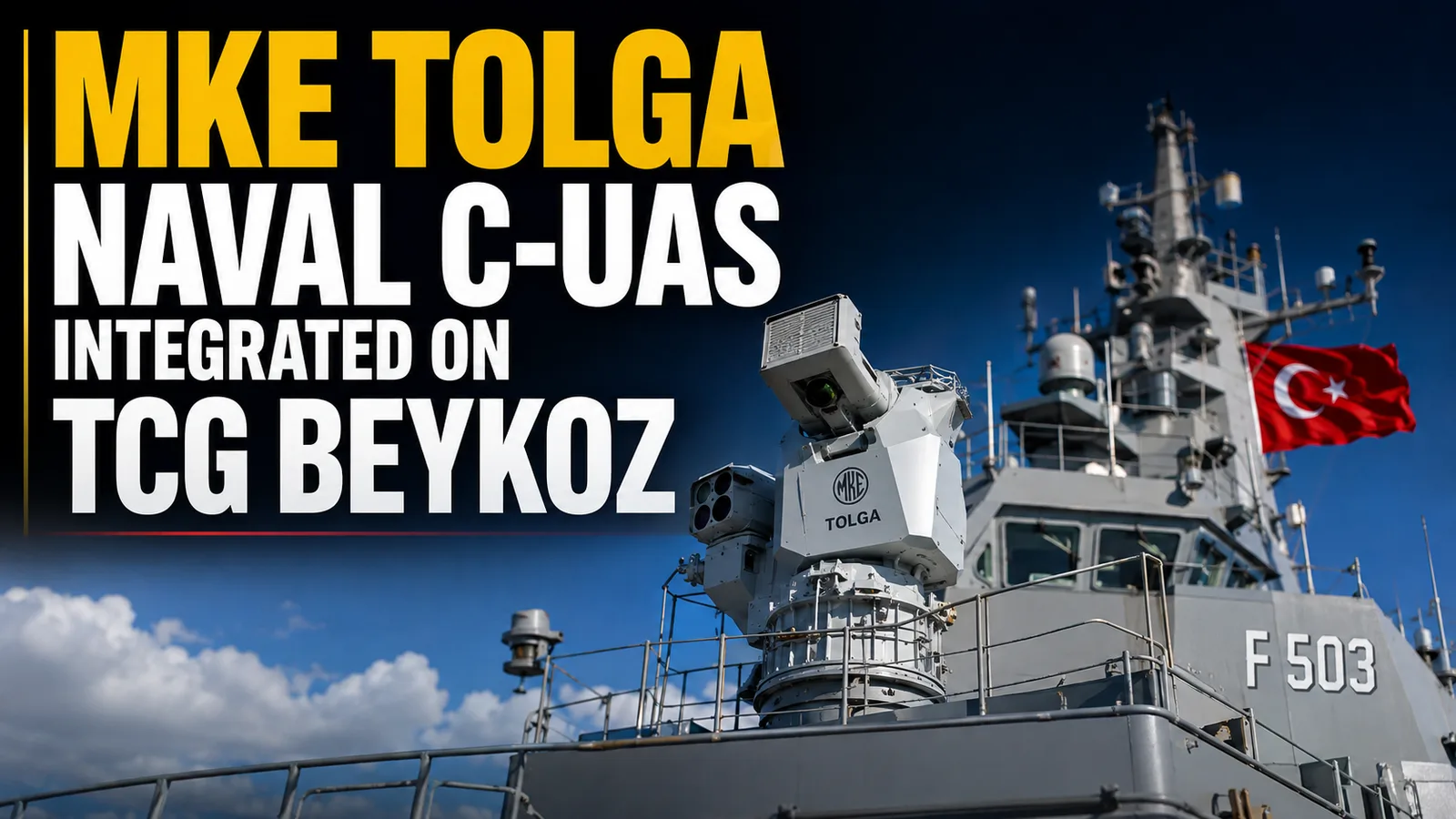
MKE TOLGA naval integration has reached a new milestone after Makine ve Kimya Endüstrisi installed stabilised 20 mm TOLGA weapon stations aboard Turkish Navy corvette TCG Beykoz, extending the indigenous layered counter-UAS system from land applications into the maritime domain.
MKE General Manager İlhami Keleş said on 21 August 2026 that 20 mm weapon stations had been installed on both sides of the ship and configured to operate under TOLGA’s radar and command-and-control architecture. MKE intends to expand the approach to additional naval platforms.
The development matters because small UAVs, one-way attack drones and increasingly autonomous surface threats are compressing the reaction time available to warships. Rather than depending exclusively on comparatively expensive missile interceptors, TOLGA adds a gun-based and electronically integrated inner layer intended to engage lower-cost threats closer to the ship.
Key Facts
- Announcement: 21 August 2026 during TEKNOFEST Mavi Vatan.
- Platform: Turkish Navy TCG Beykoz.
- Naval configuration: Stabilised 20 mm TOLGA weapon stations installed on both sides of the ship.
- Fire-control architecture: Weapons are intended to operate through TOLGA radar and command-and-control systems.
- Published 20 mm engagement envelope: Up to approximately 1,000 metres according to MKE.
- Detection architecture: MKE states that TOLGA radar, electro-optical and electronic-warfare components can provide surveillance and tracking out to 10 km.
- Status: Integration has been confirmed; MKE has not publicly announced a TOLGA naval live-fire acceptance test aboard TCG Beykoz.
MKE TOLGA Moves From Land to Naval Platforms
Speaking to Anadolu Agency on 21 August 2026, Keleş said MKE had begun transferring the TOLGA architecture to ships.
According to Keleş, stabilised versions of the system’s 20 mm weapon station have been positioned on the port and starboard sides of TCG Beykoz.
The weapons are intended to be controlled through TOLGA’s radar and command-and-control infrastructure, turning the installation into more than a pair of independently operated naval guns.
Keleş also said the programme had started with the Turkish Naval Forces and that MKE intended to transfer the architecture to other ships.
No number of future vessels, integration contract value or fleet-wide installation schedule was disclosed.
The Naval Configuration Centres on Stabilised 20 mm Guns
The configuration disclosed for TCG Beykoz is narrower than the full land-based TOLGA family.
MKE’s complete TOLGA architecture includes radar, electro-optical sensing, electronic jamming and several kinetic effectors in different calibres.
For TCG Beykoz, the publicly identified hard-kill layer is the stabilised 20 mm weapon system.
Stabilisation is essential at sea because the weapon must compensate for ship motion caused by roll, pitch and changing sea conditions while keeping the firing solution aligned with a small and potentially manoeuvring aerial target.
The August announcement does not state that the 35 mm or 12.7 mm TOLGA effectors have also been installed aboard the ship.
TOLGA Combines Detection, Soft Kill and Hard Kill
TOLGA was developed as a layered short-range air-defence and counter-UAS architecture rather than a single gun system.
MKE describes the system as a response to mini and micro UAVs, tactical drones, smart munitions and cruise missiles.
The architecture combines surveillance sensors, electronic attack and kinetic effectors under one command-and-control layer.
This creates two principal engagement routes.
The soft-kill layer can use electronic jamming against susceptible drone command, communications or navigation links. If electronic effects are insufficient, the system can transition to gun-based hard-kill engagement.
This layered approach is particularly relevant against mixed attacks containing both radio-controlled UAVs and more autonomous threats that may continue toward the target despite jamming.
MKE Publishes a 10 km Detection Layer
MKE states that TOLGA’s mobile radar, electro-optical system and jammer architecture can provide detection and tracking coverage out to approximately 10,000 metres.
The kinetic layers then operate at progressively shorter ranges.
- 35 mm TOLGA: manufacturer-stated engagement range up to 3,000 metres.
- 20 mm TOLGA: manufacturer-stated engagement range up to 1,000 metres.
- 12.7 mm TOLGA: manufacturer-stated engagement range up to approximately 300 metres.
The TCG Beykoz integration therefore places the currently disclosed naval kinetic layer in the inner portion of the broader TOLGA engagement architecture.
Those ranges are MKE-published system figures and should not be interpreted as guaranteed engagement performance against every target type, aspect or sea condition.
Specialised Anti-Drone Ammunition Is Central to the Economics
TOLGA’s value proposition also depends heavily on ammunition.
MKE has developed specialised anti-drone rounds intended to detonate near the target and distribute fragments through the engagement volume.
This approach increases the probability of damaging a small aerial vehicle without relying exclusively on a direct projectile impact.
The economic logic is increasingly important for naval forces.
Using a sophisticated short-range surface-to-air missile against every inexpensive UAV can create an unfavourable cost exchange and rapidly consume finite missile magazines.
A gun-based inner layer gives commanders another engagement option, particularly after a threat has penetrated the outer missile-defence envelope.
TOLGA Has Already Completed Major Land-Based Live-Fire Testing
The naval integration follows substantial land-based development work.
MKE announced on 3 July 2026 that TOLGA had successfully completed seven different live-fire scenarios against aerial threats during a major demonstration.
The company said approximately 150 representatives from the Turkish General Staff, service commands, Gendarmerie, Coast Guard, Presidency of Defence Industries and defence industry attended the activity.
The tested system incorporated the GÖKBÖRÜ AESA radar, acoustic detection, electro-optical sensing, jamming, 12.7 mm and 20 mm weapon systems and centralised command and control.
MKE also identifies a 35 mm hard-kill layer as part of the wider TOLGA family.
Defence Agenda previously analysed this development in MKE TOLGA Short-Range Air Defence System.
TCG Beykoz Integration Is a Separate Validation Step
A successful land-based firing campaign does not automatically validate the same weapon architecture at sea.
Naval integration adds platform motion, saltwater exposure, vibration, power-distribution constraints, electromagnetic compatibility and different command-and-control interfaces.
The use of stabilised 20 mm mounts addresses one of those fundamental differences.
However, MKE has not publicly stated that the complete TCG Beykoz configuration has completed naval firing trials against representative UAV or missile targets.
The 21 August milestone should therefore be described as a confirmed ship integration rather than final fleet qualification.
TCG Beykoz Has Already Supported Naval Air-Defence Testing
TCG Beykoz is not new to experimental close-air-defence integration.
Türkiye’s Ministry of National Defence confirmed that ROKETSAN’s LEVENT close-in air-defence missile system conducted firing tests from TCG Beykoz between 23 and 26 March 2025.
Those tests marked the first firing of LEVENT from a naval platform.
The same ship now hosting the TOLGA 20 mm integration gives Türkiye a useful continuity between missile-based and gun-based close-in defensive technologies.
It should not, however, be assumed that LEVENT and TOLGA are currently operating aboard TCG Beykoz as a permanently combined operational fit unless the Turkish Navy formally confirms that configuration.
Gun and Missile Layers Address Different Intercept Economics
The relationship between TOLGA and systems such as LEVENT is more complementary than competitive.
A short-range missile can engage threats significantly further from the ship and provide capability against faster or more demanding targets.
A 20 mm gun operates at much shorter range but can offer a lower-cost engagement option and carries a fundamentally different magazine architecture.
A layered ship-defence model can therefore employ missiles against threats outside the inner engagement zone while retaining gun-based effectors for drones and targets that penetrate closer to the vessel.
Defence Agenda’s TF-2000 Destroyer Capabilities analysis shows the same layered logic at a larger scale, combining long-range missiles with point-defence and close-in systems around high-value naval platforms.
Naval Counter-UAS Is Becoming a Separate Requirement
The TOLGA integration also reflects how naval air defence is changing.
Traditional warship air-defence architectures were designed primarily around aircraft and anti-ship missiles.
Today, ships must also account for smaller UAVs that can conduct reconnaissance, provide targeting information or carry explosive payloads.
These threats can be inexpensive enough to employ in numbers, creating a magazine-depth problem for ships relying predominantly on guided missiles.
A counter-UAS layer therefore needs not only technical effectiveness but favourable cost per engagement.
This economic pressure has accelerated development of programmable ammunition, electronic warfare, directed energy and smaller-calibre automated weapons across multiple navies.
MKE Is Expanding TOLGA Across Platform Classes
Naval integration follows earlier efforts to make TOLGA platform-agnostic.
At Eurosatory 2026, MKE’s 20 mm TOLGA weapon architecture was integrated onto HT Division’s KATICA 6×6 unmanned ground vehicle.
Defence Agenda covered that milestone in MKE TOLGA Integrated on European UGV for the First Time.
The progression from fixed and mobile land configurations to an unmanned ground vehicle and now a Turkish Navy corvette indicates that MKE is treating TOLGA as a modular family rather than a single vehicle-mounted product.
That strategy could improve export flexibility because customers can potentially select sensor, command-and-control and effector combinations according to the platform being protected.
Future TOLGA Layers Could Include Missiles and Lasers
MKE’s current development roadmap extends beyond conventional guns and jamming.
The company has publicly stated that it intends to expand TOLGA through integration of the ENFAL-17 missile and a laser weapon system.
Those additions would potentially give the architecture a broader set of engagement economics.
Electronic attack could address susceptible UAVs without ammunition expenditure, guns could engage closer threats using relatively low-cost rounds, a laser could provide another low-cost-per-shot option under suitable atmospheric conditions, and missiles could extend the protected envelope against more demanding targets.
These future elements should not be treated as part of the current TCG Beykoz configuration unless MKE separately confirms their naval integration.
TOLGA Adds Another Layer to Türkiye’s Çelik Kubbe Architecture
MKE positions TOLGA within Türkiye’s wider Çelik Kubbe integrated air-defence architecture, specifically in the approximately 3,000-metre-and-below layer.
The concept increasingly encompasses both military formations and fixed infrastructure rather than functioning as one monolithic air-defence system.
Defence Agenda examined the broader lower-layer development in ASELSAN Steel Dome Adds New C-UAS Layer, where electronic warfare, directed energy and conventional effectors are increasingly being combined against low-cost threats.
Moving TOLGA onto ships extends that philosophy into maritime force protection.
MKE BALKIN Addresses Another Naval Survivability Layer
Keleş’s TEKNOFEST Mavi Vatan remarks also placed TOLGA within a wider MKE naval-defence portfolio.
He highlighted MKE BALKIN, a naval decoy ammunition intended to help warships counter missile threats, alongside the DENİZHAN-76 naval gun and the PİRANA kamikaze uncrewed surface vehicle.
Keleş said Türkiye had previously depended on foreign sources for the type of decoy ammunition represented by BALKIN and that supply had been vulnerable to embargo restrictions.
The broader industrial strategy is therefore to localise several elements of ship survivability simultaneously: guns, ammunition, decoys and now close-in counter-UAS systems.
MKE Is Also Studying Potential Civil-Ship Applications
MKE sees potential applications beyond naval vessels.
Keleş said the company was discussing the issue of protection for civilian vessels with Türkiye’s Ministry of Transport and Infrastructure as commercial ships increasingly face threats from unmanned aerial and maritime systems.
He acknowledged that international regulations currently create restrictions on arming civilian ships and said Türkiye intended to raise the changing threat environment through international maritime channels.
This remains a policy concept rather than an approved TOLGA civil-maritime deployment programme.
It nevertheless demonstrates how attacks involving uncrewed systems are beginning to blur traditional distinctions between military force protection and commercial maritime security.
Counterargument: One-Kilometre Guns Leave Little Reaction Time
The 20 mm layer also carries an inherent limitation: its published engagement envelope is short.
At approximately 1,000 metres, a fast inbound threat leaves little time for detection confirmation, weapon assignment and engagement.
This reinforces why the 20 mm turret cannot be evaluated in isolation.
Its effectiveness depends on earlier detection, accurate tracking, automated command-and-control and other outer defensive layers reducing the number of threats that reach the inner envelope.
Against saturation attacks, magazine capacity, reload procedures and the ability to engage several targets in rapid succession will be as important as nominal engagement range.
The Naval Test Phase Will Determine Operational Value
The most important remaining milestone is at-sea validation of the complete integration.
A naval firing campaign would need to demonstrate target tracking from a moving ship, stabilised firing, radar-to-weapon handover and performance against representative aerial threats.
Environmental qualification will also matter because saltwater, vibration and prolonged shipboard operation can impose different reliability requirements from a land-based test range.
Only after those steps can the programme’s readiness for broader fleet deployment be assessed with confidence.
Implications / Next
The first milestone to watch is naval live-fire testing. MKE has confirmed integration on TCG Beykoz but has not yet publicly announced an at-sea TOLGA firing campaign.
The second is fleet expansion. Keleş says TOLGA will be transferred to additional ships, but the platform classes and procurement quantities remain undisclosed.
The third is combat-management integration. Connecting TOLGA to a ship’s wider surveillance picture rather than operating only through local sensors could increase reaction time and improve engagement coordination.
The fourth is effectors. Future naval adoption of the 35 mm, ENFAL-17 or directed-energy elements would transform TOLGA from a 20 mm counter-UAS installation into a substantially broader layered ship-defence family.
The fifth is production scale. If Türkiye decides to equip several ship classes, MKE will need to manufacture stabilised turrets, specialised ammunition, sensors and command-and-control equipment at fleet quantities while supporting land and export demand simultaneously.
Conclusion
MKE’s integration of TOLGA aboard TCG Beykoz marks an important transition from land-based counter-UAS development toward naval close-in defence.
The disclosed configuration combines stabilised 20 mm weapon stations with TOLGA radar and command-and-control architecture, giving the Turkish Navy a new indigenous gun-based option against drones and other close-range aerial threats.
The milestone should nevertheless be interpreted as an integration step rather than final operational qualification.
No TOLGA naval firing campaign aboard TCG Beykoz has yet been publicly announced, and the number of additional ships intended to receive the system remains unknown.
If subsequent trials validate the architecture and Türkiye expands it across the fleet, TOLGA could become a new inner layer within a naval defence model combining electronic warfare, guns, missiles, decoys and eventually directed-energy effectors.
Further Reading
- Anadolu Agency: MKE TOLGA Integrated on TCG Beykoz
- MKE: TOLGA Short-Range Air Defence System
- MKE: TOLGA Live-Fire Test Results
- Türkiye Ministry of National Defence: LEVENT Tests from TCG Beykoz
- Defence Agenda: MKE TOLGA Short-Range Air Defence System
- Defence Agenda: MKE TOLGA Integrated on European UGV
- Defence Agenda: ASELSAN Steel Dome Adds New C-UAS Layer
- Defence Agenda: TF-2000 Destroyer Capabilities