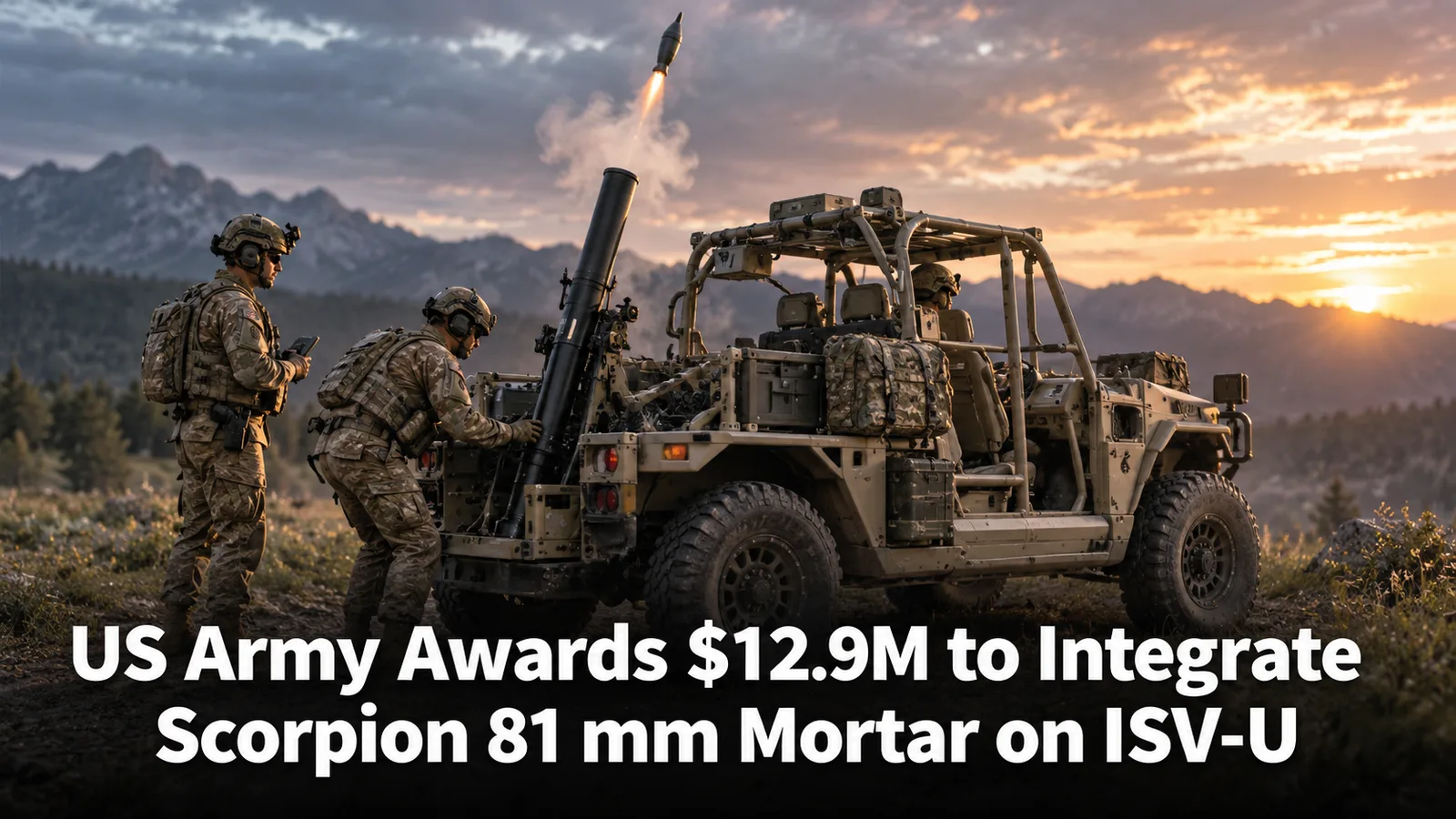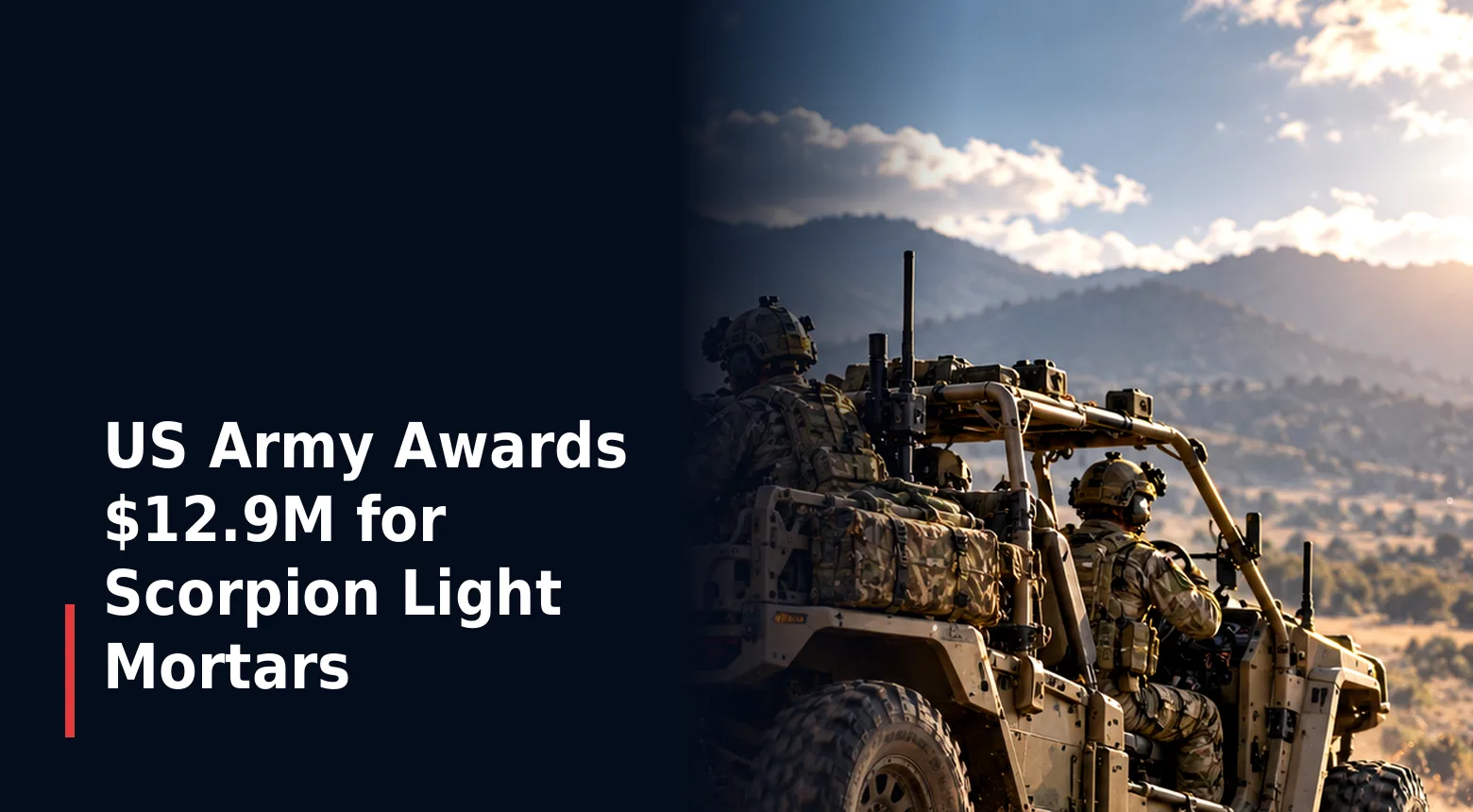
The U.S. Army awarded Global Military Products a $12.9 million contract for Scorpion Light 81 mm mobile mortar integration on Infantry Squad Vehicle–Utility platforms, the supplier announced on 3 September 2026. The programme is intended to combine rapid shoot-and-scoot fire support with Army digital fire control; the award does not yet establish full-rate production or a fielded fleet.
The award covers an Army-specific integration effort
Global Military Products said the U.S. Army made the $12.9 million award through the Department of Defense Ordnance Technology Consortium's Other Transaction Authority route. The contract covers procurement and integration of Scorpion Light mobile mortar equipment with Army digital fire-control systems, government-furnished M253 barrels and the Infantry Squad Vehicle–Utility platform. It is important to distinguish the funding for this integration effort from a later decision to equip a defined number of operational formations.
The announcement did not provide a confirmed Army production or fielding quantity. Earlier demonstrations and separate U.S. Marine Corps arrangements concern different activities and should not be folded into the new Army award. Contract value, integration scope and the identified vehicle are verifiable; operational deployment strength, unit assignments and final fleet size require additional customer evidence.
Mobility targets the exposure of traditional mortar teams
The Scorpion Light architecture places an 81 mm mortar on a comparatively light utility vehicle so the crew can stop, engage a target and displace more rapidly than with a conventional dismounted position. Its value is mainly in reducing the time between movement, emplacement, fire and withdrawal. The system does not fundamentally change the ballistic performance of the government-furnished M253 barrel or the ammunition selected for a given fire mission.
Global Military Products and trade reporting describe rapid firing and displacement demonstrations, including a contractor-reported sequence of eight rounds in less than two minutes. Such results are useful evidence of design potential, but they are not a universal timing guarantee for every crew, terrain or tactical situation. Real operations must also account for ammunition resupply, protection against counter-battery fire, communications, safe backblast and the vehicle's payload limits.
Digital fire control is as important as the mortar mount
An effective mobile indirect-fire system needs to receive a mission, calculate fire data, establish its position, lay the weapon and communicate corrections without burdening the crew with a cumbersome interface. The contract expressly includes Army digital fire-control integration, which may allow the weapon to fit existing processes rather than requiring a separate contractor-specific command chain. Software safety, navigation accuracy and configuration management will be central to acceptance.
Integration is not an automatic result of attaching the tube to a vehicle. Live-fire tests must examine the platform's stability, recoil loads, electromagnetic compatibility and crew ergonomics, while evaluating performance when the vehicle moves between multiple firing positions. The Army will also need maintenance documentation, instructor capacity and spares arrangements if it decides to expand beyond a limited qualification effort.
Procurement maturity remains below routine fielding
A technology-consortium agreement can speed development and contracting, but it should not be described as an award for unrestricted series production. The next stages involve finalising the Army configuration, completing certification, demonstrating repeatability and making a funded quantity decision. Only later operational acceptance and unit allocation can establish the extent to which mobile mortar capability has entered service.
For light and expeditionary formations, the potential is operationally significant because organic 81 mm fires can accompany rapidly moving units. Yet it competes for vehicle space, ammunition capacity, crew training time and logistical support within already constrained formations. A rigorous programme assessment must consider those trade-offs alongside the attractive headline mobility benefits.
Implications / Next
Track Army configuration qualification, any formal production award and a verified operational quantity. Keep the separate Marine Corps Scorpion activity outside this $12.9 million Army contract. For the Army, integration also means addressing weight distribution, vibration, crew ergonomics, ammunition stowage and safe firing procedures on a compact vehicle. These practical engineering tests often decide whether an attractive concept becomes a repeatable unit-level capability. The initial award should therefore be evaluated against delivered test vehicles and validated tactics, rather than being counted as proof that every planned infantry unit now possesses a mobile mortar system.